Anandapadmanabhan J.
S1 M.Com
Chi-Square Test
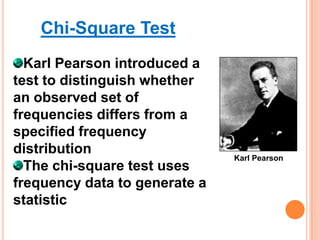
Karl Pearson introduced a
test to distinguish whether
an observed set of
frequencies differs from a
specified frequency
distribution
The chi-square test uses
frequency data to generate a
statistic

Karl Pearson
A chi-square test is a statistical test
commonly used for testing independence
and goodness of fit. Testing independence
determines whether two or more
observations across two populations are
dependent on each other (that is, whether
one variable helps to estimate the other).
Testing for goodness of fit determines if
an observed frequency distribution
matches a theoretical frequency
distribution.
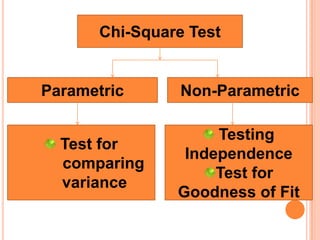
Chi-Square Test

Parametric
Test for
comparing
variance

Non-Parametric
Testing
Independence
Test for
Goodness of Fit
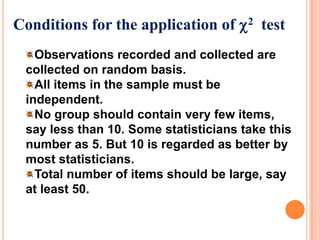
Conditions for the application of 2 test
Observations recorded and collected are
collected on random basis.
All items in the sample must be
independent.
No group should contain very few items,
say less than 10. Some statisticians take this
number as 5. But 10 is regarded as better by
most statisticians.
Total number of items should be large, say
at least 50.
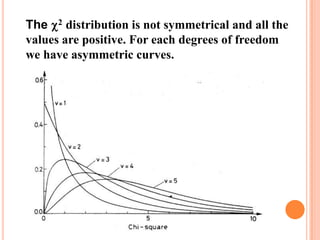
The 2 distribution is not symmetrical and all the
values are positive. For each degrees of freedom
we have asymmetric curves.
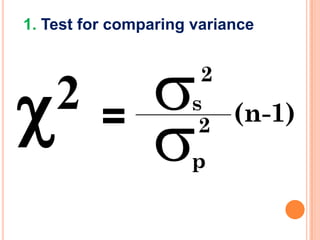
1. Test for comparing variance

2 =

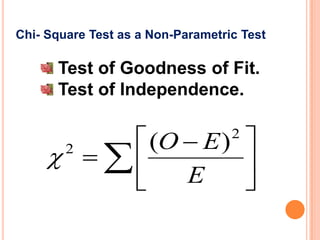
Chi- Square Test as a Non-Parametric Test

Test of Goodness of Fit.
Test of Independence.

 (O  E ) 
2
  

E


2
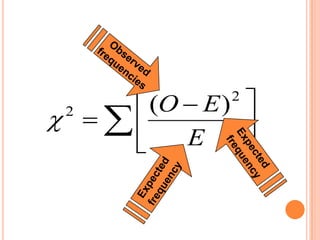
 (O  E ) 
2
  

E


2
2. As a Test of Goodness of Fit
It enables us to see how well does
the assumed theoretical distribution(such
as Binomial distribution, Poisson
distribution or Normal distribution) fit to
the observed data. When the calculated
value of χ2 is less than the table value at
certain level of significance, the fit is
considered to be good one and if the
calculated value is greater than the table
value, the fit is not considered to be good.
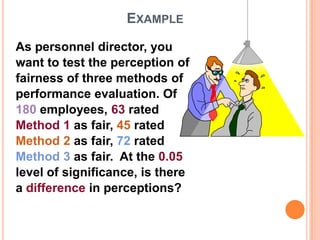
EXAMPLE
As personnel director, you
want to test the perception of
fairness of three methods of
performance evaluation. Of
180 employees, 63 rated
Method 1 as fair, 45 rated
Method 2 as fair, 72 rated
Method 3 as fair. At the 0.05
level of significance, is there
a difference in perceptions?
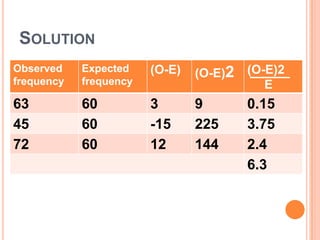
SOLUTION
Observed
frequency

Expected
frequency

(O-E)

(O-E)2

(O-E)2
E

63
45
72

60
60
60

3
-15
12

9
225
144

0.15
3.75
2.4
6.3
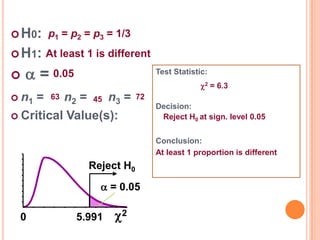
 H0: p1 = p2 = p3 = 1/3
 H1: At least 1 is different



 = 0.05

Test Statistic:
2 = 6.3

 n1

= 63 n2 = 45 n3 =
 Critical Value(s):

72

Decision:
Reject H0 at sign. level 0.05
Conclusion:
At least 1 proportion is different

Reject H0
 = 0.05
0

5.991

2
3.As a Test of Independence
χ2 test enables us to explain whether or not
two attributes are associated. Testing
independence determines whether two or more
observations across two populations are
dependent on each other (that is, whether one
variable helps to estimate the other. If the
calculated value is less than the table value at
certain level of significance for a given degree of
freedom, we conclude that null hypotheses stands
which means that two attributes are independent
or not associated. If calculated value is greater
than the table value, we reject the null
hypotheses.
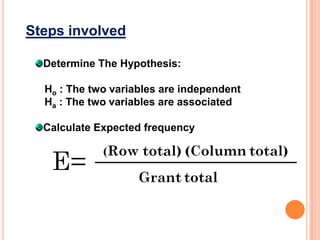
Steps involved
Determine The Hypothesis:
Ho : The two variables are independent
Ha : The two variables are associated

Calculate Expected frequency
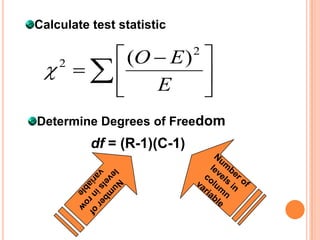
Calculate test statistic

 (O  E ) 
  

E


2

2

Determine Degrees of Freedom

df = (R-1)(C-1)
Compare computed test statistic
against a tabled/critical value
The computed value of the Pearson chisquare statistic is compared with the critical
value to determine if the computed value is
improbable
The critical tabled values are based on
sampling distributions of the Pearson chisquare statistic.
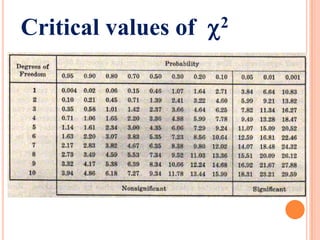
If calculated 2 is greater than 2 table value,
reject Ho
Critical values of

2

EXAMPLE
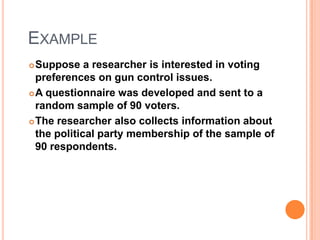
Suppose a researcher is interested in voting
preferences on gun control issues.
 A questionnaire was developed and sent to a
random sample of 90 voters.
 The researcher also collects information about
the political party membership of the sample of
90 respondents.

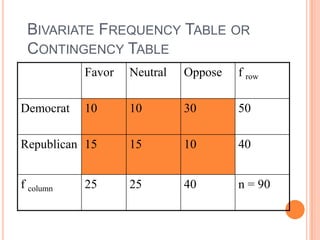
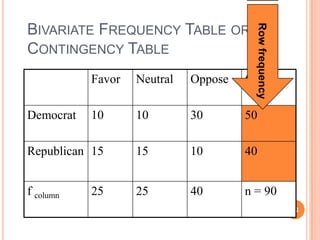
BIVARIATE FREQUENCY TABLE OR
CONTINGENCY TABLE
Favor

Neutral

Oppose

f row

10

10

30

50

Republican 15

15

10

40

f column

25

40

n = 90

Democrat

25
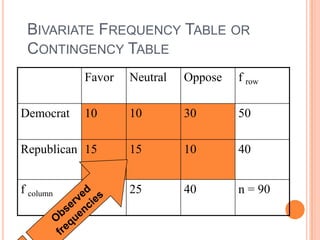
BIVARIATE FREQUENCY TABLE OR
CONTINGENCY TABLE
Favor

Neutral

Oppose

f row

10

10

30

50

Republican 15

15

10

40

f column

25

40

n = 90

Democrat

25
Row frequency

BIVARIATE FREQUENCY TABLE OR
CONTINGENCY TABLE
Favor

Neutral

Oppose

f row

10

10

30

50

Republican 15

15

10

40

f column

25

40

n = 90

Democrat

25

22
BIVARIATE FREQUENCY TABLE OR
CONTINGENCY TABLE
Favor

Neutral

Oppose

f row

10

10

30

50

Republican 15

15

10

40

f column

25

40

n = 90

Democrat

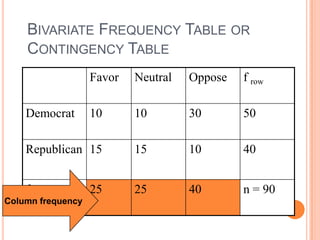
Column frequency

25
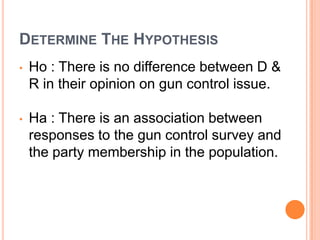
DETERMINE THE HYPOTHESIS
•

Ho : There is no difference between D &
R in their opinion on gun control issue.

•

Ha : There is an association between
responses to the gun control survey and
the party membership in the population.
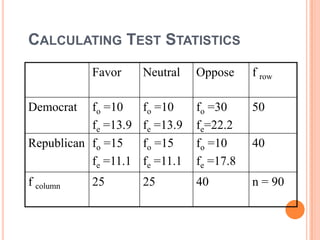
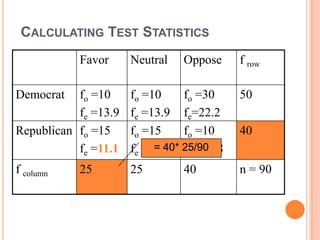
CALCULATING TEST STATISTICS
Favor

Neutral

Oppose

f row

fo =10
fe =13.9
Republican fo =15
fe =11.1

fo =10
fe =13.9
fo =15
fe =11.1

fo =30
fe=22.2
fo =10
fe =17.8

50

f column

25

40

n = 90

Democrat

25

40
CALCULATING TEST STATISTICS
Favor
Democrat

Neutral

Oppose

f row

fo =10
fe =13.9
Republican fo =15
fe =11.1

fo =10
fo =30
fe =13.9 fe=22.2
fo =15
fo =10
= 40* fe =17.8
fe =11.1 25/90

50

f column

25

n = 90

25

40

40
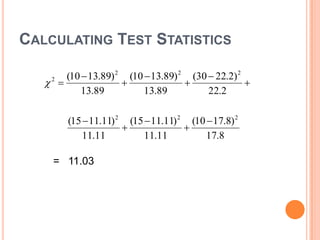
CALCULATING TEST STATISTICS
(10  13.89) 2 (10  13.89) 2 (30  22.2) 2
 



13.89
13.89
22.2
2

(15  11.11) 2 (15  11.11) 2 (10  17.8) 2


11.11
11.11
17.8

= 11.03
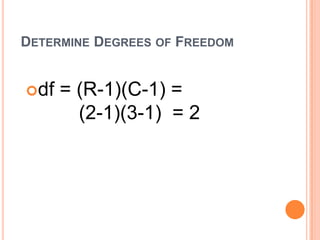
DETERMINE DEGREES OF FREEDOM
df

= (R-1)(C-1) =
(2-1)(3-1) = 2
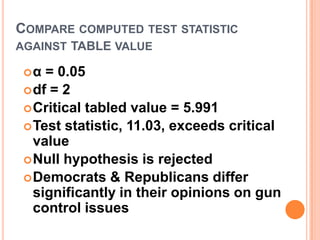
COMPARE COMPUTED TEST STATISTIC
AGAINST TABLE VALUE
α

= 0.05
 df = 2
 Critical tabled value = 5.991
 Test statistic, 11.03, exceeds critical
value
 Null hypothesis is rejected
 Democrats & Republicans differ
significantly in their opinions on gun
control issues
2 TEST OF INDEPENDENCE
THINKING CHALLENGE
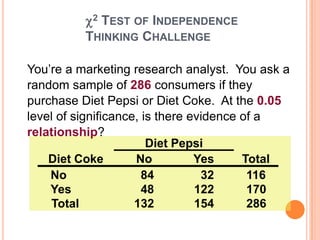
You’re a marketing research analyst. You ask a
random sample of 286 consumers if they
purchase Diet Pepsi or Diet Coke. At the 0.05
level of significance, is there evidence of a
relationship?
Diet Pepsi
Diet Coke
No
Yes
Total
No
84
32
116
Yes
48
122
170
Total
132
154
286
2 TEST OF INDEPENDENCE SOLUTION*



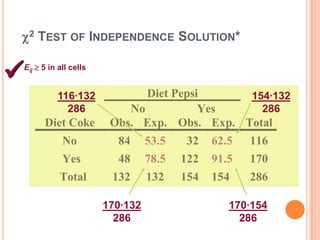
Eij  5 in all cells

116·132
286

Diet Coke

Diet Pepsi
154·132
286
No
Yes
Obs. Exp. Obs. Exp. Total

No

84

53.5

32

62.5

116

Yes

48

78.5

122

91.5

170

Total

132

132

154

154

286

170·132
286

170·154
286
2 TEST OF INDEPENDENCE SOLUTION*

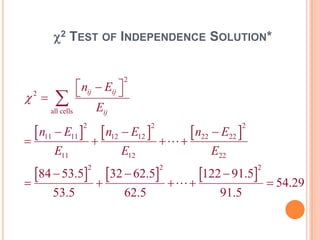
 nij  Eij 


  
Eij
all cells

2

2

 n11  E11 


 n12  E12 


2

2

E11

E12

84  53.5


2

53.5

 n22  E22 
 

2

E22

32  62.5


2

62.5

122  91.5
 

2

91.5

 54.29
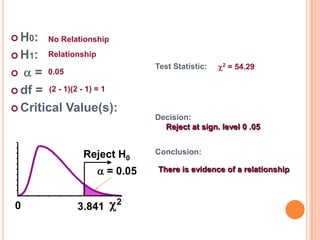
 H0:

No Relationship

 H1:

Relationship

 = 0.05
 df = (2 - 1)(2 - 1) = 1
 Critical Value(s):


Test Statistic:

2 = 54.29

Decision:
Reject at sign. level 0 .05

Reject H0
 = 0.05

0

3.841

2

Conclusion:

There is evidence of a relationship
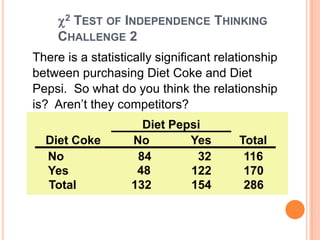
2 TEST OF INDEPENDENCE THINKING
CHALLENGE 2
There is a statistically significant relationship
between purchasing Diet Coke and Diet
Pepsi. So what do you think the relationship
is? Aren’t they competitors?
Diet Coke
No
Yes
Total

Diet Pepsi
No
Yes
84
32
48
122
132
154

Total
116
170
286
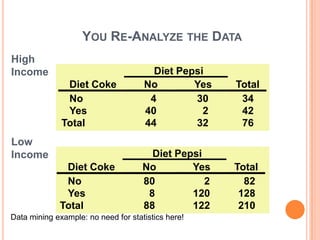
YOU RE-ANALYZE THE DATA
High
Income
Diet Coke
No
Yes
Total

Diet Pepsi
No
Yes
4
30
40
2
44
32

Total
34
42
76

Diet Coke
No
Yes
Total

Diet Pepsi
No
Yes
80
2
8
120
88
122

Total
82
128
210

Low
Income

Data mining example: no need for statistics here!
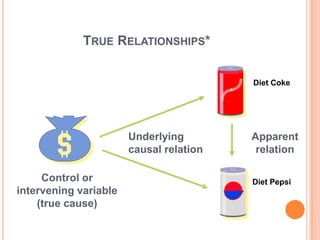
TRUE RELATIONSHIPS*
Diet Coke

Underlying
causal relation
Control or
intervening variable
(true cause)

Apparent
relation
Diet Pepsi
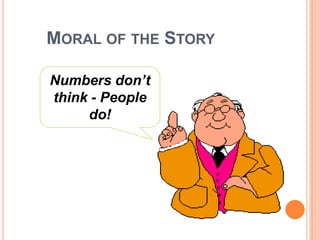
MORAL OF THE STORY
Numbers don’t
think - People
do!
CONCLUSION
1.

Explained 2 Test for Proportions

2.

Explained 2 Test of Independence
Chi square test

Chi square test

  • 1.
  • 2.
    Chi-Square Test Karl Pearsonintroduced a test to distinguish whether an observed set of frequencies differs from a specified frequency distribution The chi-square test uses frequency data to generate a statistic Karl Pearson
  • 3.
    A chi-square testis a statistical test commonly used for testing independence and goodness of fit. Testing independence determines whether two or more observations across two populations are dependent on each other (that is, whether one variable helps to estimate the other). Testing for goodness of fit determines if an observed frequency distribution matches a theoretical frequency distribution.
  • 4.
  • 5.
    Conditions for theapplication of 2 test Observations recorded and collected are collected on random basis. All items in the sample must be independent. No group should contain very few items, say less than 10. Some statisticians take this number as 5. But 10 is regarded as better by most statisticians. Total number of items should be large, say at least 50.
  • 6.
    The 2 distributionis not symmetrical and all the values are positive. For each degrees of freedom we have asymmetric curves.
  • 7.
    1. Test forcomparing variance 2 = 
  • 8.
    Chi- Square Testas a Non-Parametric Test Test of Goodness of Fit. Test of Independence.  (O  E )  2     E   2
  • 9.
     (O E )  2     E   2
  • 10.
    2. As aTest of Goodness of Fit It enables us to see how well does the assumed theoretical distribution(such as Binomial distribution, Poisson distribution or Normal distribution) fit to the observed data. When the calculated value of χ2 is less than the table value at certain level of significance, the fit is considered to be good one and if the calculated value is greater than the table value, the fit is not considered to be good.
  • 11.
    EXAMPLE As personnel director,you want to test the perception of fairness of three methods of performance evaluation. Of 180 employees, 63 rated Method 1 as fair, 45 rated Method 2 as fair, 72 rated Method 3 as fair. At the 0.05 level of significance, is there a difference in perceptions?
  • 12.
  • 13.
     H0: p1= p2 = p3 = 1/3  H1: At least 1 is different   = 0.05 Test Statistic: 2 = 6.3  n1 = 63 n2 = 45 n3 =  Critical Value(s): 72 Decision: Reject H0 at sign. level 0.05 Conclusion: At least 1 proportion is different Reject H0  = 0.05 0 5.991 2
  • 14.
    3.As a Testof Independence χ2 test enables us to explain whether or not two attributes are associated. Testing independence determines whether two or more observations across two populations are dependent on each other (that is, whether one variable helps to estimate the other. If the calculated value is less than the table value at certain level of significance for a given degree of freedom, we conclude that null hypotheses stands which means that two attributes are independent or not associated. If calculated value is greater than the table value, we reject the null hypotheses.
  • 15.
    Steps involved Determine TheHypothesis: Ho : The two variables are independent Ha : The two variables are associated Calculate Expected frequency
  • 16.
    Calculate test statistic (O  E )      E   2 2 Determine Degrees of Freedom df = (R-1)(C-1)
  • 17.
    Compare computed teststatistic against a tabled/critical value The computed value of the Pearson chisquare statistic is compared with the critical value to determine if the computed value is improbable The critical tabled values are based on sampling distributions of the Pearson chisquare statistic. If calculated 2 is greater than 2 table value, reject Ho
  • 18.
  • 19.
    EXAMPLE Suppose a researcheris interested in voting preferences on gun control issues.  A questionnaire was developed and sent to a random sample of 90 voters.  The researcher also collects information about the political party membership of the sample of 90 respondents. 
  • 20.
    BIVARIATE FREQUENCY TABLEOR CONTINGENCY TABLE Favor Neutral Oppose f row 10 10 30 50 Republican 15 15 10 40 f column 25 40 n = 90 Democrat 25
  • 21.
    BIVARIATE FREQUENCY TABLEOR CONTINGENCY TABLE Favor Neutral Oppose f row 10 10 30 50 Republican 15 15 10 40 f column 25 40 n = 90 Democrat 25
  • 22.
    Row frequency BIVARIATE FREQUENCYTABLE OR CONTINGENCY TABLE Favor Neutral Oppose f row 10 10 30 50 Republican 15 15 10 40 f column 25 40 n = 90 Democrat 25 22
  • 23.
    BIVARIATE FREQUENCY TABLEOR CONTINGENCY TABLE Favor Neutral Oppose f row 10 10 30 50 Republican 15 15 10 40 f column 25 40 n = 90 Democrat Column frequency 25
  • 24.
    DETERMINE THE HYPOTHESIS • Ho: There is no difference between D & R in their opinion on gun control issue. • Ha : There is an association between responses to the gun control survey and the party membership in the population.
  • 25.
    CALCULATING TEST STATISTICS Favor Neutral Oppose frow fo =10 fe =13.9 Republican fo =15 fe =11.1 fo =10 fe =13.9 fo =15 fe =11.1 fo =30 fe=22.2 fo =10 fe =17.8 50 f column 25 40 n = 90 Democrat 25 40
  • 26.
    CALCULATING TEST STATISTICS Favor Democrat Neutral Oppose frow fo =10 fe =13.9 Republican fo =15 fe =11.1 fo =10 fo =30 fe =13.9 fe=22.2 fo =15 fo =10 = 40* fe =17.8 fe =11.1 25/90 50 f column 25 n = 90 25 40 40
  • 27.
    CALCULATING TEST STATISTICS (10 13.89) 2 (10  13.89) 2 (30  22.2) 2      13.89 13.89 22.2 2 (15  11.11) 2 (15  11.11) 2 (10  17.8) 2   11.11 11.11 17.8 = 11.03
  • 28.
    DETERMINE DEGREES OFFREEDOM df = (R-1)(C-1) = (2-1)(3-1) = 2
  • 29.
    COMPARE COMPUTED TESTSTATISTIC AGAINST TABLE VALUE α = 0.05  df = 2  Critical tabled value = 5.991  Test statistic, 11.03, exceeds critical value  Null hypothesis is rejected  Democrats & Republicans differ significantly in their opinions on gun control issues
  • 30.
    2 TEST OFINDEPENDENCE THINKING CHALLENGE You’re a marketing research analyst. You ask a random sample of 286 consumers if they purchase Diet Pepsi or Diet Coke. At the 0.05 level of significance, is there evidence of a relationship? Diet Pepsi Diet Coke No Yes Total No 84 32 116 Yes 48 122 170 Total 132 154 286
  • 31.
    2 TEST OFINDEPENDENCE SOLUTION*  Eij  5 in all cells 116·132 286 Diet Coke Diet Pepsi 154·132 286 No Yes Obs. Exp. Obs. Exp. Total No 84 53.5 32 62.5 116 Yes 48 78.5 122 91.5 170 Total 132 132 154 154 286 170·132 286 170·154 286
  • 32.
    2 TEST OFINDEPENDENCE SOLUTION*  nij  Eij       Eij all cells 2 2  n11  E11    n12  E12   2 2 E11 E12 84  53.5  2 53.5  n22  E22    2 E22 32  62.5  2 62.5 122  91.5   2 91.5  54.29
  • 33.
     H0: No Relationship H1: Relationship  = 0.05  df = (2 - 1)(2 - 1) = 1  Critical Value(s):  Test Statistic: 2 = 54.29 Decision: Reject at sign. level 0 .05 Reject H0  = 0.05 0 3.841 2 Conclusion: There is evidence of a relationship
  • 34.
    2 TEST OFINDEPENDENCE THINKING CHALLENGE 2 There is a statistically significant relationship between purchasing Diet Coke and Diet Pepsi. So what do you think the relationship is? Aren’t they competitors? Diet Coke No Yes Total Diet Pepsi No Yes 84 32 48 122 132 154 Total 116 170 286
  • 35.
    YOU RE-ANALYZE THEDATA High Income Diet Coke No Yes Total Diet Pepsi No Yes 4 30 40 2 44 32 Total 34 42 76 Diet Coke No Yes Total Diet Pepsi No Yes 80 2 8 120 88 122 Total 82 128 210 Low Income Data mining example: no need for statistics here!
  • 36.
    TRUE RELATIONSHIPS* Diet Coke Underlying causalrelation Control or intervening variable (true cause) Apparent relation Diet Pepsi
  • 37.
    MORAL OF THESTORY Numbers don’t think - People do!
  • 38.
    CONCLUSION 1. Explained 2 Testfor Proportions 2. Explained 2 Test of Independence