October 3, 2022
Ahmet Can Mert
ahmet.mert@iaik.tugraz.at
A Brief Introductionto FPGAs
FPGA: Definition
• FPGA: Field Programmable Gate Arrays
• An array of logic cells with programmable control signals and a
programmable routing grid
• It can be configured/programmed to perform any digital circuits
• Microcontroller
• Video processor
• Crypto miner
• How to configure?
• Define its behavior using Hardware Description Languages
• Compile and download it to FPGA
FPGA: Definition
• FPGA: Field Programmable Gate Arrays
• ConfigurableLogic Blocks (CLBs)
• Programmable Interconnects
• Programmable I/O blocks
• Other functionalblocks: DSPs, Block RAMs, Ultra RAMs, ...
Image is retrieved from [https://towardsdatascience.com/introduction-to-fpga-and-its-architecture-20a62c14421c]
FPGA: A Brief History of FPGAs
• Some major inventions that led to FPGAs
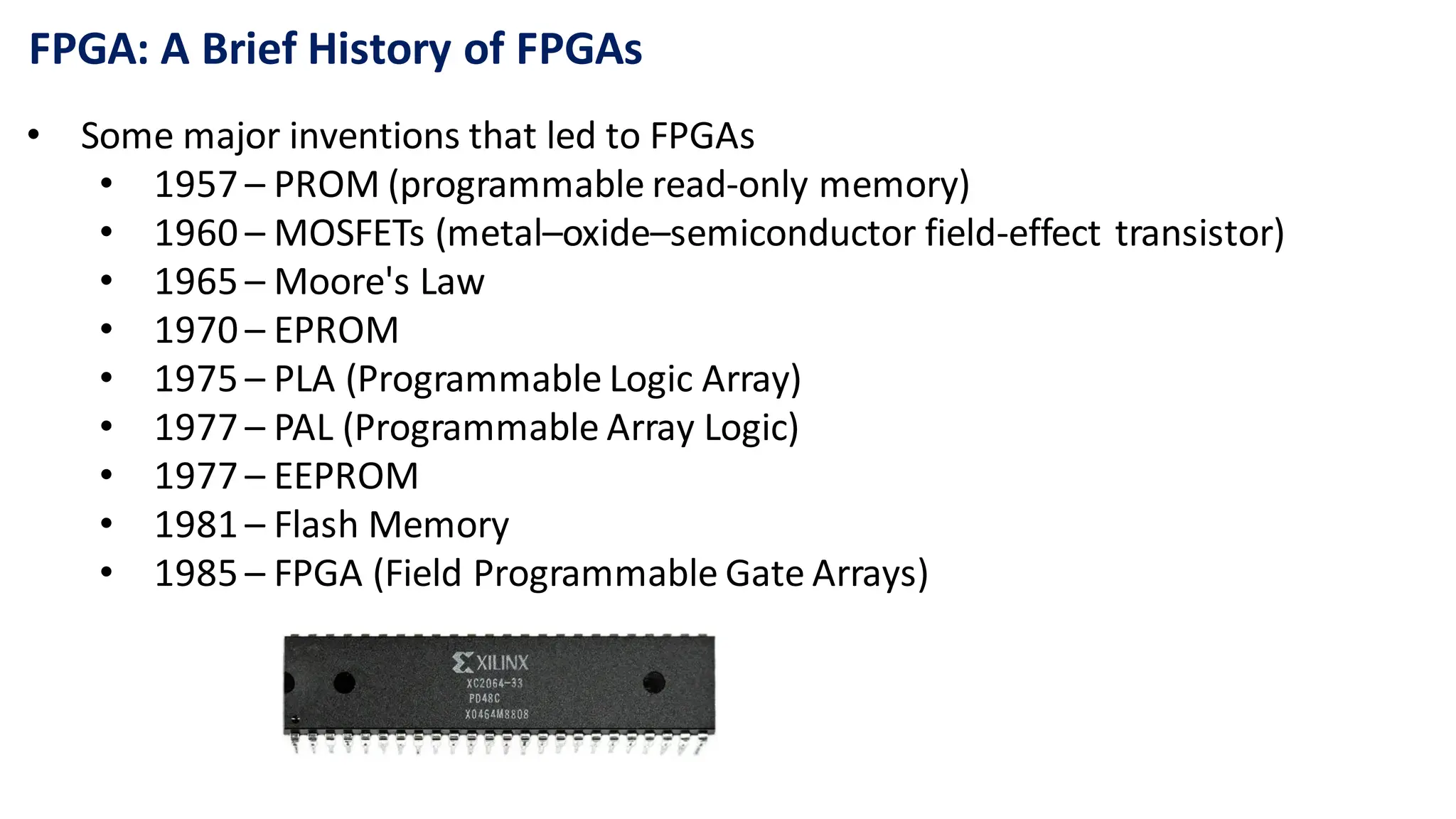
• 1957 – PROM (programmable read-only memory)
• 1960 – MOSFETs (metal–oxide–semiconductor field-effect transistor)
• 1965 – Moore's Law
FPGA: A Brief History of FPGAs
• Some major inventions that led to FPGAs
• 1957 – PROM (programmable read-only memory)
• 1960 – MOSFETs (metal–oxide–semiconductor field-effect transistor)
• 1965 – Moore's Law
Image is retrieved from [https://en.wikipedia.org/wiki/Moore%27s_law]
FPGA: A Brief History of FPGAs
• Some major inventions that led to FPGAs
• 1957 – PROM (programmable read-only memory)
• 1960 – MOSFETs (metal–oxide–semiconductor field-effect transistor)
• 1965 – Moore's Law
• 1970 – EPROM
• 1975 – PLA (Programmable Logic Array)
• 1977 – PAL (Programmable Array Logic)
FPGA: A Brief History of FPGAs
• Some major inventions that led to FPGAs
• 1957 – PROM (programmable read-only memory)
• 1960 – MOSFETs (metal–oxide–semiconductor field-effect transistor)
• 1965 – Moore's Law
• 1970 – EPROM
• 1975 – PLA (Programmable Logic Array)
• 1977 – PAL (Programmable Array Logic)
Image is retrieved from [https://www.electronics-tutorial.net/programmable-logic-devices/programmable-array-logic/]
FPGA: A Brief History of FPGAs
• Some major inventions that led to FPGAs
• 1957 – PROM (programmable read-only memory)
• 1960 – MOSFETs (metal–oxide–semiconductor field-effect transistor)
• 1965 – Moore's Law
• 1970 – EPROM
• 1975 – PLA (Programmable Logic Array)
• 1977 – PAL (Programmable Array Logic)
• 1977 – EEPROM
• 1981 – Flash Memory
• 1985 – FPGA (Field Programmable Gate Arrays)
FPGA: First FPGA
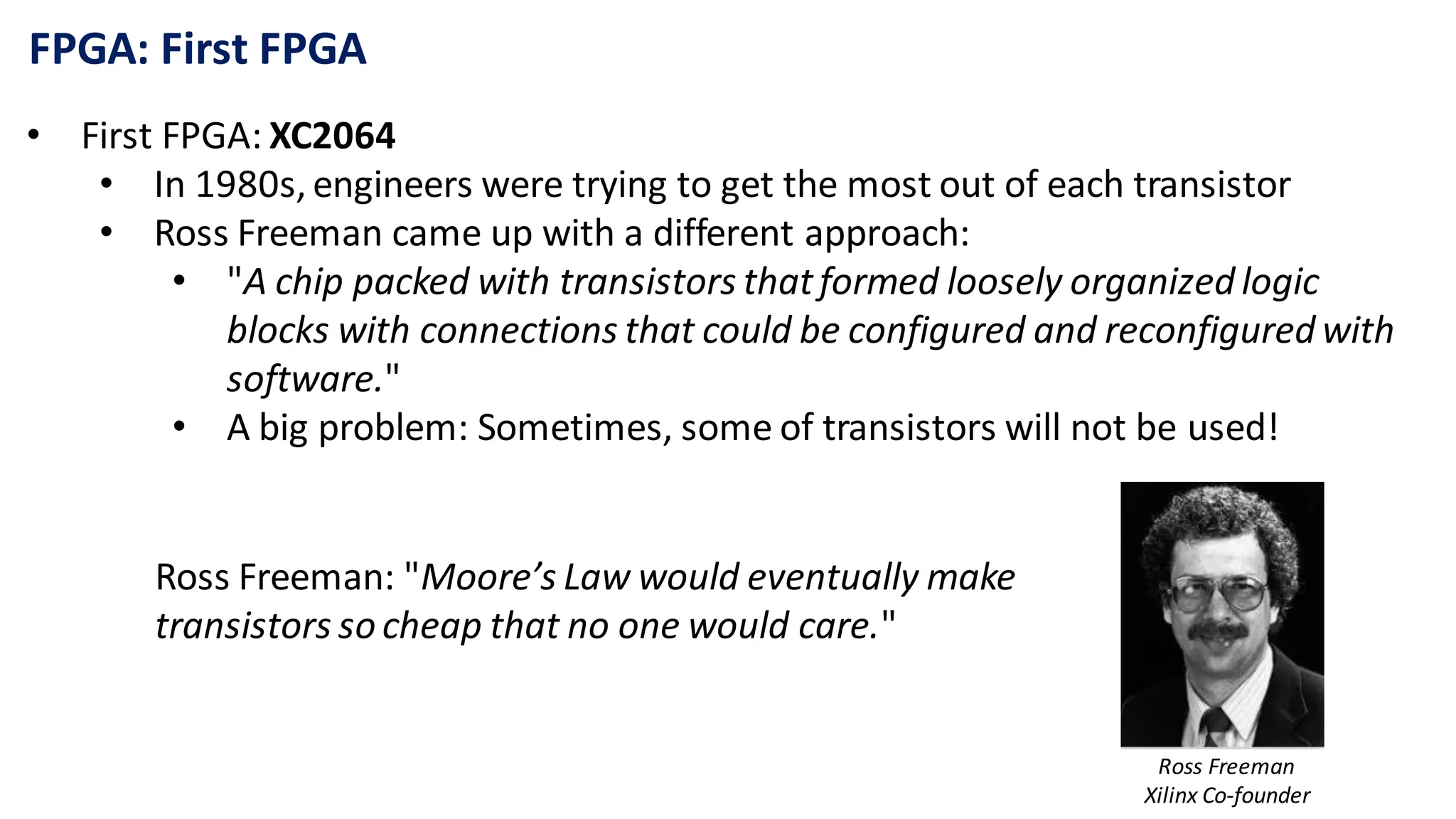
• First FPGA: XC2064
• In 1980s, engineers were trying to get the most out of each transistor
• Ross Freeman came up with a different approach:
• "A chip packed with transistors thatformed loosely organized logic
blocks with connections that could be configured and reconfigured with
software."
• A big problem: Sometimes, some of transistors will not be used!
Ross Freeman: "Moore’s Law would eventually make
transistors so cheap that no one would care."
Ross Freeman
Xilinx Co-founder
FPGA: First FPGA
• First FPGA: XC2064
• 8x8 grid of CLBs (Image from the Patent is a simplified 3x3 version)
• Each CLB has 4 inputs and 2 outputs
• Comb. Logic (Lookup Table – LUT)
• D-FF
• Multiplexers (MUX)
FPGA connections from Xilinx FPGA Patent
Images are retrieved from [https://semiwiki.com/fpga/290990-reverse-engineering-the-first-fpga-chip-xilinx-xc2064/]
FPGA: First FPGA
• First FPGA: XC2064
• Lookup Table – LUT
• Inside logic block, FPGAs do not have gates. Instead, they have lookup
tables with reconfigurable outputs.
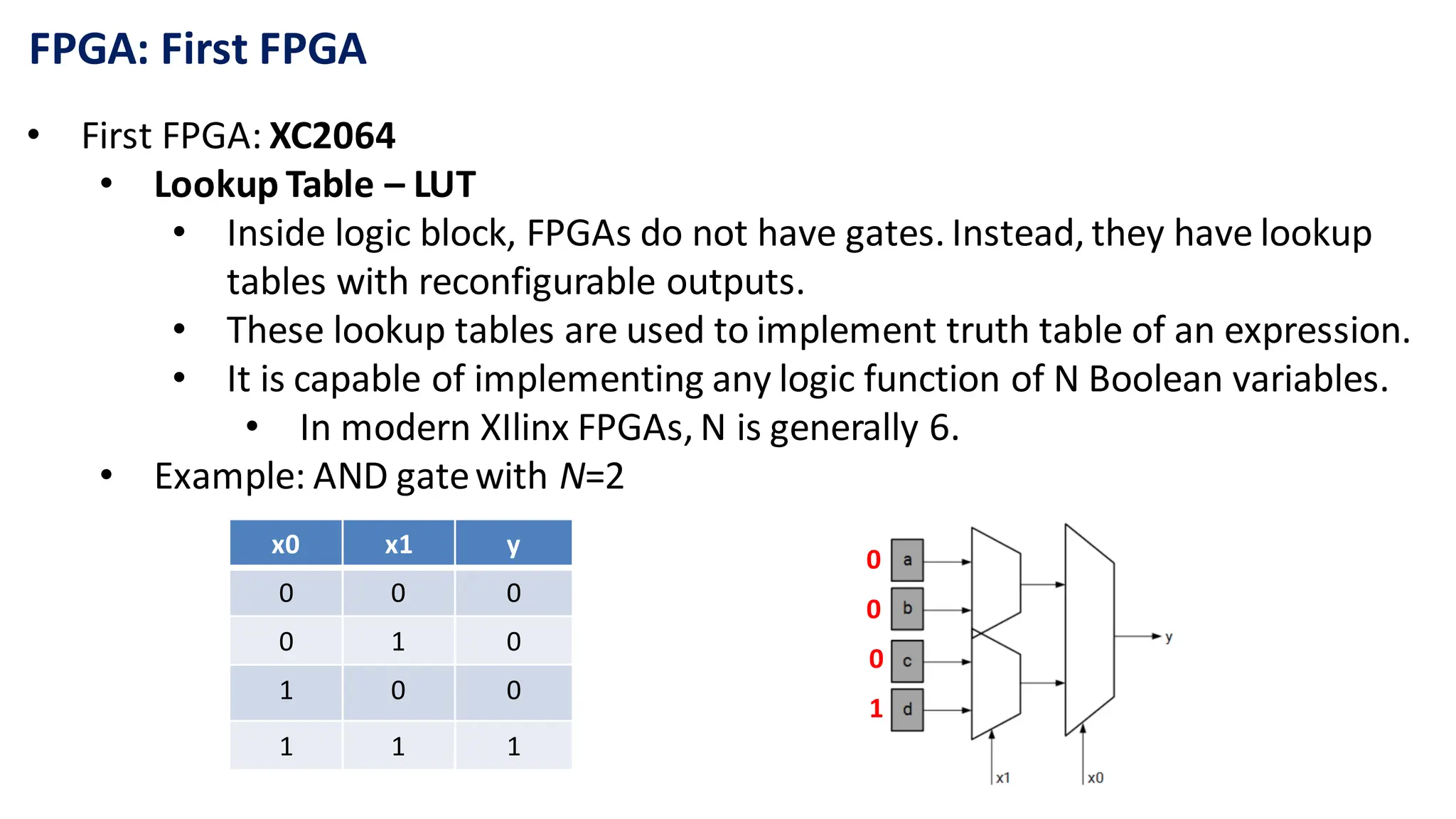
• These lookup tables are used to implement truth table of an expression.
• It is capable of implementing any logic function of N Boolean variables.
• In modern XIlinx FPGAs, N is generally 6.
FPGA: First FPGA
• First FPGA: XC2064
• Lookup Table – LUT
• Inside logic block, FPGAs do not have gates. Instead, they have lookup
tables with reconfigurable outputs.
• These lookup tables are used to implement truth table of an expression.
• It is capable of implementing any logic function of N Boolean variables.
• In modern XIlinx FPGAs, N is generally 6.
• Example: AND gatewith N=2
x0 x1 y
0 0 0
0 1 0
1 0 0
1 1 1
0
0
0
1
FPGA: First FPGA
• First FPGA: XC2064
• The interconnects
• There are several horizontal and vertical line segments.
• Interconnect points allow connections to be made between a horizontal
line and a vertical line, allowing arbitrary paths to be created.
• Switch matrices
Images are retrieved from [https://semiwiki.com/fpga/290990-reverse-engineering-the-first-fpga-chip-xilinx-xc2064/]
FPGA: Modern FPGAs
• Modern FPGAs have …
• More CLBs
• Larger LUTs (6-input LUTs)
• Custom building blocks (DSPs, BRAMs, Advanced I/O, ...)
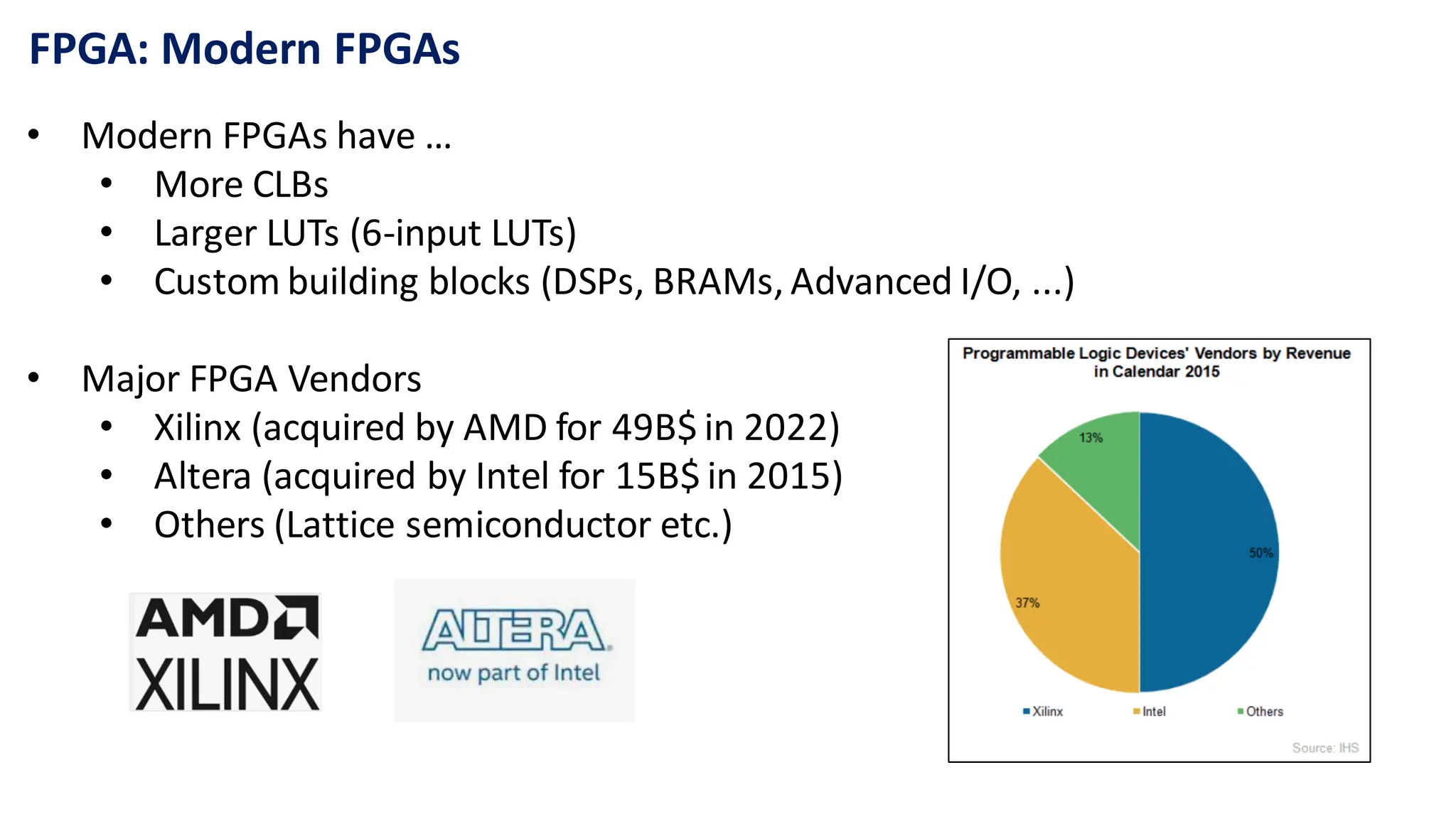
• Major FPGA Vendors
• Xilinx (acquired by AMD for 49B$ in 2022)
• Altera (acquired by Intel for 15B$ in 2015)
• Others (Lattice semiconductor etc.)
FPGA: Modern FPGAs
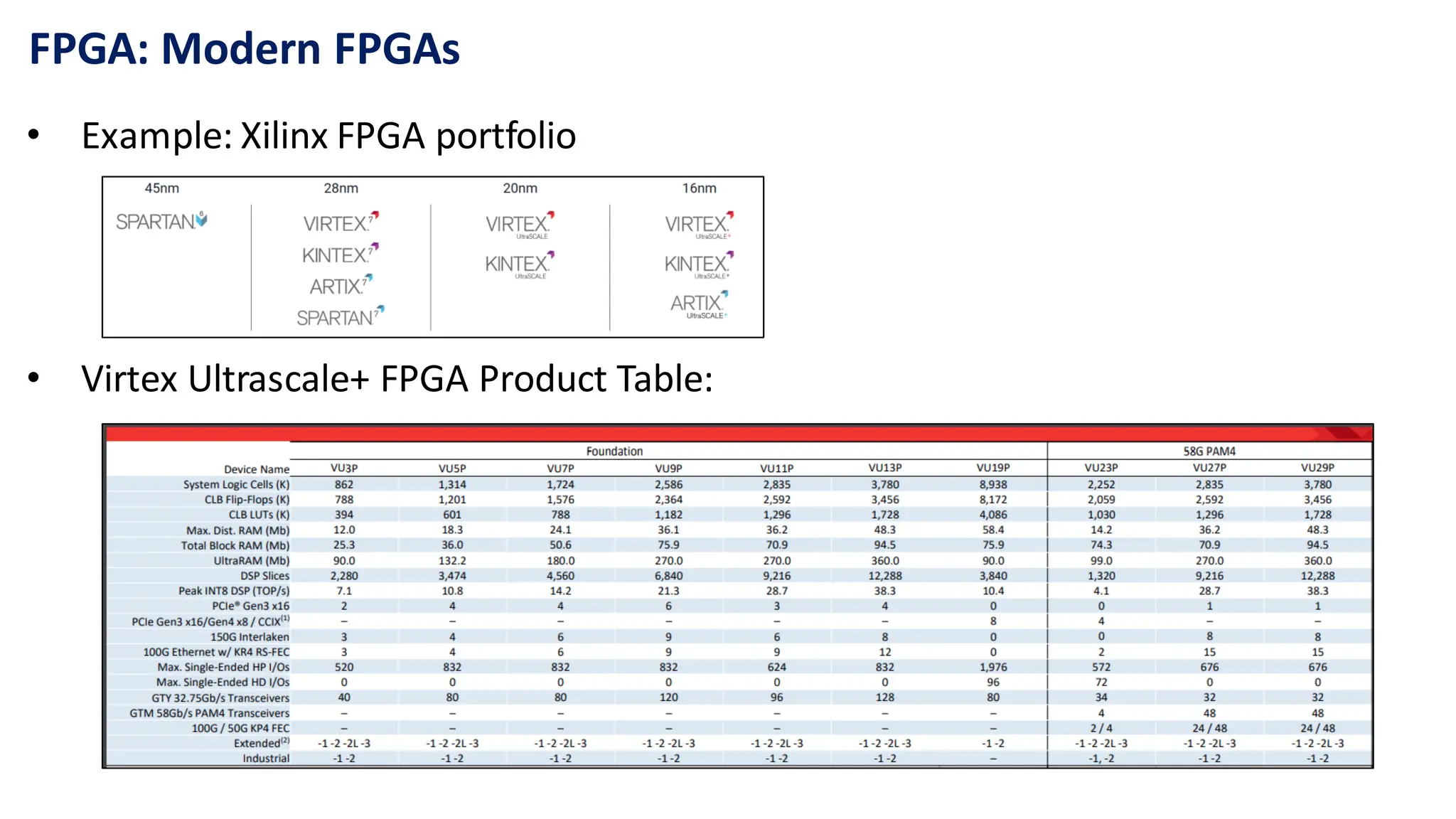
• Example: Xilinx FPGA portfolio
• Virtex Ultrascale+ FPGA Product Table:
FPGA: Modern FPGAs
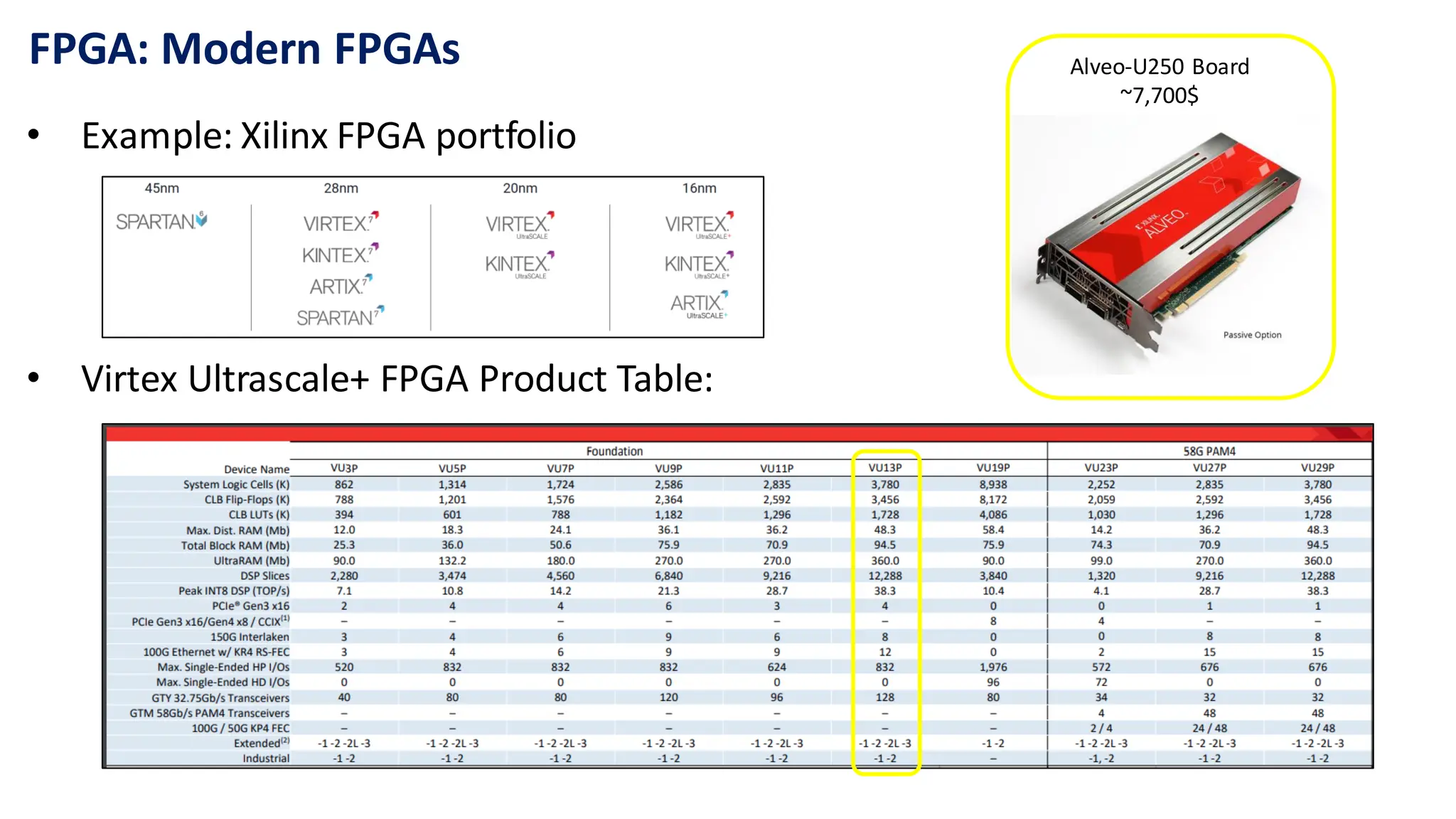
• Example: Xilinx FPGA portfolio
• Virtex Ultrascale+ FPGA Product Table:
Alveo-U250 Board
~7,700$
FPGA: Why should I learn FPGA?
• FPGAs are now everywhere
• IoT to Data Centers
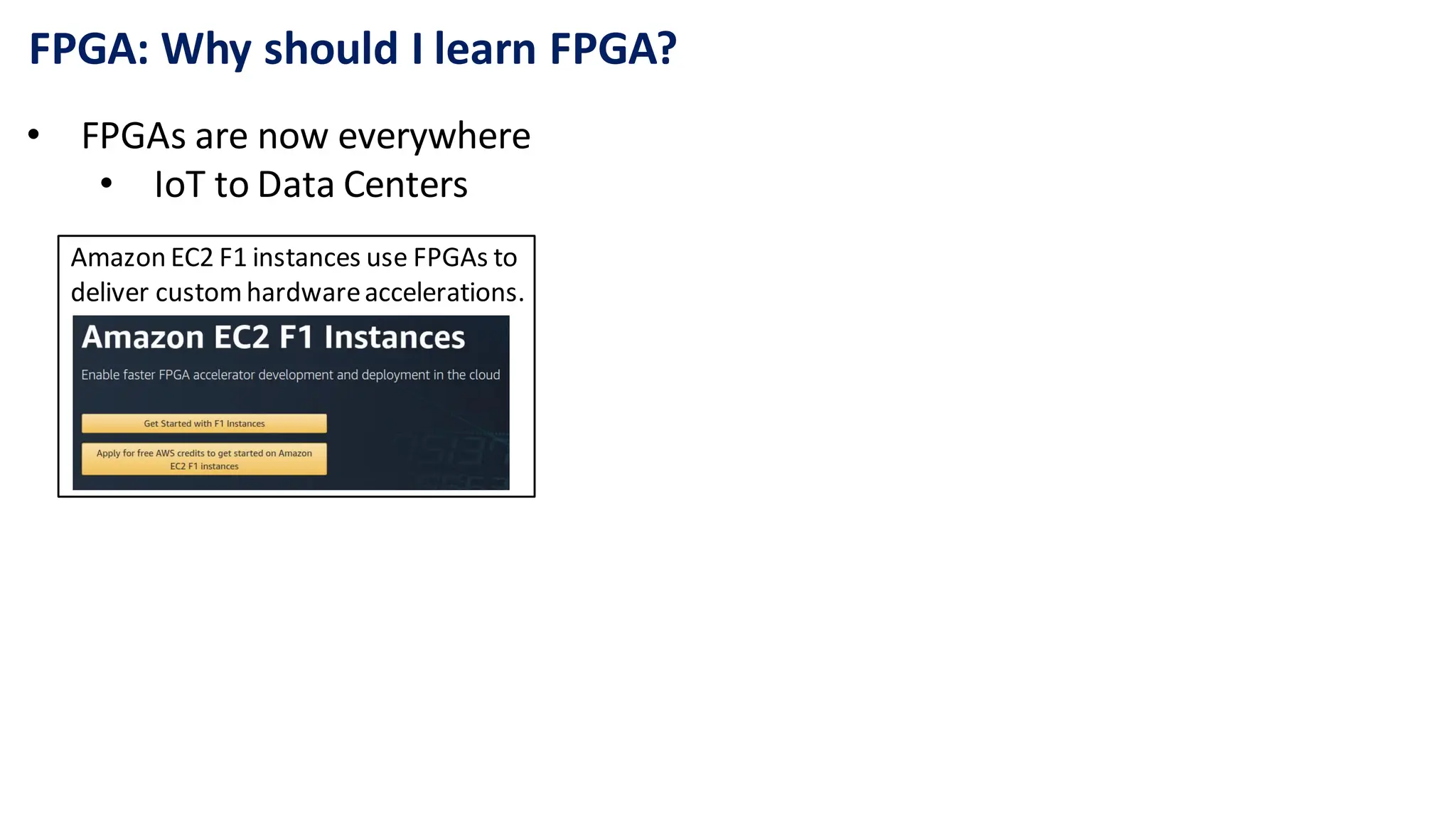
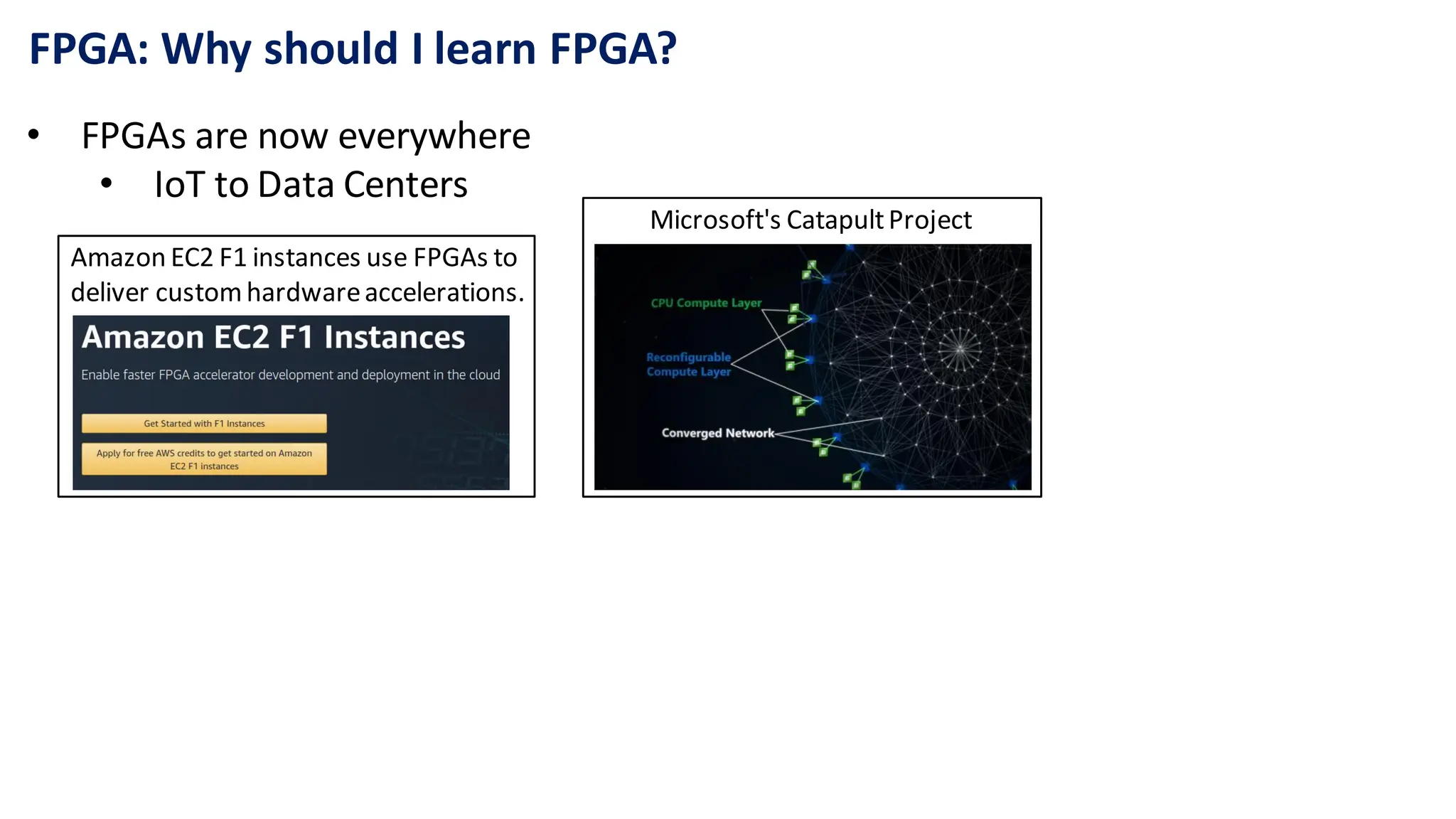
Amazon EC2 F1 instances use FPGAs to
deliver customhardwareaccelerations.​
FPGA: Why should I learn FPGA?
• FPGAs are now everywhere
• IoT to Data Centers
Amazon EC2 F1 instances use FPGAs to
deliver customhardwareaccelerations.​
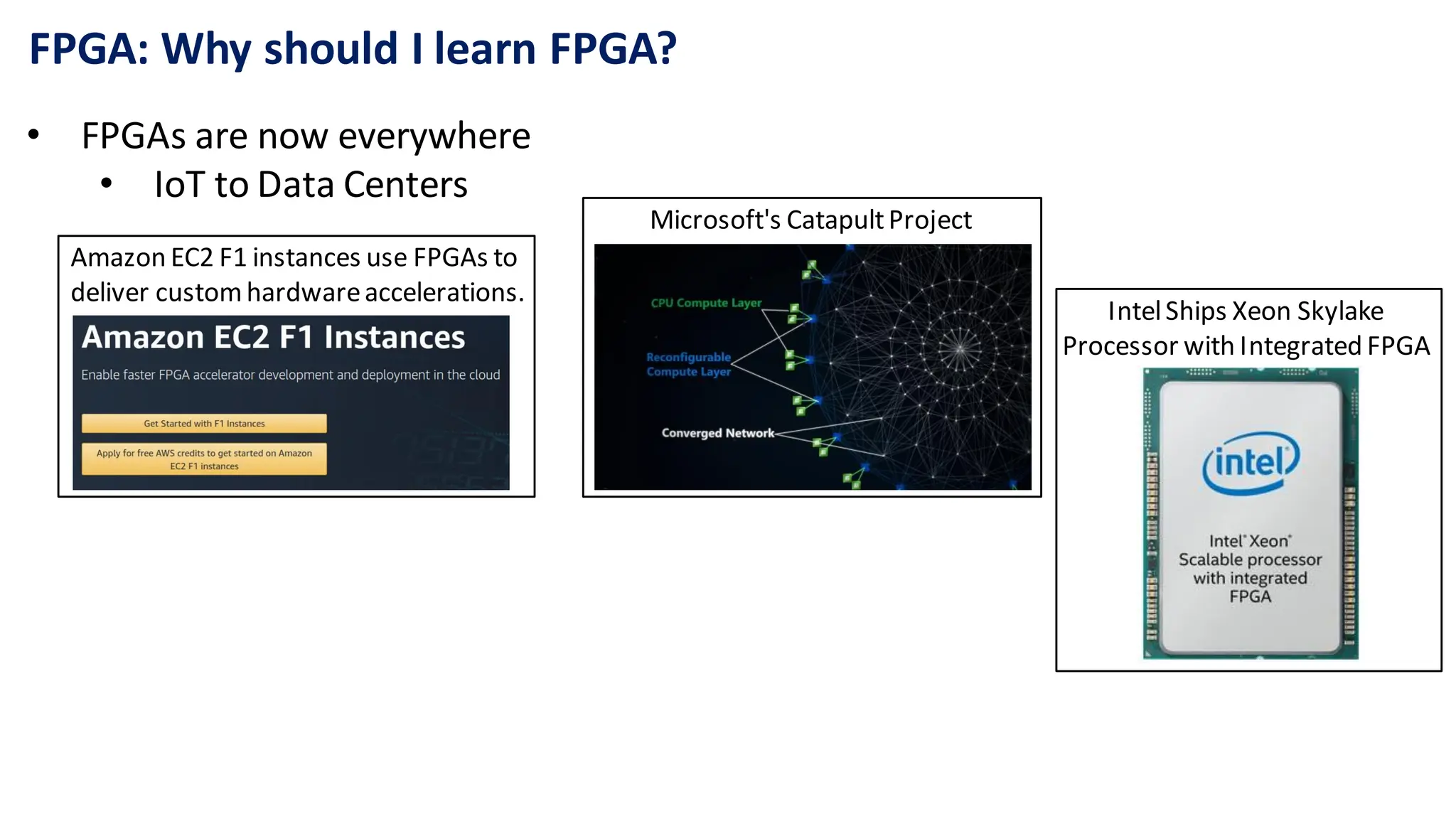
Microsoft's CatapultProject
FPGA: Why should I learn FPGA?
• FPGAs are now everywhere
• IoT to Data Centers
Amazon EC2 F1 instances use FPGAs to
deliver customhardwareaccelerations.​
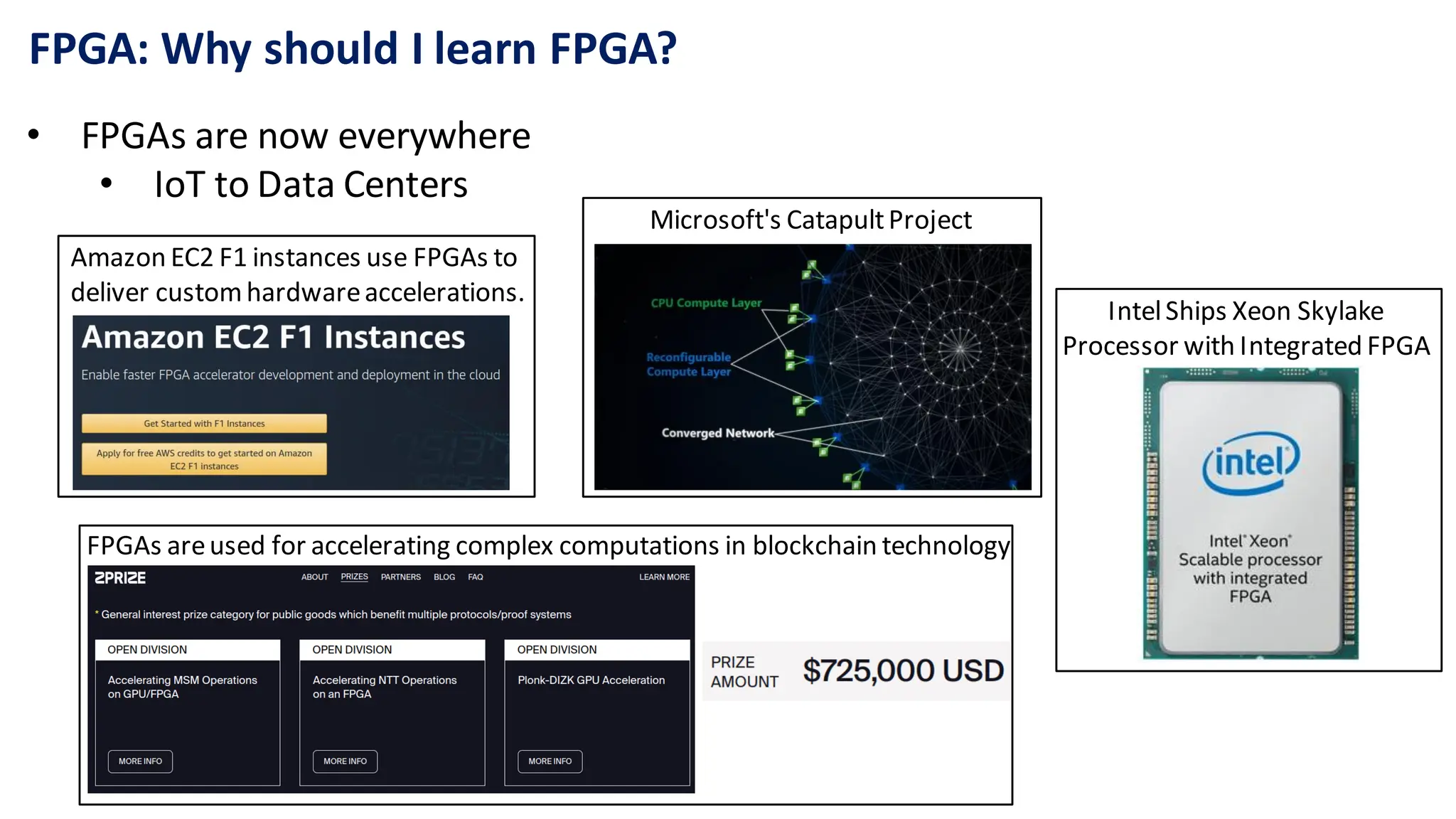
IntelShips Xeon Skylake
Processor with Integrated FPGA​
Microsoft's CatapultProject
FPGA: Why should I learn FPGA?
• FPGAs are now everywhere
• IoT to Data Centers
Amazon EC2 F1 instances use FPGAs to
deliver customhardwareaccelerations.​
IntelShips Xeon Skylake
Processor with Integrated FPGA​
Microsoft's CatapultProject
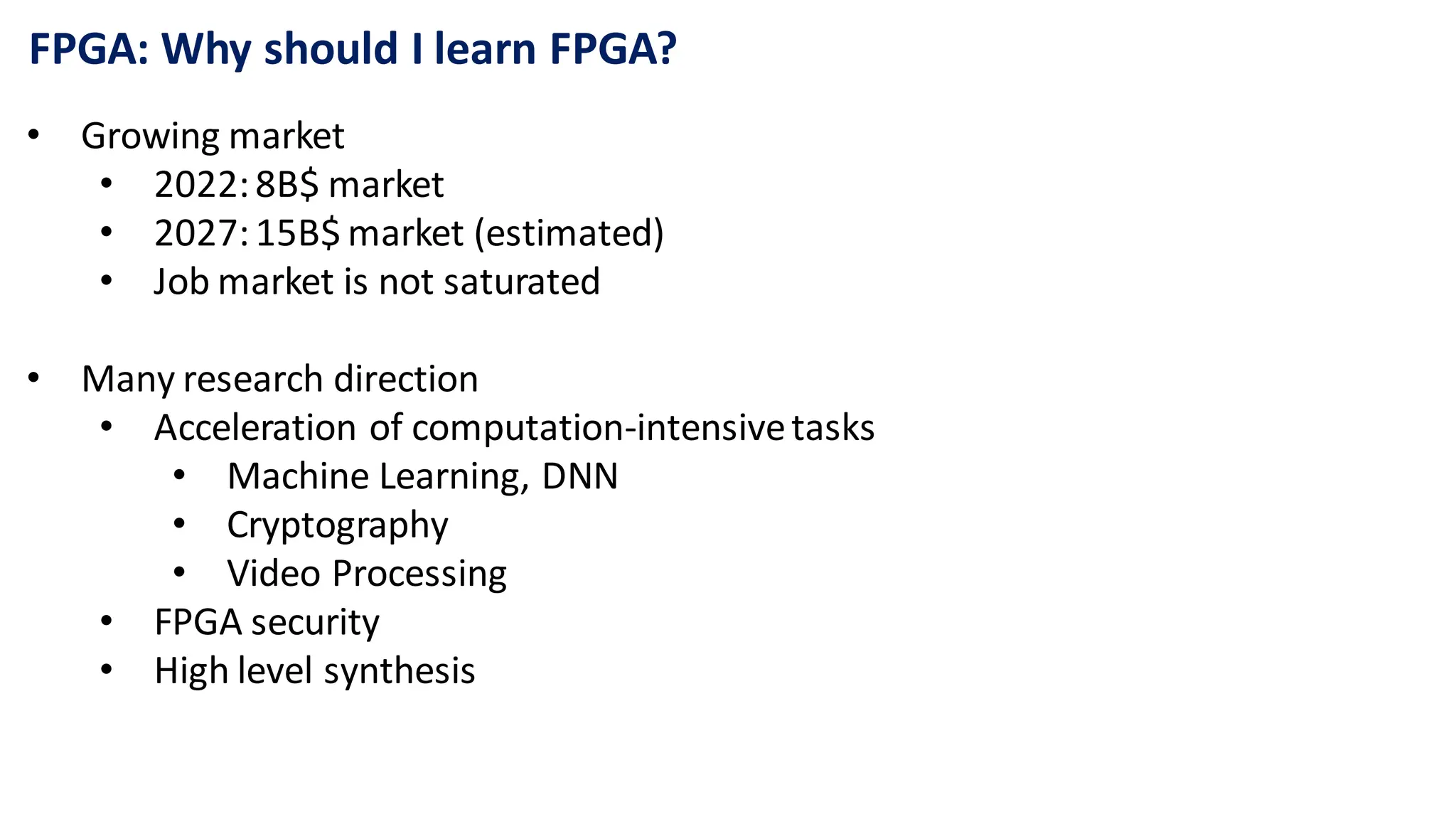
FPGAs areused for accelerating complex computations in blockchain technology
FPGA: Why should I learn FPGA?
• Growing market
• 2022:8B$ market
• 2027:15B$ market (estimated)
• Job market is not saturated
• Many research direction
• Acceleration of computation-intensivetasks
• Machine Learning, DNN
• Cryptography
• Video Processing
• FPGA security
• High level synthesis
FPGA: Where are FPGAs used?
• FPGAs could be …
• A target platform
• A prototype platform for ASIC or SoC
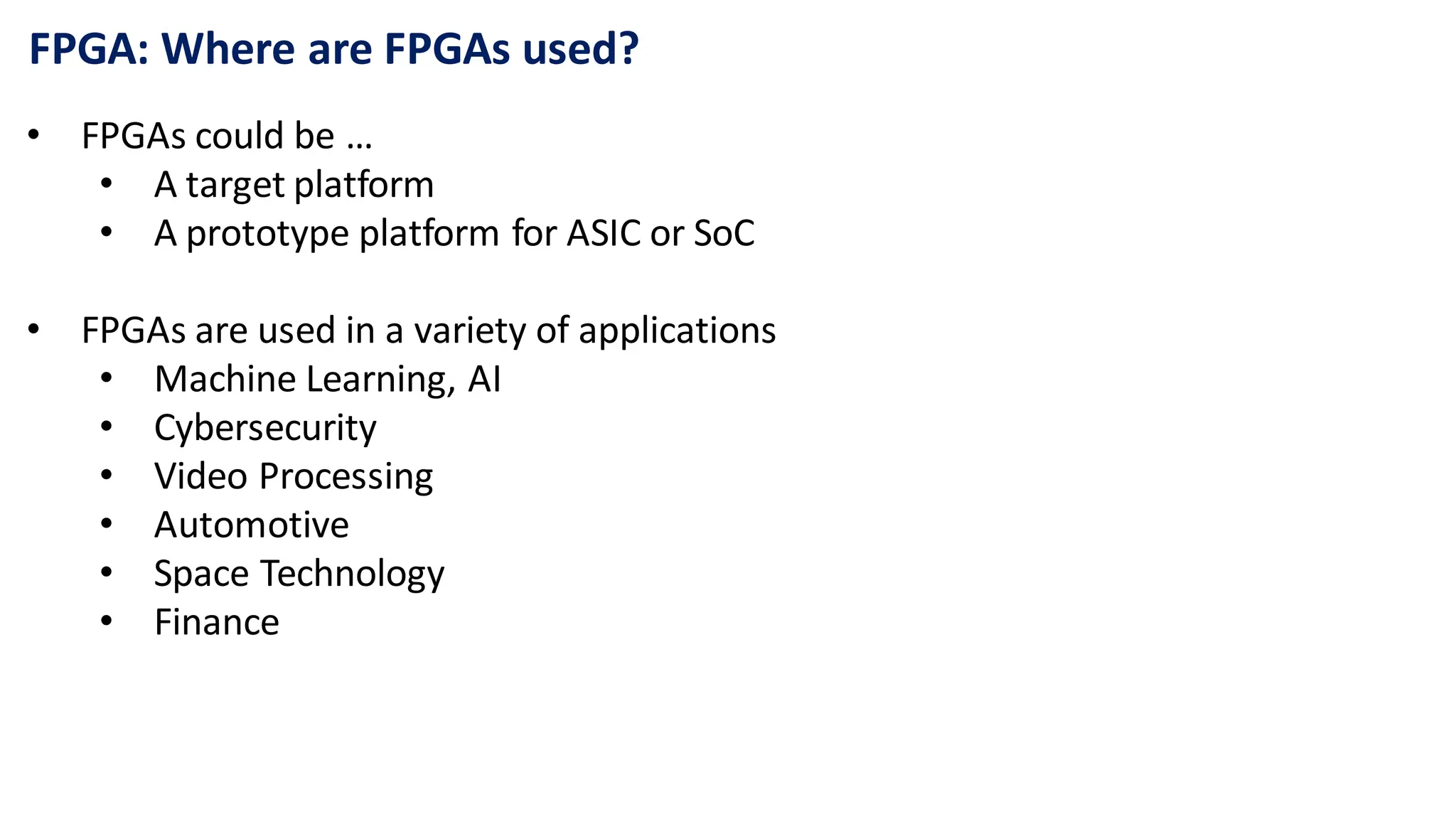
FPGA: Where are FPGAs used?
• FPGAs could be …
• A target platform
• A prototype platform for ASIC or SoC
• FPGAs are used in a variety of applications
• Machine Learning, AI
• Cybersecurity
• Video Processing
• Automotive
• Space Technology
• Finance
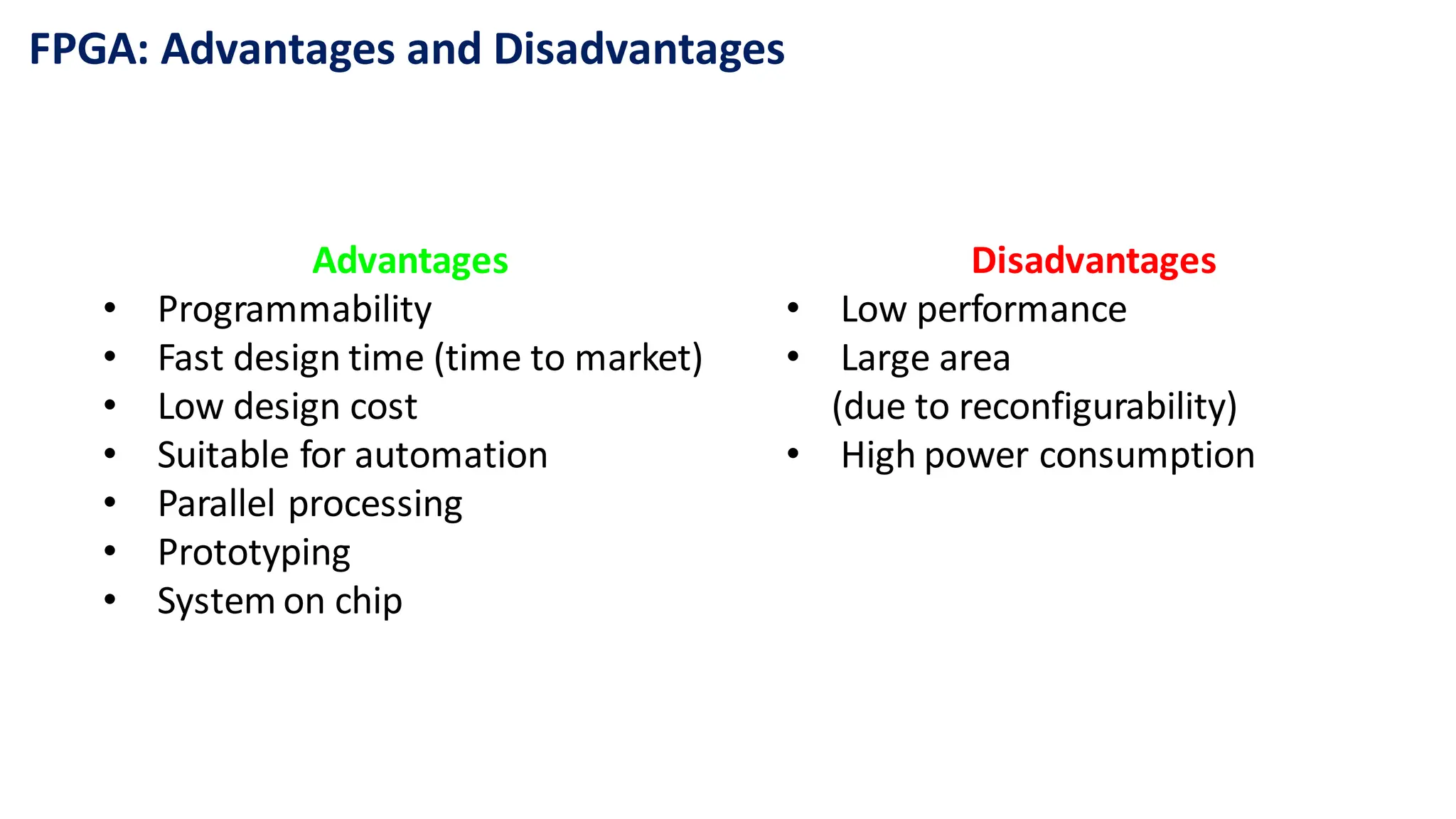
FPGA: Advantages and Disadvantages
Advantages
• Programmability
• Fast design time (time to market)
• Low design cost
• Suitable for automation
• Parallel processing
• Prototyping
• System on chip
Disadvantages
• Low performance
• Large area
(due to reconfigurability)
• High power consumption
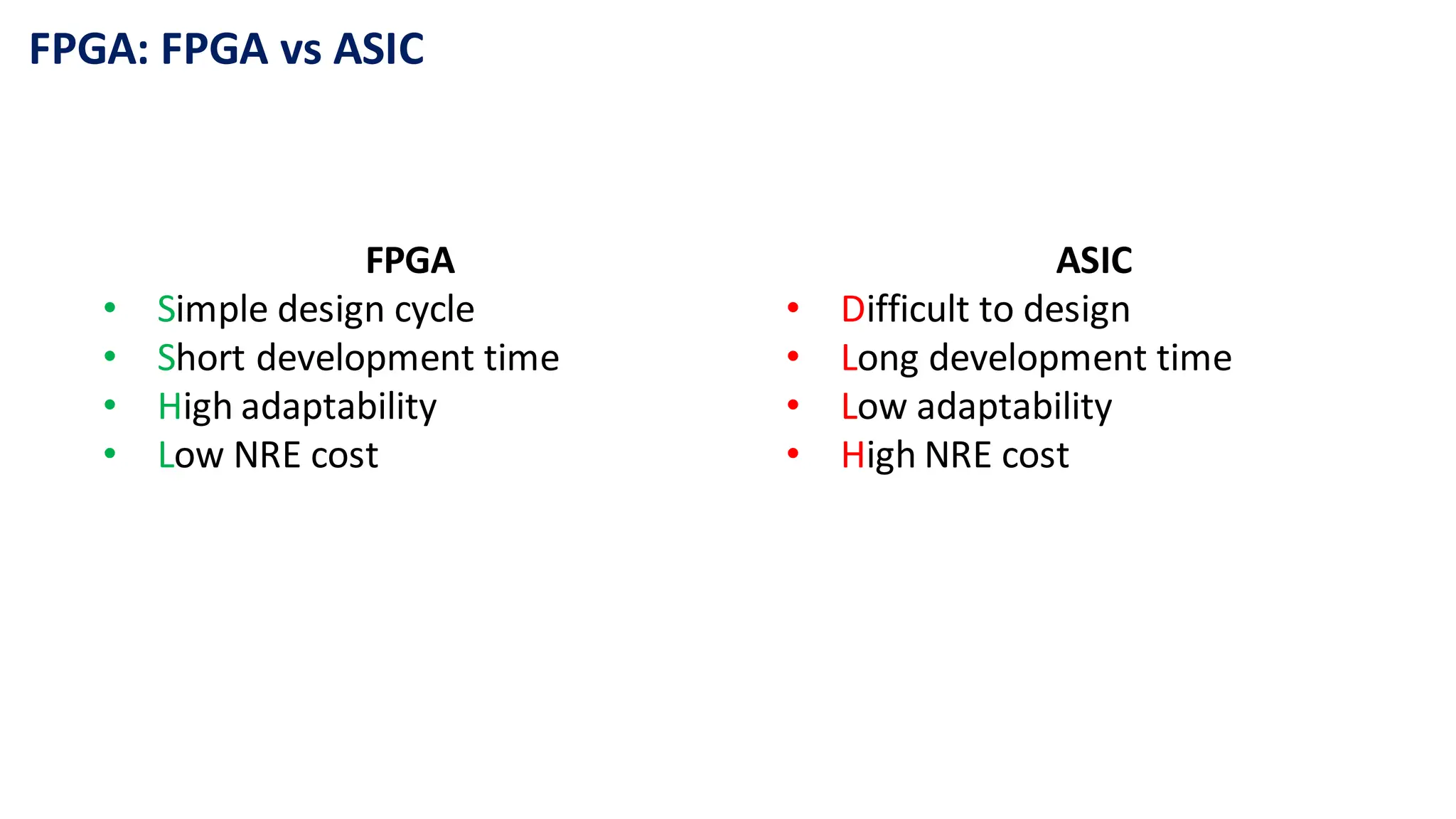
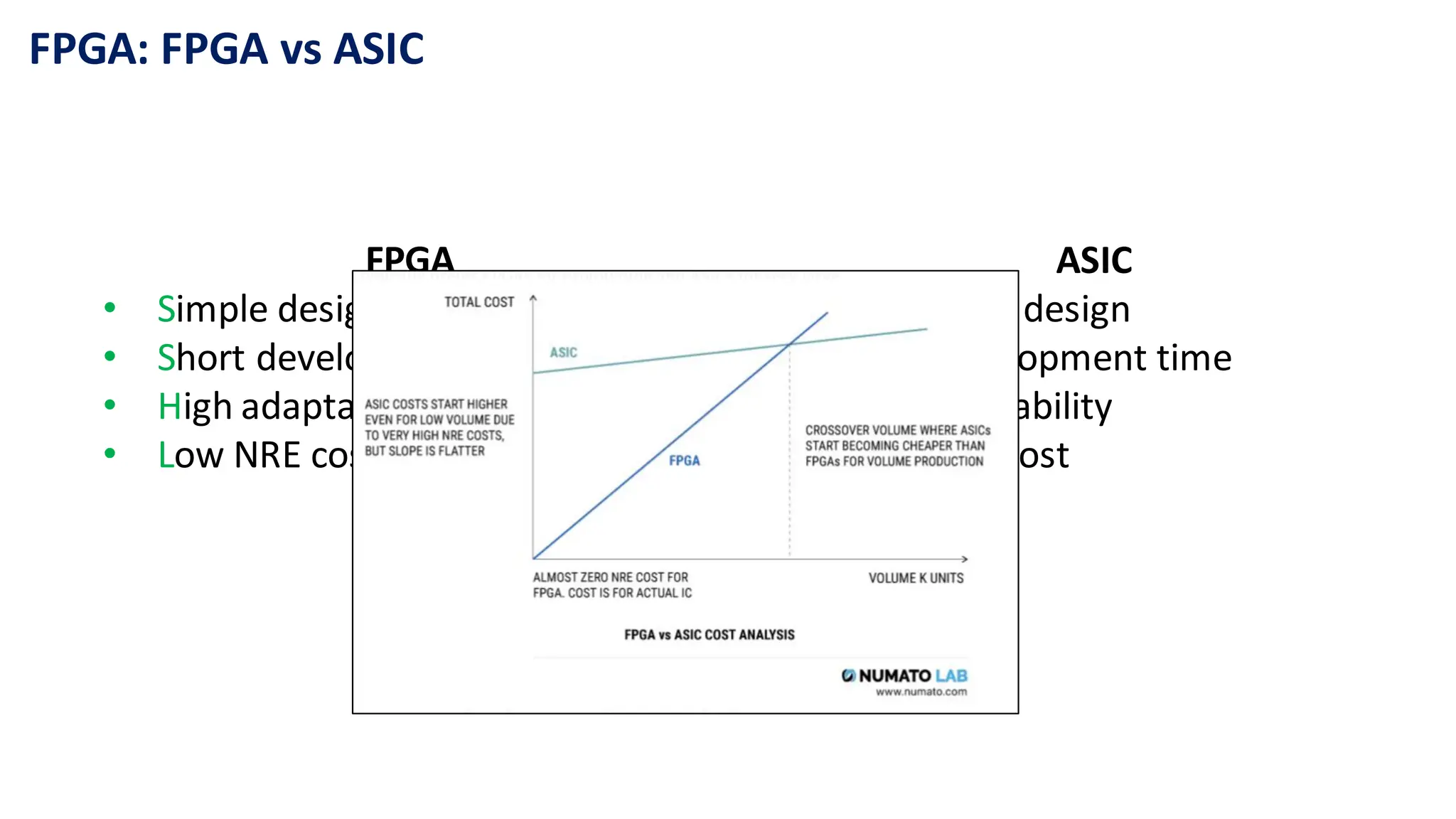
FPGA: FPGA vs ASIC
FPGA
• Simple design cycle
• Short development time
• High adaptability
• Low NRE cost
ASIC
• Difficult to design
• Long development time
• Low adaptability
• High NRE cost
FPGA: FPGA vs ASIC
FPGA
• Simple design cycle
• Short development time
• High adaptability
• Low NRE cost
ASIC
• Difficult to design
• Long development time
• Low adaptability
• High NRE cost
FPGA: FPGA vs ASIC
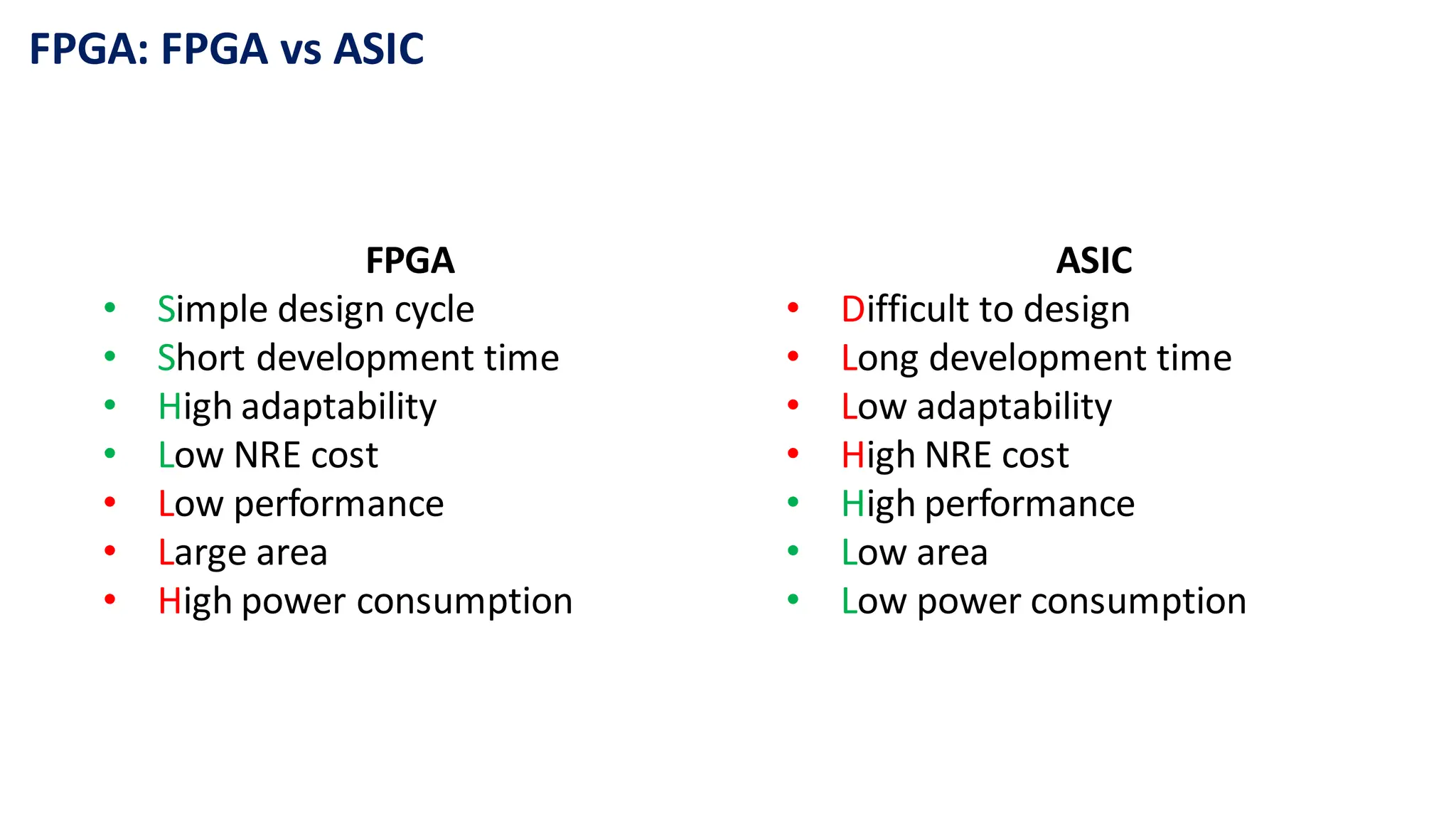
FPGA
• Simple design cycle
• Short development time
• High adaptability
• Low NRE cost
• Low performance
• Large area
• High power consumption
ASIC
• Difficult to design
• Long development time
• Low adaptability
• High NRE cost
• High performance
• Low area
• Low power consumption
FPGA: FPGA vs ASIC
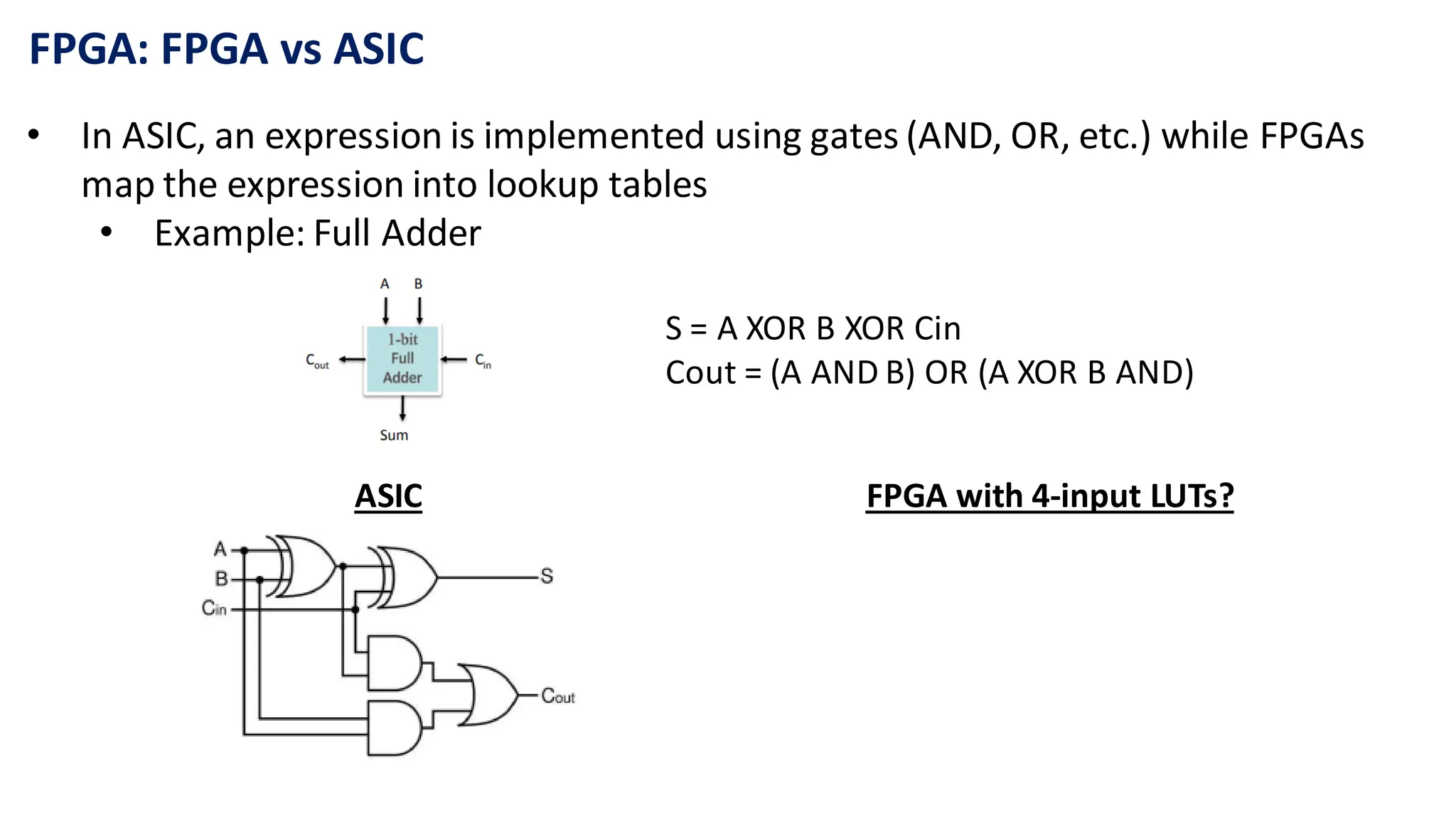
• In ASIC, an expression is implemented using gates (AND, OR, etc.) while FPGAs
map the expression into lookup tables
• Example: Full Adder
S = A XOR B XOR Cin
Cout = (A AND B) OR (A XOR B AND)
ASIC FPGA with 4-input LUTs?
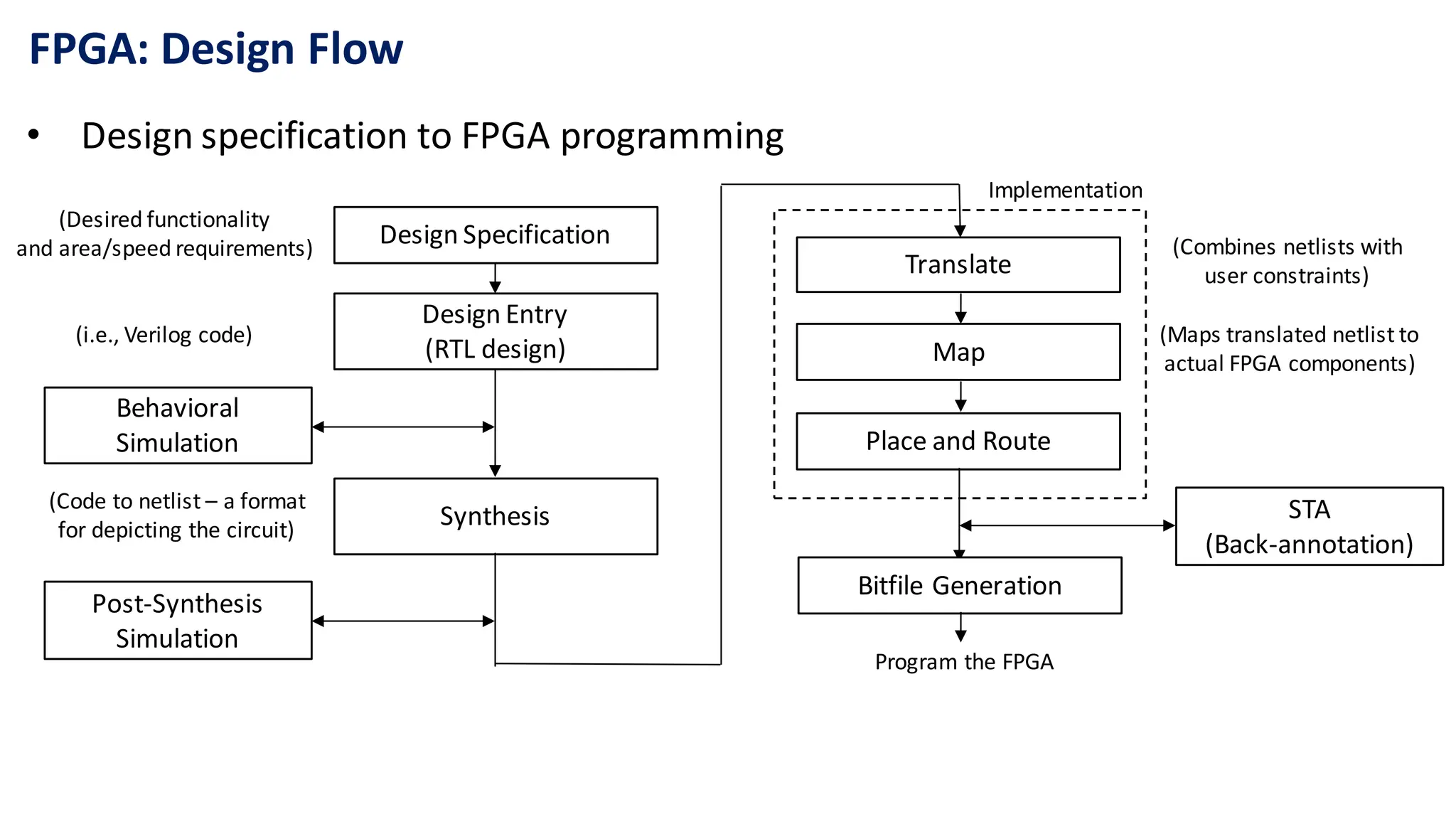
FPGA: Design Flow
• Design specification to FPGA programming
Design Specification
Design Entry
(RTL design)
(Desired functionality
and area/speed requirements)
(i.e., Verilog code)
Behavioral
Simulation
Synthesis
Post-Synthesis
Simulation
(Code to netlist – a format
for depicting the circuit)
Translate
Map
Place and Route
Implementation
Bitfile Generation
Program the FPGA
(Combines netlists with
user constraints)
(Maps translated netlist to
actual FPGA components)
STA
(Back-annotation)
FPGA: Components (a bit more in detail)
• FPGA: Field Programmable Gate Arrays
• ConfigurableLogic Blocks (CLBs)
• Programmable Interconnects
• Programmable I/O blocks
• Other functionalblocks: DSPs, Block RAMs, Ultra RAMs, ...
Image is retrieved from [https://towardsdatascience.com/introduction-to-fpga-and-its-architecture-20a62c14421c]
FPGA: Components (a bit more in detail)
• Building blocks of different vendors and FPGA series can show differences, here
we take Xilinx 7-series FPGAs as example.
• Main building blocks
• CLB, Slice, LUT
• Interconnects
• Custom blocks
• DSP
• Block RAM, Ultra RAM
• CPU core
• Soft and hard cores
FPGA: Components (a bit more in detail)
• 7-series overview (Artix-7)
• Modern FPGAs have diverse resources
Image is retrieved from [https://xilinx.eetrend.com/files-eetrend-xilinx/forum/201509/9204-20390-7_series_architecture_overview.pdf]
FPGA: Components (a bit more in detail)
• Configurable Logic Block (CLB)
• Has 2 slices
• SLICEM (LUT can be used for logic and memory)
• SLICEL (LUT can be used only for logic)
• Connected to interconnect through switch matrix
Image is retrieved from [https://xilinx.eetrend.com/files-eetrend-xilinx/forum/201509/9204-20390-7_series_architecture_overview.pdf]
FPGA: Components (a bit more in detail)
• CLB Slices
• Four 6-input LUTs
• D-FFs
• Multiplexers
Image is retrieved from [https://xilinx.eetrend.com/files-eetrend-xilinx/forum/201509/9204-20390-7_series_architecture_overview.pdf]
FPGA: Components (a bit more in detail)
• CLB Slices
• Four 6-input LUTs
• D-FFs
• Multiplexers
Image is retrieved from [https://xilinx.eetrend.com/files-eetrend-xilinx/forum/201509/9204-20390-7_series_architecture_overview.pdf]
FPGA: Components (a bit more in detail)
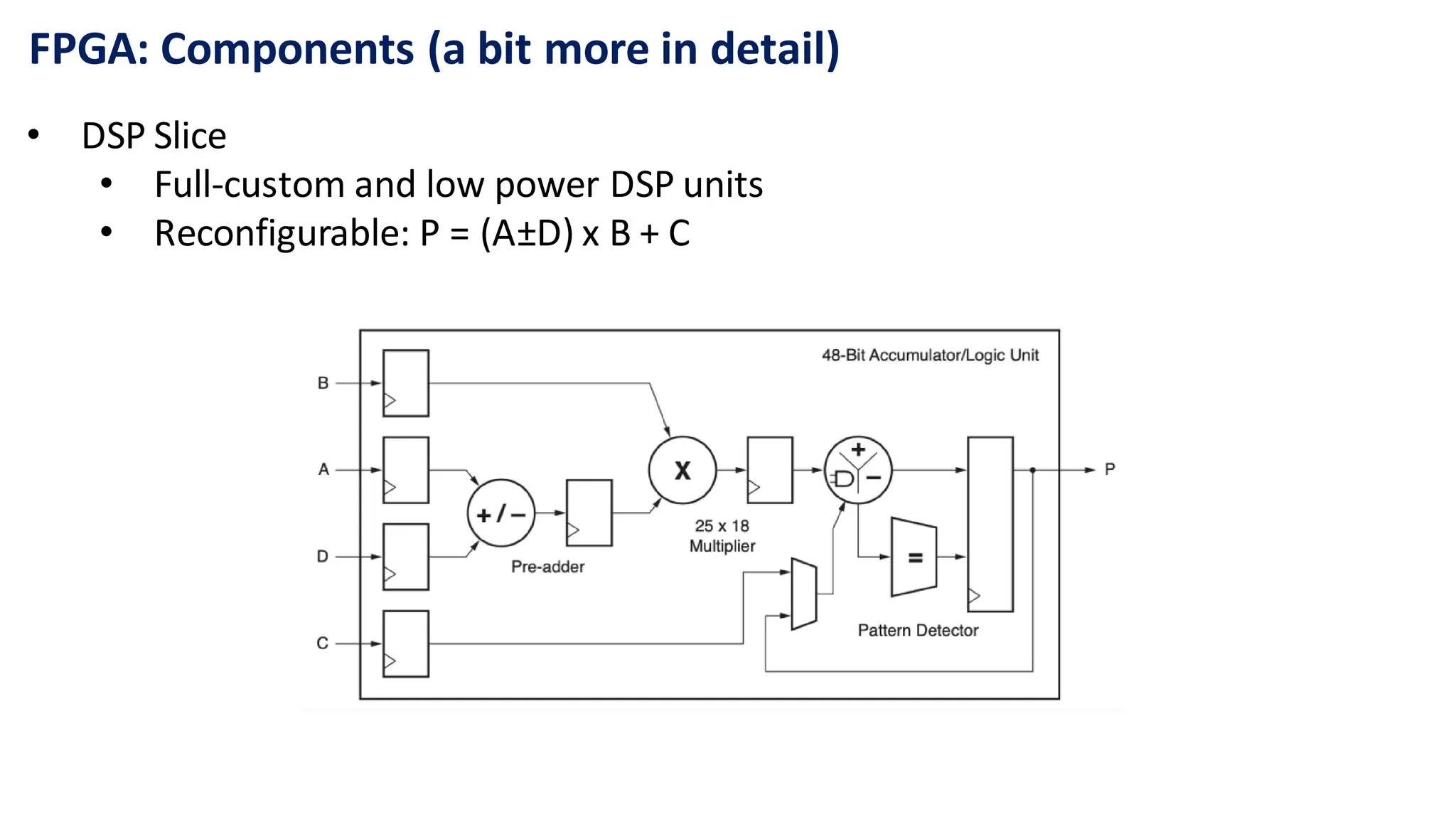
• DSP Slice
• Full-custom and low power DSP units
• Reconfigurable: P = (A±D) x B + C
FPGA: Components (a bit more in detail)
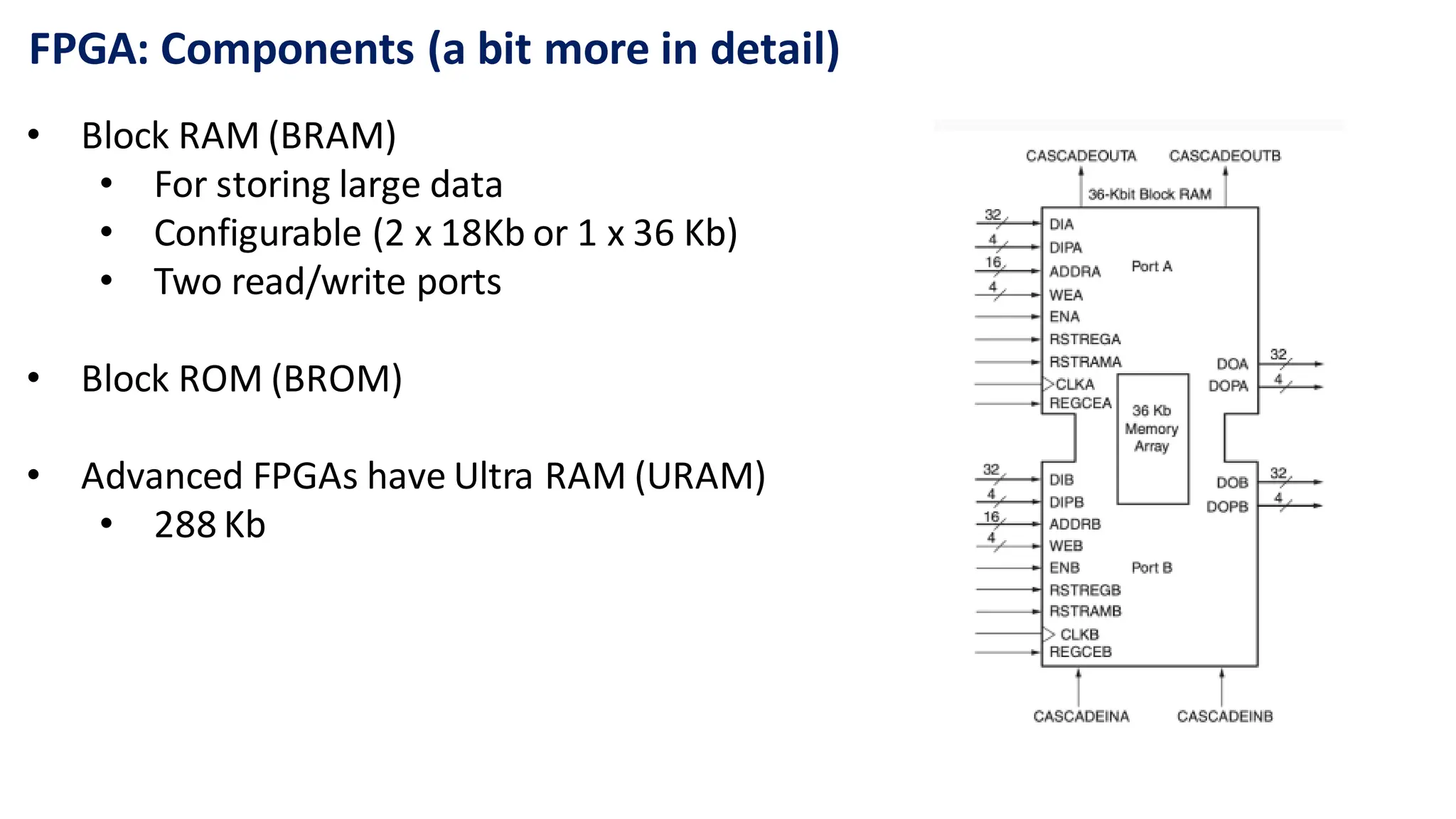
• Block RAM (BRAM)
• For storing large data
• Configurable (2 x 18Kb or 1 x 36 Kb)
• Two read/write ports
• Block ROM (BROM)
• Advanced FPGAs have Ultra RAM (URAM)
• 288 Kb
FPGA: Components (a bit more in detail)
• FPGA boards might be coupled with processors
• Xilinx PYNQ-Z2 has an ARM Cortex
• It is also possible to instantiate "soft" processor in FPGAs
• Xilinx's Microblaze soft processor core
• HW/SW co-design

Field programmable Gate Arrays Chapter 6.pdf

  • 1.
    October 3, 2022 AhmetCan Mert ahmet.mert@iaik.tugraz.at A Brief Introductionto FPGAs
  • 2.
    FPGA: Definition • FPGA:Field Programmable Gate Arrays • An array of logic cells with programmable control signals and a programmable routing grid • It can be configured/programmed to perform any digital circuits • Microcontroller • Video processor • Crypto miner • How to configure? • Define its behavior using Hardware Description Languages • Compile and download it to FPGA
  • 3.
    FPGA: Definition • FPGA:Field Programmable Gate Arrays • ConfigurableLogic Blocks (CLBs) • Programmable Interconnects • Programmable I/O blocks • Other functionalblocks: DSPs, Block RAMs, Ultra RAMs, ... Image is retrieved from [https://towardsdatascience.com/introduction-to-fpga-and-its-architecture-20a62c14421c]
  • 4.
    FPGA: A BriefHistory of FPGAs • Some major inventions that led to FPGAs • 1957 – PROM (programmable read-only memory) • 1960 – MOSFETs (metal–oxide–semiconductor field-effect transistor) • 1965 – Moore's Law
  • 5.
    FPGA: A BriefHistory of FPGAs • Some major inventions that led to FPGAs • 1957 – PROM (programmable read-only memory) • 1960 – MOSFETs (metal–oxide–semiconductor field-effect transistor) • 1965 – Moore's Law Image is retrieved from [https://en.wikipedia.org/wiki/Moore%27s_law]
  • 6.
    FPGA: A BriefHistory of FPGAs • Some major inventions that led to FPGAs • 1957 – PROM (programmable read-only memory) • 1960 – MOSFETs (metal–oxide–semiconductor field-effect transistor) • 1965 – Moore's Law • 1970 – EPROM • 1975 – PLA (Programmable Logic Array) • 1977 – PAL (Programmable Array Logic)
  • 7.
    FPGA: A BriefHistory of FPGAs • Some major inventions that led to FPGAs • 1957 – PROM (programmable read-only memory) • 1960 – MOSFETs (metal–oxide–semiconductor field-effect transistor) • 1965 – Moore's Law • 1970 – EPROM • 1975 – PLA (Programmable Logic Array) • 1977 – PAL (Programmable Array Logic) Image is retrieved from [https://www.electronics-tutorial.net/programmable-logic-devices/programmable-array-logic/]
  • 8.
    FPGA: A BriefHistory of FPGAs • Some major inventions that led to FPGAs • 1957 – PROM (programmable read-only memory) • 1960 – MOSFETs (metal–oxide–semiconductor field-effect transistor) • 1965 – Moore's Law • 1970 – EPROM • 1975 – PLA (Programmable Logic Array) • 1977 – PAL (Programmable Array Logic) • 1977 – EEPROM • 1981 – Flash Memory • 1985 – FPGA (Field Programmable Gate Arrays)
  • 9.
    FPGA: First FPGA •First FPGA: XC2064 • In 1980s, engineers were trying to get the most out of each transistor • Ross Freeman came up with a different approach: • "A chip packed with transistors thatformed loosely organized logic blocks with connections that could be configured and reconfigured with software." • A big problem: Sometimes, some of transistors will not be used! Ross Freeman: "Moore’s Law would eventually make transistors so cheap that no one would care." Ross Freeman Xilinx Co-founder
  • 10.
    FPGA: First FPGA •First FPGA: XC2064 • 8x8 grid of CLBs (Image from the Patent is a simplified 3x3 version) • Each CLB has 4 inputs and 2 outputs • Comb. Logic (Lookup Table – LUT) • D-FF • Multiplexers (MUX) FPGA connections from Xilinx FPGA Patent Images are retrieved from [https://semiwiki.com/fpga/290990-reverse-engineering-the-first-fpga-chip-xilinx-xc2064/]
  • 11.
    FPGA: First FPGA •First FPGA: XC2064 • Lookup Table – LUT • Inside logic block, FPGAs do not have gates. Instead, they have lookup tables with reconfigurable outputs. • These lookup tables are used to implement truth table of an expression. • It is capable of implementing any logic function of N Boolean variables. • In modern XIlinx FPGAs, N is generally 6.
  • 12.
    FPGA: First FPGA •First FPGA: XC2064 • Lookup Table – LUT • Inside logic block, FPGAs do not have gates. Instead, they have lookup tables with reconfigurable outputs. • These lookup tables are used to implement truth table of an expression. • It is capable of implementing any logic function of N Boolean variables. • In modern XIlinx FPGAs, N is generally 6. • Example: AND gatewith N=2 x0 x1 y 0 0 0 0 1 0 1 0 0 1 1 1 0 0 0 1
  • 13.
    FPGA: First FPGA •First FPGA: XC2064 • The interconnects • There are several horizontal and vertical line segments. • Interconnect points allow connections to be made between a horizontal line and a vertical line, allowing arbitrary paths to be created. • Switch matrices Images are retrieved from [https://semiwiki.com/fpga/290990-reverse-engineering-the-first-fpga-chip-xilinx-xc2064/]
  • 14.
    FPGA: Modern FPGAs •Modern FPGAs have … • More CLBs • Larger LUTs (6-input LUTs) • Custom building blocks (DSPs, BRAMs, Advanced I/O, ...) • Major FPGA Vendors • Xilinx (acquired by AMD for 49B$ in 2022) • Altera (acquired by Intel for 15B$ in 2015) • Others (Lattice semiconductor etc.)
  • 15.
    FPGA: Modern FPGAs •Example: Xilinx FPGA portfolio • Virtex Ultrascale+ FPGA Product Table:
  • 16.
    FPGA: Modern FPGAs •Example: Xilinx FPGA portfolio • Virtex Ultrascale+ FPGA Product Table: Alveo-U250 Board ~7,700$
  • 17.
    FPGA: Why shouldI learn FPGA? • FPGAs are now everywhere • IoT to Data Centers Amazon EC2 F1 instances use FPGAs to deliver customhardwareaccelerations.​
  • 18.
    FPGA: Why shouldI learn FPGA? • FPGAs are now everywhere • IoT to Data Centers Amazon EC2 F1 instances use FPGAs to deliver customhardwareaccelerations.​ Microsoft's CatapultProject
  • 19.
    FPGA: Why shouldI learn FPGA? • FPGAs are now everywhere • IoT to Data Centers Amazon EC2 F1 instances use FPGAs to deliver customhardwareaccelerations.​ IntelShips Xeon Skylake Processor with Integrated FPGA​ Microsoft's CatapultProject
  • 20.
    FPGA: Why shouldI learn FPGA? • FPGAs are now everywhere • IoT to Data Centers Amazon EC2 F1 instances use FPGAs to deliver customhardwareaccelerations.​ IntelShips Xeon Skylake Processor with Integrated FPGA​ Microsoft's CatapultProject FPGAs areused for accelerating complex computations in blockchain technology
  • 21.
    FPGA: Why shouldI learn FPGA? • Growing market • 2022:8B$ market • 2027:15B$ market (estimated) • Job market is not saturated • Many research direction • Acceleration of computation-intensivetasks • Machine Learning, DNN • Cryptography • Video Processing • FPGA security • High level synthesis
  • 22.
    FPGA: Where areFPGAs used? • FPGAs could be … • A target platform • A prototype platform for ASIC or SoC
  • 23.
    FPGA: Where areFPGAs used? • FPGAs could be … • A target platform • A prototype platform for ASIC or SoC • FPGAs are used in a variety of applications • Machine Learning, AI • Cybersecurity • Video Processing • Automotive • Space Technology • Finance
  • 24.
    FPGA: Advantages andDisadvantages Advantages • Programmability • Fast design time (time to market) • Low design cost • Suitable for automation • Parallel processing • Prototyping • System on chip Disadvantages • Low performance • Large area (due to reconfigurability) • High power consumption
  • 25.
    FPGA: FPGA vsASIC FPGA • Simple design cycle • Short development time • High adaptability • Low NRE cost ASIC • Difficult to design • Long development time • Low adaptability • High NRE cost
  • 26.
    FPGA: FPGA vsASIC FPGA • Simple design cycle • Short development time • High adaptability • Low NRE cost ASIC • Difficult to design • Long development time • Low adaptability • High NRE cost
  • 27.
    FPGA: FPGA vsASIC FPGA • Simple design cycle • Short development time • High adaptability • Low NRE cost • Low performance • Large area • High power consumption ASIC • Difficult to design • Long development time • Low adaptability • High NRE cost • High performance • Low area • Low power consumption
  • 28.
    FPGA: FPGA vsASIC • In ASIC, an expression is implemented using gates (AND, OR, etc.) while FPGAs map the expression into lookup tables • Example: Full Adder S = A XOR B XOR Cin Cout = (A AND B) OR (A XOR B AND) ASIC FPGA with 4-input LUTs?
  • 29.
    FPGA: Design Flow •Design specification to FPGA programming Design Specification Design Entry (RTL design) (Desired functionality and area/speed requirements) (i.e., Verilog code) Behavioral Simulation Synthesis Post-Synthesis Simulation (Code to netlist – a format for depicting the circuit) Translate Map Place and Route Implementation Bitfile Generation Program the FPGA (Combines netlists with user constraints) (Maps translated netlist to actual FPGA components) STA (Back-annotation)
  • 30.
    FPGA: Components (abit more in detail) • FPGA: Field Programmable Gate Arrays • ConfigurableLogic Blocks (CLBs) • Programmable Interconnects • Programmable I/O blocks • Other functionalblocks: DSPs, Block RAMs, Ultra RAMs, ... Image is retrieved from [https://towardsdatascience.com/introduction-to-fpga-and-its-architecture-20a62c14421c]
  • 31.
    FPGA: Components (abit more in detail) • Building blocks of different vendors and FPGA series can show differences, here we take Xilinx 7-series FPGAs as example. • Main building blocks • CLB, Slice, LUT • Interconnects • Custom blocks • DSP • Block RAM, Ultra RAM • CPU core • Soft and hard cores
  • 32.
    FPGA: Components (abit more in detail) • 7-series overview (Artix-7) • Modern FPGAs have diverse resources Image is retrieved from [https://xilinx.eetrend.com/files-eetrend-xilinx/forum/201509/9204-20390-7_series_architecture_overview.pdf]
  • 33.
    FPGA: Components (abit more in detail) • Configurable Logic Block (CLB) • Has 2 slices • SLICEM (LUT can be used for logic and memory) • SLICEL (LUT can be used only for logic) • Connected to interconnect through switch matrix Image is retrieved from [https://xilinx.eetrend.com/files-eetrend-xilinx/forum/201509/9204-20390-7_series_architecture_overview.pdf]
  • 34.
    FPGA: Components (abit more in detail) • CLB Slices • Four 6-input LUTs • D-FFs • Multiplexers Image is retrieved from [https://xilinx.eetrend.com/files-eetrend-xilinx/forum/201509/9204-20390-7_series_architecture_overview.pdf]
  • 35.
    FPGA: Components (abit more in detail) • CLB Slices • Four 6-input LUTs • D-FFs • Multiplexers Image is retrieved from [https://xilinx.eetrend.com/files-eetrend-xilinx/forum/201509/9204-20390-7_series_architecture_overview.pdf]
  • 36.
    FPGA: Components (abit more in detail) • DSP Slice • Full-custom and low power DSP units • Reconfigurable: P = (A±D) x B + C
  • 37.
    FPGA: Components (abit more in detail) • Block RAM (BRAM) • For storing large data • Configurable (2 x 18Kb or 1 x 36 Kb) • Two read/write ports • Block ROM (BROM) • Advanced FPGAs have Ultra RAM (URAM) • 288 Kb
  • 38.
    FPGA: Components (abit more in detail) • FPGA boards might be coupled with processors • Xilinx PYNQ-Z2 has an ARM Cortex • It is also possible to instantiate "soft" processor in FPGAs • Xilinx's Microblaze soft processor core • HW/SW co-design