DSD and HDL Simulation, Assignment Questions
Problem Give implementation of 3 bit UP counter using ACT3 LMs
Solution:
PS NS
𝑨 𝑩 𝑪 𝑨 𝑩 𝑪
0 0 0 0 0 1
0 0 1 0 1 0
0 1 0 0 1 1
0 1 1 1 0 0
1 0 0 1 0 1
1 0 1 1 1 0
1 1 0 1 1 1
1 1 1 0 0 0
Design equations are as follows:
𝐴 = 𝐴̅̅̅̅ 𝐵 𝐶 + 𝐴 𝐶̅̅̅ + 𝐴 𝐵̅̅̅
𝐵 = 𝐵̅̅̅ 𝐶 + 𝐵 𝐶̅̅̅
𝐶 = 𝐶̅̅̅
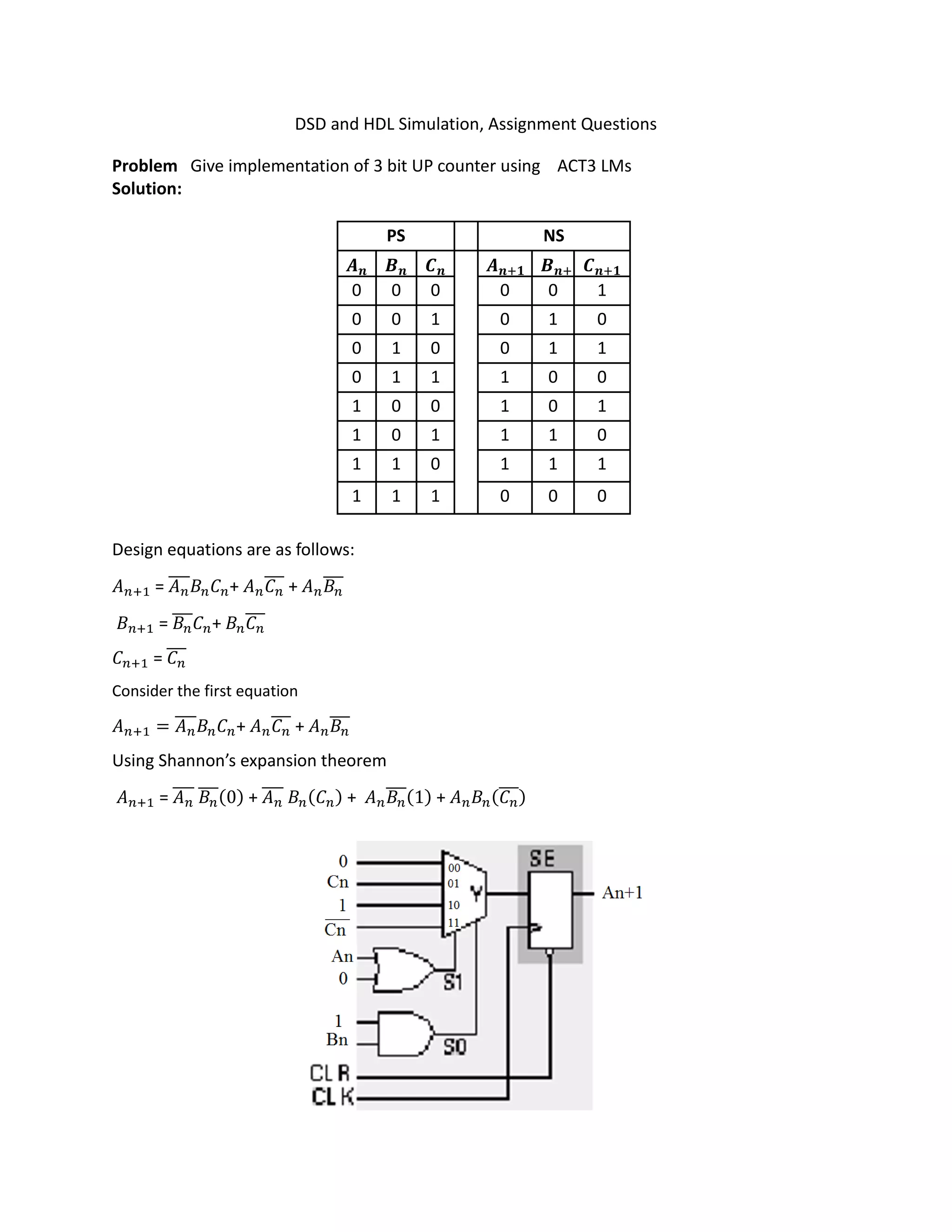
Consider the first equation
𝐴 = 𝐴̅̅̅̅ 𝐵 𝐶 + 𝐴 𝐶̅̅̅ + 𝐴 𝐵̅̅̅
Using Shannon’s expansion theorem
𝐴 = 𝐴̅̅̅̅ 𝐵̅̅̅(0) + 𝐴̅̅̅̅ 𝐵 (𝐶 ) + 𝐴 𝐵̅̅̅(1) + 𝐴 𝐵 (𝐶̅̅̅)
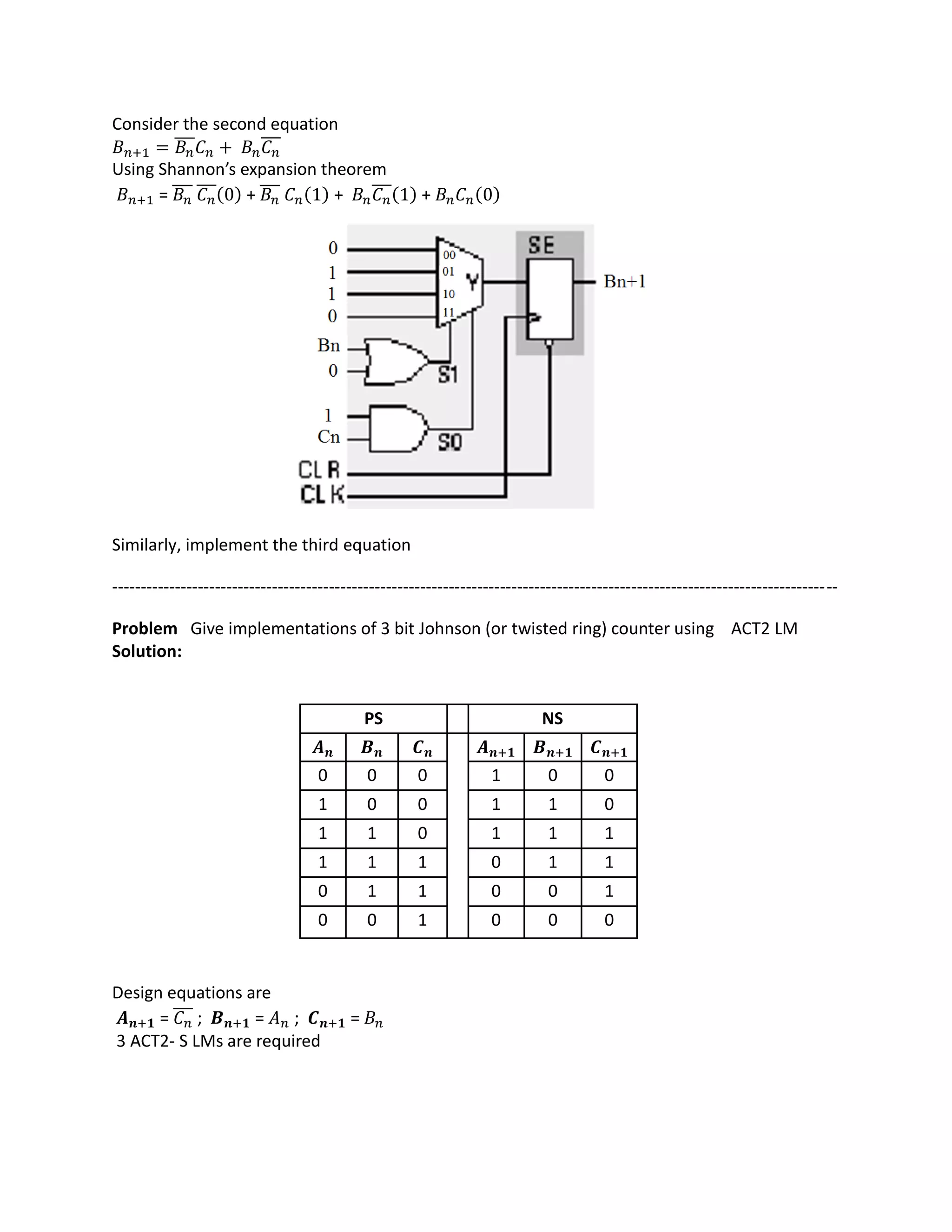
Consider the second equation
𝐵 = 𝐵̅̅̅ 𝐶 + 𝐵 𝐶̅̅̅
Using Shannon’s expansion theorem
𝐵 = 𝐵̅̅̅ 𝐶̅̅̅(0) + 𝐵̅̅̅ 𝐶 (1) + 𝐵 𝐶̅̅̅(1) + 𝐵 𝐶 (0)
Similarly, implement the third equation
-------------------------------------------------------------------------------------------------------------------------------
Problem Give implementations of 3 bit Johnson (or twisted ring) counter using ACT2 LM
Solution:
PS NS
𝑨 𝑩 𝑪 𝑨 𝑩 𝑪
0 0 0 1 0 0
1 0 0 1 1 0
1 1 0 1 1 1
1 1 1 0 1 1
0 1 1 0 0 1
0 0 1 0 0 0
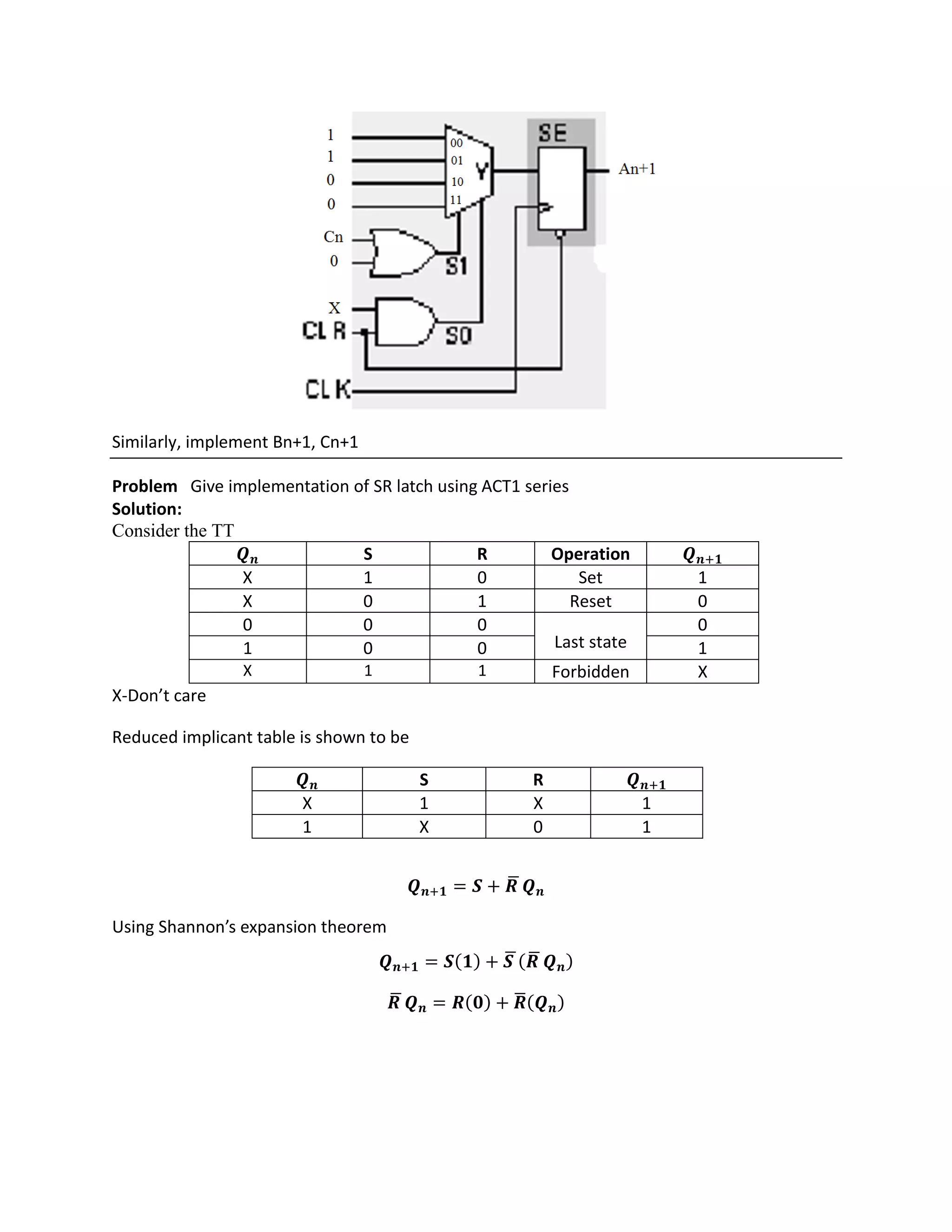
Design equations are
𝑨 = 𝐶̅̅̅ ; 𝑩 = 𝐴 ; 𝑪 = 𝐵
3 ACT2- S LMs are required
Similarly, implement Bn+1, Cn+1
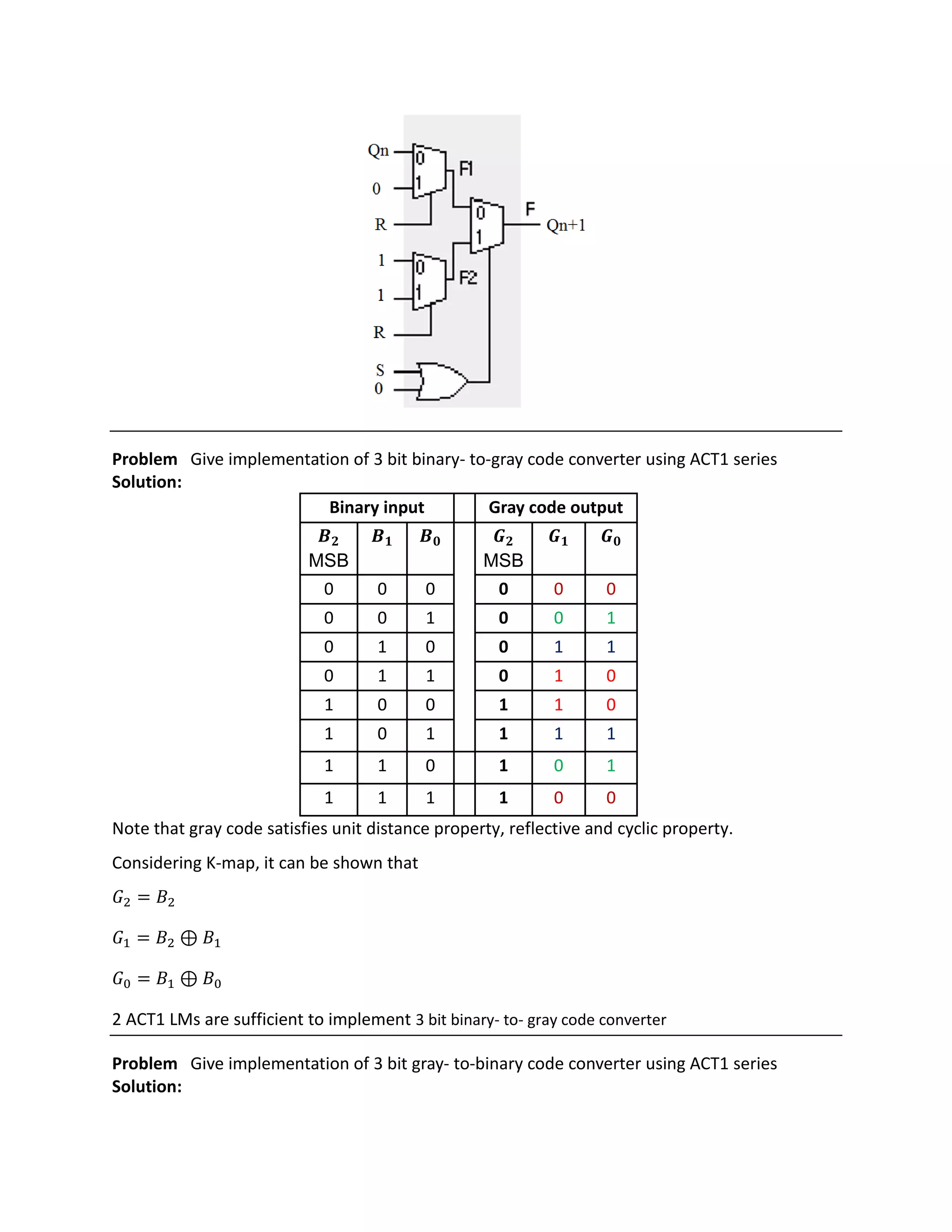
Problem Give implementation of SR latch using ACT1 series
Solution:
Consider the TT
S R Operation
X 1 0 Set 1
X 0 1 Reset 0
0 0 0
Last state
0
1 0 0 1
X 1 1 Forbidden X
X-Don’t care
Reduced implicant table is shown to be
S R
X 1 X 1
1 X 0 1
= + ̅
Using Shannon’s expansion theorem
= ( ) + ̅( ̅ )
̅ = ( ) + ̅( )
Problem Give implementation of 3 bit binary- to-gray code converter using ACT1 series
Solution:
Binary input Gray code output
𝑩
MSB
𝑩 𝑩 𝑮
MSB
𝑮 𝑮
0 0 0 0 0 0
0 0 1 0 0 1
0 1 0 0 1 1
0 1 1 0 1 0
1 0 0 1 1 0
1 0 1 1 1 1
1 1 0 1 0 1
1 1 1 1 0 0
Note that gray code satisfies unit distance property, reflective and cyclic property.
Considering K-map, it can be shown that
= 𝐵
= 𝐵 𝐵
= 𝐵 𝐵
2 ACT1 LMs are sufficient to implement 3 bit binary- to- gray code converter
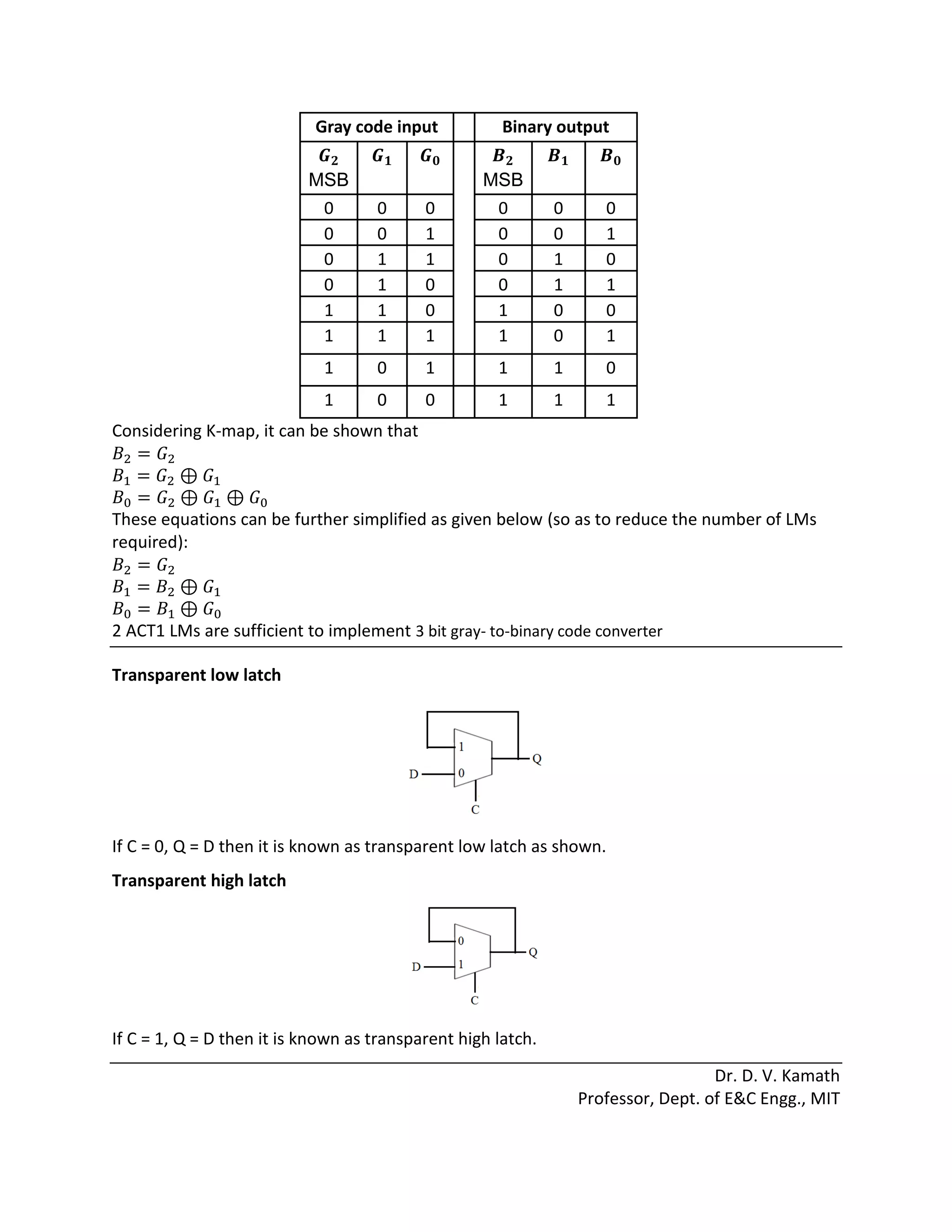
Problem Give implementation of 3 bit gray- to-binary code converter using ACT1 series
Solution:
Gray code input Binary output
𝑮
MSB
𝑮 𝑮 𝑩
MSB
𝑩 𝑩
0 0 0 0 0 0
0 0 1 0 0 1
0 1 1 0 1 0
0 1 0 0 1 1
1 1 0 1 0 0
1 1 1 1 0 1
1 0 1 1 1 0
1 0 0 1 1 1
Considering K-map, it can be shown that
𝐵 =
𝐵 =
𝐵 =
These equations can be further simplified as given below (so as to reduce the number of LMs
required):
𝐵 =
𝐵 = 𝐵
𝐵 = 𝐵
2 ACT1 LMs are sufficient to implement 3 bit gray- to-binary code converter
Transparent low latch
If C = 0, Q = D then it is known as transparent low latch as shown.
Transparent high latch
If C = 1, Q = D then it is known as transparent high latch.
Dr. D. V. Kamath
Professor, Dept. of E&C Engg., MIT

actel fpga problems

  • 1.
    DSD and HDLSimulation, Assignment Questions Problem Give implementation of 3 bit UP counter using ACT3 LMs Solution: PS NS 𝑨 𝑩 𝑪 𝑨 𝑩 𝑪 0 0 0 0 0 1 0 0 1 0 1 0 0 1 0 0 1 1 0 1 1 1 0 0 1 0 0 1 0 1 1 0 1 1 1 0 1 1 0 1 1 1 1 1 1 0 0 0 Design equations are as follows: 𝐴 = 𝐴̅̅̅̅ 𝐵 𝐶 + 𝐴 𝐶̅̅̅ + 𝐴 𝐵̅̅̅ 𝐵 = 𝐵̅̅̅ 𝐶 + 𝐵 𝐶̅̅̅ 𝐶 = 𝐶̅̅̅ Consider the first equation 𝐴 = 𝐴̅̅̅̅ 𝐵 𝐶 + 𝐴 𝐶̅̅̅ + 𝐴 𝐵̅̅̅ Using Shannon’s expansion theorem 𝐴 = 𝐴̅̅̅̅ 𝐵̅̅̅(0) + 𝐴̅̅̅̅ 𝐵 (𝐶 ) + 𝐴 𝐵̅̅̅(1) + 𝐴 𝐵 (𝐶̅̅̅)
  • 2.
    Consider the secondequation 𝐵 = 𝐵̅̅̅ 𝐶 + 𝐵 𝐶̅̅̅ Using Shannon’s expansion theorem 𝐵 = 𝐵̅̅̅ 𝐶̅̅̅(0) + 𝐵̅̅̅ 𝐶 (1) + 𝐵 𝐶̅̅̅(1) + 𝐵 𝐶 (0) Similarly, implement the third equation ------------------------------------------------------------------------------------------------------------------------------- Problem Give implementations of 3 bit Johnson (or twisted ring) counter using ACT2 LM Solution: PS NS 𝑨 𝑩 𝑪 𝑨 𝑩 𝑪 0 0 0 1 0 0 1 0 0 1 1 0 1 1 0 1 1 1 1 1 1 0 1 1 0 1 1 0 0 1 0 0 1 0 0 0 Design equations are 𝑨 = 𝐶̅̅̅ ; 𝑩 = 𝐴 ; 𝑪 = 𝐵 3 ACT2- S LMs are required
  • 3.
    Similarly, implement Bn+1,Cn+1 Problem Give implementation of SR latch using ACT1 series Solution: Consider the TT S R Operation X 1 0 Set 1 X 0 1 Reset 0 0 0 0 Last state 0 1 0 0 1 X 1 1 Forbidden X X-Don’t care Reduced implicant table is shown to be S R X 1 X 1 1 X 0 1 = + ̅ Using Shannon’s expansion theorem = ( ) + ̅( ̅ ) ̅ = ( ) + ̅( )
  • 4.
    Problem Give implementationof 3 bit binary- to-gray code converter using ACT1 series Solution: Binary input Gray code output 𝑩 MSB 𝑩 𝑩 𝑮 MSB 𝑮 𝑮 0 0 0 0 0 0 0 0 1 0 0 1 0 1 0 0 1 1 0 1 1 0 1 0 1 0 0 1 1 0 1 0 1 1 1 1 1 1 0 1 0 1 1 1 1 1 0 0 Note that gray code satisfies unit distance property, reflective and cyclic property. Considering K-map, it can be shown that = 𝐵 = 𝐵 𝐵 = 𝐵 𝐵 2 ACT1 LMs are sufficient to implement 3 bit binary- to- gray code converter Problem Give implementation of 3 bit gray- to-binary code converter using ACT1 series Solution:
  • 5.
    Gray code inputBinary output 𝑮 MSB 𝑮 𝑮 𝑩 MSB 𝑩 𝑩 0 0 0 0 0 0 0 0 1 0 0 1 0 1 1 0 1 0 0 1 0 0 1 1 1 1 0 1 0 0 1 1 1 1 0 1 1 0 1 1 1 0 1 0 0 1 1 1 Considering K-map, it can be shown that 𝐵 = 𝐵 = 𝐵 = These equations can be further simplified as given below (so as to reduce the number of LMs required): 𝐵 = 𝐵 = 𝐵 𝐵 = 𝐵 2 ACT1 LMs are sufficient to implement 3 bit gray- to-binary code converter Transparent low latch If C = 0, Q = D then it is known as transparent low latch as shown. Transparent high latch If C = 1, Q = D then it is known as transparent high latch. Dr. D. V. Kamath Professor, Dept. of E&C Engg., MIT