Seminar Placement and Routing options in Full Custom Shankardas Deepti Bharath CGB0911002 VSD528  M. Sc. [Engg.] in VLSI System Design Module Title: Full Custom Physical Design Module Leader:  Mr. Chandramohan P.
Outline Introduction Full-Custom design methodology Why Is Placement and Routing important? Types of placement techniques in full custom design Routing  Routing options Summary
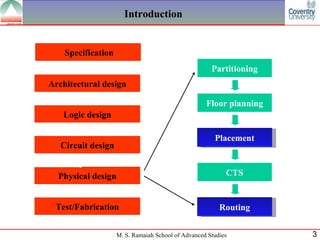
Introduction Floor planning CTS Physical Design Partitioning Routing Placement Specification Architectural design  Circuit design  Physical design  Test/Fabrication Logic design
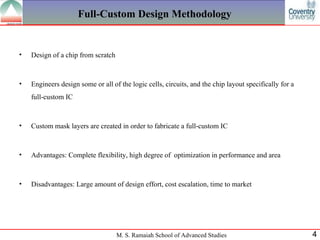
Full-Custom Design Methodology Design of a chip from scratch Engineers design some or all of the logic cells, circuits, and the chip layout specifically for a full-custom IC Custom mask layers are created in order to fabricate a full-custom IC Advantages: Complete flexibility, high degree of  optimization in performance and area Disadvantages: Large amount of design effort, cost escalation, time to market
Why Is Placement and Routing Important? The first phase in the VLSI design that determines the physical layout of a chip. P&R is the first phase in VLSI design that determines the physical layout of a chip  Circuit Placement becomes very critical in today’s high performance VLSI design. The quality of the attainable routing is highly determined by the placement. The circuit delay, power dissipation and area are dominated by the interconnections made during  routing.
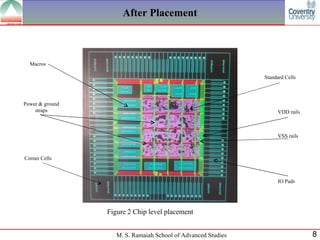
For digital custom design Diffusion sharing  Gate matrix  Transparent latch  Folding transistor  Tapering For analog custom design Fingering  Interdigitization  Common centroid  Folding technique For mixed signal custom design Shielding power supply and grounding.  Types of placement techniques in full custom design
(a) Diffusion sharing (b) Gate matrix layout (c) Tapering technique (f) Common centriod (e) Interdigitization (d) Fingering Analog custom design Mixed custom design Digital custom design Placement in Custom Design Figure 1. Placement techniques in custom design
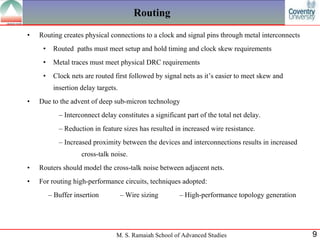
After Placement Macros Standard Cells IO Pads Corner Cells VDD rails VSS rails Power & ground straps Figure 2 Chip level placement
Routing Routing creates physical connections to a clock and signal pins through metal interconnects Routed  paths must meet setup and hold timing and clock skew requirements Metal traces must meet physical DRC requirements Clock nets are routed first followed by signal nets as it’s easier to meet skew and insertion delay targets. Due to the advent of deep sub-micron technology –  Interconnect delay constitutes a significant part of the total net delay. –  Reduction in feature sizes has resulted in increased wire resistance. –  Increased proximity between the devices and interconnections results in increased  cross-talk noise. Routers should model the cross-talk noise between adjacent nets. For routing high-performance circuits, techniques adopted: –  Buffer insertion  – Wire sizing  – High-performance topology generation
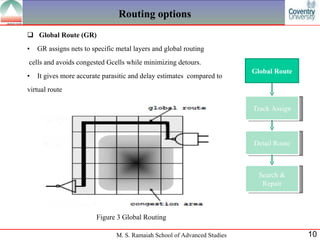
Global Route (GR) GR assigns nets to specific metal layers and global routing cells and avoids congested Gcells while minimizing detours. It gives more accurate parasitic and delay estimates  compared to  virtual route Global Route Track Assign Detail Route Search & Repair Figure 3 Global Routing Routing options
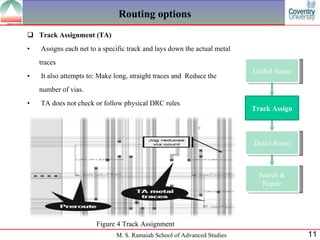
Track Assignment (TA) Assigns each net to a specific track and lays down the actual metal traces It also attempts to: Make long, straight traces and  Reduce the  number of vias. TA does not check or follow physical DRC rules Global Route Track Assign Detail Route Search & Repair Figure 4 Track Assignment Routing options
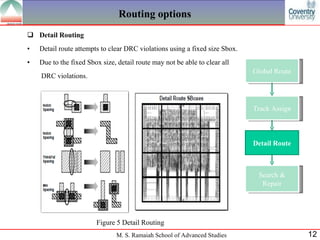
Detail Routing Detail route attempts to clear DRC violations using a fixed size Sbox. Due to the fixed Sbox size, detail route may not be able to clear all   DRC violations. Global Route Track Assign Detail Route Search & Repair Figure 5 Detail Routing Routing options
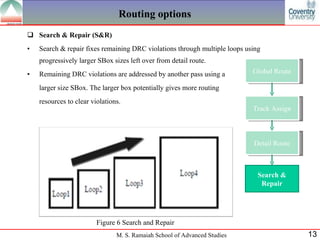
Search & Repair (S&R) Search & repair fixes remaining DRC violations through multiple loops using progressively larger SBox sizes left over from detail route. Remaining DRC violations are addressed by another pass using a larger size SBox. The larger box potentially gives more routing  resources to clear violations. Global Route Track Assign Detail Route Search & Repair Routing options  Figure 6 Search and Repair
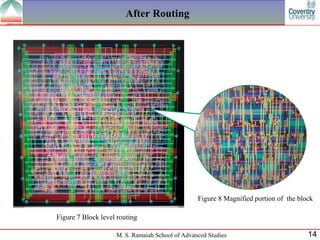
After Routing Figure 7 Block level routing Figure 8 Magnified portion of  the block
Summary Macro and Pad cell locations are defined during the Floorplanning stage, before  P&R. Standard cells are placed in “placement rows” during placement. Placement rows are commonly abutted to reduce core area.  Cell orientations in abutted rows are  normally flipped. Cells in a timing-critical path are placed close together to reduce routing-related delays. The circuit delay, power dissipation and area are the main objective of placement. Rout-ability (or congestion) is a function of the number of available tracks in a given area compared to the number of signals that need to be routed through that area. Routing along the timing-critical path is given priority:  Creates shorter, faster connections therby reducing parasitics.
References [1] Jon Wateresian (2002)  Fabricating Printed Circuit Boards. Massachusetts: Newnes [2]  Linfu Xiao, et al. ,  ‘ Practical Placement and Routing Techniques for Analog Circuit Designs’ ,  IEEE,  Dept. of CSE, Chinese Univ. of Hong Kong, Shatin, China, Dec 2010. [3] Chandramohan P., Digital circuit design and layout, Full custom physical design (VSD 528),  session-2 MSRSAS, Bangalore [4] Shawki Areibi and Zhen Yang (2003),  ‘Congestion Driven Placement for VLSI Standard Cell, Design’  , School of Engineering, University of Guelph, Ontario, Canada, Dec 2003.
Thank You

Placement and routing in full custom physical design

  • 1.
    Seminar Placement andRouting options in Full Custom Shankardas Deepti Bharath CGB0911002 VSD528 M. Sc. [Engg.] in VLSI System Design Module Title: Full Custom Physical Design Module Leader: Mr. Chandramohan P.
  • 2.
    Outline Introduction Full-Customdesign methodology Why Is Placement and Routing important? Types of placement techniques in full custom design Routing Routing options Summary
  • 3.
    Introduction Floor planningCTS Physical Design Partitioning Routing Placement Specification Architectural design Circuit design Physical design Test/Fabrication Logic design
  • 4.
    Full-Custom Design MethodologyDesign of a chip from scratch Engineers design some or all of the logic cells, circuits, and the chip layout specifically for a full-custom IC Custom mask layers are created in order to fabricate a full-custom IC Advantages: Complete flexibility, high degree of optimization in performance and area Disadvantages: Large amount of design effort, cost escalation, time to market
  • 5.
    Why Is Placementand Routing Important? The first phase in the VLSI design that determines the physical layout of a chip. P&R is the first phase in VLSI design that determines the physical layout of a chip Circuit Placement becomes very critical in today’s high performance VLSI design. The quality of the attainable routing is highly determined by the placement. The circuit delay, power dissipation and area are dominated by the interconnections made during routing.
  • 6.
    For digital customdesign Diffusion sharing Gate matrix Transparent latch Folding transistor Tapering For analog custom design Fingering Interdigitization Common centroid Folding technique For mixed signal custom design Shielding power supply and grounding. Types of placement techniques in full custom design
  • 7.
    (a) Diffusion sharing(b) Gate matrix layout (c) Tapering technique (f) Common centriod (e) Interdigitization (d) Fingering Analog custom design Mixed custom design Digital custom design Placement in Custom Design Figure 1. Placement techniques in custom design
  • 8.
    After Placement MacrosStandard Cells IO Pads Corner Cells VDD rails VSS rails Power & ground straps Figure 2 Chip level placement
  • 9.
    Routing Routing createsphysical connections to a clock and signal pins through metal interconnects Routed paths must meet setup and hold timing and clock skew requirements Metal traces must meet physical DRC requirements Clock nets are routed first followed by signal nets as it’s easier to meet skew and insertion delay targets. Due to the advent of deep sub-micron technology – Interconnect delay constitutes a significant part of the total net delay. – Reduction in feature sizes has resulted in increased wire resistance. – Increased proximity between the devices and interconnections results in increased cross-talk noise. Routers should model the cross-talk noise between adjacent nets. For routing high-performance circuits, techniques adopted: – Buffer insertion – Wire sizing – High-performance topology generation
  • 10.
    Global Route (GR)GR assigns nets to specific metal layers and global routing cells and avoids congested Gcells while minimizing detours. It gives more accurate parasitic and delay estimates compared to virtual route Global Route Track Assign Detail Route Search & Repair Figure 3 Global Routing Routing options
  • 11.
    Track Assignment (TA)Assigns each net to a specific track and lays down the actual metal traces It also attempts to: Make long, straight traces and Reduce the number of vias. TA does not check or follow physical DRC rules Global Route Track Assign Detail Route Search & Repair Figure 4 Track Assignment Routing options
  • 12.
    Detail Routing Detailroute attempts to clear DRC violations using a fixed size Sbox. Due to the fixed Sbox size, detail route may not be able to clear all DRC violations. Global Route Track Assign Detail Route Search & Repair Figure 5 Detail Routing Routing options
  • 13.
    Search & Repair(S&R) Search & repair fixes remaining DRC violations through multiple loops using progressively larger SBox sizes left over from detail route. Remaining DRC violations are addressed by another pass using a larger size SBox. The larger box potentially gives more routing resources to clear violations. Global Route Track Assign Detail Route Search & Repair Routing options Figure 6 Search and Repair
  • 14.
    After Routing Figure7 Block level routing Figure 8 Magnified portion of the block
  • 15.
    Summary Macro andPad cell locations are defined during the Floorplanning stage, before P&R. Standard cells are placed in “placement rows” during placement. Placement rows are commonly abutted to reduce core area. Cell orientations in abutted rows are normally flipped. Cells in a timing-critical path are placed close together to reduce routing-related delays. The circuit delay, power dissipation and area are the main objective of placement. Rout-ability (or congestion) is a function of the number of available tracks in a given area compared to the number of signals that need to be routed through that area. Routing along the timing-critical path is given priority: Creates shorter, faster connections therby reducing parasitics.
  • 16.
    References [1] JonWateresian (2002) Fabricating Printed Circuit Boards. Massachusetts: Newnes [2] Linfu Xiao, et al. , ‘ Practical Placement and Routing Techniques for Analog Circuit Designs’ , IEEE, Dept. of CSE, Chinese Univ. of Hong Kong, Shatin, China, Dec 2010. [3] Chandramohan P., Digital circuit design and layout, Full custom physical design (VSD 528), session-2 MSRSAS, Bangalore [4] Shawki Areibi and Zhen Yang (2003), ‘Congestion Driven Placement for VLSI Standard Cell, Design’ , School of Engineering, University of Guelph, Ontario, Canada, Dec 2003.
  • 17.

Editor's Notes

  • #10 1.Metal routes must meet minimum width and spacing “design rules” to prevent open and short circuits during fabrication. 2. Congestion can be reduced by adding blockages during floor planning. When a blockage is placed the router, routes around the blockage thereby reducing congestion.
  • #11 Detour – Routing takes a longer route instead of a shorter one. In GR no PHYSICAL connections are made only nets are assigned to specific metal layers.
  • #12 If TA can reduce the number of jogs and jumps in metal traces, this will generally improve timing (since each jump generally requires a via to jump to a higher or lower level metal layer). Reducing the number of vias is generally a plus for reliability and yield since their failure rate is slightly higher than that of a simple, straight metal track in a modern, planarized process.
  • #13 The detail route doesn’t work on the entire chip at a time but instead works, box by box (using a fixed size box called Sbox) until the routing pass is complete.
  • #14 Search and Repair divides the chip into SBoxes and works through each SBox sequentially trying to fix DRC violations by rerouting within the confines of the box. Droute – Detail Route…Sbox – Square Box.