2D Transformation
TRANSFORMATION
• Transformation means changing some graphics
into something else by applying rules. We can
have various types of transformations such as
translation, scaling up or down, rotation,
shearing, etc.
• When a transformation takes place on a 2D
plane, it is called 2D transformation.
• Transformations play an important role in
computer graphics to reposition the graphics on
the screen and change their size or orientation.
Homogenous Coordinates
• To perform a sequence of transformation such
as translation followed by rotation and scaling,
we need to follow a sequential process −
• Translate the coordinates,
• Rotate the translated coordinates, and then
• Scale the rotated coordinates to complete the
composite transformation.
Translation
• A translation moves an object to a different
position on the screen.
• You can translate a point in 2D by adding
translation coordinate (tx, ty) to the original
coordinate X, Y to get the new coordinate X′,
Y′.
•
• From the above figure, you can write that −
• X’ = X + tx
• Y’ = Y + ty
• The pair (tx, ty) is called the translation vector
or shift vector. The above equations can also
be represented using the column vectors.
• P=[X] / [Y]
• p' = [X′] / [Y′]
• T = [tx] / [ty]
• We can write it as −
• P’ = P + T
Rotation
• In rotation, we rotate the object at particular
angle θ theta from its origin.
• From the following figure, we can see that the
point PX,Y is located at angle φ from the
horizontal X coordinate with distance r from
the origin.
• Let us suppose you want to rotate it at the
angle θ. After rotating it to a new location, you
will get a new point P’ X′,Y′.
•
• Using standard trigonometric the original coordinate of
point P X,Y can be represented as −
• X=r cosϕ ......(1)
• Y=r sinϕ ......(2)
• Same way we can represent the point P’ X′, Y′ as −
• x′=rcos(ϕ+θ) = rcosϕcosθ − rsinϕsinθ.......(3)
• y′=rsin(ϕ+θ) = rcosϕsinθ + rsinϕcosθ.......(4)
Substituting equation 1 & 2 in 3 & 4 respectively, we will get
x′=xcosθ−ysinθ
y′=xsinθ+ycosθ
• Representing the above equation in matrix
form,
• [X′Y′]=[XY] [cosƟ sinƟ]
[-sinƟ cosƟ] OR
• P’ = P . R
• Where R is the rotation matrix
• R= [cosƟ sinƟ]
[-sinƟ cosƟ]
• The rotation angle can be positive and negative.
• For positive rotation angle, we can use the above
rotation matrix. However, for negative angle
rotation, the matrix will change as shown below −
• R= [cos(-Ɵ) sin(-Ɵ)]
[-sin(-Ɵ) cos(-Ɵ)]
• =[cosƟ -sinƟ]
[sinƟ cosƟ]
• (∵cos(−θ)=cosθ and sin(−θ)=−sinθ)
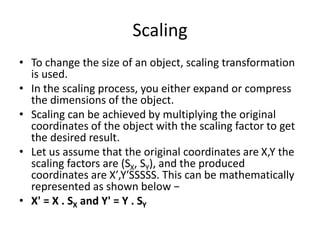
Scaling
• To change the size of an object, scaling transformation
is used.
• In the scaling process, you either expand or compress
the dimensions of the object.
• Scaling can be achieved by multiplying the original
coordinates of the object with the scaling factor to get
the desired result.
• Let us assume that the original coordinates are X,Y the
scaling factors are (SX, SY), and the produced
coordinates are X′,Y′SSSSS. This can be mathematically
represented as shown below −
• X' = X . SX and Y' = Y . SY
• The scaling factor SX, SY scales the object in X
and Y direction respectively. The above
equations can also be represented in matrix
form as below −
X’ = X [Sx 0]
Y’ Y [0 Sy]
• P’ = P . S
• Where S is the scaling matrix. The scaling
process is shown in the following figure.
BEFORE SCALING
AFTER SCALING
SCALING FACTOR
• If we provide values less than 1 to the scaling
factor S, then we can reduce the size of the
object. If we provide values greater than 1,
then we can increase the size of the object.
THANK YOU

moule 3 ppt1 basic 2D transformations.pptx

  • 1.
  • 2.
    TRANSFORMATION • Transformation meanschanging some graphics into something else by applying rules. We can have various types of transformations such as translation, scaling up or down, rotation, shearing, etc. • When a transformation takes place on a 2D plane, it is called 2D transformation. • Transformations play an important role in computer graphics to reposition the graphics on the screen and change their size or orientation.
  • 3.
    Homogenous Coordinates • Toperform a sequence of transformation such as translation followed by rotation and scaling, we need to follow a sequential process − • Translate the coordinates, • Rotate the translated coordinates, and then • Scale the rotated coordinates to complete the composite transformation.
  • 4.
    Translation • A translationmoves an object to a different position on the screen. • You can translate a point in 2D by adding translation coordinate (tx, ty) to the original coordinate X, Y to get the new coordinate X′, Y′.
  • 5.
  • 6.
    • From theabove figure, you can write that − • X’ = X + tx • Y’ = Y + ty • The pair (tx, ty) is called the translation vector or shift vector. The above equations can also be represented using the column vectors. • P=[X] / [Y] • p' = [X′] / [Y′] • T = [tx] / [ty] • We can write it as − • P’ = P + T
  • 7.
    Rotation • In rotation,we rotate the object at particular angle θ theta from its origin. • From the following figure, we can see that the point PX,Y is located at angle φ from the horizontal X coordinate with distance r from the origin. • Let us suppose you want to rotate it at the angle θ. After rotating it to a new location, you will get a new point P’ X′,Y′.
  • 8.
  • 9.
    • Using standardtrigonometric the original coordinate of point P X,Y can be represented as − • X=r cosϕ ......(1) • Y=r sinϕ ......(2) • Same way we can represent the point P’ X′, Y′ as − • x′=rcos(ϕ+θ) = rcosϕcosθ − rsinϕsinθ.......(3) • y′=rsin(ϕ+θ) = rcosϕsinθ + rsinϕcosθ.......(4) Substituting equation 1 & 2 in 3 & 4 respectively, we will get
  • 10.
    x′=xcosθ−ysinθ y′=xsinθ+ycosθ • Representing theabove equation in matrix form, • [X′Y′]=[XY] [cosƟ sinƟ] [-sinƟ cosƟ] OR • P’ = P . R • Where R is the rotation matrix • R= [cosƟ sinƟ] [-sinƟ cosƟ]
  • 11.
    • The rotationangle can be positive and negative. • For positive rotation angle, we can use the above rotation matrix. However, for negative angle rotation, the matrix will change as shown below − • R= [cos(-Ɵ) sin(-Ɵ)] [-sin(-Ɵ) cos(-Ɵ)] • =[cosƟ -sinƟ] [sinƟ cosƟ] • (∵cos(−θ)=cosθ and sin(−θ)=−sinθ)
  • 12.
    Scaling • To changethe size of an object, scaling transformation is used. • In the scaling process, you either expand or compress the dimensions of the object. • Scaling can be achieved by multiplying the original coordinates of the object with the scaling factor to get the desired result. • Let us assume that the original coordinates are X,Y the scaling factors are (SX, SY), and the produced coordinates are X′,Y′SSSSS. This can be mathematically represented as shown below − • X' = X . SX and Y' = Y . SY
  • 13.
    • The scalingfactor SX, SY scales the object in X and Y direction respectively. The above equations can also be represented in matrix form as below − X’ = X [Sx 0] Y’ Y [0 Sy] • P’ = P . S • Where S is the scaling matrix. The scaling process is shown in the following figure.
  • 14.
  • 15.
  • 16.
    SCALING FACTOR • Ifwe provide values less than 1 to the scaling factor S, then we can reduce the size of the object. If we provide values greater than 1, then we can increase the size of the object.
  • 17.