LIQUID CRYSTAL DISPLAY
Liquid Crystal Display
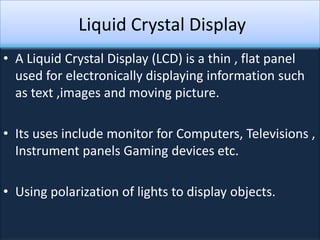
• A Liquid Crystal Display (LCD) is a thin , flat panel
  used for electronically displaying information such
  as text ,images and moving picture.

• Its uses include monitor for Computers, Televisions ,
  Instrument panels Gaming devices etc.

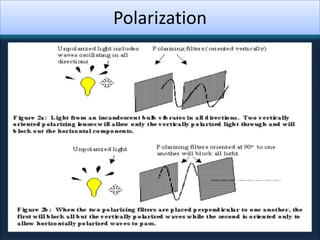
• Using polarization of lights to display objects.
Polarization

• polarizationCrystal Display (LCD) is a thin , flat panel
   • A Liquid
     used for electronically displaying information such as
     text ,images and moving picture.
   • Its uses include monitor for Computers, Televisions ,
                      polarization
     Instrument panels Gaming devices etc.
   • Using polarization of lights to display objects.
LIQUID CRYSTAL CONCEPT
Liquid Crystal Concept

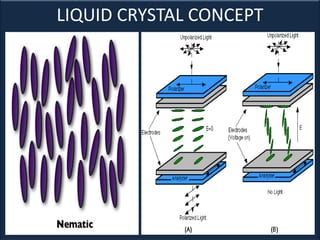
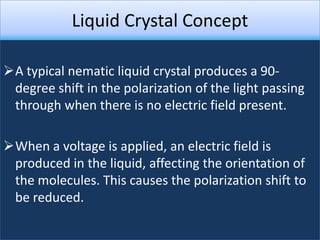
A typical nematic liquid crystal produces a 90-
 degree shift in the polarization of the light passing
 through when there is no electric field present.

When a voltage is applied, an electric field is
 produced in the liquid, affecting the orientation of
 the molecules. This causes the polarization shift to
 be reduced.
LCD WORKING PRINCIPAL
LCD WORKING
LCD WORKING
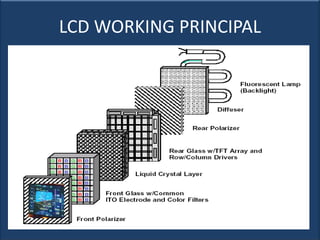
• TFT Glass has as many TFTs as the number of pixels displayed.

• A Color Filter Glass has color filter which generates color.

• Diffuser distributing the light evenly across the viewing area

• Liquid crystals move according to the difference in voltage
  between the Color Filter Glass and the TFT Glass.

• The amount of light supplied by Back Light is determined by
  the amount of movement of the liquid crystals in such a way
  as to generate color.
LCD WORKING
LCD WORKING

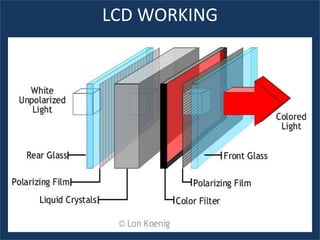
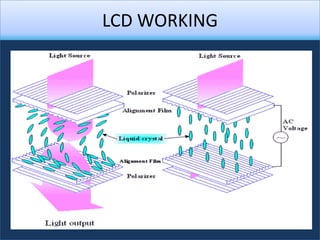
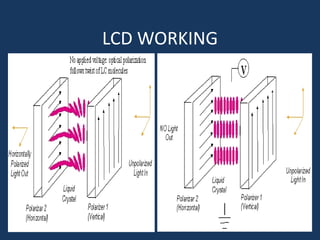
• With no voltage applied across the pixel, the LC
  molecules twist to align to the rubbing of the glass
  plates. Light entering the first polarizer is twisted
  and can exit the second polarizer --> pixel is ON

• With a voltage applied across the pixel, the LC
  molecules untwist to align with the electric field.
  Light entering the first polarizer cannot exit the
  second polarizer --> pixel is OFF.
LCD WORKING
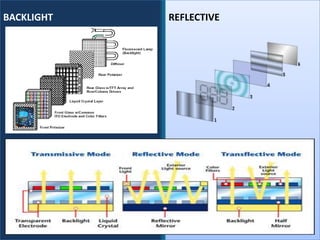
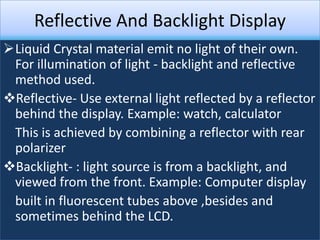
BACKLIGHT   REFLECTIVE
Reflective And Backlight Display
Liquid Crystal material emit no light of their own.
 For illumination of light - backlight and reflective
 method used.
Reflective- Use external light reflected by a reflector
 behind the display. Example: watch, calculator
 This is achieved by combining a reflector with rear
 polarizer
Backlight- : light source is from a backlight, and
 viewed from the front. Example: Computer display
 built in fluorescent tubes above ,besides and
 sometimes behind the LCD.
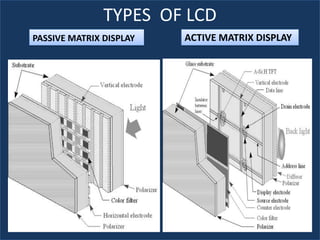
TYPES OF LCD
PASSIVE MATRIX DISPLAY   ACTIVE MATRIX DISPLAY
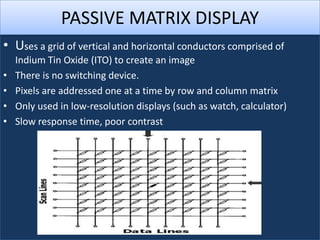
PASSIVE MATRIX DISPLAY
• Uses a grid of vertical and horizontal conductors comprised of
    Indium Tin Oxide (ITO) to create an image
•   There is no switching device.
•   Pixels are addressed one at a time by row and column matrix
•   Only used in low-resolution displays (such as watch, calculator)
•   Slow response time, poor contrast
Passive Matrix Display Problems

• Crosstalk occurs when neighboring pixel voltages
  affect each other, reducing the gray scale, contrast,
  and viewing angle.

• Submarining occurs when slow-to-respond LC
  materials cannot respond quickly enough and the
  picture can disappear temporarily.

• One Solution: placing a switch at each pixel, such as
  a transistor or diode --> pixel matrix becomes
  “active.”
Active Matrix Liquid Crystal Display

• It is based on Thin Film Transistor (TFT) Technology
• Switching element at each pixel. Individual pixels isolated
  from each other. Thin Film Transistors most commonly
  used.
• Each row line is activated sequentially
• Used in computer displays
• A switching device and a storage capacitor are integrated at
  the each cross point of the electrodes
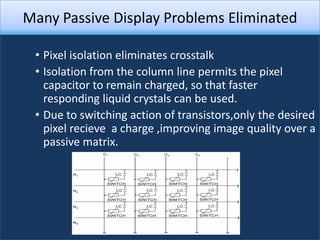
Many Passive Display Problems Eliminated

 • Pixel isolation eliminates crosstalk
 • Isolation from the column line permits the pixel
   capacitor to remain charged, so that faster
   responding liquid crystals can be used.
 • Due to switching action of transistors,only the desired
   pixel recieve a charge ,improving image quality over a
   passive matrix.
Advantage of Active Matrix Display

•   Higher sizes
•   Higher contrast
•   Higher gray scale
•   Higher resolution
•   Higher viewing angle
•   Faster response. Eliminates “ghosting”
•   Better control of the color
Color Display
Each pixel has three sub-pixels: Red, Green and Blue.

Different intensities of the sub-pixels give perception of
 whole spectrum of colors.

If each red ,green and blue sub-pixel can display 256
 different intensity of their respective color , then each
 pixel can produce a possible palette of 16.8 million
 (256*256*256) colors.
Advantage Of LCD Over CRT
•   Smaller size —LCDs occupy approximately 60 percent less space
    than CRT displays an important feature when office space is limited.

•   Lower power consumption—LCDs typically consume about half
    the power and emit much less heat than CRT displays.

•   Lighter weight —LCDs weigh approximately 70 percent less than
    CRT displays of comparable size.

•   No electromagnetic fields —LCDs do not emit electromagnetic
    fields and are not susceptible to them. Thus, they are suitable for
    use in areas where CRTs cannot be used.

•   Longer life —LCDs have a longer useful life than CRTs.

liquid crystal display

  • 1.
  • 2.
    Liquid Crystal Display •A Liquid Crystal Display (LCD) is a thin , flat panel used for electronically displaying information such as text ,images and moving picture. • Its uses include monitor for Computers, Televisions , Instrument panels Gaming devices etc. • Using polarization of lights to display objects.
  • 3.
    Polarization • polarizationCrystal Display(LCD) is a thin , flat panel • A Liquid used for electronically displaying information such as text ,images and moving picture. • Its uses include monitor for Computers, Televisions , polarization Instrument panels Gaming devices etc. • Using polarization of lights to display objects.
  • 4.
  • 5.
    Liquid Crystal Concept Atypical nematic liquid crystal produces a 90- degree shift in the polarization of the light passing through when there is no electric field present. When a voltage is applied, an electric field is produced in the liquid, affecting the orientation of the molecules. This causes the polarization shift to be reduced.
  • 6.
  • 7.
  • 8.
    LCD WORKING • TFTGlass has as many TFTs as the number of pixels displayed. • A Color Filter Glass has color filter which generates color. • Diffuser distributing the light evenly across the viewing area • Liquid crystals move according to the difference in voltage between the Color Filter Glass and the TFT Glass. • The amount of light supplied by Back Light is determined by the amount of movement of the liquid crystals in such a way as to generate color.
  • 9.
  • 10.
    LCD WORKING • Withno voltage applied across the pixel, the LC molecules twist to align to the rubbing of the glass plates. Light entering the first polarizer is twisted and can exit the second polarizer --> pixel is ON • With a voltage applied across the pixel, the LC molecules untwist to align with the electric field. Light entering the first polarizer cannot exit the second polarizer --> pixel is OFF.
  • 11.
  • 12.
    BACKLIGHT REFLECTIVE
  • 13.
    Reflective And BacklightDisplay Liquid Crystal material emit no light of their own. For illumination of light - backlight and reflective method used. Reflective- Use external light reflected by a reflector behind the display. Example: watch, calculator This is achieved by combining a reflector with rear polarizer Backlight- : light source is from a backlight, and viewed from the front. Example: Computer display built in fluorescent tubes above ,besides and sometimes behind the LCD.
  • 14.
    TYPES OF LCD PASSIVEMATRIX DISPLAY ACTIVE MATRIX DISPLAY
  • 15.
    PASSIVE MATRIX DISPLAY •Uses a grid of vertical and horizontal conductors comprised of Indium Tin Oxide (ITO) to create an image • There is no switching device. • Pixels are addressed one at a time by row and column matrix • Only used in low-resolution displays (such as watch, calculator) • Slow response time, poor contrast
  • 16.
    Passive Matrix DisplayProblems • Crosstalk occurs when neighboring pixel voltages affect each other, reducing the gray scale, contrast, and viewing angle. • Submarining occurs when slow-to-respond LC materials cannot respond quickly enough and the picture can disappear temporarily. • One Solution: placing a switch at each pixel, such as a transistor or diode --> pixel matrix becomes “active.”
  • 17.
    Active Matrix LiquidCrystal Display • It is based on Thin Film Transistor (TFT) Technology • Switching element at each pixel. Individual pixels isolated from each other. Thin Film Transistors most commonly used. • Each row line is activated sequentially • Used in computer displays • A switching device and a storage capacitor are integrated at the each cross point of the electrodes
  • 18.
    Many Passive DisplayProblems Eliminated • Pixel isolation eliminates crosstalk • Isolation from the column line permits the pixel capacitor to remain charged, so that faster responding liquid crystals can be used. • Due to switching action of transistors,only the desired pixel recieve a charge ,improving image quality over a passive matrix.
  • 19.
    Advantage of ActiveMatrix Display • Higher sizes • Higher contrast • Higher gray scale • Higher resolution • Higher viewing angle • Faster response. Eliminates “ghosting” • Better control of the color
  • 20.
    Color Display Each pixelhas three sub-pixels: Red, Green and Blue. Different intensities of the sub-pixels give perception of whole spectrum of colors. If each red ,green and blue sub-pixel can display 256 different intensity of their respective color , then each pixel can produce a possible palette of 16.8 million (256*256*256) colors.
  • 21.
    Advantage Of LCDOver CRT • Smaller size —LCDs occupy approximately 60 percent less space than CRT displays an important feature when office space is limited. • Lower power consumption—LCDs typically consume about half the power and emit much less heat than CRT displays. • Lighter weight —LCDs weigh approximately 70 percent less than CRT displays of comparable size. • No electromagnetic fields —LCDs do not emit electromagnetic fields and are not susceptible to them. Thus, they are suitable for use in areas where CRTs cannot be used. • Longer life —LCDs have a longer useful life than CRTs.