
Computer Graphics And Multimedia MCS-053 Lecture  Transformations A.Balamurali
Modeling Transformations Specify transformations for objects  Allows definitions of objects in own coordinate systems Allows use of object definition multiple times in a scene Remember how OpenGL provides a transformation stack  because they are so frequent
Overview 2D Transformations Basic 2D transformations Matrix representation Matrix composition 3D Transformations Basic 3D transformations Same as 2D
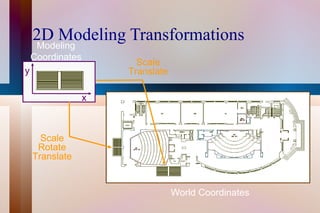
2D Modeling Transformations Scale Rotate Translate Scale Translate x y World Coordinates Modeling Coordinates
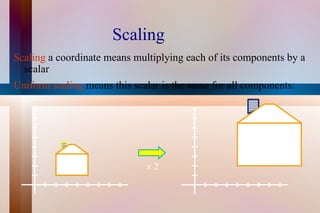
Scaling Scaling  a coordinate means multiplying each of its components by a scalar Uniform scaling  means this scalar is the same for all components:    2
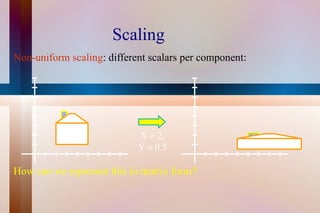
Non-uniform scaling : different scalars per component: How can we represent this in matrix form? Scaling X    2, Y    0.5
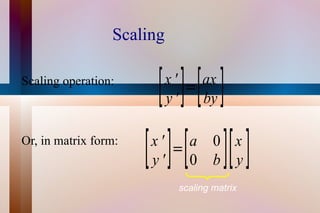
Scaling Scaling operation: Or, in matrix form: scaling matrix
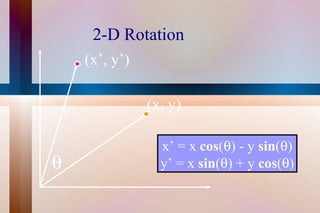
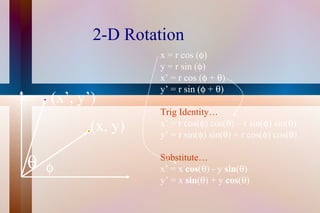
2-D Rotation x’ = x  cos (  ) - y  sin (  ) y’ = x  sin (  ) + y  cos (  )  (x, y) (x’, y’)
2-D Rotation x = r cos (  ) y = r sin (  ) x’ = r cos (   +   ) y’ = r sin (   +   ) Trig Identity… x’ = r cos(  ) cos(  ) – r sin(  ) sin(  ) y’ = r sin(  ) sin(  ) + r cos(  ) cos(  ) Substitute… x’ = x  cos (  ) - y  sin (  ) y’ = x  sin (  ) + y  cos (  )   (x, y) (x’, y’)
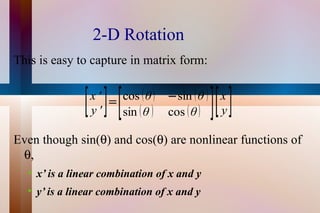
2-D Rotation This is easy to capture in matrix form: Even though sin(  ) and cos(  ) are nonlinear functions of   , x’ is a linear combination of x and y y’ is a linear combination of x and y
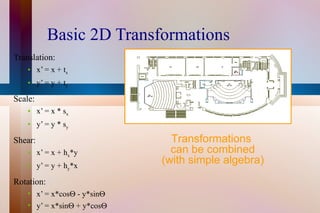
Basic 2D Transformations Translation: x’ = x + t x y’ = y + t y Scale: x’ = x * s x   y’ = y * s y Shear: x’ = x + h x *y y’ = y + h y *x Rotation: x’ = x*cos   - y*sin    y’ = x*sin   + y*cos    Transformations  can be combined (with simple algebra)
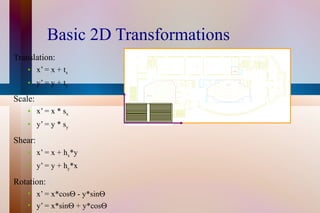
Basic 2D Transformations Translation: x’ = x + t x y’ = y + t y Scale: x’ = x * s x   y’ = y * s y Shear: x’ = x + h x *y y’ = y + h y *x Rotation: x’ = x*cos   - y*sin    y’ = x*sin   + y*cos 
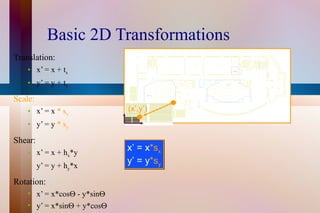
Basic 2D Transformations Translation: x’ = x + t x y’ = y + t y Scale: x’ = x  * s x   y’ = y  * s y Shear: x’ = x + h x *y y’ = y + h y *x Rotation: x’ = x*cos   - y*sin    y’ = x*sin   + y*cos  x’ = x *s x y’ = y *s y (x,y) (x’,y’)
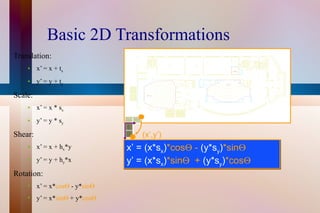
Basic 2D Transformations Translation: x’ = x + t x y’ = y + t y Scale: x’ = x * s x   y’ = y * s y Shear: x’ = x + h x *y y’ = y + h y *x Rotation: x’ = x* cos   - y* sin    y’ = x* sin   + y* cos  x’ = (x*s x ) *cos   -  (y*s y ) *sin  y’ = (x*s x ) *sin    +  (y*s y ) *cos  (x’,y’)
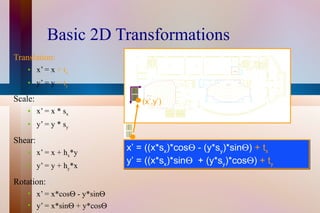
Basic 2D Transformations Translation: x’ = x  + t x y’ = y  + t y Scale: x’ = x * s x   y’ = y * s y Shear: x’ = x + h x *y y’ = y + h y *x Rotation: x’ = x*cos   - y*sin    y’ = x*sin   + y*cos  x’ = ((x*s x )*cos   - (y*s y )*sin  )  + t x y’ = ((x*s x )*sin    + (y*s y )*cos  )  + t y (x’,y’)
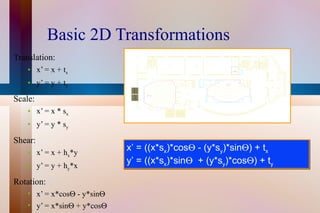
Basic 2D Transformations Translation: x’ = x + t x y’ = y + t y Scale: x’ = x * s x   y’ = y * s y Shear: x’ = x + h x *y y’ = y + h y *x Rotation: x’ = x*cos   - y*sin    y’ = x*sin   + y*cos  x’ = ((x*s x )*cos   - (y*s y )*sin  ) + t x y’ = ((x*s x )*sin    + (y*s y )*cos  ) + t y
Overview 2D Transformations Basic 2D transformations Matrix representation Matrix composition 3D Transformations Basic 3D transformations Same as 2D
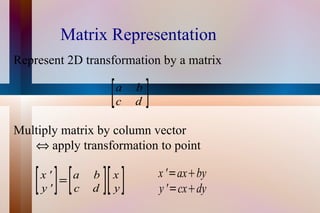
Matrix Representation Represent 2D transformation by a matrix Multiply matrix by column vector   apply transformation to point
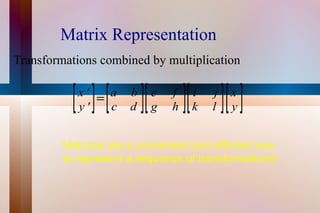
Matrix Representation Transformations combined by multiplication Matrices are a convenient and efficient way  to represent a sequence of transformations!
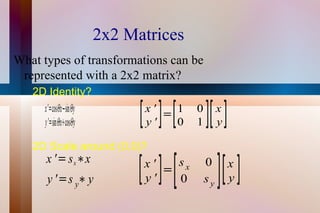
2x2 Matrices What types of transformations can be  represented with a 2x2 matrix? 2D Identity? 2D Scale around (0,0)?
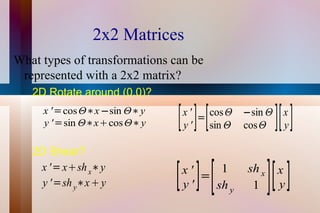
2x2 Matrices What types of transformations can be  represented with a 2x2 matrix? 2D Rotate around (0,0)? 2D Shear?
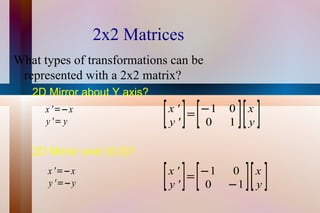
2x2 Matrices What types of transformations can be  represented with a 2x2 matrix? 2D Mirror about Y axis? 2D Mirror over (0,0)?
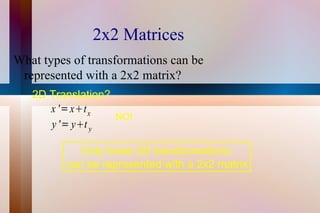
2x2 Matrices What types of transformations can be  represented with a 2x2 matrix? 2D Translation? Only linear 2D transformations  can be represented with a 2x2 matrix NO!
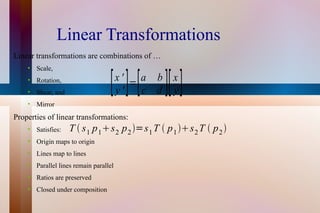
Linear Transformations Linear transformations are combinations of … Scale, Rotation, Shear, and Mirror Properties of linear transformations: Satisfies: Origin maps to origin Lines map to lines Parallel lines remain parallel Ratios are preserved Closed under composition
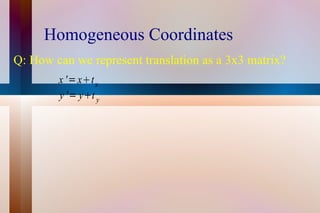
Homogeneous Coordinates Q: How can we represent translation as a 3x3 matrix?
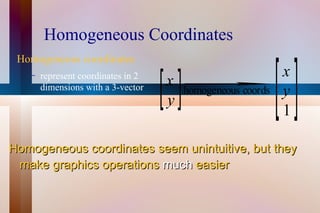
Homogeneous Coordinates Homogeneous coordinates represent coordinates in 2 dimensions with a 3-vector Homogeneous coordinates seem unintuitive, but they make graphics operations  much  easier
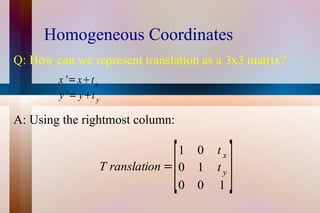
Homogeneous Coordinates Q: How can we represent translation as a 3x3 matrix? A: Using the rightmost column:
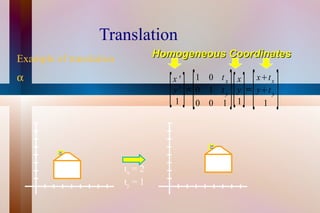
Translation Example of translation  t x  = 2 t y  = 1 Homogeneous Coordinates
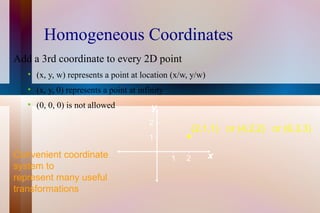
Homogeneous Coordinates Add a 3rd coordinate to every 2D point (x, y, w) represents a point at location (x/w, y/w) (x, y, 0) represents a point at infinity (0, 0, 0) is not allowed Convenient coordinate system to  represent many useful transformations 1 2 1 2 (2,1,1) or (4,2,2) or (6,3,3) x y
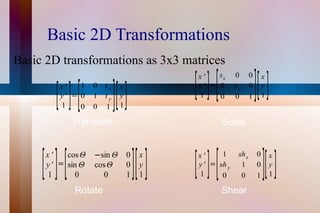
Basic 2D Transformations Basic 2D transformations as 3x3 matrices Translate Rotate Shear Scale
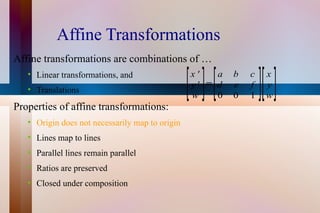
Affine Transformations Affine transformations are combinations of … Linear transformations, and Translations Properties of affine transformations: Origin does not necessarily map to origin Lines map to lines Parallel lines remain parallel Ratios are preserved Closed under composition
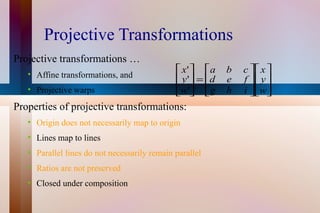
Projective Transformations Projective transformations … Affine transformations, and Projective warps Properties of projective transformations: Origin does not necessarily map to origin Lines map to lines Parallel lines do not necessarily remain parallel Ratios are not preserved Closed under composition
Overview 2D Transformations Basic 2D transformations Matrix representation Matrix composition 3D Transformations Basic 3D transformations Same as 2D
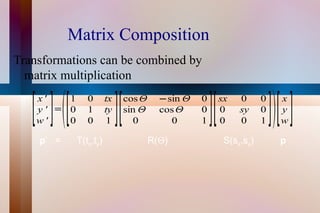
Matrix Composition Transformations can be combined by  matrix multiplication p ’  =  T(t x ,t y )  R(  )  S(s x ,s y )  p
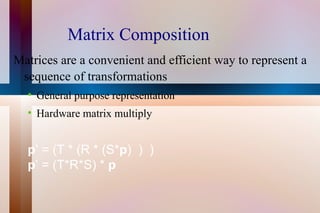
Matrix Composition Matrices are a convenient and efficient way to represent a sequence of transformations General purpose representation Hardware matrix multiply p ’ = (T * (R * (S* p )  )  ) p ’ = (T*R*S) *  p
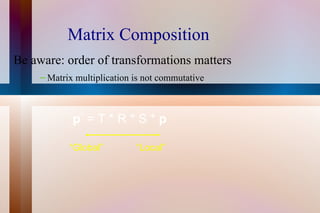
Matrix Composition Be aware: order of transformations matters Matrix multiplication is not commutative p ’ = T * R * S *  p “ Global” “ Local”
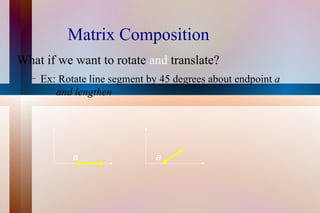
Matrix Composition What if we want to rotate  and  translate? Ex:  Rotate line segment by 45 degrees about endpoint  a   and lengthen a a
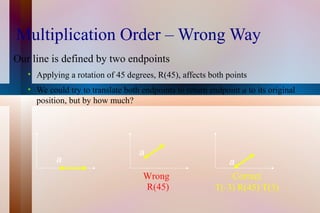
Multiplication Order – Wrong Way Our line is defined by two endpoints Applying a rotation of 45 degrees, R(45), affects both points We could try to translate both endpoints to return endpoint  a  to its original position, but by how much? Wrong Correct T(-3) R(45) T(3) R(45) a a a
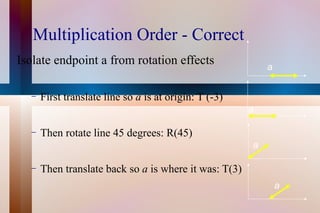
Multiplication Order - Correct Isolate endpoint a from rotation effects First translate line so  a  is at origin: T (-3) Then rotate line 45 degrees: R(45) Then translate back so  a  is where it was: T(3) a a a a
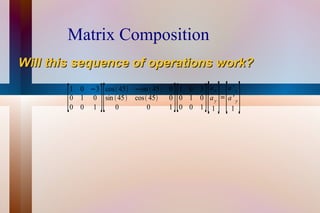
Matrix Composition Will this sequence of operations work?
Matrix Composition After correctly ordering the matrices Multiply matrices together What results is one matrix –  store it (on stack)! Multiply this matrix by the vector of each vertex All vertices easily transformed with one matrix  multiply
Overview 2D Transformations Basic 2D transformations Matrix representation Matrix composition 3D Transformations Basic 3D transformations Same as 2D
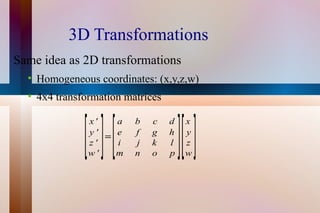
3D Transformations Same idea as 2D transformations Homogeneous coordinates: (x,y,z,w)  4x4 transformation matrices
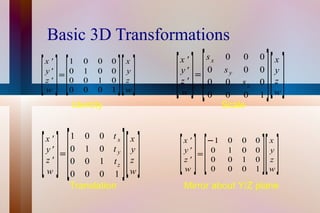
Basic 3D Transformations Identity Scale Translation Mirror about Y/Z plane
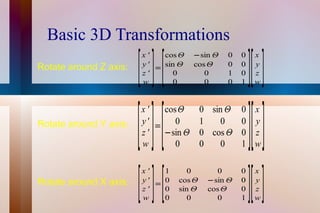
Basic 3D Transformations Rotate around Z axis: Rotate around Y axis: Rotate around X axis:
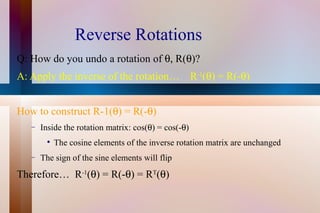
Reverse Rotations Q: How do you undo a rotation of   R(  )? A: Apply the inverse of the rotation…  R -1 (  ) = R(-  )  How to construct R-1(  ) = R(-  )   Inside the rotation matrix: cos(  ) = cos(-  ) The cosine elements of the inverse rotation matrix are unchanged The sign of the sine elements will flip Therefore…  R -1 (  ) = R(-  ) = R T (  )
Summary Coordinate systems World vs. modeling coordinates 2-D and 3-D transformations Trigonometry and geometry Matrix representations Linear vs. affine transformations Matrix operations Matrix composition

Computer graphics

  • 1.
    Computer Graphics AndMultimedia MCS-053 Lecture Transformations A.Balamurali
  • 2.
    Modeling Transformations Specifytransformations for objects Allows definitions of objects in own coordinate systems Allows use of object definition multiple times in a scene Remember how OpenGL provides a transformation stack because they are so frequent
  • 3.
    Overview 2D TransformationsBasic 2D transformations Matrix representation Matrix composition 3D Transformations Basic 3D transformations Same as 2D
  • 4.
    2D Modeling TransformationsScale Rotate Translate Scale Translate x y World Coordinates Modeling Coordinates
  • 5.
    Scaling Scaling a coordinate means multiplying each of its components by a scalar Uniform scaling means this scalar is the same for all components:  2
  • 6.
    Non-uniform scaling :different scalars per component: How can we represent this in matrix form? Scaling X  2, Y  0.5
  • 7.
    Scaling Scaling operation:Or, in matrix form: scaling matrix
  • 8.
    2-D Rotation x’= x cos (  ) - y sin (  ) y’ = x sin (  ) + y cos (  )  (x, y) (x’, y’)
  • 9.
    2-D Rotation x= r cos (  ) y = r sin (  ) x’ = r cos (  +  ) y’ = r sin (  +  ) Trig Identity… x’ = r cos(  ) cos(  ) – r sin(  ) sin(  ) y’ = r sin(  ) sin(  ) + r cos(  ) cos(  ) Substitute… x’ = x cos (  ) - y sin (  ) y’ = x sin (  ) + y cos (  )   (x, y) (x’, y’)
  • 10.
    2-D Rotation Thisis easy to capture in matrix form: Even though sin(  ) and cos(  ) are nonlinear functions of  , x’ is a linear combination of x and y y’ is a linear combination of x and y
  • 11.
    Basic 2D TransformationsTranslation: x’ = x + t x y’ = y + t y Scale: x’ = x * s x y’ = y * s y Shear: x’ = x + h x *y y’ = y + h y *x Rotation: x’ = x*cos  - y*sin  y’ = x*sin  + y*cos  Transformations can be combined (with simple algebra)
  • 12.
    Basic 2D TransformationsTranslation: x’ = x + t x y’ = y + t y Scale: x’ = x * s x y’ = y * s y Shear: x’ = x + h x *y y’ = y + h y *x Rotation: x’ = x*cos  - y*sin  y’ = x*sin  + y*cos 
  • 13.
    Basic 2D TransformationsTranslation: x’ = x + t x y’ = y + t y Scale: x’ = x * s x y’ = y * s y Shear: x’ = x + h x *y y’ = y + h y *x Rotation: x’ = x*cos  - y*sin  y’ = x*sin  + y*cos  x’ = x *s x y’ = y *s y (x,y) (x’,y’)
  • 14.
    Basic 2D TransformationsTranslation: x’ = x + t x y’ = y + t y Scale: x’ = x * s x y’ = y * s y Shear: x’ = x + h x *y y’ = y + h y *x Rotation: x’ = x* cos  - y* sin  y’ = x* sin  + y* cos  x’ = (x*s x ) *cos  - (y*s y ) *sin  y’ = (x*s x ) *sin  + (y*s y ) *cos  (x’,y’)
  • 15.
    Basic 2D TransformationsTranslation: x’ = x + t x y’ = y + t y Scale: x’ = x * s x y’ = y * s y Shear: x’ = x + h x *y y’ = y + h y *x Rotation: x’ = x*cos  - y*sin  y’ = x*sin  + y*cos  x’ = ((x*s x )*cos  - (y*s y )*sin  ) + t x y’ = ((x*s x )*sin  + (y*s y )*cos  ) + t y (x’,y’)
  • 16.
    Basic 2D TransformationsTranslation: x’ = x + t x y’ = y + t y Scale: x’ = x * s x y’ = y * s y Shear: x’ = x + h x *y y’ = y + h y *x Rotation: x’ = x*cos  - y*sin  y’ = x*sin  + y*cos  x’ = ((x*s x )*cos  - (y*s y )*sin  ) + t x y’ = ((x*s x )*sin  + (y*s y )*cos  ) + t y
  • 17.
    Overview 2D TransformationsBasic 2D transformations Matrix representation Matrix composition 3D Transformations Basic 3D transformations Same as 2D
  • 18.
    Matrix Representation Represent2D transformation by a matrix Multiply matrix by column vector  apply transformation to point
  • 19.
    Matrix Representation Transformationscombined by multiplication Matrices are a convenient and efficient way to represent a sequence of transformations!
  • 20.
    2x2 Matrices Whattypes of transformations can be represented with a 2x2 matrix? 2D Identity? 2D Scale around (0,0)?
  • 21.
    2x2 Matrices Whattypes of transformations can be represented with a 2x2 matrix? 2D Rotate around (0,0)? 2D Shear?
  • 22.
    2x2 Matrices Whattypes of transformations can be represented with a 2x2 matrix? 2D Mirror about Y axis? 2D Mirror over (0,0)?
  • 23.
    2x2 Matrices Whattypes of transformations can be represented with a 2x2 matrix? 2D Translation? Only linear 2D transformations can be represented with a 2x2 matrix NO!
  • 24.
    Linear Transformations Lineartransformations are combinations of … Scale, Rotation, Shear, and Mirror Properties of linear transformations: Satisfies: Origin maps to origin Lines map to lines Parallel lines remain parallel Ratios are preserved Closed under composition
  • 25.
    Homogeneous Coordinates Q:How can we represent translation as a 3x3 matrix?
  • 26.
    Homogeneous Coordinates Homogeneouscoordinates represent coordinates in 2 dimensions with a 3-vector Homogeneous coordinates seem unintuitive, but they make graphics operations much easier
  • 27.
    Homogeneous Coordinates Q:How can we represent translation as a 3x3 matrix? A: Using the rightmost column:
  • 28.
    Translation Example oftranslation  t x = 2 t y = 1 Homogeneous Coordinates
  • 29.
    Homogeneous Coordinates Adda 3rd coordinate to every 2D point (x, y, w) represents a point at location (x/w, y/w) (x, y, 0) represents a point at infinity (0, 0, 0) is not allowed Convenient coordinate system to represent many useful transformations 1 2 1 2 (2,1,1) or (4,2,2) or (6,3,3) x y
  • 30.
    Basic 2D TransformationsBasic 2D transformations as 3x3 matrices Translate Rotate Shear Scale
  • 31.
    Affine Transformations Affinetransformations are combinations of … Linear transformations, and Translations Properties of affine transformations: Origin does not necessarily map to origin Lines map to lines Parallel lines remain parallel Ratios are preserved Closed under composition
  • 32.
    Projective Transformations Projectivetransformations … Affine transformations, and Projective warps Properties of projective transformations: Origin does not necessarily map to origin Lines map to lines Parallel lines do not necessarily remain parallel Ratios are not preserved Closed under composition
  • 33.
    Overview 2D TransformationsBasic 2D transformations Matrix representation Matrix composition 3D Transformations Basic 3D transformations Same as 2D
  • 34.
    Matrix Composition Transformationscan be combined by matrix multiplication p ’ = T(t x ,t y ) R(  ) S(s x ,s y ) p
  • 35.
    Matrix Composition Matricesare a convenient and efficient way to represent a sequence of transformations General purpose representation Hardware matrix multiply p ’ = (T * (R * (S* p ) ) ) p ’ = (T*R*S) * p
  • 36.
    Matrix Composition Beaware: order of transformations matters Matrix multiplication is not commutative p ’ = T * R * S * p “ Global” “ Local”
  • 37.
    Matrix Composition Whatif we want to rotate and translate? Ex: Rotate line segment by 45 degrees about endpoint a and lengthen a a
  • 38.
    Multiplication Order –Wrong Way Our line is defined by two endpoints Applying a rotation of 45 degrees, R(45), affects both points We could try to translate both endpoints to return endpoint a to its original position, but by how much? Wrong Correct T(-3) R(45) T(3) R(45) a a a
  • 39.
    Multiplication Order -Correct Isolate endpoint a from rotation effects First translate line so a is at origin: T (-3) Then rotate line 45 degrees: R(45) Then translate back so a is where it was: T(3) a a a a
  • 40.
    Matrix Composition Willthis sequence of operations work?
  • 41.
    Matrix Composition Aftercorrectly ordering the matrices Multiply matrices together What results is one matrix – store it (on stack)! Multiply this matrix by the vector of each vertex All vertices easily transformed with one matrix multiply
  • 42.
    Overview 2D TransformationsBasic 2D transformations Matrix representation Matrix composition 3D Transformations Basic 3D transformations Same as 2D
  • 43.
    3D Transformations Sameidea as 2D transformations Homogeneous coordinates: (x,y,z,w) 4x4 transformation matrices
  • 44.
    Basic 3D TransformationsIdentity Scale Translation Mirror about Y/Z plane
  • 45.
    Basic 3D TransformationsRotate around Z axis: Rotate around Y axis: Rotate around X axis:
  • 46.
    Reverse Rotations Q:How do you undo a rotation of  R(  )? A: Apply the inverse of the rotation… R -1 (  ) = R(-  ) How to construct R-1(  ) = R(-  ) Inside the rotation matrix: cos(  ) = cos(-  ) The cosine elements of the inverse rotation matrix are unchanged The sign of the sine elements will flip Therefore… R -1 (  ) = R(-  ) = R T (  )
  • 47.
    Summary Coordinate systemsWorld vs. modeling coordinates 2-D and 3-D transformations Trigonometry and geometry Matrix representations Linear vs. affine transformations Matrix operations Matrix composition