Composite Transformation
More complex geometric & coordinate
   transformations can be built from the basic
   transformation by using the process of
   composition of function.
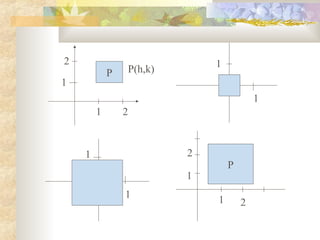
Example: Scaling about a fixed point.
Transformation sequence to produce scaling
w.r.t a selected fixed position (h, k) using a
scaling function that can only scale relative to
the coordinate origin are:-
2                            1
            P   P(h,k)
1
                                         1
        1       2


    1                    2
                                 P
                         1
                1            1       2
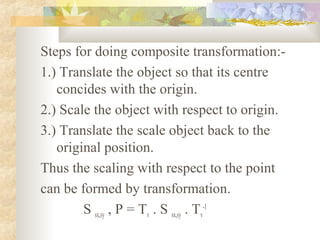
Steps for doing composite transformation:-
1.) Translate the object so that its centre
   concides with the origin.
2.) Scale the object with respect to origin.
3.) Translate the scale object back to the
   original position.
Thus the scaling with respect to the point
can be formed by transformation.
        S sx,sy , P = Tv . S sx,sy . Tv-1
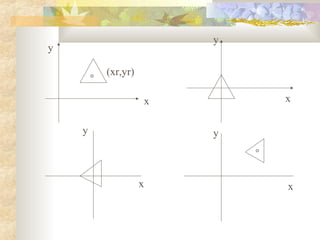
Rotation about a fixed point
We can generate rotation about any selected
pivot point (xr,yr) by performing following
sequence of translate-rotate-translate opn.
1.) Translate the object so that pivot point
   position is moved to the co-ordinate origin.
2.) Rotate the object about the co-ordinate
   origin.
3.) Translate the object so that the pivot point
   is returned to the original position.
y
y

        (xr,yr)

                  x       x


    y                 y


                  x       x
Thus the rotation about a point P can be
formed by the transformation
           R θ ,P = Tv . Rθ . Tv-1

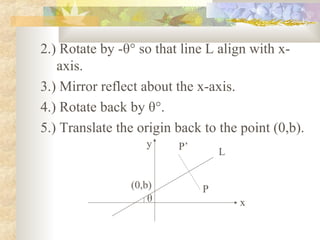
Mirror reflection about a line:
Let line L has a y intercept (0,b) & an angle of
inclination θ. Then the reflection of an object
about a line L needs to follow the following:
1.) Translate the intersection point to the
   origin.
2.) Rotate by -θ° so that line L align with x-
   axis.
3.) Mirror reflect about the x-axis.
4.) Rotate back by θ°.
5.) Translate the origin back to the point (0,b).
                   y     P’       L


                (0,b)         P
                    θ                 x
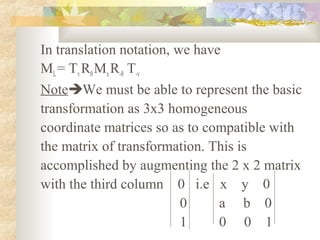
In translation notation, we have
ML = Tv Rθ Mx R-θ T-v
NoteWe must be able to represent the basic
transformation as 3x3 homogeneous
coordinate matrices so as to compatible with
the matrix of transformation. This is
accomplished by augmenting the 2 x 2 matrix
with the third column 0 i.e x y 0
                          0     a b 0
                          1     0 0 1
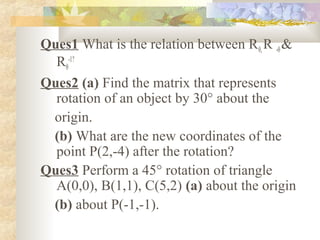
Ques1 What is the relation between Rθ, R -θ &
  Rθ-1?
Ques2 (a) Find the matrix that represents
  rotation of an object by 30° about the
 origin.
 (b) What are the new coordinates of the
  point P(2,-4) after the rotation?
Ques3 Perform a 45° rotation of triangle
  A(0,0), B(1,1), C(5,2) (a) about the origin
 (b) about P(-1,-1).
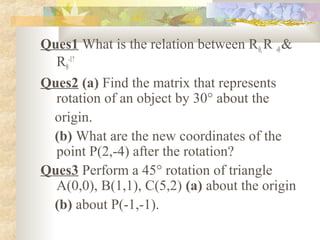
Ques1 What is the relation between Rθ, R -θ &
  Rθ-1?
Ques2 (a) Find the matrix that represents
  rotation of an object by 30° about the
 origin.
 (b) What are the new coordinates of the
  point P(2,-4) after the rotation?
Ques3 Perform a 45° rotation of triangle
  A(0,0), B(1,1), C(5,2) (a) about the origin
 (b) about P(-1,-1).

Composite transformations

  • 1.
    Composite Transformation More complexgeometric & coordinate transformations can be built from the basic transformation by using the process of composition of function. Example: Scaling about a fixed point. Transformation sequence to produce scaling w.r.t a selected fixed position (h, k) using a scaling function that can only scale relative to the coordinate origin are:-
  • 2.
    2 1 P P(h,k) 1 1 1 2 1 2 P 1 1 1 2
  • 3.
    Steps for doingcomposite transformation:- 1.) Translate the object so that its centre concides with the origin. 2.) Scale the object with respect to origin. 3.) Translate the scale object back to the original position. Thus the scaling with respect to the point can be formed by transformation. S sx,sy , P = Tv . S sx,sy . Tv-1
  • 4.
    Rotation about afixed point We can generate rotation about any selected pivot point (xr,yr) by performing following sequence of translate-rotate-translate opn. 1.) Translate the object so that pivot point position is moved to the co-ordinate origin. 2.) Rotate the object about the co-ordinate origin. 3.) Translate the object so that the pivot point is returned to the original position.
  • 5.
    y y (xr,yr) x x y y x x
  • 6.
    Thus the rotationabout a point P can be formed by the transformation R θ ,P = Tv . Rθ . Tv-1 Mirror reflection about a line: Let line L has a y intercept (0,b) & an angle of inclination θ. Then the reflection of an object about a line L needs to follow the following: 1.) Translate the intersection point to the origin.
  • 7.
    2.) Rotate by-θ° so that line L align with x- axis. 3.) Mirror reflect about the x-axis. 4.) Rotate back by θ°. 5.) Translate the origin back to the point (0,b). y P’ L (0,b) P θ x
  • 8.
    In translation notation,we have ML = Tv Rθ Mx R-θ T-v NoteWe must be able to represent the basic transformation as 3x3 homogeneous coordinate matrices so as to compatible with the matrix of transformation. This is accomplished by augmenting the 2 x 2 matrix with the third column 0 i.e x y 0 0 a b 0 1 0 0 1
  • 9.
    Ques1 What isthe relation between Rθ, R -θ & Rθ-1? Ques2 (a) Find the matrix that represents rotation of an object by 30° about the origin. (b) What are the new coordinates of the point P(2,-4) after the rotation? Ques3 Perform a 45° rotation of triangle A(0,0), B(1,1), C(5,2) (a) about the origin (b) about P(-1,-1).
  • 10.
    Ques1 What isthe relation between Rθ, R -θ & Rθ-1? Ques2 (a) Find the matrix that represents rotation of an object by 30° about the origin. (b) What are the new coordinates of the point P(2,-4) after the rotation? Ques3 Perform a 45° rotation of triangle A(0,0), B(1,1), C(5,2) (a) about the origin (b) about P(-1,-1).