2D TRANSFORMATIONS
IN COMPUTER GRAPHICS
VIJAY
SHARMA
2D Transformations
 “Transformations are the operations applied
to geometrical description of an object to
change its position, orientation, or size are
called geometric transformations”.
ROTATION
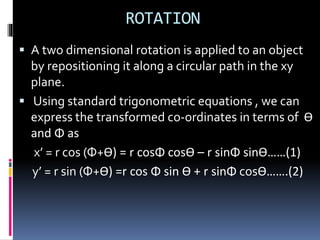
 A two dimensional rotation is applied to an object
by repositioning it along a circular path in the xy
plane.
 Using standard trigonometric equations , we can
express the transformed co-ordinates in terms of Ө
and Φ as
x’ = r cos (Φ+Ө) = r cosΦ cosӨ – r sinΦ sinӨ……(1)
y’ = r sin (Φ+Ө) =r cos Φ sin Ө + r sinΦ cosӨ…….(2)
ROTATION
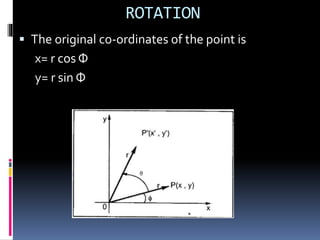
 The original co-ordinates of the point is
x= r cos Φ
y= r sin Φ
ROTATION
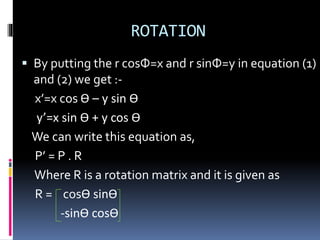
 By putting the r cosΦ=x and r sinΦ=y in equation (1)
and (2) we get :-
x’=x cos Ө – y sin Ө
y’=x sin Ө + y cos Ө
We can write this equation as,
P’ = P . R
Where R is a rotation matrix and it is given as
R = cosӨ sinӨ
-sinӨ cosӨ
REFLECTION
 In this transformation the mirror image of an object
is produced.
 The object is rotated about any axis by 180ᵒ
 So for reflection we need reflection axis, there can
be various cases depending upon the axis chosen for
the reflection.
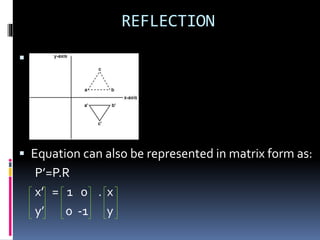
 Reflection about X axis: To reflect a point P(x,y) to
new position P’(x’,y’) about x-axis use the equation:
x’=x
y’=-y
REFLECTION

 Equation can also be represented in matrix form as:
P’=P.R
x’ = 1 0 . x
y’ 0 -1 y
SHEARING
 It is transformation which changes the shape of
object.The sliding of layers of object occur.The
shear can be in one direction or in two directions.
 Shearing in the X-direction: In this horizontal
shearing sliding of layers occur.The homogeneous
matrix for shearing in the x-direction is shown on
below:
1 0 0
Shₓ 1 0
0 0 1
SHEARING
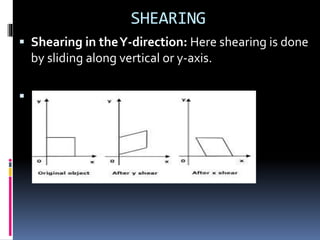
 Shearing in theY-direction: Here shearing is done
by sliding along vertical or y-axis.


2D transformations

  • 1.
    2D TRANSFORMATIONS IN COMPUTERGRAPHICS VIJAY SHARMA
  • 2.
    2D Transformations  “Transformationsare the operations applied to geometrical description of an object to change its position, orientation, or size are called geometric transformations”.
  • 3.
    ROTATION  A twodimensional rotation is applied to an object by repositioning it along a circular path in the xy plane.  Using standard trigonometric equations , we can express the transformed co-ordinates in terms of Ө and Φ as x’ = r cos (Φ+Ө) = r cosΦ cosӨ – r sinΦ sinӨ……(1) y’ = r sin (Φ+Ө) =r cos Φ sin Ө + r sinΦ cosӨ…….(2)
  • 4.
    ROTATION  The originalco-ordinates of the point is x= r cos Φ y= r sin Φ
  • 5.
    ROTATION  By puttingthe r cosΦ=x and r sinΦ=y in equation (1) and (2) we get :- x’=x cos Ө – y sin Ө y’=x sin Ө + y cos Ө We can write this equation as, P’ = P . R Where R is a rotation matrix and it is given as R = cosӨ sinӨ -sinӨ cosӨ
  • 6.
    REFLECTION  In thistransformation the mirror image of an object is produced.  The object is rotated about any axis by 180ᵒ  So for reflection we need reflection axis, there can be various cases depending upon the axis chosen for the reflection.  Reflection about X axis: To reflect a point P(x,y) to new position P’(x’,y’) about x-axis use the equation: x’=x y’=-y
  • 7.
    REFLECTION   Equation canalso be represented in matrix form as: P’=P.R x’ = 1 0 . x y’ 0 -1 y
  • 8.
    SHEARING  It istransformation which changes the shape of object.The sliding of layers of object occur.The shear can be in one direction or in two directions.  Shearing in the X-direction: In this horizontal shearing sliding of layers occur.The homogeneous matrix for shearing in the x-direction is shown on below: 1 0 0 Shₓ 1 0 0 0 1
  • 9.
    SHEARING  Shearing intheY-direction: Here shearing is done by sliding along vertical or y-axis. 