Pooja Dixit
Department of Computer Science
Sophia Girls’ College (Autonomous),
Ajmer
3-D viewing Projection
3-D Display Methods
 Viewing transformation for 3-d are more complex than in 2d.
 Representing n-dimensional object into (n-1) dimension is known as projection.
 In 2-d system we use only two coordinates x and y. but in 3-d an extra
coordinates z is added.
 3-d techniques are mainly used in entertainment, Games, and Computer aided
design industries.
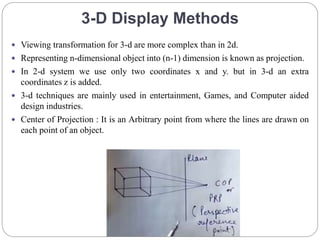
 Center of Projection : It is an Arbitrary point from where the lines are drawn on
each point of an object.
Projection
 To map the 3-d object on 2-d display device, projection is
performed.
 Projection is the process of transformation of point in 3-d
coordinates system to the points in 2-d coordinates system. Thus
projection of a 3-d object is defined by straight projection rays
called projectors.
Types of Projection
 There are two types of projection
1. Perspective
2. Parallel
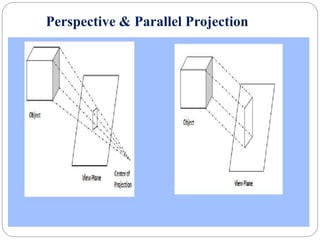
3. Parallel Projection:- In parallel projection, the lines of sight
from the object to the projection plane are parallel to each
other.
 This projection discarded z-coordinates and parallel lines
from each vertex on the object are extended until they
instersect the view plan. In parallel projection we specify
the direction of projection instead of center of projection.
Perspective & Parallel Projection
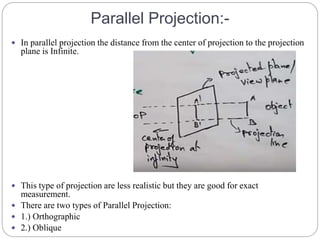
Parallel Projection:-
 In parallel projection the distance from the center of projection to the projection
plane is Infinite.
 This type of projection are less realistic but they are good for exact
measurement.
 There are two types of Parallel Projection:
 1.) Orthographic
 2.) Oblique
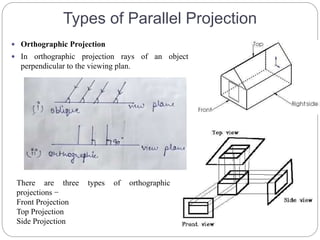
 Orthographic Projection
 In orthographic projection rays of an object are
perpendicular to the viewing plan.

There are three types of orthographic
projections −
Front Projection
Top Projection
Side Projection
Types of Parallel Projection
Oblique Projection
 In this type of projection rays of projection doesn't make 90 degree angle. It
make any arbitrary angle alpha.
 It include three dimensions: Length, Height, Width.
 Projectors not perpendicular to view plan.
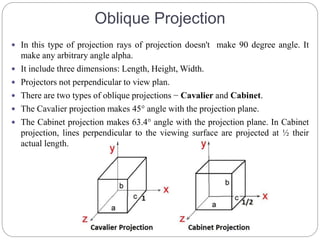
 There are two types of oblique projections − Cavalier and Cabinet.
 The Cavalier projection makes 45° angle with the projection plane.
 The Cabinet projection makes 63.4° angle with the projection plane. In Cabinet
projection, lines perpendicular to the viewing surface are projected at ½ their
actual length.
Perspective Projection
 This type of projection is normal to the human eyes.
 Distance of the projection to the projection plane is Finite.
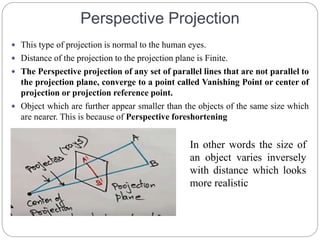
 The Perspective projection of any set of parallel lines that are not parallel to
the projection plane, converge to a point called Vanishing Point or center of
projection or projection reference point.
 Object which are further appear smaller than the objects of the same size which
are nearer. This is because of Perspective foreshortening
In other words the size of
an object varies inversely
with distance which looks
more realistic
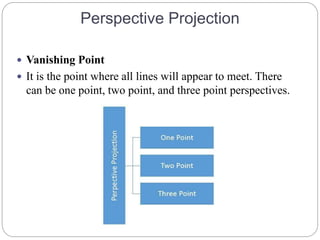
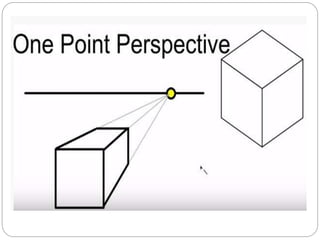
 Vanishing Point
 It is the point where all lines will appear to meet. There
can be one point, two point, and three point perspectives.
Perspective Projection
 There are 3 types of perspective projections which are shown in the following
chart.
 One point perspective projection is simple to draw. If an object have only one
vanishing point so that’s called one point perspective projection.
 Two point: If an object have two vanishing point so that’s called two point
perspective projection. this perspective projection gives better impression of
depth.
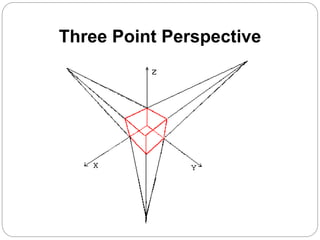
 Three point: If an object have three vanishing point so that’s called three point
perspective projection. perspective projection is most difficult to draw.
Perspective Projection
Three Point Perspective

3 d viewing projection

  • 1.
    Pooja Dixit Department ofComputer Science Sophia Girls’ College (Autonomous), Ajmer 3-D viewing Projection
  • 2.
    3-D Display Methods Viewing transformation for 3-d are more complex than in 2d.  Representing n-dimensional object into (n-1) dimension is known as projection.  In 2-d system we use only two coordinates x and y. but in 3-d an extra coordinates z is added.  3-d techniques are mainly used in entertainment, Games, and Computer aided design industries.  Center of Projection : It is an Arbitrary point from where the lines are drawn on each point of an object.
  • 3.
    Projection  To mapthe 3-d object on 2-d display device, projection is performed.  Projection is the process of transformation of point in 3-d coordinates system to the points in 2-d coordinates system. Thus projection of a 3-d object is defined by straight projection rays called projectors.
  • 4.
    Types of Projection There are two types of projection 1. Perspective 2. Parallel 3. Parallel Projection:- In parallel projection, the lines of sight from the object to the projection plane are parallel to each other.  This projection discarded z-coordinates and parallel lines from each vertex on the object are extended until they instersect the view plan. In parallel projection we specify the direction of projection instead of center of projection.
  • 5.
  • 6.
    Parallel Projection:-  Inparallel projection the distance from the center of projection to the projection plane is Infinite.  This type of projection are less realistic but they are good for exact measurement.  There are two types of Parallel Projection:  1.) Orthographic  2.) Oblique
  • 7.
     Orthographic Projection In orthographic projection rays of an object are perpendicular to the viewing plan.  There are three types of orthographic projections − Front Projection Top Projection Side Projection Types of Parallel Projection
  • 8.
    Oblique Projection  Inthis type of projection rays of projection doesn't make 90 degree angle. It make any arbitrary angle alpha.  It include three dimensions: Length, Height, Width.  Projectors not perpendicular to view plan.  There are two types of oblique projections − Cavalier and Cabinet.  The Cavalier projection makes 45° angle with the projection plane.  The Cabinet projection makes 63.4° angle with the projection plane. In Cabinet projection, lines perpendicular to the viewing surface are projected at ½ their actual length.
  • 9.
    Perspective Projection  Thistype of projection is normal to the human eyes.  Distance of the projection to the projection plane is Finite.  The Perspective projection of any set of parallel lines that are not parallel to the projection plane, converge to a point called Vanishing Point or center of projection or projection reference point.  Object which are further appear smaller than the objects of the same size which are nearer. This is because of Perspective foreshortening In other words the size of an object varies inversely with distance which looks more realistic
  • 10.
     Vanishing Point It is the point where all lines will appear to meet. There can be one point, two point, and three point perspectives. Perspective Projection
  • 11.
     There are3 types of perspective projections which are shown in the following chart.  One point perspective projection is simple to draw. If an object have only one vanishing point so that’s called one point perspective projection.  Two point: If an object have two vanishing point so that’s called two point perspective projection. this perspective projection gives better impression of depth.  Three point: If an object have three vanishing point so that’s called three point perspective projection. perspective projection is most difficult to draw. Perspective Projection
  • 14.