2D transformations and
homogeneous coordinates
        TARUN GEHLOTS
Map of the lecture
• Transformations in 2D:
  – vector/matrix notation
  – example: translation, scaling, rotation
• Homogeneous coordinates:
  – consistent notation
  – several other good points (later)
• Composition of transformations
• Transformations for the window system
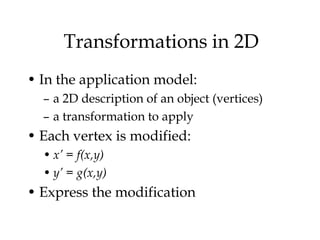
Transformations in 2D
• In the application model:
  – a 2D description of an object (vertices)
  – a transformation to apply
• Each vertex is modified:
  • x’ = f(x,y)
  • y’ = g(x,y)
• Express the modification
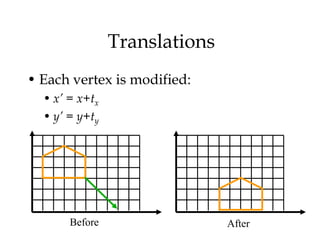
Translations
• Each vertex is modified:
  • x’ = x+tx
  • y’ = y+ty


       Before                  After
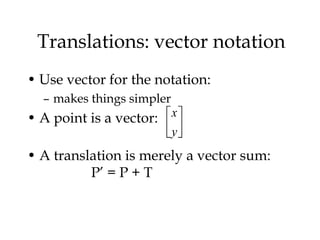
Translations: vector notation
• Use vector for the notation:
  – makes things simpler
• A point is a vector: x
                           y
• A translation is merely a vector sum:
          P’ = P + T
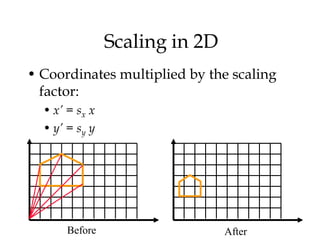
Scaling in 2D
• Coordinates multiplied by the scaling
  factor:
  • x’ = sx x
  • y’ = sy y


       Before                   After
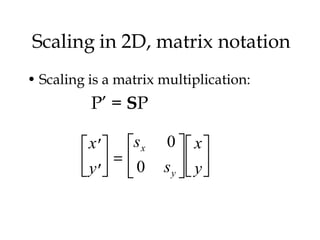
Scaling in 2D, matrix notation
• Scaling is a matrix multiplication:
          P’ = SP

          x      sx    0   x
          y       0   sy   y
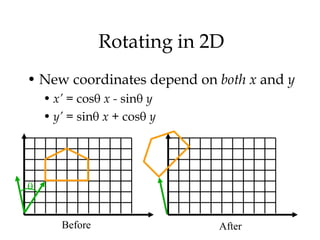
Rotating in 2D
• New coordinates depend on both x and y
  • x’ = cos x - sin y
  • y’ = sin x + cos y


     Before                 After
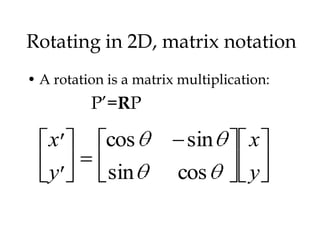
Rotating in 2D, matrix notation
• A rotation is a matrix multiplication:
          P’=RP

   x        cos           sin       x
   y         sin        cos         y
2D transformations, summary
• Vector-matrix notation simplifies writing:
  – translation is a vector sum
  – rotation and scaling are matrix-vector
    multiplication
• I would like a consistent notation:
  – that expresses all three identically
  – that expresses combination of these also
    identically
• How to do this?
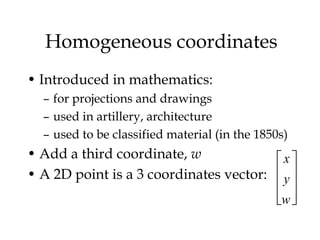
Homogeneous coordinates
• Introduced in mathematics:
  – for projections and drawings
  – used in artillery, architecture
  – used to be classified material (in the 1850s)
• Add a third coordinate, w                     x
• A 2D point is a 3 coordinates vector:         y
                                               w
Homogeneous coordinates (2)
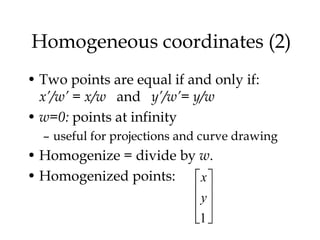
• Two points are equal if and only if:
  x’/w’ = x/w and y’/w’= y/w
• w=0: points at infinity
  – useful for projections and curve drawing
• Homogenize = divide by w.
• Homogenized points:    x
                         y
                         1
Translations with homogeneous
x   1 0 tx   x            x   x
                          w   w   tx
y   0 1 ty   y
                          y   y
w   0 0 1 w
                          w   w   ty
             x   x wt x
             y   y wt y
             w     w
Scaling with homogeneous
x   sx   0    0   x              x         x
y   0    sy   0   y              w   s   x w
                                 y         y
w   0    0    1 w
                                 w   s   y w
                      x   sx x
                      y   sy y
                      w   w
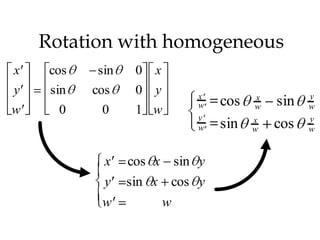
Rotation with homogeneous
x    cos    sin    0   x
y    sin   cos     0   y       x         x         y
                               w   cos   w   sin   w
w     0     0      1 w
                               y         x         y
                               w   sin   w   cos   w


             x    cos x sin y
             y    sin x cos y
            w              w
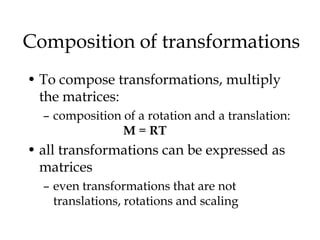
Composition of transformations
• To compose transformations, multiply
  the matrices:
  – composition of a rotation and a translation:
                M = RT
• all transformations can be expressed as
  matrices
  – even transformations that are not
    translations, rotations and scaling
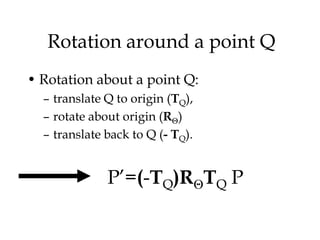
Rotation around a point Q
• Rotation about a point Q:
  – translate Q to origin (TQ),
  – rotate about origin (R )
  – translate back to Q (- TQ).


              P’=(-TQ)R TQ P
Beware!
• Matrix multiplication is not commutative
• The order of the transformations is vital
  – Rotation followed by translation is very different
    from translation followed by rotation
  – careful with the order of the matrices!
• Small commutativity:
  – rotation commute with rotation, translation with
    translation…
From World to Window
• Inside the application:
  – application model
  – coordinates related to the model
  – possibly floating point
• On the screen:
  – pixel coordinates
  – integer
  – restricted viewport: umin/umax, vmin/vmax
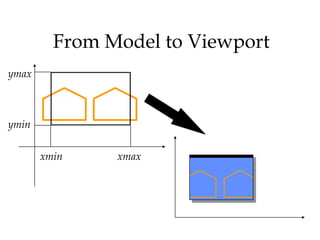
From Model to Viewport
ymax


ymin

       xmin    xmax
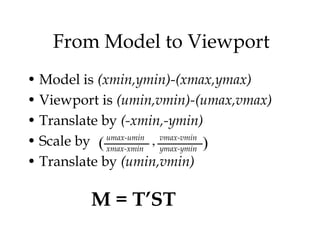
From Model to Viewport
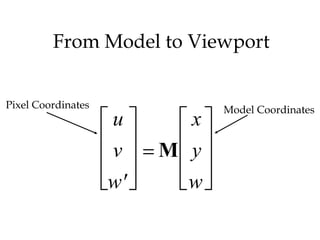
• Model is (xmin,ymin)-(xmax,ymax)
• Viewport is (umin,vmin)-(umax,vmax)
• Translate by (-xmin,-ymin)
• Scale by ( umax-umin , vmax-vmin )
             xmax-xmin   ymax-ymin
• Translate by (umin,vmin)

         M = T’ST
From Model to Viewport


Pixel Coordinates             Model Coordinates
                    u     x
                    v   M y
                    w     w
Mouse position: inverse problem
• Mouse click: coordinates in pixels
• We want the equivalent in World Coord
  – because the user has selected an object
  – to draw something
  – for interaction
• How can we convert from window
  coordinates to model coordinates?
Mouse click: inverse problem
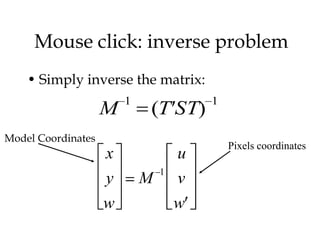
    • Simply inverse the matrix:
                        1               1
                    M       (T ST)
Model Coordinates
                                            Pixels coordinates
                    x               u
                                1
                    y       M       v
                    w               w
2D transformations: conclusion
• Simple, consistent matrix notation
  – using homogeneous coordinates
  – all transformations expressed as matrices
• Used by the window system:
  – for conversion from model to window
  – for conversion from window to model
• Used by the application:
  – for modeling transformations

2 d transformations and homogeneous coordinates

  • 1.
    2D transformations and homogeneouscoordinates TARUN GEHLOTS
  • 2.
    Map of thelecture • Transformations in 2D: – vector/matrix notation – example: translation, scaling, rotation • Homogeneous coordinates: – consistent notation – several other good points (later) • Composition of transformations • Transformations for the window system
  • 3.
    Transformations in 2D •In the application model: – a 2D description of an object (vertices) – a transformation to apply • Each vertex is modified: • x’ = f(x,y) • y’ = g(x,y) • Express the modification
  • 4.
    Translations • Each vertexis modified: • x’ = x+tx • y’ = y+ty Before After
  • 5.
    Translations: vector notation •Use vector for the notation: – makes things simpler • A point is a vector: x y • A translation is merely a vector sum: P’ = P + T
  • 6.
    Scaling in 2D •Coordinates multiplied by the scaling factor: • x’ = sx x • y’ = sy y Before After
  • 7.
    Scaling in 2D,matrix notation • Scaling is a matrix multiplication: P’ = SP x sx 0 x y 0 sy y
  • 8.
    Rotating in 2D •New coordinates depend on both x and y • x’ = cos x - sin y • y’ = sin x + cos y Before After
  • 9.
    Rotating in 2D,matrix notation • A rotation is a matrix multiplication: P’=RP x cos sin x y sin cos y
  • 10.
    2D transformations, summary •Vector-matrix notation simplifies writing: – translation is a vector sum – rotation and scaling are matrix-vector multiplication • I would like a consistent notation: – that expresses all three identically – that expresses combination of these also identically • How to do this?
  • 11.
    Homogeneous coordinates • Introducedin mathematics: – for projections and drawings – used in artillery, architecture – used to be classified material (in the 1850s) • Add a third coordinate, w x • A 2D point is a 3 coordinates vector: y w
  • 12.
    Homogeneous coordinates (2) •Two points are equal if and only if: x’/w’ = x/w and y’/w’= y/w • w=0: points at infinity – useful for projections and curve drawing • Homogenize = divide by w. • Homogenized points: x y 1
  • 13.
    Translations with homogeneous x 1 0 tx x x x w w tx y 0 1 ty y y y w 0 0 1 w w w ty x x wt x y y wt y w w
  • 14.
    Scaling with homogeneous x sx 0 0 x x x y 0 sy 0 y w s x w y y w 0 0 1 w w s y w x sx x y sy y w w
  • 15.
    Rotation with homogeneous x cos sin 0 x y sin cos 0 y x x y w cos w sin w w 0 0 1 w y x y w sin w cos w x cos x sin y y sin x cos y w w
  • 16.
    Composition of transformations •To compose transformations, multiply the matrices: – composition of a rotation and a translation: M = RT • all transformations can be expressed as matrices – even transformations that are not translations, rotations and scaling
  • 17.
    Rotation around apoint Q • Rotation about a point Q: – translate Q to origin (TQ), – rotate about origin (R ) – translate back to Q (- TQ). P’=(-TQ)R TQ P
  • 18.
    Beware! • Matrix multiplicationis not commutative • The order of the transformations is vital – Rotation followed by translation is very different from translation followed by rotation – careful with the order of the matrices! • Small commutativity: – rotation commute with rotation, translation with translation…
  • 19.
    From World toWindow • Inside the application: – application model – coordinates related to the model – possibly floating point • On the screen: – pixel coordinates – integer – restricted viewport: umin/umax, vmin/vmax
  • 20.
    From Model toViewport ymax ymin xmin xmax
  • 21.
    From Model toViewport • Model is (xmin,ymin)-(xmax,ymax) • Viewport is (umin,vmin)-(umax,vmax) • Translate by (-xmin,-ymin) • Scale by ( umax-umin , vmax-vmin ) xmax-xmin ymax-ymin • Translate by (umin,vmin) M = T’ST
  • 22.
    From Model toViewport Pixel Coordinates Model Coordinates u x v M y w w
  • 23.
    Mouse position: inverseproblem • Mouse click: coordinates in pixels • We want the equivalent in World Coord – because the user has selected an object – to draw something – for interaction • How can we convert from window coordinates to model coordinates?
  • 24.
    Mouse click: inverseproblem • Simply inverse the matrix: 1 1 M (T ST) Model Coordinates Pixels coordinates x u 1 y M v w w
  • 25.
    2D transformations: conclusion •Simple, consistent matrix notation – using homogeneous coordinates – all transformations expressed as matrices • Used by the window system: – for conversion from model to window – for conversion from window to model • Used by the application: – for modeling transformations