BASIC TRANSFORMATION
NEHRUREVATHY
DEPT. OF BCA
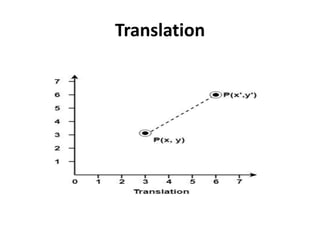
Translation
• It is the straight line movement of an object from one
position to another is called Translation.
• Here the object is positioned from one coordinate
location to another.
• Translation of point:
• To translate a point from coordinate position (x, y) to
another (x1 y1), we add algebraically the translation
distances Tx and Ty to original coordinate.
• x1=x+Tx y1=y+Ty
• The translation pair (Tx,Ty) is called as shift vector.
Translation
• Translation is a movement of objects without
deformation.
• Every position or point is translated by the
same amount.
• Let P is a point with coordinates (x, y). It will
be translated as (x1 y1).
Translation
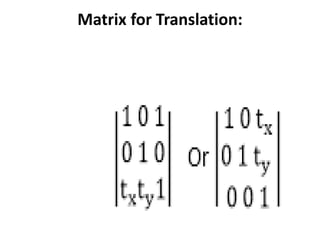
Matrix for Translation:
SCALING
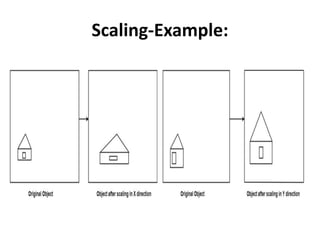
• It is used to alter or change the size of objects.
• The change is done using scaling factors.
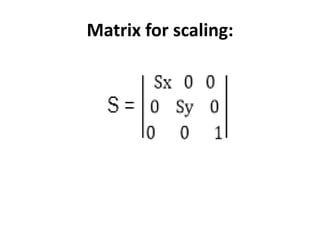
• There are two scaling factors, i.e. Sx in x
direction Sy in y-direction.
• If the original position is x and y.
• Scaling factors are Sx and Sy then the value of
coordinates after scaling will be x1 and y1.
SCALING
• If the picture to be enlarged to twice its
original size then Sx = Sy =2.
• If Sxand Sy are not equal then scaling will
occur but it will elongate or distort the
picture.
• If scaling factors are less than one, then the
size of the object will be reduced.
• If scaling factors are higher than one, then the
size of the object will be enlarged.
SCALING
• If Sxand Syare equal it is also called as Uniform
Scaling.
• If not equal then called as Differential
Scaling.
• If scaling factors with values less than one will
move the object closer to coordinate origin.
• while a value higher than one will move
coordinate position farther from origin.
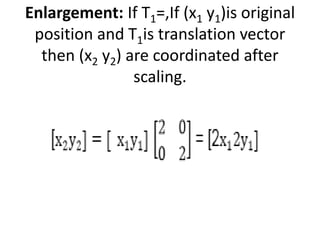
Enlargement: If T1=,If (x1 y1)is original
position and T1is translation vector
then (x2 y2) are coordinated after
scaling.
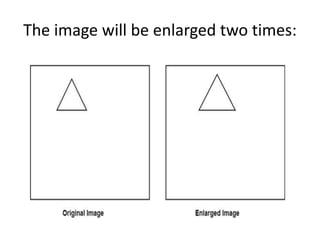
The image will be enlarged two times:
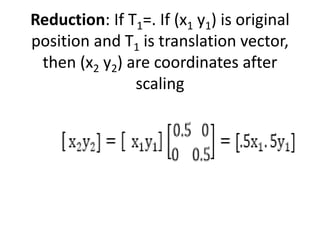
Reduction: If T1=. If (x1 y1) is original
position and T1 is translation vector,
then (x2 y2) are coordinates after
scaling
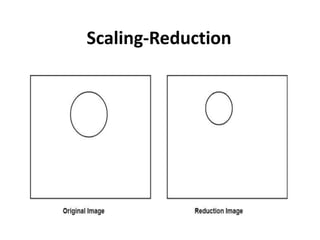
Scaling-Reduction
Scaling-Example:
Matrix for scaling:
Rotation
• It is a process of changing the angle of the object.
• Rotation can be clockwise or anticlockwise.
• For rotation, we have to specify the angle of
rotation and rotation point.
• Rotation point is also called a pivot point.
• It is print about which object is rotated.
• Types of Rotation:
1.Anticlockwise
2.Counterclockwise
Rotation
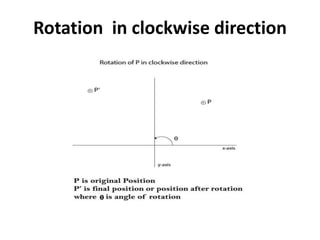
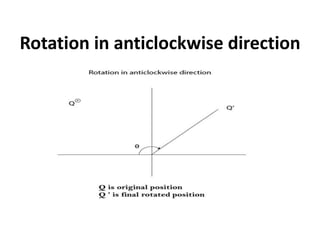
• The positive value of the pivot point (rotation
angle) rotates an object in a counter-clockwise
(anti-clockwise) direction.
• The negative value of the pivot point (rotation
angle) rotates an object in a clockwise
direction.
• When the object is rotated, then every point
of the object is rotated by the same angle.
Rotation in clockwise direction
Rotation in anticlockwise direction
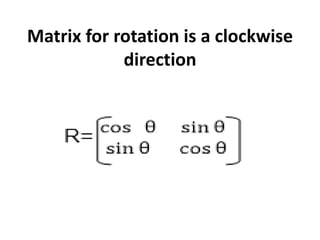
Matrix for rotation is a clockwise
direction
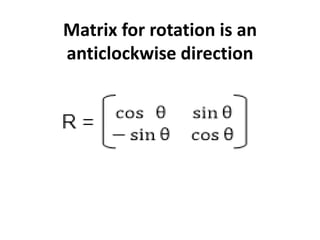
Matrix for rotation is an
anticlockwise direction
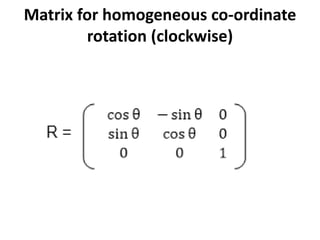
Matrix for homogeneous co-ordinate
rotation (clockwise)
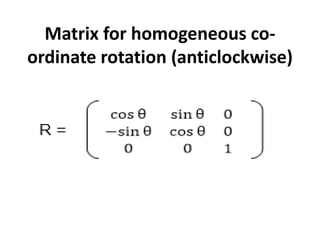
Matrix for homogeneous co-
ordinate rotation (anticlockwise)
Reflection
• It is a transformation which produces a mirror image of
an object.
• The mirror image can be either about x-axis or y-axis.
• The object is rotated by 180°.
• Types of Reflection:
1.Reflection about the x-axis
2.Reflection about the y-axis
3.Reflection about an axis perpendicular to xy plane
and passing through the origin
4.Reflection about line y=x
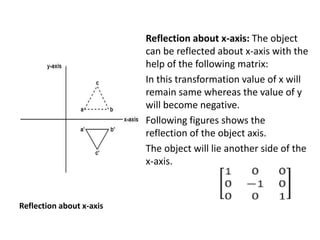
Reflection about x-axis: The object
can be reflected about x-axis with the
help of the following matrix:
In this transformation value of x will
remain same whereas the value of y
will become negative.
Following figures shows the
reflection of the object axis.
The object will lie another side of the
x-axis.
Reflection about x-axis
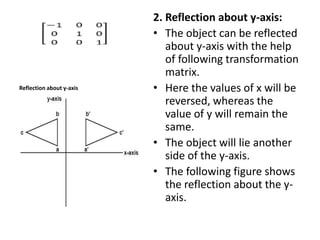
2. Reflection about y-axis:
• The object can be reflected
about y-axis with the help
of following transformation
matrix.
• Here the values of x will be
reversed, whereas the
value of y will remain the
same.
• The object will lie another
side of the y-axis.
• The following figure shows
the reflection about the y-
axis.
Reflection about y-axis
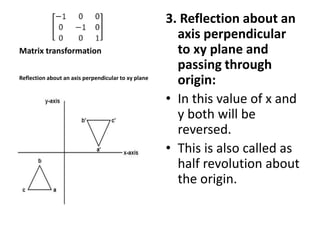
Matrix transformation
3. Reflection about an
axis perpendicular
to xy plane and
passing through
origin:
• In this value of x and
y both will be
reversed.
• This is also called as
half revolution about
the origin.
Reflection about an axis perpendicular to xy plane
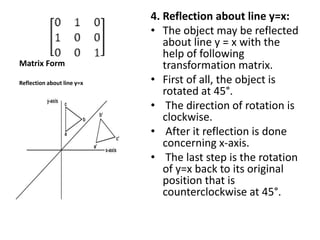
Matrix Form
4. Reflection about line y=x:
• The object may be reflected
about line y = x with the
help of following
transformation matrix.
• First of all, the object is
rotated at 45°.
• The direction of rotation is
clockwise.
• After it reflection is done
concerning x-axis.
• The last step is the rotation
of y=x back to its original
position that is
counterclockwise at 45°.
Reflection about line y=x
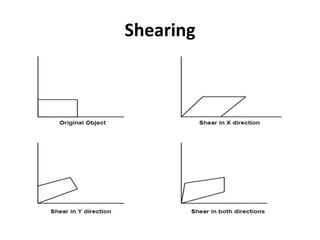
Shearing
• It is transformation which changes the shape
of object.
• The shear can be in one direction or in two
directions.
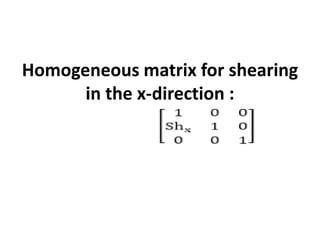
• Shearing in the X-direction: In this horizontal
shearing sliding of layers occur.
• Homogeneous Matrix:
Homogeneous matrix for shearing
in the x-direction :
Shearing
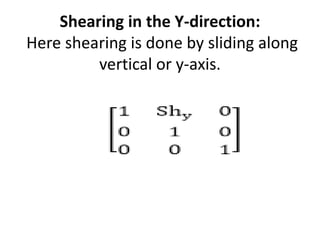
Shearing in the Y-direction:
Here shearing is done by sliding along
vertical or y-axis.
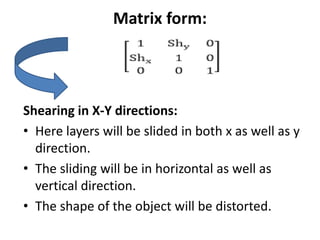
Matrix form:
Shearing in X-Y directions:
• Here layers will be slided in both x as well as y
direction.
• The sliding will be in horizontal as well as
vertical direction.
• The shape of the object will be distorted.

2D- Transformation

  • 1.
  • 2.
    Translation • It isthe straight line movement of an object from one position to another is called Translation. • Here the object is positioned from one coordinate location to another. • Translation of point: • To translate a point from coordinate position (x, y) to another (x1 y1), we add algebraically the translation distances Tx and Ty to original coordinate. • x1=x+Tx y1=y+Ty • The translation pair (Tx,Ty) is called as shift vector.
  • 3.
    Translation • Translation isa movement of objects without deformation. • Every position or point is translated by the same amount. • Let P is a point with coordinates (x, y). It will be translated as (x1 y1).
  • 4.
  • 5.
  • 6.
    SCALING • It isused to alter or change the size of objects. • The change is done using scaling factors. • There are two scaling factors, i.e. Sx in x direction Sy in y-direction. • If the original position is x and y. • Scaling factors are Sx and Sy then the value of coordinates after scaling will be x1 and y1.
  • 7.
    SCALING • If thepicture to be enlarged to twice its original size then Sx = Sy =2. • If Sxand Sy are not equal then scaling will occur but it will elongate or distort the picture. • If scaling factors are less than one, then the size of the object will be reduced. • If scaling factors are higher than one, then the size of the object will be enlarged.
  • 8.
    SCALING • If SxandSyare equal it is also called as Uniform Scaling. • If not equal then called as Differential Scaling. • If scaling factors with values less than one will move the object closer to coordinate origin. • while a value higher than one will move coordinate position farther from origin.
  • 9.
    Enlargement: If T1=,If(x1 y1)is original position and T1is translation vector then (x2 y2) are coordinated after scaling.
  • 10.
    The image willbe enlarged two times:
  • 11.
    Reduction: If T1=.If (x1 y1) is original position and T1 is translation vector, then (x2 y2) are coordinates after scaling
  • 12.
  • 13.
  • 14.
  • 15.
    Rotation • It isa process of changing the angle of the object. • Rotation can be clockwise or anticlockwise. • For rotation, we have to specify the angle of rotation and rotation point. • Rotation point is also called a pivot point. • It is print about which object is rotated. • Types of Rotation: 1.Anticlockwise 2.Counterclockwise
  • 16.
    Rotation • The positivevalue of the pivot point (rotation angle) rotates an object in a counter-clockwise (anti-clockwise) direction. • The negative value of the pivot point (rotation angle) rotates an object in a clockwise direction. • When the object is rotated, then every point of the object is rotated by the same angle.
  • 17.
  • 18.
  • 19.
    Matrix for rotationis a clockwise direction
  • 20.
    Matrix for rotationis an anticlockwise direction
  • 21.
    Matrix for homogeneousco-ordinate rotation (clockwise)
  • 22.
    Matrix for homogeneousco- ordinate rotation (anticlockwise)
  • 23.
    Reflection • It isa transformation which produces a mirror image of an object. • The mirror image can be either about x-axis or y-axis. • The object is rotated by 180°. • Types of Reflection: 1.Reflection about the x-axis 2.Reflection about the y-axis 3.Reflection about an axis perpendicular to xy plane and passing through the origin 4.Reflection about line y=x
  • 24.
    Reflection about x-axis:The object can be reflected about x-axis with the help of the following matrix: In this transformation value of x will remain same whereas the value of y will become negative. Following figures shows the reflection of the object axis. The object will lie another side of the x-axis. Reflection about x-axis
  • 25.
    2. Reflection abouty-axis: • The object can be reflected about y-axis with the help of following transformation matrix. • Here the values of x will be reversed, whereas the value of y will remain the same. • The object will lie another side of the y-axis. • The following figure shows the reflection about the y- axis. Reflection about y-axis
  • 26.
    Matrix transformation 3. Reflectionabout an axis perpendicular to xy plane and passing through origin: • In this value of x and y both will be reversed. • This is also called as half revolution about the origin. Reflection about an axis perpendicular to xy plane
  • 27.
    Matrix Form 4. Reflectionabout line y=x: • The object may be reflected about line y = x with the help of following transformation matrix. • First of all, the object is rotated at 45°. • The direction of rotation is clockwise. • After it reflection is done concerning x-axis. • The last step is the rotation of y=x back to its original position that is counterclockwise at 45°. Reflection about line y=x
  • 28.
    Shearing • It istransformation which changes the shape of object. • The shear can be in one direction or in two directions. • Shearing in the X-direction: In this horizontal shearing sliding of layers occur. • Homogeneous Matrix:
  • 29.
    Homogeneous matrix forshearing in the x-direction :
  • 30.
  • 31.
    Shearing in theY-direction: Here shearing is done by sliding along vertical or y-axis.
  • 32.
    Matrix form: Shearing inX-Y directions: • Here layers will be slided in both x as well as y direction. • The sliding will be in horizontal as well as vertical direction. • The shape of the object will be distorted.