Display Devices

Organized By: Vinay Arora
               Assistant Professor, CSED
               Thapar University, Patiala
Disclaimer

         This is NOT A COPYRIGHT                           MATERIAL
Content has been taken mainly from the following books & websites:

          Computer Graphics C Version By Donald Hearn, M. Pauline Baker
Schaum's outline of theory and problems of computer graphics By Zhigang Xiang, Roy A. Plastock
                Computer Graphics: Principles and Practice By James D. Foley
                         http://en.wikipedia.org/wiki/Computer_graphics
                         http://www.howstuffworks.com/3dgraphics.htm
                         http://www.graphics.cornell.edu/online/tutorial/
                                     http://www.cgarena.com/
                                               etc…


                                         Vinay Arora
                                         TU, CSED
Display Devices
   A Display Device is an Output device for presentation of Information
   for Visual reception.

   The Display Systems are often referred to as Video Monitor or Video
   Display Unit (VDU).

   Display Devices having CRT:-

        DVST – Direct View Storage Tube

        Random Scan

        Raster Scan

                                 Vinay Arora
                                 TU, CSED
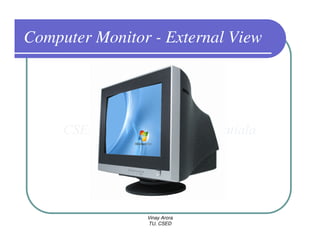
Computer Monitor - External View


                Vinay Arora
                TU, CSED
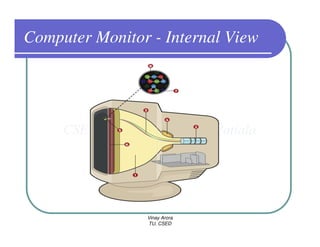
Computer Monitor - Internal View


                Vinay Arora
                TU, CSED
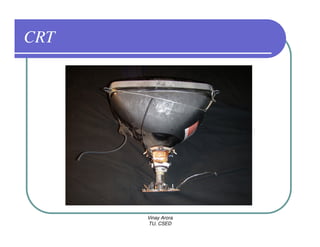
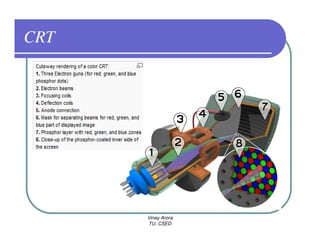
CRT


      Vinay Arora
      TU, CSED
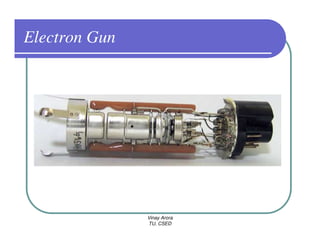
Electron Gun


               Vinay Arora
               TU, CSED
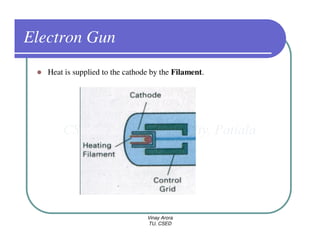
Electron Gun
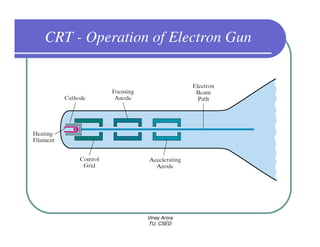
   Heat is supplied to the cathode by the Filament.


                                 Vinay Arora
                                 TU, CSED
CRT - Operation of Electron Gun


               Vinay Arora
               TU, CSED
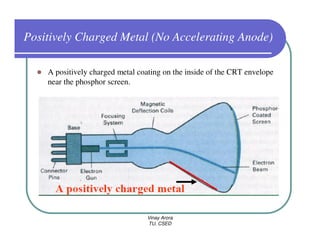
Positively Charged Metal (No Accelerating Anode)

    A positively charged metal coating on the inside of the CRT envelope
    near the phosphor screen.


                                 Vinay Arora
                                 TU, CSED
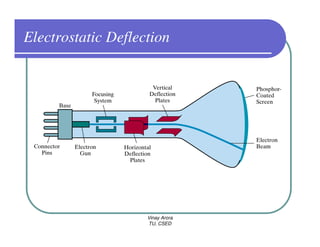
Electrostatic Deflection


                    Vinay Arora
                    TU, CSED
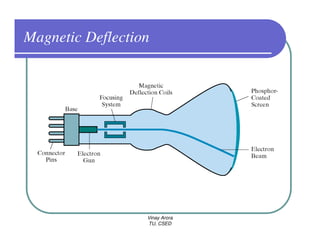
Magnetic Deflection


                  Vinay Arora
                  TU, CSED
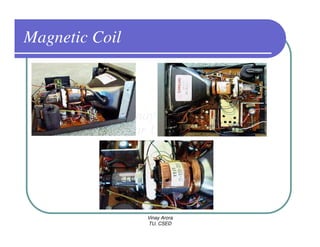
Magnetic Coil


                Vinay Arora
                TU, CSED
CRT


      Vinay Arora
      TU, CSED
Brands of CRT


                Vinay Arora
                TU, CSED
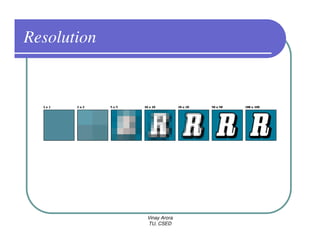
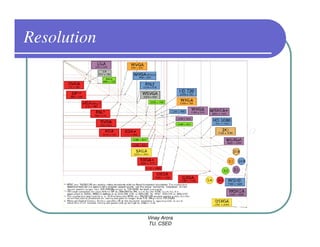
Resolution


             Vinay Arora
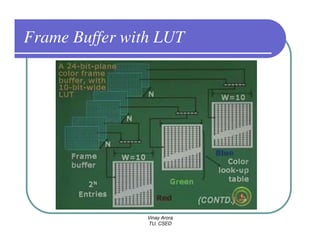
             TU, CSED
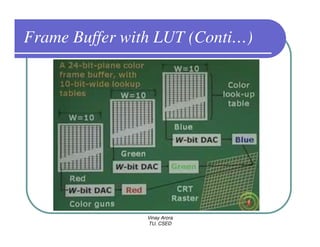
Resolution


             Vinay Arora
             TU, CSED
Related Terms
   Fluorescence – Is the light emitted as electrons lose their excess energy
   while the Phosphor is being struck by electrons.


   Phosphorescence – Is the light given off by the return of the relatively
   more stable excited electrons to their unexcited state, once the electron
   beam excitation is removed.


   Persistence – Time from the removal of the excitation to the moment
   when Phosphorescence has decayed to 10% of the Initial Light Output.


                                  Vinay Arora
                                  TU, CSED
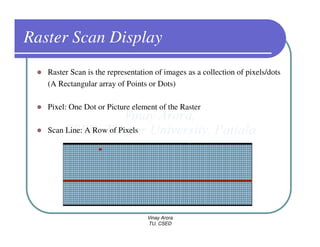
Raster Scan Display
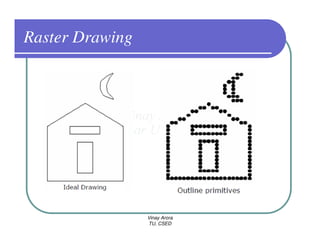
   Raster Scan is the representation of images as a collection of pixels/dots
   (A Rectangular array of Points or Dots)

   Pixel: One Dot or Picture element of the Raster

   Scan Line: A Row of Pixels


                                  Vinay Arora
                                  TU, CSED
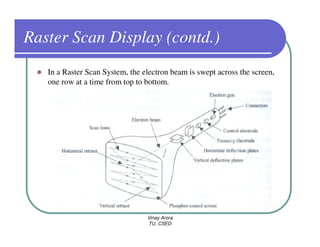
Raster Scan Display (contd.)
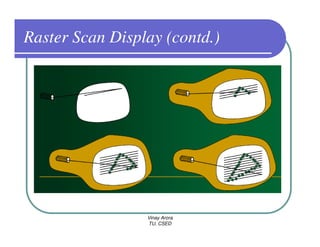
   In a Raster Scan System, the electron beam is swept across the screen,
   one row at a time from top to bottom.


                                 Vinay Arora
                                 TU, CSED
Raster Scan Display (contd.)
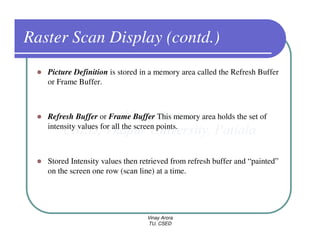
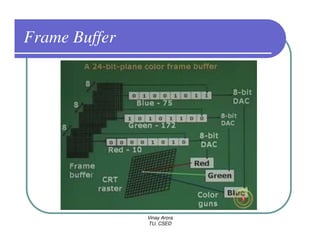
   Picture Definition is stored in a memory area called the Refresh Buffer
   or Frame Buffer.


   Refresh Buffer or Frame Buffer This memory area holds the set of
   intensity values for all the screen points.


   Stored Intensity values then retrieved from refresh buffer and “painted”
   on the screen one row (scan line) at a time.


                                  Vinay Arora
                                  TU, CSED
Raster Scan Display (contd.)


                 Vinay Arora
                 TU, CSED
Raster Drawing


                 Vinay Arora
                 TU, CSED
Architecture - Raster System
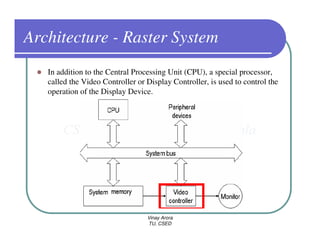
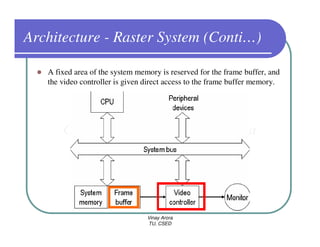
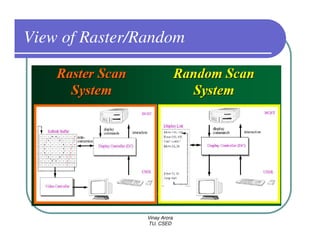
   In addition to the Central Processing Unit (CPU), a special processor,
   called the Video Controller or Display Controller, is used to control the
   operation of the Display Device.


                                  Vinay Arora
                                  TU, CSED
Architecture - Raster System (Conti…)

   A fixed area of the system memory is reserved for the frame buffer, and
   the video controller is given direct access to the frame buffer memory.


                                 Vinay Arora
                                 TU, CSED
Pixel Coordinate System
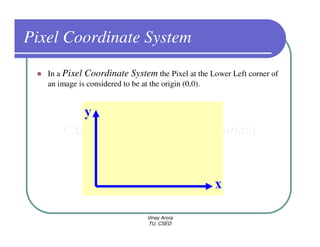
   In a Pixel Coordinate System the Pixel at the Lower Left corner of
   an image is considered to be at the origin (0,0).


                               Vinay Arora
                               TU, CSED
Cartesian Coordinates
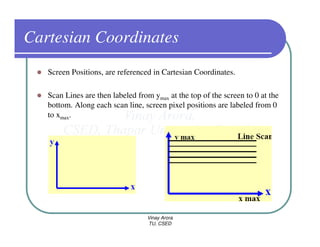
   Screen Positions, are referenced in Cartesian Coordinates.

   Scan Lines are then labeled from ymax at the top of the screen to 0 at the
   bottom. Along each scan line, screen pixel positions are labeled from 0
   to xmax.


                                  Vinay Arora
                                  TU, CSED
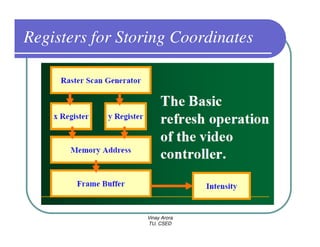
Registers for Storing Coordinates


                 Vinay Arora
                 TU, CSED
Random Scan Display
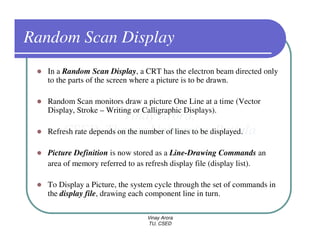
   In a Random Scan Display, a CRT has the electron beam directed only
   to the parts of the screen where a picture is to be drawn.

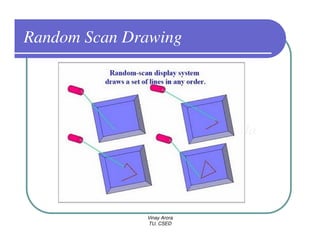
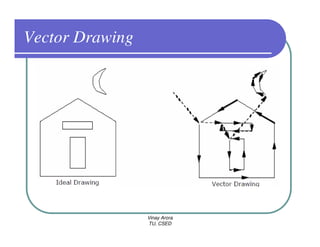
   Random Scan monitors draw a picture One Line at a time (Vector
   Display, Stroke – Writing or Calligraphic Displays).

   Refresh rate depends on the number of lines to be displayed.

   Picture Definition is now stored as a Line-Drawing Commands an
   area of memory referred to as refresh display file (display list).

   To Display a Picture, the system cycle through the set of commands in
   the display file, drawing each component line in turn.

                                 Vinay Arora
                                 TU, CSED
Random Scan Display
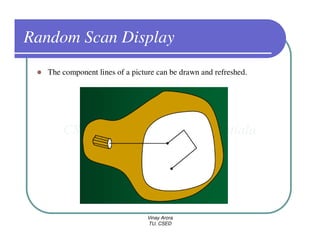
   The component lines of a picture can be drawn and refreshed.


                                Vinay Arora
                                TU, CSED
Random Scan Drawing


              Vinay Arora
              TU, CSED
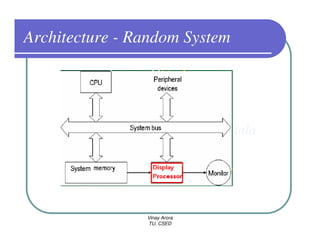
Architecture - Random System


                Vinay Arora
                TU, CSED
Random Scan Display
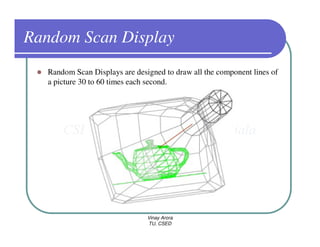
   Random Scan Displays are designed to draw all the component lines of
   a picture 30 to 60 times each second.


                                Vinay Arora
                                TU, CSED
Vector Drawing


                 Vinay Arora
                 TU, CSED
Random Scan Drawing
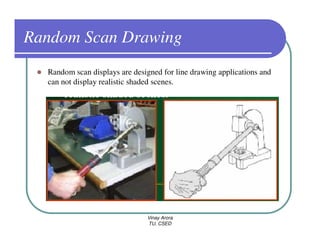
  Random scan displays are designed for line drawing applications and
  can not display realistic shaded scenes.


                               Vinay Arora
                               TU, CSED
View of Raster/Random


                Vinay Arora
                TU, CSED
Bitmap / Pixmap
   A Black-and-White System: Each Screen Point is either ON or OFF,
   so only one bit per pixel is needed to control the intensity of screen
   positions.

   On a Black-and-White System with one bit per pixel, the Frame Buffer
   is called BITMAP.

   For system with multiple bits per pixel, the Frame Buffer is called
   PIXMAP.

   Sometimes, refresh rates are described in unit of cycles per second, or
   Hertz (HZ)


                                  Vinay Arora
                                  TU, CSED
Color CRT Monitors
   A CRT monitor displays color pictures by using a combination of
   phosphors that emit different   COLOR lights.
   Methods:-


        1. Beam Penetration

        2. Shadow Mask


                                   Vinay Arora
                                   TU, CSED
Beam Penetration Method
   Used with Random Scan monitors.

   Two layers of phosphor (red and green) are coated onto the inside of the
   CRT screen.

   The display color depends on how far the electron beam penetrates
   into the phosphor layers.

   The speed of the electrons, and the screen color at any point, is
   controlled by the beam acceleration voltage.


                                  Vinay Arora
                                  TU, CSED
Beam Penetration Method (contd.)
   Only 4 colors are possible (red, green, orange, and yellow).

   Quality of pictures is not as good as with other methods.


                                  Vinay Arora
                                  TU, CSED
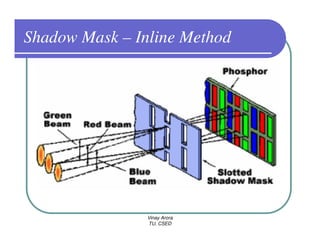
Shadow Mask Method
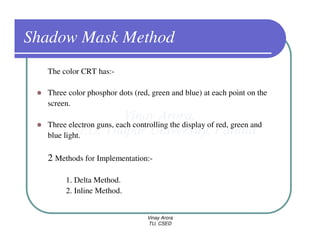
  The color CRT has:-

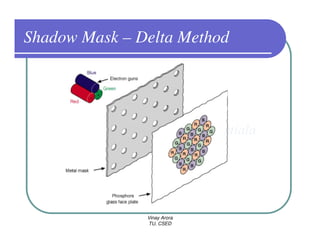
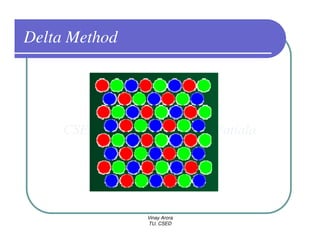
  Three color phosphor dots (red, green and blue) at each point on the
  screen.

  Three electron guns, each controlling the display of red, green and
  blue light.

  2 Methods for Implementation:-

       1. Delta Method.
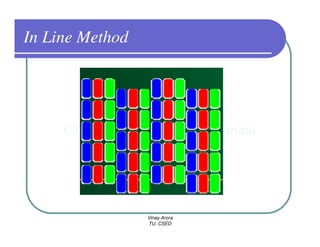
       2. Inline Method.


                                 Vinay Arora
                                 TU, CSED
Shadow Mask Method (contd.)
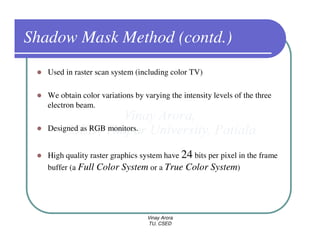
   Used in raster scan system (including color TV)

   We obtain color variations by varying the intensity levels of the three
   electron beam.

   Designed as RGB monitors.


   High quality raster graphics system have 24 bits per pixel in the frame
   buffer (a Full Color System or a True Color System)


                                  Vinay Arora
                                  TU, CSED
Shadow Mask – Delta Method


               Vinay Arora
               TU, CSED
Delta Method


               Vinay Arora
               TU, CSED
Shadow Mask – Inline Method


                Vinay Arora
                TU, CSED
In Line Method


                 Vinay Arora
                 TU, CSED
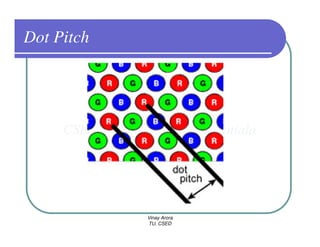
Dot Pitch


            Vinay Arora
            TU, CSED
Flat Panel Displays
   A class of video devices that have reduce volume and weight compared
   to a CRT.

   A significant feature of Flat Panel Displays is that they are thinner than
   CRTs.

   Current uses for Flat Panel Displays:

        Small TV monitors
        Calculators
        Pocket video games
        Laptop computers
        Advertisement board in elevators
                                   Vinay Arora
                                   TU, CSED
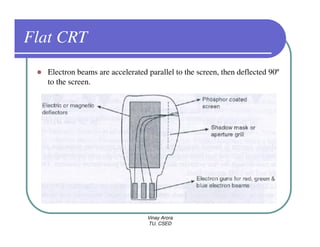
Flat CRT
   Electron beams are accelerated parallel to the screen, then deflected 90º
   to the screen.


                                  Vinay Arora
                                  TU, CSED
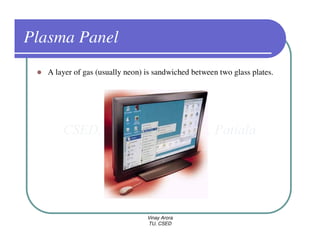
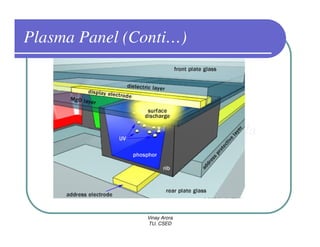
Plasma Panel
   A layer of gas (usually neon) is sandwiched between two glass plates.


                                 Vinay Arora
                                 TU, CSED
Plasma Panel (Conti…)


               Vinay Arora
               TU, CSED
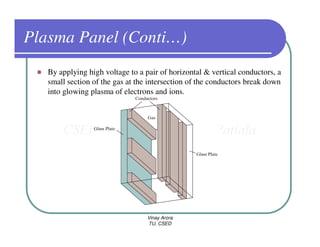
Plasma Panel (Conti…)
   By applying high voltage to a pair of horizontal & vertical conductors, a
   small section of the gas at the intersection of the conductors break down
   into glowing plasma of electrons and ions.


                                  Vinay Arora
                                  TU, CSED
Thin Film Electroluminescent
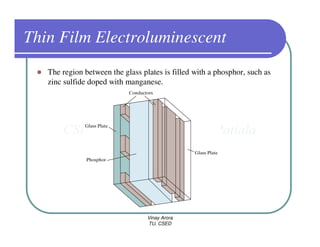
   The region between the glass plates is filled with a phosphor, such as
   zinc sulfide doped with manganese.


                                  Vinay Arora
                                  TU, CSED
Light Emitting Diode (LED)
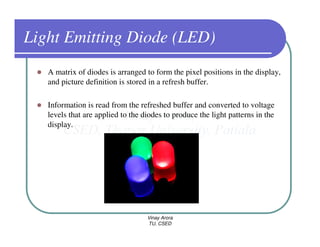
   A matrix of diodes is arranged to form the pixel positions in the display,
   and picture definition is stored in a refresh buffer.

   Information is read from the refreshed buffer and converted to voltage
   levels that are applied to the diodes to produce the light patterns in the
   display.


                                   Vinay Arora
                                   TU, CSED
Liquid Crystal Displays (LCD)
   Used in small systems, such as calculators, laptop computers.

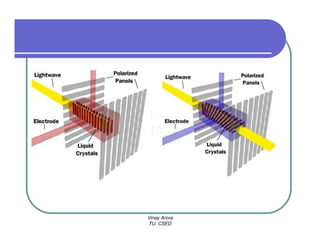
   Produce a picture by passing polarized light (from the surrounding
   or from an internal light source) through a liquid-crystal material that
   can be aligned to either block or transmit the light.

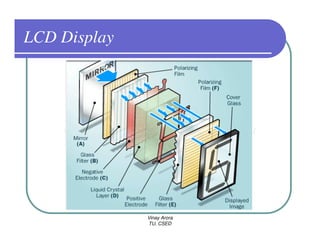
   Two glass plates, each containing a light polarizer at right angles to the
   other plate, sandwich the liquid crystal materials.

   Rows of horizontal transparent conductor & columns of vertical
   conductors (put into glass plates)


                                   Vinay Arora
                                   TU, CSED
LCD Display


              Vinay Arora
              TU, CSED
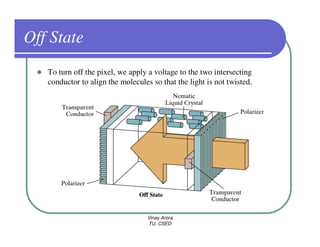
Off State
   To turn off the pixel, we apply a voltage to the two intersecting
   conductor to align the molecules so that the light is not twisted.


                                   Vinay Arora
                                   TU, CSED
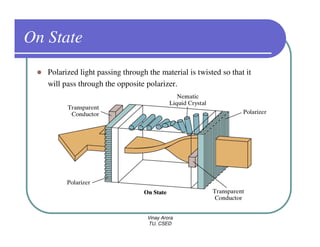
On State
   Polarized light passing through the material is twisted so that it
   will pass through the opposite polarizer.


                                   Vinay Arora
                                   TU, CSED
Vinay Arora
TU, CSED
Color Model


              Vinay Arora
              TU, CSED
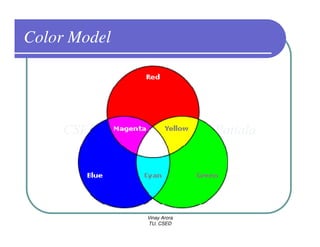
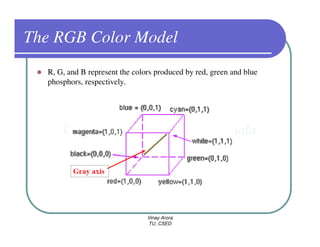
The RGB Color Model
  R, G, and B represent the colors produced by red, green and blue
  phosphors, respectively.


                                Vinay Arora
                                TU, CSED
Color Depth, Bit Depth
   The number of discrete intensities that the video card is capable of
   generating for each color determines the maximum number of colors
   that can be displayed.

   The Number of Memory Bits required to store color information
   (intensity values for all three primary color components) about a pixel is
   called COLOR DEPTH or BIT DEPTH.

   A minimum of one memory bit (color depth=1) is required to store
   intensity value either 0 or 1 for every screen pixel.


   If there are n pixels in an image a total of n bits memory used for storing
   intensity values (in a pure black & white image)

                                   Vinay Arora
                                   TU, CSED
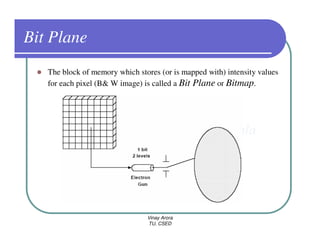
Bit Plane
   The block of memory which stores (or is mapped with) intensity values
   for each pixel (B& W image) is called a Bit Plane or Bitmap.


                                Vinay Arora
                                TU, CSED
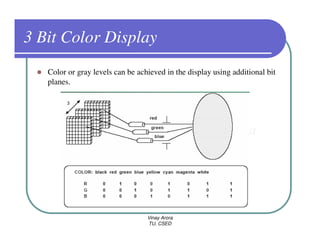
3 Bit Color Display
   Color or gray levels can be achieved in the display using additional bit
   planes.


                                  Vinay Arora
                                  TU, CSED
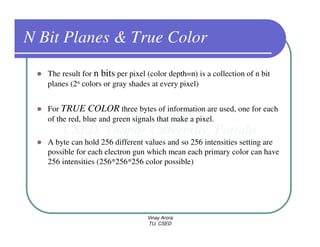
N Bit Planes & True Color
   The result for n bits per pixel (color depth=n) is a collection of n bit
   planes (2n colors or gray shades at every pixel)


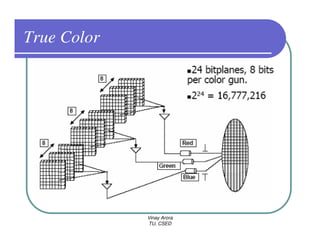
   For TRUE COLOR three bytes of information are used, one for each
   of the red, blue and green signals that make a pixel.

   A byte can hold 256 different values and so 256 intensities setting are
   possible for each electron gun which mean each primary color can have
   256 intensities (256*256*256 color possible)


                                   Vinay Arora
                                   TU, CSED
True Color


             Vinay Arora
             TU, CSED
Frame Buffer


               Vinay Arora
               TU, CSED
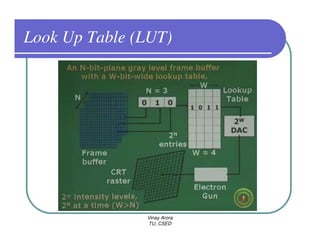
Look Up Table (LUT)


               Vinay Arora
               TU, CSED
Frame Buffer with LUT


                Vinay Arora
                TU, CSED
Frame Buffer with LUT (Conti…)


                Vinay Arora
                TU, CSED
General Terms
   Modeling Coordinates

   World Coordinates

   Device Coordinates

   Geometric Transformations

   Viewing Transformations

   GKS (Graphics Kernel System)

   PHIGS/PHIGS+ (Programmer’s Hierarchical Interactive Graphics Standard)

                                  Vinay Arora
                                  TU, CSED
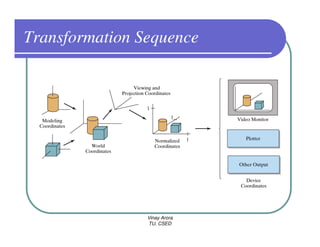
Transformation Sequence


                Vinay Arora
                TU, CSED
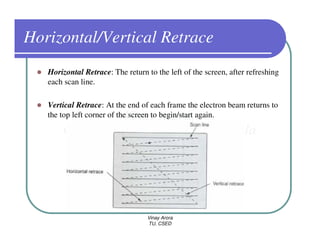
Horizontal/Vertical Retrace
   Horizontal Retrace: The return to the left of the screen, after refreshing
   each scan line.

   Vertical Retrace: At the end of each frame the electron beam returns to
   the top left corner of the screen to begin/start again.


                                  Vinay Arora
                                  TU, CSED
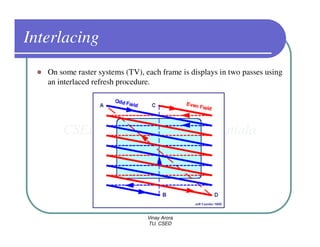
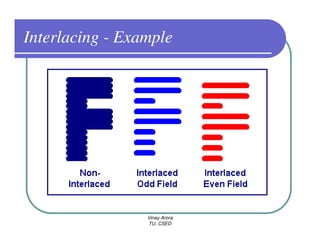
Interlacing
   On some raster systems (TV), each frame is displays in two passes using
   an interlaced refresh procedure.


                                 Vinay Arora
                                 TU, CSED
Interlacing - Example


                 Vinay Arora
                 TU, CSED
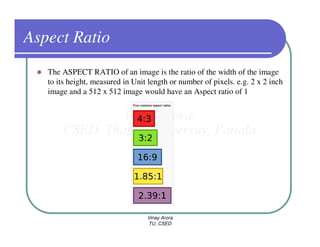
Aspect Ratio
   The ASPECT RATIO of an image is the ratio of the width of the image
   to its height, measured in Unit length or number of pixels. e.g. 2 x 2 inch
   image and a 512 x 512 image would have an Aspect ratio of 1


                                  Vinay Arora
                                  TU, CSED
Resolution


   Can be defined as the Number of Pixels per unit Length.


   Normally Image Size is given as Total Number of pixels in Horizontal
   direction times the Total number of pixels in Vertical direction.
   e.g. 512 x 512, 1024 x 768 etc.


                                 Vinay Arora
                                 TU, CSED
Thnx…


  Vinay Arora
  TU, CSED

CG - Display Devices

  • 1.
    Display Devices Organized By:Vinay Arora Assistant Professor, CSED Thapar University, Patiala
  • 2.
    Disclaimer This is NOT A COPYRIGHT MATERIAL Content has been taken mainly from the following books & websites: Computer Graphics C Version By Donald Hearn, M. Pauline Baker Schaum's outline of theory and problems of computer graphics By Zhigang Xiang, Roy A. Plastock Computer Graphics: Principles and Practice By James D. Foley http://en.wikipedia.org/wiki/Computer_graphics http://www.howstuffworks.com/3dgraphics.htm http://www.graphics.cornell.edu/online/tutorial/ http://www.cgarena.com/ etc… Vinay Arora TU, CSED
  • 3.
    Display Devices A Display Device is an Output device for presentation of Information for Visual reception. The Display Systems are often referred to as Video Monitor or Video Display Unit (VDU). Display Devices having CRT:- DVST – Direct View Storage Tube Random Scan Raster Scan Vinay Arora TU, CSED
  • 4.
    Computer Monitor -External View Vinay Arora TU, CSED
  • 5.
    Computer Monitor -Internal View Vinay Arora TU, CSED
  • 6.
    CRT Vinay Arora TU, CSED
  • 7.
    Electron Gun Vinay Arora TU, CSED
  • 8.
    Electron Gun Heat is supplied to the cathode by the Filament. Vinay Arora TU, CSED
  • 9.
    CRT - Operationof Electron Gun Vinay Arora TU, CSED
  • 10.
    Positively Charged Metal(No Accelerating Anode) A positively charged metal coating on the inside of the CRT envelope near the phosphor screen. Vinay Arora TU, CSED
  • 11.
    Electrostatic Deflection Vinay Arora TU, CSED
  • 12.
    Magnetic Deflection Vinay Arora TU, CSED
  • 13.
    Magnetic Coil Vinay Arora TU, CSED
  • 14.
    CRT Vinay Arora TU, CSED
  • 15.
    Brands of CRT Vinay Arora TU, CSED
  • 16.
    Resolution Vinay Arora TU, CSED
  • 17.
    Resolution Vinay Arora TU, CSED
  • 18.
    Related Terms Fluorescence – Is the light emitted as electrons lose their excess energy while the Phosphor is being struck by electrons. Phosphorescence – Is the light given off by the return of the relatively more stable excited electrons to their unexcited state, once the electron beam excitation is removed. Persistence – Time from the removal of the excitation to the moment when Phosphorescence has decayed to 10% of the Initial Light Output. Vinay Arora TU, CSED
  • 19.
    Raster Scan Display Raster Scan is the representation of images as a collection of pixels/dots (A Rectangular array of Points or Dots) Pixel: One Dot or Picture element of the Raster Scan Line: A Row of Pixels Vinay Arora TU, CSED
  • 20.
    Raster Scan Display(contd.) In a Raster Scan System, the electron beam is swept across the screen, one row at a time from top to bottom. Vinay Arora TU, CSED
  • 21.
    Raster Scan Display(contd.) Picture Definition is stored in a memory area called the Refresh Buffer or Frame Buffer. Refresh Buffer or Frame Buffer This memory area holds the set of intensity values for all the screen points. Stored Intensity values then retrieved from refresh buffer and “painted” on the screen one row (scan line) at a time. Vinay Arora TU, CSED
  • 22.
    Raster Scan Display(contd.) Vinay Arora TU, CSED
  • 23.
    Raster Drawing Vinay Arora TU, CSED
  • 24.
    Architecture - RasterSystem In addition to the Central Processing Unit (CPU), a special processor, called the Video Controller or Display Controller, is used to control the operation of the Display Device. Vinay Arora TU, CSED
  • 25.
    Architecture - RasterSystem (Conti…) A fixed area of the system memory is reserved for the frame buffer, and the video controller is given direct access to the frame buffer memory. Vinay Arora TU, CSED
  • 26.
    Pixel Coordinate System In a Pixel Coordinate System the Pixel at the Lower Left corner of an image is considered to be at the origin (0,0). Vinay Arora TU, CSED
  • 27.
    Cartesian Coordinates Screen Positions, are referenced in Cartesian Coordinates. Scan Lines are then labeled from ymax at the top of the screen to 0 at the bottom. Along each scan line, screen pixel positions are labeled from 0 to xmax. Vinay Arora TU, CSED
  • 28.
    Registers for StoringCoordinates Vinay Arora TU, CSED
  • 29.
    Random Scan Display In a Random Scan Display, a CRT has the electron beam directed only to the parts of the screen where a picture is to be drawn. Random Scan monitors draw a picture One Line at a time (Vector Display, Stroke – Writing or Calligraphic Displays). Refresh rate depends on the number of lines to be displayed. Picture Definition is now stored as a Line-Drawing Commands an area of memory referred to as refresh display file (display list). To Display a Picture, the system cycle through the set of commands in the display file, drawing each component line in turn. Vinay Arora TU, CSED
  • 30.
    Random Scan Display The component lines of a picture can be drawn and refreshed. Vinay Arora TU, CSED
  • 31.
    Random Scan Drawing Vinay Arora TU, CSED
  • 32.
    Architecture - RandomSystem Vinay Arora TU, CSED
  • 33.
    Random Scan Display Random Scan Displays are designed to draw all the component lines of a picture 30 to 60 times each second. Vinay Arora TU, CSED
  • 34.
    Vector Drawing Vinay Arora TU, CSED
  • 35.
    Random Scan Drawing Random scan displays are designed for line drawing applications and can not display realistic shaded scenes. Vinay Arora TU, CSED
  • 36.
    View of Raster/Random Vinay Arora TU, CSED
  • 37.
    Bitmap / Pixmap A Black-and-White System: Each Screen Point is either ON or OFF, so only one bit per pixel is needed to control the intensity of screen positions. On a Black-and-White System with one bit per pixel, the Frame Buffer is called BITMAP. For system with multiple bits per pixel, the Frame Buffer is called PIXMAP. Sometimes, refresh rates are described in unit of cycles per second, or Hertz (HZ) Vinay Arora TU, CSED
  • 38.
    Color CRT Monitors A CRT monitor displays color pictures by using a combination of phosphors that emit different COLOR lights. Methods:- 1. Beam Penetration 2. Shadow Mask Vinay Arora TU, CSED
  • 39.
    Beam Penetration Method Used with Random Scan monitors. Two layers of phosphor (red and green) are coated onto the inside of the CRT screen. The display color depends on how far the electron beam penetrates into the phosphor layers. The speed of the electrons, and the screen color at any point, is controlled by the beam acceleration voltage. Vinay Arora TU, CSED
  • 40.
    Beam Penetration Method(contd.) Only 4 colors are possible (red, green, orange, and yellow). Quality of pictures is not as good as with other methods. Vinay Arora TU, CSED
  • 41.
    Shadow Mask Method The color CRT has:- Three color phosphor dots (red, green and blue) at each point on the screen. Three electron guns, each controlling the display of red, green and blue light. 2 Methods for Implementation:- 1. Delta Method. 2. Inline Method. Vinay Arora TU, CSED
  • 42.
    Shadow Mask Method(contd.) Used in raster scan system (including color TV) We obtain color variations by varying the intensity levels of the three electron beam. Designed as RGB monitors. High quality raster graphics system have 24 bits per pixel in the frame buffer (a Full Color System or a True Color System) Vinay Arora TU, CSED
  • 43.
    Shadow Mask –Delta Method Vinay Arora TU, CSED
  • 44.
    Delta Method Vinay Arora TU, CSED
  • 45.
    Shadow Mask –Inline Method Vinay Arora TU, CSED
  • 46.
    In Line Method Vinay Arora TU, CSED
  • 47.
    Dot Pitch Vinay Arora TU, CSED
  • 48.
    Flat Panel Displays A class of video devices that have reduce volume and weight compared to a CRT. A significant feature of Flat Panel Displays is that they are thinner than CRTs. Current uses for Flat Panel Displays: Small TV monitors Calculators Pocket video games Laptop computers Advertisement board in elevators Vinay Arora TU, CSED
  • 49.
    Flat CRT Electron beams are accelerated parallel to the screen, then deflected 90º to the screen. Vinay Arora TU, CSED
  • 50.
    Plasma Panel A layer of gas (usually neon) is sandwiched between two glass plates. Vinay Arora TU, CSED
  • 51.
    Plasma Panel (Conti…) Vinay Arora TU, CSED
  • 52.
    Plasma Panel (Conti…) By applying high voltage to a pair of horizontal & vertical conductors, a small section of the gas at the intersection of the conductors break down into glowing plasma of electrons and ions. Vinay Arora TU, CSED
  • 53.
    Thin Film Electroluminescent The region between the glass plates is filled with a phosphor, such as zinc sulfide doped with manganese. Vinay Arora TU, CSED
  • 54.
    Light Emitting Diode(LED) A matrix of diodes is arranged to form the pixel positions in the display, and picture definition is stored in a refresh buffer. Information is read from the refreshed buffer and converted to voltage levels that are applied to the diodes to produce the light patterns in the display. Vinay Arora TU, CSED
  • 55.
    Liquid Crystal Displays(LCD) Used in small systems, such as calculators, laptop computers. Produce a picture by passing polarized light (from the surrounding or from an internal light source) through a liquid-crystal material that can be aligned to either block or transmit the light. Two glass plates, each containing a light polarizer at right angles to the other plate, sandwich the liquid crystal materials. Rows of horizontal transparent conductor & columns of vertical conductors (put into glass plates) Vinay Arora TU, CSED
  • 56.
    LCD Display Vinay Arora TU, CSED
  • 57.
    Off State To turn off the pixel, we apply a voltage to the two intersecting conductor to align the molecules so that the light is not twisted. Vinay Arora TU, CSED
  • 58.
    On State Polarized light passing through the material is twisted so that it will pass through the opposite polarizer. Vinay Arora TU, CSED
  • 59.
  • 60.
    Color Model Vinay Arora TU, CSED
  • 61.
    The RGB ColorModel R, G, and B represent the colors produced by red, green and blue phosphors, respectively. Vinay Arora TU, CSED
  • 62.
    Color Depth, BitDepth The number of discrete intensities that the video card is capable of generating for each color determines the maximum number of colors that can be displayed. The Number of Memory Bits required to store color information (intensity values for all three primary color components) about a pixel is called COLOR DEPTH or BIT DEPTH. A minimum of one memory bit (color depth=1) is required to store intensity value either 0 or 1 for every screen pixel. If there are n pixels in an image a total of n bits memory used for storing intensity values (in a pure black & white image) Vinay Arora TU, CSED
  • 63.
    Bit Plane The block of memory which stores (or is mapped with) intensity values for each pixel (B& W image) is called a Bit Plane or Bitmap. Vinay Arora TU, CSED
  • 64.
    3 Bit ColorDisplay Color or gray levels can be achieved in the display using additional bit planes. Vinay Arora TU, CSED
  • 65.
    N Bit Planes& True Color The result for n bits per pixel (color depth=n) is a collection of n bit planes (2n colors or gray shades at every pixel) For TRUE COLOR three bytes of information are used, one for each of the red, blue and green signals that make a pixel. A byte can hold 256 different values and so 256 intensities setting are possible for each electron gun which mean each primary color can have 256 intensities (256*256*256 color possible) Vinay Arora TU, CSED
  • 66.
    True Color Vinay Arora TU, CSED
  • 67.
    Frame Buffer Vinay Arora TU, CSED
  • 68.
    Look Up Table(LUT) Vinay Arora TU, CSED
  • 69.
    Frame Buffer withLUT Vinay Arora TU, CSED
  • 70.
    Frame Buffer withLUT (Conti…) Vinay Arora TU, CSED
  • 71.
    General Terms Modeling Coordinates World Coordinates Device Coordinates Geometric Transformations Viewing Transformations GKS (Graphics Kernel System) PHIGS/PHIGS+ (Programmer’s Hierarchical Interactive Graphics Standard) Vinay Arora TU, CSED
  • 72.
    Transformation Sequence Vinay Arora TU, CSED
  • 73.
    Horizontal/Vertical Retrace Horizontal Retrace: The return to the left of the screen, after refreshing each scan line. Vertical Retrace: At the end of each frame the electron beam returns to the top left corner of the screen to begin/start again. Vinay Arora TU, CSED
  • 74.
    Interlacing On some raster systems (TV), each frame is displays in two passes using an interlaced refresh procedure. Vinay Arora TU, CSED
  • 75.
    Interlacing - Example Vinay Arora TU, CSED
  • 76.
    Aspect Ratio The ASPECT RATIO of an image is the ratio of the width of the image to its height, measured in Unit length or number of pixels. e.g. 2 x 2 inch image and a 512 x 512 image would have an Aspect ratio of 1 Vinay Arora TU, CSED
  • 77.
    Resolution Can be defined as the Number of Pixels per unit Length. Normally Image Size is given as Total Number of pixels in Horizontal direction times the Total number of pixels in Vertical direction. e.g. 512 x 512, 1024 x 768 etc. Vinay Arora TU, CSED
  • 78.
    Thnx… VinayArora TU, CSED