B-Tech CSE 6th
13/NR/UT/CS005
Submitted By: Shivani Soni
Submitted To: Mr. Vinod Thakur
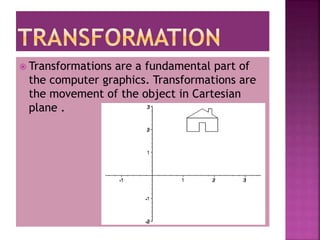
 Transformations are a fundamental part of
the computer graphics. Transformations are
the movement of the object in Cartesian
plane .
 There are two types of transformation in
computer graphics.
 1) 2D transformation
 2) 3D transformation
 Types of 2D and 3D transformation
 1) Translation
 2) Rotation
 3) Scaling
 4) Shearing
 5) Mirror reflection
 Transformation are used to position
objects , to shape object , to change
viewing positions , and even how
something is viewed.
 In simple words transformation is used for
 1) Modeling
 2) viewing
 When the transformation takes place on a 2D
plane .it is called 2D transformation.
 2D means two dimensional (x-axis and Y-axis)
Object Transformation in 2D
 Alter the coordinates descriptions an object
 Translation , rotation , scaling , shearing,
 reflection.
 Coordinate system unchanged
Coordinate transformation in 2D
 Produce a different coordinate system
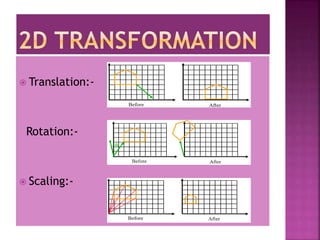
 Translation:-
Rotation:-
 Scaling:-
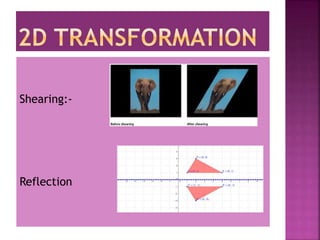
Shearing:-
Reflection
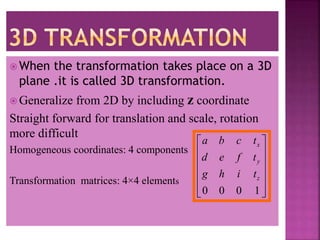
 When the transformation takes place on a 3D
plane .it is called 3D transformation.
 Generalize from 2D by including z coordinate
Straight forward for translation and scale, rotation
more difficult
Homogeneous coordinates: 4 components
Transformation matrices: 4×4 elements 











1000
z
y
x
tihg
tfed
tcba
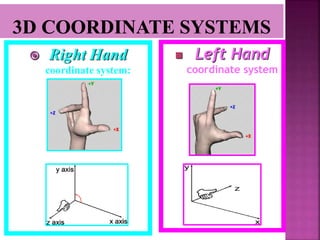
 Right Hand
coordinate system:
 Left Hand
coordinate system
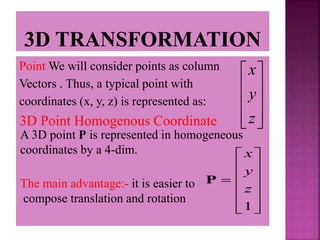
Point We will consider points as column
Vectors . Thus, a typical point with
coordinates (x, y, z) is represented as:










z
y
x
3D Point Homogenous Coordinate
A 3D point P is represented in homogeneous
coordinates by a 4-dim.
The main advantage:- it is easier to
compose translation and rotation 












1
z
y
x
P
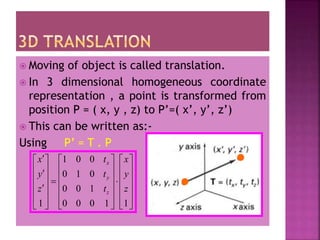
 Moving of object is called translation.
 In 3 dimensional homogeneous coordinate
representation , a point is transformed from
position P = ( x, y , z) to P’=( x’, y’, z’)
 This can be written as:-
Using P’ = T . P









































11000
100
010
001
1
z
y
x
t
t
t
z
y
x
z
y
x
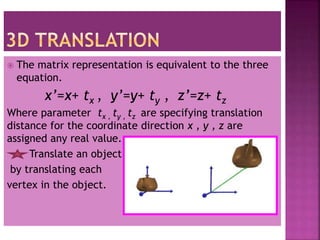
 The matrix representation is equivalent to the three
equation.
x’=x+ tx , y’=y+ ty , z’=z+ tz
Where parameter tx , ty , tz are specifying translation
distance for the coordinate direction x , y , z are
assigned any real value.
Translate an object
by translating each
vertex in the object.
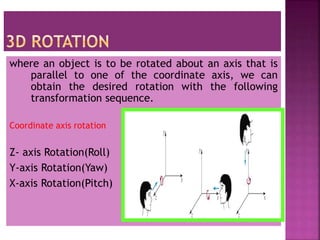
where an object is to be rotated about an axis that is
parallel to one of the coordinate axis, we can
obtain the desired rotation with the following
transformation sequence.
Coordinate axis rotation
Z- axis Rotation(Roll)
Y-axis Rotation(Yaw)
X-axis Rotation(Pitch)
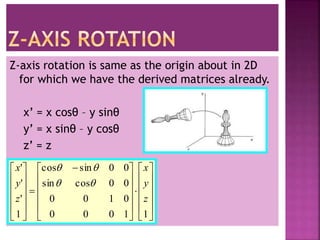
Z-axis rotation is same as the origin about in 2D
for which we have the derived matrices already.
x’ = x cosθ – y sinθ
y’ = x sinθ – y cosθ
z’ = z
























 













11000
0100
00cossin
00sincos
1
'
'
'
z
y
x
z
y
x


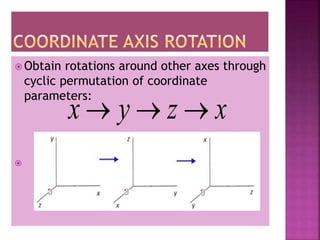
 Obtain rotations around other axes through
cyclic permutation of coordinate
parameters:

xzyx 
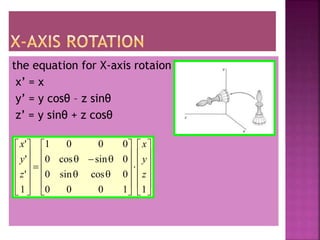
the equation for X-axis rotaion
x’ = x
y’ = y cosθ – z sinθ
z’ = y sinθ + z cosθ








































11000
0cossin0
0sincos0
0001
1
'
'
'
z
y
x
z
y
x
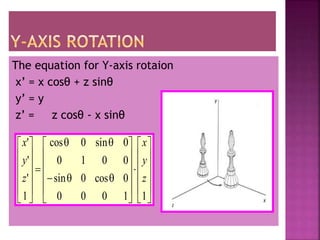
The equation for Y-axis rotaion
x’ = x cosθ + z sinθ
y’ = y
z’ = z cosθ - x sinθ








































11000
0cos0sin
0010
0sin0cos
1
'
'
'
z
y
x
z
y
x
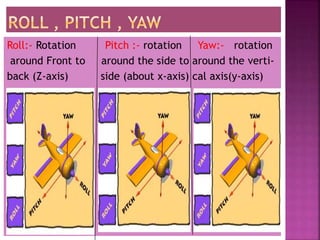
Roll:- Rotation Pitch :- rotation Yaw:- rotation
around Front to around the side to around the verti-
back (Z-axis) side (about x-axis) cal axis(y-axis)
 Changes the size of the object and repositions
the object relative to the coordinate origin.
PSP 









































11000
000
000
000
1
z
y
x
s
s
s
z
y
x
z
y
x
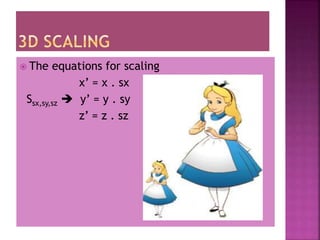
 The equations for scaling
x’ = x . sx
Ssx,sy,sz  y’ = y . sy
z’ = z . sz
 The equations for scaling
x’ = x . sx
Ssx,sy,sz  y’ = y . sy
z’ = z . sz
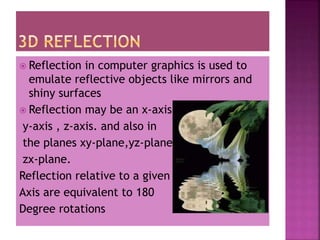
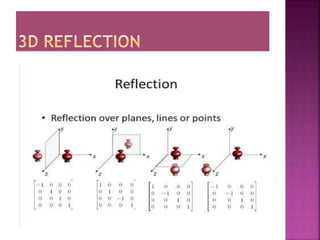
 Reflection in computer graphics is used to
emulate reflective objects like mirrors and
shiny surfaces
 Reflection may be an x-axis
y-axis , z-axis. and also in
the planes xy-plane,yz-plane , and
zx-plane.
Reflection relative to a given
Axis are equivalent to 180
Degree rotations
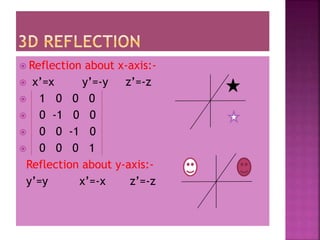
 Reflection about x-axis:-
 x’=x y’=-y z’=-z
 1 0 0 0
 0 -1 0 0
 0 0 -1 0
 0 0 0 1
Reflection about y-axis:-
y’=y x’=-x z’=-z
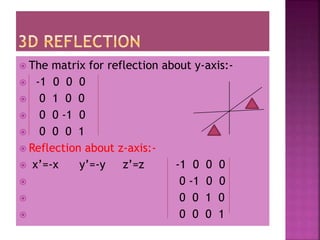
 The matrix for reflection about y-axis:-
 -1 0 0 0
 0 1 0 0
 0 0 -1 0
 0 0 0 1
 Reflection about z-axis:-
 x’=-x y’=-y z’=z -1 0 0 0
 0 -1 0 0
 0 0 1 0
 0 0 0 1
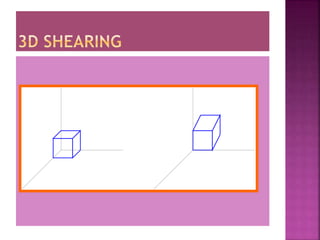
 Modify object shapes
 Useful for perspective projections
 When an object is viewed from different
directions and at different distances, the
appearance of the object will be different.
Such view is called perspective
view. Perspective projections mimic what the
human eyes see.
E.g. draw a cube (3D) on a screen (2D) Alter the
values for x and y by an amount proportional to
the distance from zref
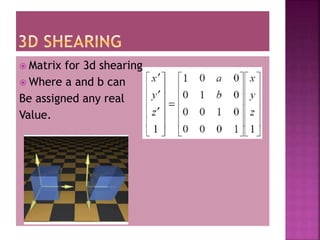
 Matrix for 3d shearing
 Where a and b can
Be assigned any real
Value.
3D transformation in computer graphics

3D transformation in computer graphics

  • 1.
    B-Tech CSE 6th 13/NR/UT/CS005 SubmittedBy: Shivani Soni Submitted To: Mr. Vinod Thakur
  • 2.
     Transformations area fundamental part of the computer graphics. Transformations are the movement of the object in Cartesian plane .
  • 3.
     There aretwo types of transformation in computer graphics.  1) 2D transformation  2) 3D transformation  Types of 2D and 3D transformation  1) Translation  2) Rotation  3) Scaling  4) Shearing  5) Mirror reflection
  • 4.
     Transformation areused to position objects , to shape object , to change viewing positions , and even how something is viewed.  In simple words transformation is used for  1) Modeling  2) viewing
  • 5.
     When thetransformation takes place on a 2D plane .it is called 2D transformation.  2D means two dimensional (x-axis and Y-axis) Object Transformation in 2D  Alter the coordinates descriptions an object  Translation , rotation , scaling , shearing,  reflection.  Coordinate system unchanged Coordinate transformation in 2D  Produce a different coordinate system
  • 6.
  • 7.
  • 9.
     When thetransformation takes place on a 3D plane .it is called 3D transformation.  Generalize from 2D by including z coordinate Straight forward for translation and scale, rotation more difficult Homogeneous coordinates: 4 components Transformation matrices: 4×4 elements             1000 z y x tihg tfed tcba
  • 10.
     Right Hand coordinatesystem:  Left Hand coordinate system
  • 11.
    Point We willconsider points as column Vectors . Thus, a typical point with coordinates (x, y, z) is represented as:           z y x 3D Point Homogenous Coordinate A 3D point P is represented in homogeneous coordinates by a 4-dim. The main advantage:- it is easier to compose translation and rotation              1 z y x P
  • 12.
     Moving ofobject is called translation.  In 3 dimensional homogeneous coordinate representation , a point is transformed from position P = ( x, y , z) to P’=( x’, y’, z’)  This can be written as:- Using P’ = T . P                                          11000 100 010 001 1 z y x t t t z y x z y x
  • 13.
     The matrixrepresentation is equivalent to the three equation. x’=x+ tx , y’=y+ ty , z’=z+ tz Where parameter tx , ty , tz are specifying translation distance for the coordinate direction x , y , z are assigned any real value. Translate an object by translating each vertex in the object.
  • 14.
    where an objectis to be rotated about an axis that is parallel to one of the coordinate axis, we can obtain the desired rotation with the following transformation sequence. Coordinate axis rotation Z- axis Rotation(Roll) Y-axis Rotation(Yaw) X-axis Rotation(Pitch)
  • 15.
    Z-axis rotation issame as the origin about in 2D for which we have the derived matrices already. x’ = x cosθ – y sinθ y’ = x sinθ – y cosθ z’ = z                                        11000 0100 00cossin 00sincos 1 ' ' ' z y x z y x  
  • 16.
     Obtain rotationsaround other axes through cyclic permutation of coordinate parameters:  xzyx 
  • 17.
    the equation forX-axis rotaion x’ = x y’ = y cosθ – z sinθ z’ = y sinθ + z cosθ                                         11000 0cossin0 0sincos0 0001 1 ' ' ' z y x z y x
  • 18.
    The equation forY-axis rotaion x’ = x cosθ + z sinθ y’ = y z’ = z cosθ - x sinθ                                         11000 0cos0sin 0010 0sin0cos 1 ' ' ' z y x z y x
  • 19.
    Roll:- Rotation Pitch:- rotation Yaw:- rotation around Front to around the side to around the verti- back (Z-axis) side (about x-axis) cal axis(y-axis)
  • 20.
     Changes thesize of the object and repositions the object relative to the coordinate origin. PSP                                           11000 000 000 000 1 z y x s s s z y x z y x
  • 21.
     The equationsfor scaling x’ = x . sx Ssx,sy,sz  y’ = y . sy z’ = z . sz  The equations for scaling x’ = x . sx Ssx,sy,sz  y’ = y . sy z’ = z . sz
  • 22.
     Reflection incomputer graphics is used to emulate reflective objects like mirrors and shiny surfaces  Reflection may be an x-axis y-axis , z-axis. and also in the planes xy-plane,yz-plane , and zx-plane. Reflection relative to a given Axis are equivalent to 180 Degree rotations
  • 23.
     Reflection aboutx-axis:-  x’=x y’=-y z’=-z  1 0 0 0  0 -1 0 0  0 0 -1 0  0 0 0 1 Reflection about y-axis:- y’=y x’=-x z’=-z
  • 24.
     The matrixfor reflection about y-axis:-  -1 0 0 0  0 1 0 0  0 0 -1 0  0 0 0 1  Reflection about z-axis:-  x’=-x y’=-y z’=z -1 0 0 0  0 -1 0 0  0 0 1 0  0 0 0 1
  • 26.
     Modify objectshapes  Useful for perspective projections  When an object is viewed from different directions and at different distances, the appearance of the object will be different. Such view is called perspective view. Perspective projections mimic what the human eyes see. E.g. draw a cube (3D) on a screen (2D) Alter the values for x and y by an amount proportional to the distance from zref
  • 28.
     Matrix for3d shearing  Where a and b can Be assigned any real Value.