Prof. Neeraj Bhargava
Pooja Dixit
Department of Computer Science
School of Engineering & System Sciences
MDS, University Ajmer, Rajasthan, India
1
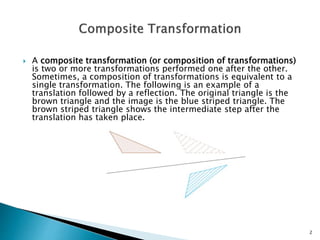
 A composite transformation (or composition of transformations)
is two or more transformations performed one after the other.
Sometimes, a composition of transformations is equivalent to a
single transformation. The following is an example of a
translation followed by a reflection. The original triangle is the
brown triangle and the image is the blue striped triangle. The
brown striped triangle shows the intermediate step after the
translation has taken place.
2
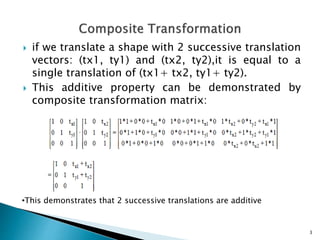
 if we translate a shape with 2 successive translation
vectors: (tx1, ty1) and (tx2, ty2),it is equal to a
single translation of (tx1+ tx2, ty1+ ty2).
 This additive property can be demonstrated by
composite transformation matrix:
•This demonstrates that 2 successive translations are additive
3
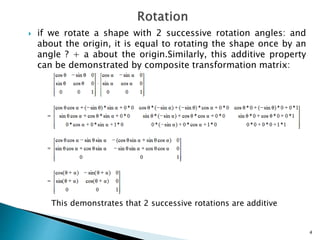
 if we rotate a shape with 2 successive rotation angles: and
about the origin, it is equal to rotating the shape once by an
angle ? + a about the origin.Similarly, this additive property
can be demonstrated by composite transformation matrix:
This demonstrates that 2 successive rotations are additive
4
 SCALING
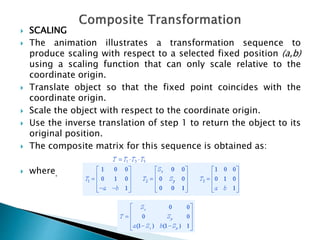
 The animation illustrates a transformation sequence to
produce scaling with respect to a selected fixed position (a,b)
using a scaling function that can only scale relative to the
coordinate origin.
 Translate object so that the fixed point coincides with the
coordinate origin.
 Scale the object with respect to the coordinate origin.
 Use the inverse translation of step 1 to return the object to its
original position.
 The composite matrix for this sequence is obtained as:
 where,

Composite transformation

  • 1.
    Prof. Neeraj Bhargava PoojaDixit Department of Computer Science School of Engineering & System Sciences MDS, University Ajmer, Rajasthan, India 1
  • 2.
     A compositetransformation (or composition of transformations) is two or more transformations performed one after the other. Sometimes, a composition of transformations is equivalent to a single transformation. The following is an example of a translation followed by a reflection. The original triangle is the brown triangle and the image is the blue striped triangle. The brown striped triangle shows the intermediate step after the translation has taken place. 2
  • 3.
     if wetranslate a shape with 2 successive translation vectors: (tx1, ty1) and (tx2, ty2),it is equal to a single translation of (tx1+ tx2, ty1+ ty2).  This additive property can be demonstrated by composite transformation matrix: •This demonstrates that 2 successive translations are additive 3
  • 4.
     if werotate a shape with 2 successive rotation angles: and about the origin, it is equal to rotating the shape once by an angle ? + a about the origin.Similarly, this additive property can be demonstrated by composite transformation matrix: This demonstrates that 2 successive rotations are additive 4
  • 5.
     SCALING  Theanimation illustrates a transformation sequence to produce scaling with respect to a selected fixed position (a,b) using a scaling function that can only scale relative to the coordinate origin.  Translate object so that the fixed point coincides with the coordinate origin.  Scale the object with respect to the coordinate origin.  Use the inverse translation of step 1 to return the object to its original position.  The composite matrix for this sequence is obtained as:  where,