2D TRANSFORMATIONS
COMPUTER GRAPHICS
2D Transformations
“Transformations are the operations applied to
geometrical description of an object to change its
position, orientation, or size are called geometric
transformations”.
Translation
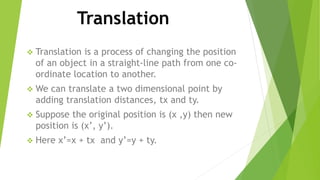
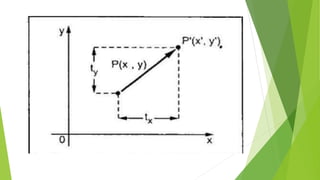
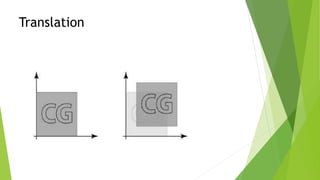
 Translation is a process of changing the position
of an object in a straight-line path from one co-
ordinate location to another.
 We can translate a two dimensional point by
adding translation distances, tx and ty.
 Suppose the original position is (x ,y) then new
position is (x’, y’).
 Here x’=x + tx and y’=y + ty.
Translation
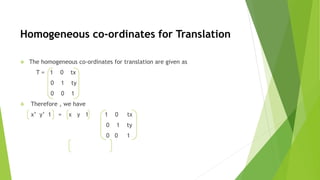
Homogeneous co-ordinates for Translation
 The homogeneous co-ordinates for translation are given as
T = 1 0 tx
0 1 ty
0 0 1
 Therefore , we have
x’ y’ 1 = x y 1 1 0 tx
0 1 ty
0 0 1
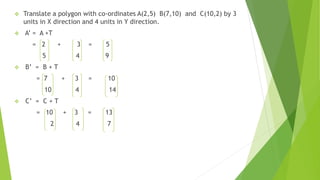
 Translate a polygon with co-ordinates A(2,5) B(7,10) and C(10,2) by 3
units in X direction and 4 units in Y direction.
 A’ = A +T
= 2 + 3 = 5
5 4 9
 B’ = B + T
= 7 + 3 = 10
10 4 14
 C’ = C + T
= 10 + 3 = 13
2 4 7
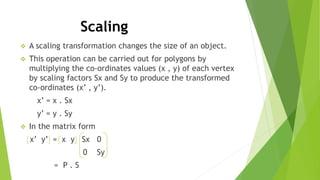
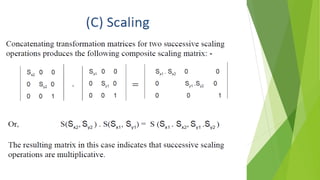
Scaling
 A scaling transformation changes the size of an object.
 This operation can be carried out for polygons by
multiplying the co-ordinates values (x , y) of each vertex
by scaling factors Sx and Sy to produce the transformed
co-ordinates (x’ , y’).
x’ = x . Sx
y’ = y . Sy
 In the matrix form
x’ y’ = x y Sx 0
0 Sy
= P . S
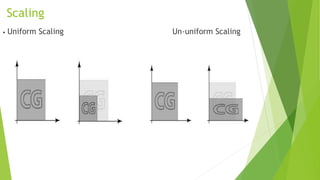
Scaling
• Uniform Scaling Un-uniform Scaling
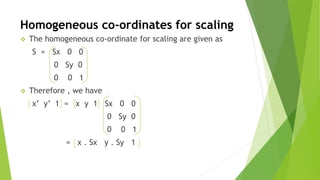
Homogeneous co-ordinates for scaling
 The homogeneous co-ordinate for scaling are given as
S = Sx 0 0
0 Sy 0
0 0 1
 Therefore , we have
x’ y’ 1 = x y 1 Sx 0 0
0 Sy 0
0 0 1
= x . Sx y . Sy 1
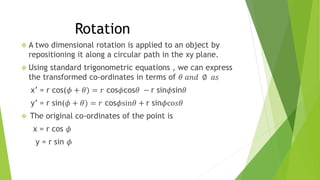
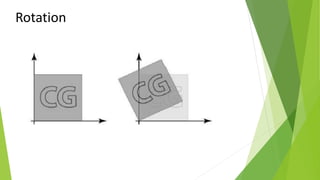
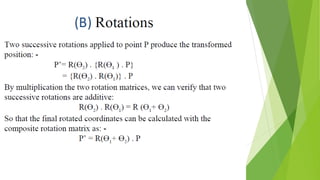
Rotation
 A two dimensional rotation is applied to an object by
repositioning it along a circular path in the xy plane.
 Using standard trigonometric equations , we can express
the transformed co-ordinates in terms of 𝜃 𝑎𝑛𝑑 ∅ 𝑎𝑠
x’ = r cos(𝜙 + 𝜃) = 𝑟 cos𝜙cos𝜃 − r sin𝜙sin𝜃
y’ = r sin(𝜙 + 𝜃) = 𝑟 cos𝜙sin𝜃 + r sin𝜙co𝑠𝜃
 The original co-ordinates of the point is
x = r cos 𝜙
y = r sin 𝜙
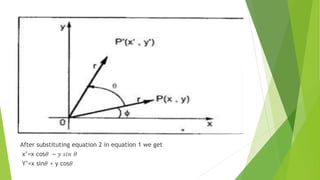
After substituting equation 2 in equation 1 we get
x’=x cos𝜃 − 𝑦 𝑠𝑖𝑛 𝜃
Y’=x sin𝜃 + y cos𝜃
Rotation
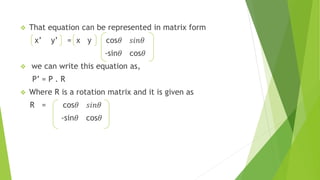
 That equation can be represented in matrix form
x’ y’ = x y cos𝜃 𝑠𝑖𝑛𝜃
-sin𝜃 cos𝜃
 we can write this equation as,
P’ = P . R
 Where R is a rotation matrix and it is given as
R = cos𝜃 𝑠𝑖𝑛𝜃
-sin𝜃 cos𝜃
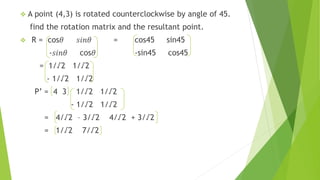
 A point (4,3) is rotated counterclockwise by angle of 45.
find the rotation matrix and the resultant point.
 R = cos𝜃 𝑠𝑖𝑛𝜃 = cos45 sin45
-𝑠𝑖𝑛𝜃 cos𝜃 -sin45 cos45
= 1/√2 1/√2
- 1/√2 1/√2
P’ = 4 3 1/√2 1/√2
- 1/√2 1/√2
= 4/√2 – 3/√2 4/√2 + 3/√2
= 1/√2 7/√2
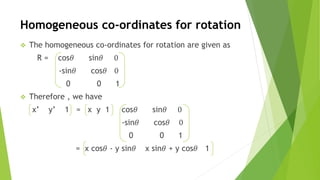
Homogeneous co-ordinates for rotation
 The homogeneous co-ordinates for rotation are given as
R = cos𝜃 sin𝜃 0
-sin𝜃 cos𝜃 0
0 0 1
 Therefore , we have
x’ y’ 1 = x y 1 cos𝜃 sin𝜃 0
-sin𝜃 cos𝜃 0
0 0 1
= x cos𝜃 - y sin𝜃 x sin𝜃 + y cos𝜃 1
CONCLUSION
To manipulate the initially created
object and to display the
modified object without having to
redraw it, we use
Transformations.
THANK YOU

COMPOSITE TRANSFORMATION COMPUTER GRAPHICDS.ppt

  • 1.
  • 2.
    2D Transformations “Transformations arethe operations applied to geometrical description of an object to change its position, orientation, or size are called geometric transformations”.
  • 3.
    Translation  Translation isa process of changing the position of an object in a straight-line path from one co- ordinate location to another.  We can translate a two dimensional point by adding translation distances, tx and ty.  Suppose the original position is (x ,y) then new position is (x’, y’).  Here x’=x + tx and y’=y + ty.
  • 5.
  • 6.
    Homogeneous co-ordinates forTranslation  The homogeneous co-ordinates for translation are given as T = 1 0 tx 0 1 ty 0 0 1  Therefore , we have x’ y’ 1 = x y 1 1 0 tx 0 1 ty 0 0 1
  • 7.
     Translate apolygon with co-ordinates A(2,5) B(7,10) and C(10,2) by 3 units in X direction and 4 units in Y direction.  A’ = A +T = 2 + 3 = 5 5 4 9  B’ = B + T = 7 + 3 = 10 10 4 14  C’ = C + T = 10 + 3 = 13 2 4 7
  • 8.
    Scaling  A scalingtransformation changes the size of an object.  This operation can be carried out for polygons by multiplying the co-ordinates values (x , y) of each vertex by scaling factors Sx and Sy to produce the transformed co-ordinates (x’ , y’). x’ = x . Sx y’ = y . Sy  In the matrix form x’ y’ = x y Sx 0 0 Sy = P . S
  • 9.
    Scaling • Uniform ScalingUn-uniform Scaling
  • 10.
    Homogeneous co-ordinates forscaling  The homogeneous co-ordinate for scaling are given as S = Sx 0 0 0 Sy 0 0 0 1  Therefore , we have x’ y’ 1 = x y 1 Sx 0 0 0 Sy 0 0 0 1 = x . Sx y . Sy 1
  • 11.
    Rotation  A twodimensional rotation is applied to an object by repositioning it along a circular path in the xy plane.  Using standard trigonometric equations , we can express the transformed co-ordinates in terms of 𝜃 𝑎𝑛𝑑 ∅ 𝑎𝑠 x’ = r cos(𝜙 + 𝜃) = 𝑟 cos𝜙cos𝜃 − r sin𝜙sin𝜃 y’ = r sin(𝜙 + 𝜃) = 𝑟 cos𝜙sin𝜃 + r sin𝜙co𝑠𝜃  The original co-ordinates of the point is x = r cos 𝜙 y = r sin 𝜙
  • 12.
    After substituting equation2 in equation 1 we get x’=x cos𝜃 − 𝑦 𝑠𝑖𝑛 𝜃 Y’=x sin𝜃 + y cos𝜃
  • 13.
  • 14.
     That equationcan be represented in matrix form x’ y’ = x y cos𝜃 𝑠𝑖𝑛𝜃 -sin𝜃 cos𝜃  we can write this equation as, P’ = P . R  Where R is a rotation matrix and it is given as R = cos𝜃 𝑠𝑖𝑛𝜃 -sin𝜃 cos𝜃
  • 15.
     A point(4,3) is rotated counterclockwise by angle of 45. find the rotation matrix and the resultant point.  R = cos𝜃 𝑠𝑖𝑛𝜃 = cos45 sin45 -𝑠𝑖𝑛𝜃 cos𝜃 -sin45 cos45 = 1/√2 1/√2 - 1/√2 1/√2 P’ = 4 3 1/√2 1/√2 - 1/√2 1/√2 = 4/√2 – 3/√2 4/√2 + 3/√2 = 1/√2 7/√2
  • 16.
    Homogeneous co-ordinates forrotation  The homogeneous co-ordinates for rotation are given as R = cos𝜃 sin𝜃 0 -sin𝜃 cos𝜃 0 0 0 1  Therefore , we have x’ y’ 1 = x y 1 cos𝜃 sin𝜃 0 -sin𝜃 cos𝜃 0 0 0 1 = x cos𝜃 - y sin𝜃 x sin𝜃 + y cos𝜃 1
  • 27.
    CONCLUSION To manipulate theinitially created object and to display the modified object without having to redraw it, we use Transformations.
  • 28.