IPSec and SSL
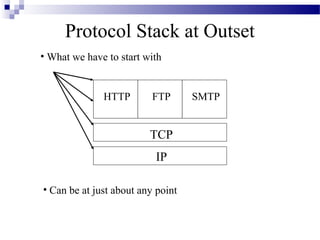
Protocol Stack at Outset
• What we have to start with


              HTTP        FTP      SMTP


                         TCP
                          IP

• Can be at just about any point
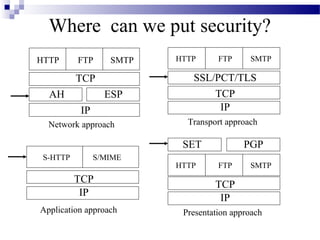
Where can we put security?
HTTP      FTP      SMTP   HTTP      FTP     SMTP

          TCP                SSL/PCT/TLS
  AH              ESP            TCP
           IP                     IP
  Network approach          Transport approach

                           SET             PGP
 S-HTTP         S/MIME
                          HTTP      FTP     SMTP
          TCP                      TCP
           IP                       IP
Application approach       Presentation approach
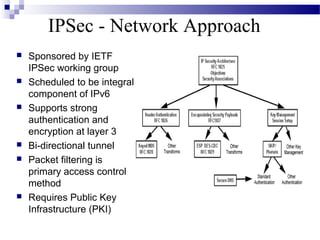
IPSec - Network Approach
   Sponsored by IETF
    IPSec working group
   Scheduled to be integral
    component of IPv6
   Supports strong
    authentication and
    encryption at layer 3
   Bi-directional tunnel
   Packet filtering is
    primary access control
    method
   Requires Public Key
    Infrastructure (PKI)
IP Layer Security
• Functionality
   – AH (Authentication Header): integrity and authenticity
   – ESP (Encrypted Security Payload): confidentiality, optional
   authentication & integrity

• Security Association (for each pair of hosts): determined by
destination IP address and the SPI (Security Parameters Index)
   – Specification of the crypto methods to be used by SPI
   – Keys to be used by the crypto methods for that SPI
   – The hosts and other entities associated with this traffic

• Key Management
   – Manual Keying (required)
   – Key Management Protocols (in flux)
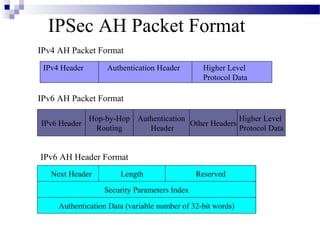
IPSec AH Packet Format
IPv4 AH Packet Format
 IPv4 Header       Authentication Header        Higher Level
                                                Protocol Data

IPv6 AH Packet Format

               Hop-by-Hop Authentication               Higher Level
IPv6 Header                              Other Headers
                Routing      Header                    Protocol Data


IPv6 AH Header Format
   Next Header         Length                  Reserved

                   Security Parameters Index

     Authentication Data (variable number of 32-bit words)
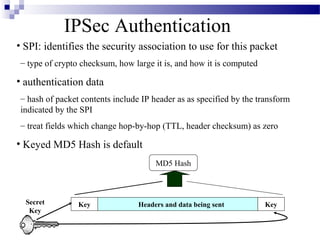
IPSec Authentication
• SPI: identifies the security association to use for this packet
– type of crypto checksum, how large it is, and how it is computed

• authentication data
– hash of packet contents include IP header as as specified by the transform
indicated by the SPI
– treat fields which change hop-by-hop (TTL, header checksum) as zero

• Keyed MD5 Hash is default
                                      MD5 Hash


  Secret        Key              Headers and data being sent         Key
   Key
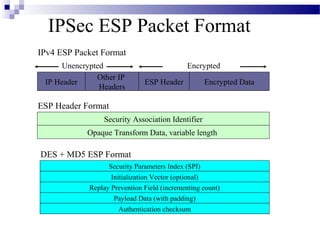
IPSec ESP Packet Format
IPv4 ESP Packet Format
     Unencrypted                            Encrypted
              Other IP
 IP Header                    ESP Header            Encrypted Data
               Headers

ESP Header Format
                Security Association Identifier
            Opaque Transform Data, variable length

DES + MD5 ESP Format
                  Security Parameters Index (SPI)
                   Initialization Vector (optional)
            Replay Prevention Field (incrementing count)
                    Payload Data (with padding)
                     Authentication checksum
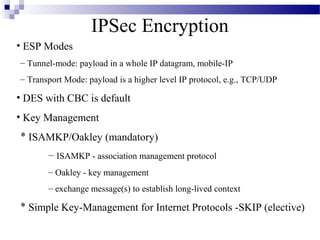
IPSec Encryption
• ESP Modes
– Tunnel-mode: payload in a whole IP datagram, mobile-IP
– Transport Mode: payload is a higher level IP protocol, e.g., TCP/UDP

• DES with CBC is default
• Key Management
* ISAMKP/Oakley (mandatory)
       – ISAMKP - association management protocol
       – Oakley - key management
       – exchange message(s) to establish long-lived context

* Simple Key-Management for Internet Protocols -SKIP (elective)
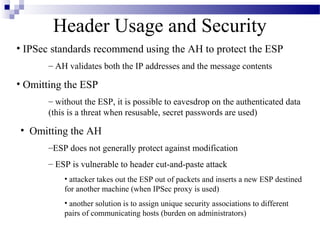
Header Usage and Security
• IPSec standards recommend using the AH to protect the ESP
       – AH validates both the IP addresses and the message contents

• Omitting the ESP
       – without the ESP, it is possible to eavesdrop on the authenticated data
       (this is a threat when resusable, secret passwords are used)

• Omitting the AH
       –ESP does not generally protect against modification
       – ESP is vulnerable to header cut-and-paste attack
           • attacker takes out the ESP out of packets and inserts a new ESP destined
           for another machine (when IPSec proxy is used)
           • another solution is to assign unique security associations to different
           pairs of communicating hosts (burden on administrators)
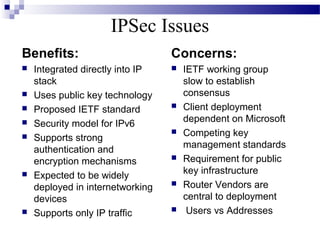
IPSec Issues
Benefits:                         Concerns:
   Integrated directly into IP      IETF working group
    stack                             slow to establish
   Uses public key technology        consensus
   Proposed IETF standard           Client deployment
                                      dependent on Microsoft
   Security model for IPv6
                                     Competing key
   Supports strong
                                      management standards
    authentication and
    encryption mechanisms            Requirement for public
                                      key infrastructure
   Expected to be widely
    deployed in internetworking      Router Vendors are
    devices                           central to deployment
   Supports only IP traffic          Users vs Addresses
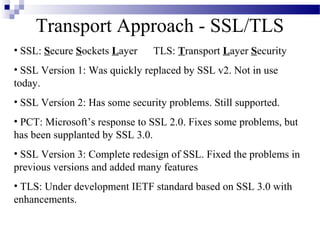
Transport Approach - SSL/TLS
• SSL: Secure Sockets Layer     TLS: Transport Layer Security
• SSL Version 1: Was quickly replaced by SSL v2. Not in use
today.
• SSL Version 2: Has some security problems. Still supported.
• PCT: Microsoft’s response to SSL 2.0. Fixes some problems, but
has been supplanted by SSL 3.0.
• SSL Version 3: Complete redesign of SSL. Fixed the problems in
previous versions and added many features
• TLS: Under development IETF standard based on SSL 3.0 with
enhancements.
What problem does SSL Solve?
• Allows secure communications between two computers, provided
that at least one has a certificate trusted by the other (avoids man-
in-the-middle when possible).
• Isolates application developers from the complexities and dangers
of cryptosystem design.
• Supports authentication, encryption, and key exchange
• Reliable connections via various secure hash functions
• Efficient, extendible, easy to integrate, not ASN.1 based, secure,
open, interoperable.
• End-to-end armored pipe only, not signed letter and sealed
envelope model.
A simple SSL-like protocol
Problem: A user wants to shop at a merchant’s server -- but the
       server doesn’t know anything about the user.
Phase 1: Handshake to produce a shared secret K.
         1. User requests, obtains, and verifies Server’s certificate
         2. User creates a 160-bit value K at random
         3. User computes K encrypted with server’s public key and sends
         the result to S.
         4. Server decrypts with its private key to recover K.
         5. Server hashes K and sends the result to user.
         6. User also hashes K and verifies the value from server.
Simple SSL-like protocol, cont
Phase 2: Secure communications using a shared secret K.
Data to be exchanged is broken into packets.
• Prior to transmission, each packet of data is encrypted and
MAC’ed (Message Authentication Coded):
    – Communications are encrypted using K to ensure that data are private
    from eavesdropping
    – Communications are MAC’ed using K to ensure that data are secure
    against tampering and modification

• The recipient decrypts the packet and verifies the MAC. An
incorrect MAC indicates a fatal error.
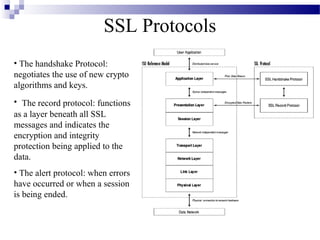
SSL Protocols
• The handshake Protocol:
negotiates the use of new crypto
algorithms and keys.
• The record protocol: functions
as a layer beneath all SSL
messages and indicates the
encryption and integrity
protection being applied to the
data.
• The alert protocol: when errors
have occurred or when a session
is being ended.
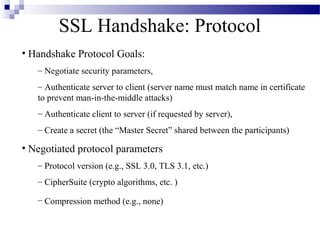
SSL Handshake: Protocol
• Handshake Protocol Goals:
   – Negotiate security parameters,
   – Authenticate server to client (server name must match name in certificate
   to prevent man-in-the-middle attacks)
   – Authenticate client to server (if requested by server),
   – Create a secret (the “Master Secret” shared between the participants)

• Negotiated protocol parameters
   – Protocol version (e.g., SSL 3.0, TLS 3.1, etc.)
   – CipherSuite (crypto algorithms, etc. )

   – Compression method (e.g., none)
SSL Handshake: CipherSuite
 • The CipherSuite defines the cryptographic algorithms, key
 sizes, etc
 • CipherSuite Parameters:
      – Encryption Algorithm: none, RC4-40, RC4-128, RC2-40, IDEA-128,
      DES-40, DES, TripleDES
      – Public Key algorithm: RSA, Fortezza, or Diffie-Hellman (with RSA,
      DSS, or, no certificates* )
      – Hash Function: MD5, SHA


* Certificate-less handshakes are vulnerable to man-in-the-middle attacks. In some
environments, anonymous Diffie-Hellman is helpful -- but in most cases, any support for
anonymous ciphersuites would be a massive security flaw
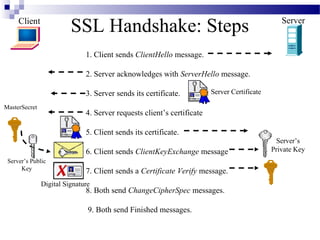
Client
                         SSL Handshake: Steps                                                   Server


                              1. Client sends ClientHello message.

                              2. Server acknowledges with ServerHello message.

                              3. Server sends its certificate.          Server Certificate

MasterSecret
                              4. Server requests client’s certificate

                              5. Client sends its certificate.
                                                                                              Server’s
                              6. Client sends ClientKeyExchange message                      Private Key
 Server’s Public
      Key                     7. Client sends a Certificate Verify message.
               Digital Signature
                              8. Both send ChangeCipherSpec messages.

                               9. Both send Finished messages.
SSL Handshake:Resuming Sessions
• Goal: minimize the number of SSL handshakes since:
   – Private key operations take server time
   – Network round trips are slow (2 per handshake)

• If two parties have recently communicated, they already have a
shared master. If both parties agree, the old master secret can be
reused. This is called resuming a session.
• A Hack: Adding state to a stateless protocol (http)
• Resuming can be done even if the parent session is still alive to
split sessions (e.g., to have 4 simultaneous connections, do the
handshake once then “resume” three new sessions).
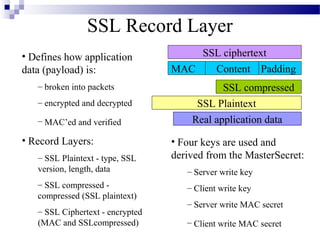
SSL Record Layer
• Defines how application             SSL ciphertext
data (payload) is:                MAC   Content Padding
   – broken into packets                     SSL compressed
   – encrypted and decrypted           SSL Plaintext
   – MAC’ed and verified              Real application data
• Record Layers:                  • Four keys are used and
   – SSL Plaintext - type, SSL    derived from the MasterSecret:
   version, length, data             – Server write key
   – SSL compressed -                – Client write key
   compressed (SSL plaintext)
                                     – Server write MAC secret
   – SSL Ciphertext - encrypted
   (MAC and SSLcompressed)           – Client write MAC secret
Strengths of the SSL
• Bruteforce Attack
   – 128 bits or more can be said to be safe in the foreseeable future.

• Dictionary Attack
   – for instance, take HTTP “get” command and use every possible key to
   precompute encrypted form of the plaintext.
   – SSL protects by having very large key spaces (even export version is
   actually 54 bit with 88 bits disclosed)

• Replay Attack
   – Attack works by rerunning the messages sent earlier
   – SSL defeats it by using a 128-bit nonce value that is unique to that
   connection

• Man-In-the-Middle Attack
   – SSL uses signed certificates to authenticate the server’s public key
Weaknesses of the SSL
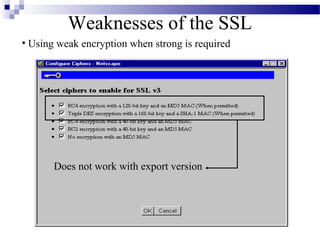
• Using weak encryption when strong is required


       Does not work with export version
Weaknesses of the SSL, cont
• Certificate problems
    – not signed by a trusted Certificate Authority
    – expired certificates (No certificate revocation list (CRL) in spec!)
    – Only real server authentication is that the DNS name in the URL matches
    the name in the certificate
    – if you are fooled into using a wrong name (www.isbankasi.com.tr instead
    of www.isbank.com.tr) you’ll never know

• Only using SSL for forms not all or most of your site
    – no caching of SSL by default therefore performance issues
    – what’s wrong with this picture:
https://www.company.com/order_form.cgi

<FORM ACTION=http://www.company.com/process_order.cgi METHOD=POST>
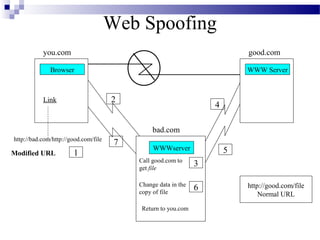
Web Spoofing
• Web spoofing is pretending to be somebody else’s web site
• Allows traffic to be intercepted and changed
• All Web traffic must pass through attacker’s proxy
   – somebody puts a false link in a popular Web page
   – by choosing DNS name very close to the real one (www.isbankasi.com.tr
   instead of www.isbank.com.tr)

• Users must be careful to detect it
• Can NOT be stopped -- even with SSL
   – unless you are using client side certificates (which hardly anybody is)
Web Spoofing
           you.com                                                          good.com

              Browser                                                       WWW Server


           Link                       2
                                                                    4

                                                bad.com
http://bad.com/http://good.com/file
                                       7
                                                WWWserver               5
Modified URL           1
                                           Call good.com to
                                           get file
                                                                3

                                           Change data in the               http://good.com/file
                                           copy of file
                                                                6
                                                                                Normal URL
                                            Return to you.com
Web Transaction Security
• Security Objectives
   – Protect transactions against attack on the Internet
   – ensure security without prior arrangements between customers and
   vendors
   – Apply crypto protections selectively as needed
   – The receiving host must be protected from attack by incoming messages

• Basic issues
   – Widely available, user-friendly transaction protocol (HTTP)
   – Authenticating the customer and vendor
   – Key management with naive users
   – Liability with bogus transactions
Web Transactions
• Three key elements
   – forms: Web pages with HTML functions to collect data from the user
   – the POST command: transmits the collected data values to the server
   – CGI Scripts: programs that process submitted data and return a Web
   page

• Web Form Security Services
   – Transaction Integrity
   – Customer Authentication
   – Vendor Authentication
   – Transaction Secrecy
Security Alternatives for Web forms
• Alternative security techniques:
   – Protection with passwords
   – Network Security (IPSec)
   – Connection Security (SSL)
   – Application Security (secure HTTP)

   –Java Applets with SSL

• Protection with passwords
   – no crypto protection, must be restricted to low-risk applications
   – vulnerable to password sniffing
   – but available and easy to implement
   – provides only customer authentication
Security Alternatives, cont
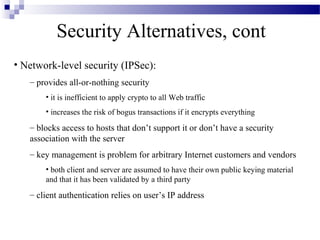
• Network-level security (IPSec):
   – provides all-or-nothing security
       • it is inefficient to apply crypto to all Web traffic
       • increases the risk of bogus transactions if it encrypts everything

   – blocks access to hosts that don’t support it or don’t have a security
   association with the server
   – key management is problem for arbitrary Internet customers and vendors
       • both client and server are assumed to have their own public keying material
       and that it has been validated by a third party
   – client authentication relies on user’s IP address
Security Alternatives, cont
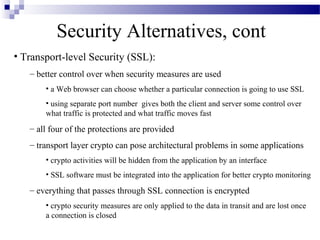
• Transport-level Security (SSL):
   – better control over when security measures are used
       • a Web browser can choose whether a particular connection is going to use SSL
       • using separate port number gives both the client and server some control over
       what traffic is protected and what traffic moves fast
   – all four of the protections are provided
   – transport layer crypto can pose architectural problems in some applications
       • crypto activities will be hidden from the application by an interface
       • SSL software must be integrated into the application for better crypto monitoring
   – everything that passes through SSL connection is encrypted
       • crypto security measures are only applied to the data in transit and are lost once
       a connection is closed
Security Alternatives, cont
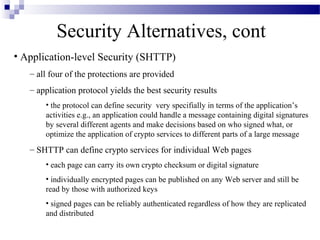
• Application-level Security (SHTTP)
   – all four of the protections are provided
   – application protocol yields the best security results
       • the protocol can define security very specifially in terms of the application’s
       activities e.g., an application could handle a message containing digital signatures
       by several different agents and make decisions based on who signed what, or
       optimize the application of crypto services to different parts of a large message
   – SHTTP can define crypto services for individual Web pages
       • each page can carry its own crypto checksum or digital signature
       • individually encrypted pages can be published on any Web server and still be
       read by those with authorized keys
       • signed pages can be reliably authenticated regardless of how they are replicated
       and distributed
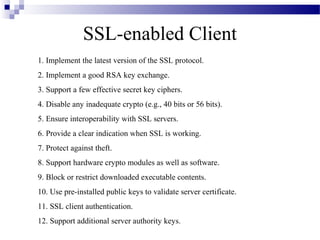
SSL-enabled Client
1. Implement the latest version of the SSL protocol.
2. Implement a good RSA key exchange.
3. Support a few effective secret key ciphers.
4. Disable any inadequate crypto (e.g., 40 bits or 56 bits).
5. Ensure interoperability with SSL servers.
6. Provide a clear indication when SSL is working.
7. Protect against theft.
8. Support hardware crypto modules as well as software.
9. Block or restrict downloaded executable contents.
10. Use pre-installed public keys to validate server certificate.
11. SSL client authentication.
12. Support additional server authority keys.
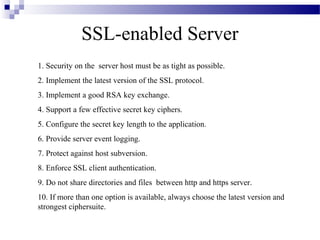
SSL-enabled Server
1. Security on the server host must be as tight as possible.
2. Implement the latest version of the SSL protocol.
3. Implement a good RSA key exchange.
4. Support a few effective secret key ciphers.
5. Configure the secret key length to the application.
6. Provide server event logging.
7. Protect against host subversion.
8. Enforce SSL client authentication.
9. Do not share directories and files between http and https server.
10. If more than one option is available, always choose the latest version and
strongest ciphersuite.
References
   Material compiled by Stephen Hayne and
    Randy Marchany

Ip sec and ssl

  • 1.
  • 2.
    Protocol Stack atOutset • What we have to start with HTTP FTP SMTP TCP IP • Can be at just about any point
  • 3.
    Where can weput security? HTTP FTP SMTP HTTP FTP SMTP TCP SSL/PCT/TLS AH ESP TCP IP IP Network approach Transport approach SET PGP S-HTTP S/MIME HTTP FTP SMTP TCP TCP IP IP Application approach Presentation approach
  • 4.
    IPSec - NetworkApproach  Sponsored by IETF IPSec working group  Scheduled to be integral component of IPv6  Supports strong authentication and encryption at layer 3  Bi-directional tunnel  Packet filtering is primary access control method  Requires Public Key Infrastructure (PKI)
  • 5.
    IP Layer Security •Functionality – AH (Authentication Header): integrity and authenticity – ESP (Encrypted Security Payload): confidentiality, optional authentication & integrity • Security Association (for each pair of hosts): determined by destination IP address and the SPI (Security Parameters Index) – Specification of the crypto methods to be used by SPI – Keys to be used by the crypto methods for that SPI – The hosts and other entities associated with this traffic • Key Management – Manual Keying (required) – Key Management Protocols (in flux)
  • 6.
    IPSec AH PacketFormat IPv4 AH Packet Format IPv4 Header Authentication Header Higher Level Protocol Data IPv6 AH Packet Format Hop-by-Hop Authentication Higher Level IPv6 Header Other Headers Routing Header Protocol Data IPv6 AH Header Format Next Header Length Reserved Security Parameters Index Authentication Data (variable number of 32-bit words)
  • 7.
    IPSec Authentication • SPI:identifies the security association to use for this packet – type of crypto checksum, how large it is, and how it is computed • authentication data – hash of packet contents include IP header as as specified by the transform indicated by the SPI – treat fields which change hop-by-hop (TTL, header checksum) as zero • Keyed MD5 Hash is default MD5 Hash Secret Key Headers and data being sent Key Key
  • 8.
    IPSec ESP PacketFormat IPv4 ESP Packet Format Unencrypted Encrypted Other IP IP Header ESP Header Encrypted Data Headers ESP Header Format Security Association Identifier Opaque Transform Data, variable length DES + MD5 ESP Format Security Parameters Index (SPI) Initialization Vector (optional) Replay Prevention Field (incrementing count) Payload Data (with padding) Authentication checksum
  • 9.
    IPSec Encryption • ESPModes – Tunnel-mode: payload in a whole IP datagram, mobile-IP – Transport Mode: payload is a higher level IP protocol, e.g., TCP/UDP • DES with CBC is default • Key Management * ISAMKP/Oakley (mandatory) – ISAMKP - association management protocol – Oakley - key management – exchange message(s) to establish long-lived context * Simple Key-Management for Internet Protocols -SKIP (elective)
  • 10.
    Header Usage andSecurity • IPSec standards recommend using the AH to protect the ESP – AH validates both the IP addresses and the message contents • Omitting the ESP – without the ESP, it is possible to eavesdrop on the authenticated data (this is a threat when resusable, secret passwords are used) • Omitting the AH –ESP does not generally protect against modification – ESP is vulnerable to header cut-and-paste attack • attacker takes out the ESP out of packets and inserts a new ESP destined for another machine (when IPSec proxy is used) • another solution is to assign unique security associations to different pairs of communicating hosts (burden on administrators)
  • 11.
    IPSec Issues Benefits: Concerns:  Integrated directly into IP  IETF working group stack slow to establish  Uses public key technology consensus  Proposed IETF standard  Client deployment dependent on Microsoft  Security model for IPv6  Competing key  Supports strong management standards authentication and encryption mechanisms  Requirement for public key infrastructure  Expected to be widely deployed in internetworking  Router Vendors are devices central to deployment  Supports only IP traffic  Users vs Addresses
  • 12.
    Transport Approach -SSL/TLS • SSL: Secure Sockets Layer TLS: Transport Layer Security • SSL Version 1: Was quickly replaced by SSL v2. Not in use today. • SSL Version 2: Has some security problems. Still supported. • PCT: Microsoft’s response to SSL 2.0. Fixes some problems, but has been supplanted by SSL 3.0. • SSL Version 3: Complete redesign of SSL. Fixed the problems in previous versions and added many features • TLS: Under development IETF standard based on SSL 3.0 with enhancements.
  • 13.
    What problem doesSSL Solve? • Allows secure communications between two computers, provided that at least one has a certificate trusted by the other (avoids man- in-the-middle when possible). • Isolates application developers from the complexities and dangers of cryptosystem design. • Supports authentication, encryption, and key exchange • Reliable connections via various secure hash functions • Efficient, extendible, easy to integrate, not ASN.1 based, secure, open, interoperable. • End-to-end armored pipe only, not signed letter and sealed envelope model.
  • 14.
    A simple SSL-likeprotocol Problem: A user wants to shop at a merchant’s server -- but the server doesn’t know anything about the user. Phase 1: Handshake to produce a shared secret K. 1. User requests, obtains, and verifies Server’s certificate 2. User creates a 160-bit value K at random 3. User computes K encrypted with server’s public key and sends the result to S. 4. Server decrypts with its private key to recover K. 5. Server hashes K and sends the result to user. 6. User also hashes K and verifies the value from server.
  • 15.
    Simple SSL-like protocol,cont Phase 2: Secure communications using a shared secret K. Data to be exchanged is broken into packets. • Prior to transmission, each packet of data is encrypted and MAC’ed (Message Authentication Coded): – Communications are encrypted using K to ensure that data are private from eavesdropping – Communications are MAC’ed using K to ensure that data are secure against tampering and modification • The recipient decrypts the packet and verifies the MAC. An incorrect MAC indicates a fatal error.
  • 16.
    SSL Protocols • Thehandshake Protocol: negotiates the use of new crypto algorithms and keys. • The record protocol: functions as a layer beneath all SSL messages and indicates the encryption and integrity protection being applied to the data. • The alert protocol: when errors have occurred or when a session is being ended.
  • 17.
    SSL Handshake: Protocol •Handshake Protocol Goals: – Negotiate security parameters, – Authenticate server to client (server name must match name in certificate to prevent man-in-the-middle attacks) – Authenticate client to server (if requested by server), – Create a secret (the “Master Secret” shared between the participants) • Negotiated protocol parameters – Protocol version (e.g., SSL 3.0, TLS 3.1, etc.) – CipherSuite (crypto algorithms, etc. ) – Compression method (e.g., none)
  • 18.
    SSL Handshake: CipherSuite • The CipherSuite defines the cryptographic algorithms, key sizes, etc • CipherSuite Parameters: – Encryption Algorithm: none, RC4-40, RC4-128, RC2-40, IDEA-128, DES-40, DES, TripleDES – Public Key algorithm: RSA, Fortezza, or Diffie-Hellman (with RSA, DSS, or, no certificates* ) – Hash Function: MD5, SHA * Certificate-less handshakes are vulnerable to man-in-the-middle attacks. In some environments, anonymous Diffie-Hellman is helpful -- but in most cases, any support for anonymous ciphersuites would be a massive security flaw
  • 19.
    Client SSL Handshake: Steps Server 1. Client sends ClientHello message. 2. Server acknowledges with ServerHello message. 3. Server sends its certificate. Server Certificate MasterSecret 4. Server requests client’s certificate 5. Client sends its certificate. Server’s 6. Client sends ClientKeyExchange message Private Key Server’s Public Key 7. Client sends a Certificate Verify message. Digital Signature 8. Both send ChangeCipherSpec messages. 9. Both send Finished messages.
  • 20.
    SSL Handshake:Resuming Sessions •Goal: minimize the number of SSL handshakes since: – Private key operations take server time – Network round trips are slow (2 per handshake) • If two parties have recently communicated, they already have a shared master. If both parties agree, the old master secret can be reused. This is called resuming a session. • A Hack: Adding state to a stateless protocol (http) • Resuming can be done even if the parent session is still alive to split sessions (e.g., to have 4 simultaneous connections, do the handshake once then “resume” three new sessions).
  • 21.
    SSL Record Layer •Defines how application SSL ciphertext data (payload) is: MAC Content Padding – broken into packets SSL compressed – encrypted and decrypted SSL Plaintext – MAC’ed and verified Real application data • Record Layers: • Four keys are used and – SSL Plaintext - type, SSL derived from the MasterSecret: version, length, data – Server write key – SSL compressed - – Client write key compressed (SSL plaintext) – Server write MAC secret – SSL Ciphertext - encrypted (MAC and SSLcompressed) – Client write MAC secret
  • 22.
    Strengths of theSSL • Bruteforce Attack – 128 bits or more can be said to be safe in the foreseeable future. • Dictionary Attack – for instance, take HTTP “get” command and use every possible key to precompute encrypted form of the plaintext. – SSL protects by having very large key spaces (even export version is actually 54 bit with 88 bits disclosed) • Replay Attack – Attack works by rerunning the messages sent earlier – SSL defeats it by using a 128-bit nonce value that is unique to that connection • Man-In-the-Middle Attack – SSL uses signed certificates to authenticate the server’s public key
  • 23.
    Weaknesses of theSSL • Using weak encryption when strong is required Does not work with export version
  • 24.
    Weaknesses of theSSL, cont • Certificate problems – not signed by a trusted Certificate Authority – expired certificates (No certificate revocation list (CRL) in spec!) – Only real server authentication is that the DNS name in the URL matches the name in the certificate – if you are fooled into using a wrong name (www.isbankasi.com.tr instead of www.isbank.com.tr) you’ll never know • Only using SSL for forms not all or most of your site – no caching of SSL by default therefore performance issues – what’s wrong with this picture: https://www.company.com/order_form.cgi <FORM ACTION=http://www.company.com/process_order.cgi METHOD=POST>
  • 25.
    Web Spoofing • Webspoofing is pretending to be somebody else’s web site • Allows traffic to be intercepted and changed • All Web traffic must pass through attacker’s proxy – somebody puts a false link in a popular Web page – by choosing DNS name very close to the real one (www.isbankasi.com.tr instead of www.isbank.com.tr) • Users must be careful to detect it • Can NOT be stopped -- even with SSL – unless you are using client side certificates (which hardly anybody is)
  • 26.
    Web Spoofing you.com good.com Browser WWW Server Link 2 4 bad.com http://bad.com/http://good.com/file 7 WWWserver 5 Modified URL 1 Call good.com to get file 3 Change data in the http://good.com/file copy of file 6 Normal URL Return to you.com
  • 27.
    Web Transaction Security •Security Objectives – Protect transactions against attack on the Internet – ensure security without prior arrangements between customers and vendors – Apply crypto protections selectively as needed – The receiving host must be protected from attack by incoming messages • Basic issues – Widely available, user-friendly transaction protocol (HTTP) – Authenticating the customer and vendor – Key management with naive users – Liability with bogus transactions
  • 28.
    Web Transactions • Threekey elements – forms: Web pages with HTML functions to collect data from the user – the POST command: transmits the collected data values to the server – CGI Scripts: programs that process submitted data and return a Web page • Web Form Security Services – Transaction Integrity – Customer Authentication – Vendor Authentication – Transaction Secrecy
  • 29.
    Security Alternatives forWeb forms • Alternative security techniques: – Protection with passwords – Network Security (IPSec) – Connection Security (SSL) – Application Security (secure HTTP) –Java Applets with SSL • Protection with passwords – no crypto protection, must be restricted to low-risk applications – vulnerable to password sniffing – but available and easy to implement – provides only customer authentication
  • 30.
    Security Alternatives, cont •Network-level security (IPSec): – provides all-or-nothing security • it is inefficient to apply crypto to all Web traffic • increases the risk of bogus transactions if it encrypts everything – blocks access to hosts that don’t support it or don’t have a security association with the server – key management is problem for arbitrary Internet customers and vendors • both client and server are assumed to have their own public keying material and that it has been validated by a third party – client authentication relies on user’s IP address
  • 31.
    Security Alternatives, cont •Transport-level Security (SSL): – better control over when security measures are used • a Web browser can choose whether a particular connection is going to use SSL • using separate port number gives both the client and server some control over what traffic is protected and what traffic moves fast – all four of the protections are provided – transport layer crypto can pose architectural problems in some applications • crypto activities will be hidden from the application by an interface • SSL software must be integrated into the application for better crypto monitoring – everything that passes through SSL connection is encrypted • crypto security measures are only applied to the data in transit and are lost once a connection is closed
  • 32.
    Security Alternatives, cont •Application-level Security (SHTTP) – all four of the protections are provided – application protocol yields the best security results • the protocol can define security very specifially in terms of the application’s activities e.g., an application could handle a message containing digital signatures by several different agents and make decisions based on who signed what, or optimize the application of crypto services to different parts of a large message – SHTTP can define crypto services for individual Web pages • each page can carry its own crypto checksum or digital signature • individually encrypted pages can be published on any Web server and still be read by those with authorized keys • signed pages can be reliably authenticated regardless of how they are replicated and distributed
  • 33.
    SSL-enabled Client 1. Implementthe latest version of the SSL protocol. 2. Implement a good RSA key exchange. 3. Support a few effective secret key ciphers. 4. Disable any inadequate crypto (e.g., 40 bits or 56 bits). 5. Ensure interoperability with SSL servers. 6. Provide a clear indication when SSL is working. 7. Protect against theft. 8. Support hardware crypto modules as well as software. 9. Block or restrict downloaded executable contents. 10. Use pre-installed public keys to validate server certificate. 11. SSL client authentication. 12. Support additional server authority keys.
  • 34.
    SSL-enabled Server 1. Securityon the server host must be as tight as possible. 2. Implement the latest version of the SSL protocol. 3. Implement a good RSA key exchange. 4. Support a few effective secret key ciphers. 5. Configure the secret key length to the application. 6. Provide server event logging. 7. Protect against host subversion. 8. Enforce SSL client authentication. 9. Do not share directories and files between http and https server. 10. If more than one option is available, always choose the latest version and strongest ciphersuite.
  • 35.
    References  Material compiled by Stephen Hayne and Randy Marchany