3-D Geometric Transformations
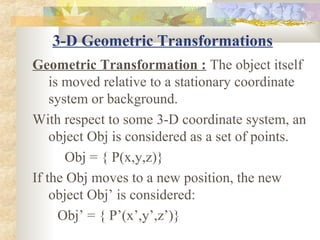
Geometric Transformation : The object itself
    is moved relative to a stationary coordinate
    system or background.
With respect to some 3-D coordinate system, an
    object Obj is considered as a set of points.
       Obj = { P(x,y,z)}
If the Obj moves to a new position, the new
    object Obj’ is considered:
      Obj’ = { P’(x’,y’,z’)}
Translation
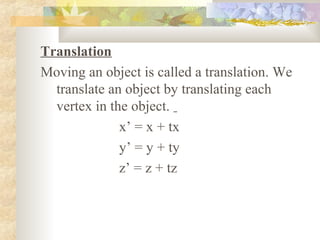
Moving an object is called a translation. We
  translate an object by translating each
  vertex in the object.
              x’ = x + tx
              y’ = y + ty
              z’ = z + tz
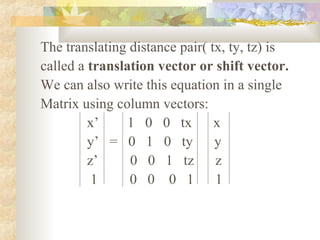
The translating distance pair( tx, ty, tz) is
called a translation vector or shift vector.
We can also write this equation in a single
Matrix using column vectors:
         x’     1 0 0 tx        x
         y’ = 0 1 0 ty          y
         z’     0 0 1 tz        z
          1     0 0 0 1         1
Rotation
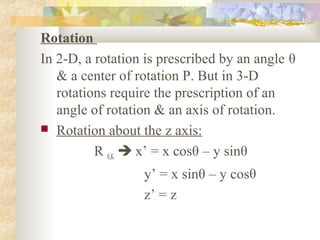
In 2-D, a rotation is prescribed by an angle θ
   & a center of rotation P. But in 3-D
   rotations require the prescription of an
   angle of rotation & an axis of rotation.
 Rotation about the z axis:

          R θ,K  x’ = x cosθ – y sinθ
                  y’ = x sinθ – y cosθ
                  z’ = z
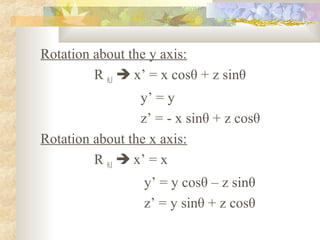
Rotation about the y axis:
         R θ,J  x’ = x cosθ + z sinθ
                  y’ = y
                  z’ = - x sinθ + z cosθ
Rotation about the x axis:
         R θ,I  x’ = x
                  y’ = y cosθ – z sinθ
                  z’ = y sinθ + z cosθ
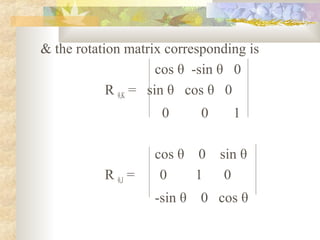
& the rotation matrix corresponding is
                      cos θ -sin θ 0
            R θ,K = sin θ cos θ 0
                      0       0     1

                     cos θ 0      sin θ
           R θ,J =    0    1       0
                     -sin θ   0 cos θ
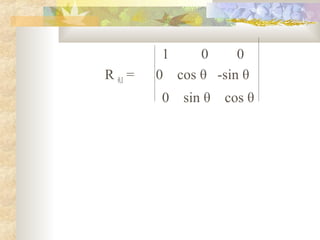
1    0     0
R θ,I =   0 cos θ -sin θ
          0   sin θ   cos θ
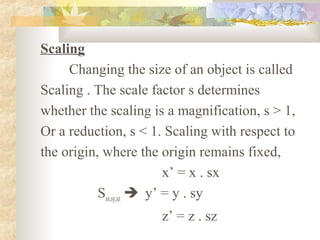
Scaling
     Changing the size of an object is called
Scaling . The scale factor s determines
whether the scaling is a magnification, s > 1,
Or a reduction, s < 1. Scaling with respect to
the origin, where the origin remains fixed,
                          x’ = x . sx
           Ssx,sy,sz  y’ = y . sy
                     z’ = z . sz
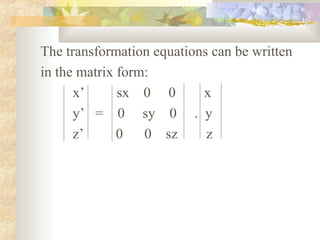
The transformation equations can be written
in the matrix form:
      x’      sx 0 0       x
      y’ = 0 sy 0 . y
      z’      0   0 sz      z
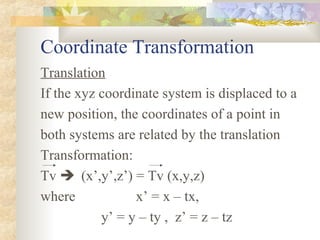
Coordinate Transformation
Translation
If the xyz coordinate system is displaced to a
new position, the coordinates of a point in
both systems are related by the translation
Transformation:
Tv  (x’,y’,z’) = Tv (x,y,z)
where            x’ = x – tx,
           y’ = y – ty , z’ = z – tz
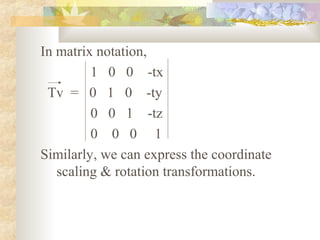
In matrix notation,
         1 0 0 -tx
 Tv = 0 1 0 -ty
         0 0 1 -tz
         0 0 0 1
Similarly, we can express the coordinate
   scaling & rotation transformations.
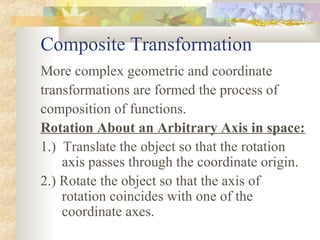
Composite Transformation
More complex geometric and coordinate
transformations are formed the process of
composition of functions.
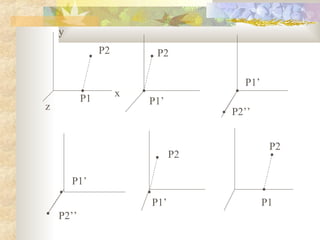
Rotation About an Arbitrary Axis in space:
1.) Translate the object so that the rotation
    axis passes through the coordinate origin.
2.) Rotate the object so that the axis of
    rotation coincides with one of the
    coordinate axes.
3.) Perform the specific rotation about the
   coordinate axis.
4.) Apply inverse rotations to bring the
   rotation axis back to its original
   orientation.
5.) Apply the inverse translation to bring the
   rotation axis back to its original position.
We can transform the rotation axis onto any
   of the three coordinate axes. For eg. We
   are taking rotation onto the z-axis.
y
                P2        P2

                                      P1’
                     x
           P1            P1’
z                                   P2’’


                                             P2
                               P2

        P1’

                         P1’                P1
    P2’’

3 d geometric transformations

  • 1.
    3-D Geometric Transformations GeometricTransformation : The object itself is moved relative to a stationary coordinate system or background. With respect to some 3-D coordinate system, an object Obj is considered as a set of points. Obj = { P(x,y,z)} If the Obj moves to a new position, the new object Obj’ is considered: Obj’ = { P’(x’,y’,z’)}
  • 2.
    Translation Moving an objectis called a translation. We translate an object by translating each vertex in the object. x’ = x + tx y’ = y + ty z’ = z + tz
  • 3.
    The translating distancepair( tx, ty, tz) is called a translation vector or shift vector. We can also write this equation in a single Matrix using column vectors: x’ 1 0 0 tx x y’ = 0 1 0 ty y z’ 0 0 1 tz z 1 0 0 0 1 1
  • 4.
    Rotation In 2-D, arotation is prescribed by an angle θ & a center of rotation P. But in 3-D rotations require the prescription of an angle of rotation & an axis of rotation.  Rotation about the z axis: R θ,K  x’ = x cosθ – y sinθ y’ = x sinθ – y cosθ z’ = z
  • 5.
    Rotation about they axis: R θ,J  x’ = x cosθ + z sinθ y’ = y z’ = - x sinθ + z cosθ Rotation about the x axis: R θ,I  x’ = x y’ = y cosθ – z sinθ z’ = y sinθ + z cosθ
  • 6.
    & the rotationmatrix corresponding is cos θ -sin θ 0 R θ,K = sin θ cos θ 0 0 0 1 cos θ 0 sin θ R θ,J = 0 1 0 -sin θ 0 cos θ
  • 7.
    1 0 0 R θ,I = 0 cos θ -sin θ 0 sin θ cos θ
  • 8.
    Scaling Changing the size of an object is called Scaling . The scale factor s determines whether the scaling is a magnification, s > 1, Or a reduction, s < 1. Scaling with respect to the origin, where the origin remains fixed, x’ = x . sx Ssx,sy,sz  y’ = y . sy z’ = z . sz
  • 9.
    The transformation equationscan be written in the matrix form: x’ sx 0 0 x y’ = 0 sy 0 . y z’ 0 0 sz z
  • 10.
    Coordinate Transformation Translation If thexyz coordinate system is displaced to a new position, the coordinates of a point in both systems are related by the translation Transformation: Tv  (x’,y’,z’) = Tv (x,y,z) where x’ = x – tx, y’ = y – ty , z’ = z – tz
  • 11.
    In matrix notation, 1 0 0 -tx Tv = 0 1 0 -ty 0 0 1 -tz 0 0 0 1 Similarly, we can express the coordinate scaling & rotation transformations.
  • 12.
    Composite Transformation More complexgeometric and coordinate transformations are formed the process of composition of functions. Rotation About an Arbitrary Axis in space: 1.) Translate the object so that the rotation axis passes through the coordinate origin. 2.) Rotate the object so that the axis of rotation coincides with one of the coordinate axes.
  • 13.
    3.) Perform thespecific rotation about the coordinate axis. 4.) Apply inverse rotations to bring the rotation axis back to its original orientation. 5.) Apply the inverse translation to bring the rotation axis back to its original position. We can transform the rotation axis onto any of the three coordinate axes. For eg. We are taking rotation onto the z-axis.
  • 14.
    y P2 P2 P1’ x P1 P1’ z P2’’ P2 P2 P1’ P1’ P1 P2’’