3-D Transformations
3-D Projections
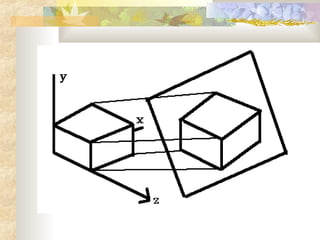
We can project the 3-D objects onto the 2-D
  plane. So Projection can be defined as a
  mapping of point P onto its image P’ in the
  projection plane or view plane.
There are two basic projection methods:
 Parallel projection
 Perspective projection
Parallel Projection
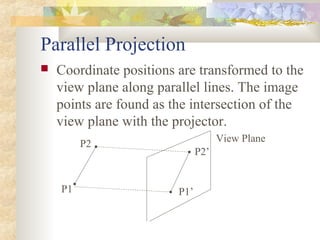
   Coordinate positions are transformed to the
    view plane along parallel lines. The image
    points are found as the intersection of the
    view plane with the projector.
                                     View Plane
         P2
                               P2’


    P1                   P1’
   Parallel Projection preserves relative
    proportions of objects.
   Accurate views of the various sides of an
    object are obtained with a parallel
    projection, but this does not give us a
    realistic representation of the appearance of
    a 3-D object.
   We can specify a parallel projection with a
    projection vector that defines the direction
    for the projection lines.
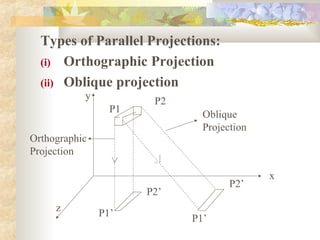
Types of Parallel Projections:
  (i) Orthographic Projection
  (ii) Oblique projection
           y           P2
                 P1           Oblique
                              Projection
Orthographic
Projection

                                           x
                                    P2’
                      P2’
     z         P1’          P1’
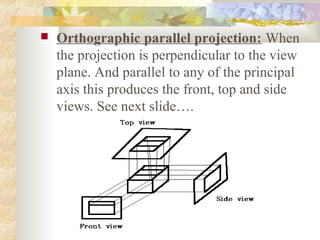
   Orthographic parallel projection: When
    the projection is perpendicular to the view
    plane. And parallel to any of the principal
    axis this produces the front, top and side
    views. See next slide….
   Types of Orthographic projections:
(i) Axonometric projection: that display
    more than one face of an object. Most
    common axonometric is Isometric
    projection.
Isometric projection is generated by aligning
    the projection plane so that it intersects
    each coordinate axis in which the object is
    defined at the same distance from the
    origin.The direction of projection makes
    equal angles with all the principal axis.
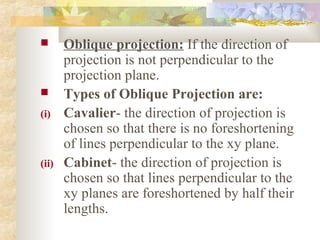
      Oblique projection: If the direction of
       projection is not perpendicular to the
       projection plane.
      Types of Oblique Projection are:
(i)    Cavalier- the direction of projection is
       chosen so that there is no foreshortening
       of lines perpendicular to the xy plane.
(ii)   Cabinet- the direction of projection is
       chosen so that lines perpendicular to the
       xy planes are foreshortened by half their
       lengths.
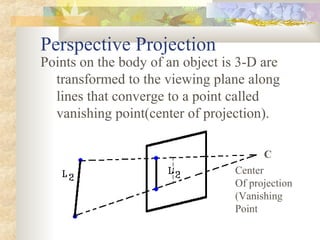
Perspective Projection
Points on the body of an object is 3-D are
  transformed to the viewing plane along
  lines that converge to a point called
  vanishing point(center of projection).

                                        C
                                  Center
                                  Of projection
                                  (Vanishing
                                  Point
So the distance of a line from the projection
plane determines its size on the projection
plane, i.e. the farther the line is from the
projection plane, the smaller its image on the
projection plane.
Characteristics:
(i) Vanishing Point: The lines that are
    parallel to the viewing plane appear to
    converge at a point called Vanishing point.
(ii) Perspective Foreshortening : Objects
    that are farther from the viewing plane are
    projected smaller in size than the objects
    that are nearer to viewing plane.
(iii) View confusion : When we project
    objects which are behind the center of
    projection appears to be projected upside
    down & backward onto the viewing plane.

3 d projections

  • 1.
  • 2.
    3-D Projections We canproject the 3-D objects onto the 2-D plane. So Projection can be defined as a mapping of point P onto its image P’ in the projection plane or view plane. There are two basic projection methods:  Parallel projection  Perspective projection
  • 3.
    Parallel Projection  Coordinate positions are transformed to the view plane along parallel lines. The image points are found as the intersection of the view plane with the projector. View Plane P2 P2’ P1 P1’
  • 4.
    Parallel Projection preserves relative proportions of objects.  Accurate views of the various sides of an object are obtained with a parallel projection, but this does not give us a realistic representation of the appearance of a 3-D object.  We can specify a parallel projection with a projection vector that defines the direction for the projection lines.
  • 5.
    Types of ParallelProjections: (i) Orthographic Projection (ii) Oblique projection y P2 P1 Oblique Projection Orthographic Projection x P2’ P2’ z P1’ P1’
  • 6.
    Orthographic parallel projection: When the projection is perpendicular to the view plane. And parallel to any of the principal axis this produces the front, top and side views. See next slide….
  • 7.
    Types of Orthographic projections: (i) Axonometric projection: that display more than one face of an object. Most common axonometric is Isometric projection. Isometric projection is generated by aligning the projection plane so that it intersects each coordinate axis in which the object is defined at the same distance from the origin.The direction of projection makes equal angles with all the principal axis.
  • 9.
    Oblique projection: If the direction of projection is not perpendicular to the projection plane.  Types of Oblique Projection are: (i) Cavalier- the direction of projection is chosen so that there is no foreshortening of lines perpendicular to the xy plane. (ii) Cabinet- the direction of projection is chosen so that lines perpendicular to the xy planes are foreshortened by half their lengths.
  • 10.
    Perspective Projection Points onthe body of an object is 3-D are transformed to the viewing plane along lines that converge to a point called vanishing point(center of projection). C Center Of projection (Vanishing Point
  • 11.
    So the distanceof a line from the projection plane determines its size on the projection plane, i.e. the farther the line is from the projection plane, the smaller its image on the projection plane. Characteristics: (i) Vanishing Point: The lines that are parallel to the viewing plane appear to converge at a point called Vanishing point.
  • 12.
    (ii) Perspective Foreshortening: Objects that are farther from the viewing plane are projected smaller in size than the objects that are nearer to viewing plane. (iii) View confusion : When we project objects which are behind the center of projection appears to be projected upside down & backward onto the viewing plane.