ENEM602 Spring 2007
Dr. Eng. Mohammad Tawfik
Interpolation
Lagrange Interpolation Polynomial
ENEM602 Spring 2007
Dr. Eng. Mohammad Tawfik
Lagrange Method
• First, we learned that a polynomial can
pass by the points by using a simple
polynomial with (n-1) terms.
• Then, we learned a way that “looks like”
the Taylor expansion (Newton’s method)
ENEM602 Spring 2007
Dr. Eng. Mohammad Tawfik
Lagrange Method (cont’d)
• Now, we will use polynomials that are zero
at all points except the one we are
evaluating at but in an easier form!
ENEM602 Spring 2007
Dr. Eng. Mohammad Tawfik
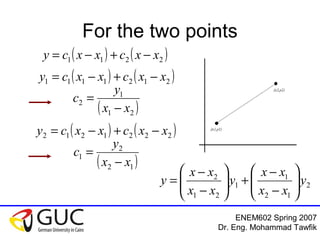
For the two points
( ) ( )2211 xxcxxcy −+−=
2
12
1
1
21
2
y
xx
xx
y
xx
xx
y 





−
−
+





−
−
=
( ) ( )2121111 xxcxxcy −+−=
( )21
1
2
xx
y
c
−
=
( ) ( )2221212 xxcxxcy −+−=
( )12
2
1
xx
y
c
−
=
ENEM602 Spring 2007
Dr. Eng. Mohammad Tawfik
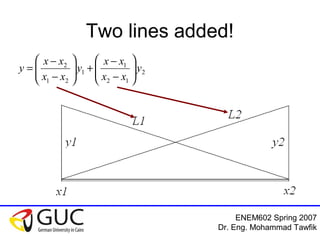
Two lines added!
2
12
1
1
21
2
y
xx
xx
y
xx
xx
y 





−
−
+





−
−
=
ENEM602 Spring 2007
Dr. Eng. Mohammad Tawfik
Homework
• Show that the polynomial obtained by
solving a set of equations is equivalent to
that obtained by Lagrange method
ENEM602 Spring 2007
Dr. Eng. Mohammad Tawfik
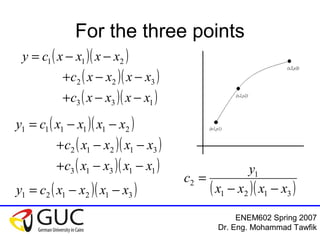
For the three points
( )( )
( )( )
( )( )133
322
211
xxxxc
xxxxc
xxxxcy
−−+
−−+
−−=
( )( )
( )( )
( )( )11313
31212
211111
xxxxc
xxxxc
xxxxcy
−−+
−−+
−−=
( )( )312121 xxxxcy −−= ( )( )3121
1
2
xxxx
y
c
−−
=
ENEM602 Spring 2007
Dr. Eng. Mohammad Tawfik
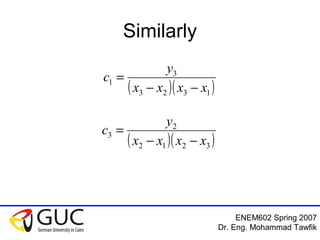
Similarly
( )( )1323
3
1
xxxx
y
c
−−
=
( )( )3212
2
3
xxxx
y
c
−−
=
ENEM602 Spring 2007
Dr. Eng. Mohammad Tawfik
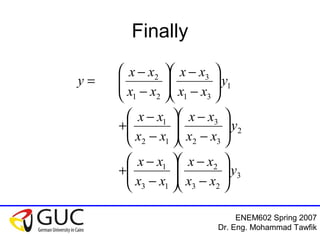
Finally
3
23
2
13
1
2
32
3
12
1
1
31
3
21
2
y
xx
xx
xx
xx
y
xx
xx
xx
xx
y
xx
xx
xx
xx
y






−
−






−
−
+






−
−






−
−
+






−
−






−
−
=
ENEM602 Spring 2007
Dr. Eng. Mohammad Tawfik
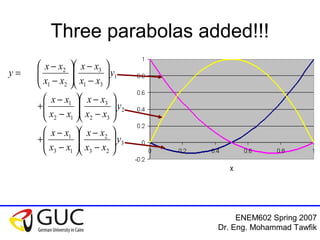
Three parabolas added!!!
3
23
2
13
1
2
32
3
12
1
1
31
3
21
2
y
xx
xx
xx
xx
y
xx
xx
xx
xx
y
xx
xx
xx
xx
y






−
−






−
−
+






−
−






−
−
+






−
−






−
−
=
ENEM602 Spring 2007
Dr. Eng. Mohammad Tawfik
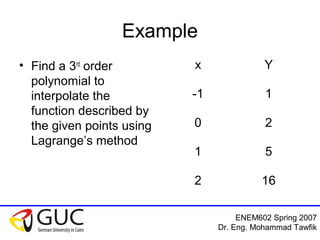
Example
• Find a 3rd
order
polynomial to
interpolate the
function described by
the given points using
Lagrange’s method
x Y
-1 1
0 2
1 5
2 16
ENEM602 Spring 2007
Dr. Eng. Mohammad Tawfik
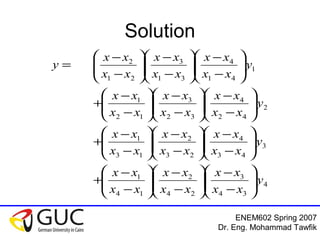
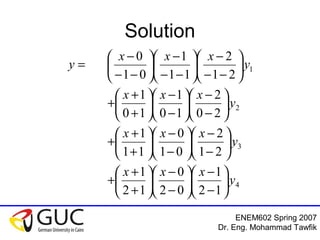
Solution
4
34
3
24
2
14
1
3
43
4
23
2
13
1
2
42
4
32
3
12
1
1
41
4
31
3
21
2
y
xx
xx
xx
xx
xx
xx
y
xx
xx
xx
xx
xx
xx
y
xx
xx
xx
xx
xx
xx
y
xx
xx
xx
xx
xx
xx
y






−
−






−
−






−
−
+






−
−






−
−






−
−
+






−
−






−
−






−
−
+






−
−






−
−






−
−
=
ENEM602 Spring 2007
Dr. Eng. Mohammad Tawfik
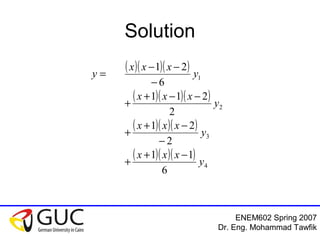
Solution
4
3
2
1
12
1
02
0
12
1
21
2
01
0
11
1
20
2
10
1
10
1
21
2
11
1
01
0
y
xxx
y
xxx
y
xxx
y
xxx
y






−
−






−
−






+
+
+






−
−






−
−






+
+
+






−
−






−
−






+
+
+






−−
−






−−
−






−−
−
=
ENEM602 Spring 2007
Dr. Eng. Mohammad Tawfik
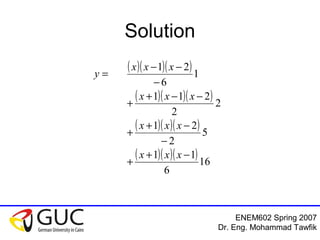
Solution
( )( )( )
( )( )( )
( )( )( )
( )( )( )
4
3
2
1
6
11
2
21
2
211
6
21
y
xxx
y
xxx
y
xxx
y
xxx
y
−+
+
−
−+
+
−−+
+
−
−−
=
ENEM602 Spring 2007
Dr. Eng. Mohammad Tawfik
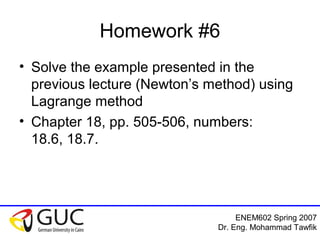
Solution
( )( )( )
( )( )( )
( )( )( )
( )( )( )16
6
11
5
2
21
2
2
211
1
6
21
−+
+
−
−+
+
−−+
+
−
−−
=
xxx
xxx
xxx
xxx
y
ENEM602 Spring 2007
Dr. Eng. Mohammad Tawfik
Homework #6
• Solve the example presented in the
previous lecture (Newton’s method) using
Lagrange method
• Chapter 18, pp. 505-506, numbers:
18.6, 18.7.

08 interpolation lagrange

  • 1.
    ENEM602 Spring 2007 Dr.Eng. Mohammad Tawfik Interpolation Lagrange Interpolation Polynomial
  • 2.
    ENEM602 Spring 2007 Dr.Eng. Mohammad Tawfik Lagrange Method • First, we learned that a polynomial can pass by the points by using a simple polynomial with (n-1) terms. • Then, we learned a way that “looks like” the Taylor expansion (Newton’s method)
  • 3.
    ENEM602 Spring 2007 Dr.Eng. Mohammad Tawfik Lagrange Method (cont’d) • Now, we will use polynomials that are zero at all points except the one we are evaluating at but in an easier form!
  • 4.
    ENEM602 Spring 2007 Dr.Eng. Mohammad Tawfik For the two points ( ) ( )2211 xxcxxcy −+−= 2 12 1 1 21 2 y xx xx y xx xx y       − − +      − − = ( ) ( )2121111 xxcxxcy −+−= ( )21 1 2 xx y c − = ( ) ( )2221212 xxcxxcy −+−= ( )12 2 1 xx y c − =
  • 5.
    ENEM602 Spring 2007 Dr.Eng. Mohammad Tawfik Two lines added! 2 12 1 1 21 2 y xx xx y xx xx y       − − +      − − =
  • 6.
    ENEM602 Spring 2007 Dr.Eng. Mohammad Tawfik Homework • Show that the polynomial obtained by solving a set of equations is equivalent to that obtained by Lagrange method
  • 7.
    ENEM602 Spring 2007 Dr.Eng. Mohammad Tawfik For the three points ( )( ) ( )( ) ( )( )133 322 211 xxxxc xxxxc xxxxcy −−+ −−+ −−= ( )( ) ( )( ) ( )( )11313 31212 211111 xxxxc xxxxc xxxxcy −−+ −−+ −−= ( )( )312121 xxxxcy −−= ( )( )3121 1 2 xxxx y c −− =
  • 8.
    ENEM602 Spring 2007 Dr.Eng. Mohammad Tawfik Similarly ( )( )1323 3 1 xxxx y c −− = ( )( )3212 2 3 xxxx y c −− =
  • 9.
    ENEM602 Spring 2007 Dr.Eng. Mohammad Tawfik Finally 3 23 2 13 1 2 32 3 12 1 1 31 3 21 2 y xx xx xx xx y xx xx xx xx y xx xx xx xx y       − −       − − +       − −       − − +       − −       − − =
  • 10.
    ENEM602 Spring 2007 Dr.Eng. Mohammad Tawfik Three parabolas added!!! 3 23 2 13 1 2 32 3 12 1 1 31 3 21 2 y xx xx xx xx y xx xx xx xx y xx xx xx xx y       − −       − − +       − −       − − +       − −       − − =
  • 11.
    ENEM602 Spring 2007 Dr.Eng. Mohammad Tawfik Example • Find a 3rd order polynomial to interpolate the function described by the given points using Lagrange’s method x Y -1 1 0 2 1 5 2 16
  • 12.
    ENEM602 Spring 2007 Dr.Eng. Mohammad Tawfik Solution 4 34 3 24 2 14 1 3 43 4 23 2 13 1 2 42 4 32 3 12 1 1 41 4 31 3 21 2 y xx xx xx xx xx xx y xx xx xx xx xx xx y xx xx xx xx xx xx y xx xx xx xx xx xx y       − −       − −       − − +       − −       − −       − − +       − −       − −       − − +       − −       − −       − − =
  • 13.
    ENEM602 Spring 2007 Dr.Eng. Mohammad Tawfik Solution 4 3 2 1 12 1 02 0 12 1 21 2 01 0 11 1 20 2 10 1 10 1 21 2 11 1 01 0 y xxx y xxx y xxx y xxx y       − −       − −       + + +       − −       − −       + + +       − −       − −       + + +       −− −       −− −       −− − =
  • 14.
    ENEM602 Spring 2007 Dr.Eng. Mohammad Tawfik Solution ( )( )( ) ( )( )( ) ( )( )( ) ( )( )( ) 4 3 2 1 6 11 2 21 2 211 6 21 y xxx y xxx y xxx y xxx y −+ + − −+ + −−+ + − −− =
  • 15.
    ENEM602 Spring 2007 Dr.Eng. Mohammad Tawfik Solution ( )( )( ) ( )( )( ) ( )( )( ) ( )( )( )16 6 11 5 2 21 2 2 211 1 6 21 −+ + − −+ + −−+ + − −− = xxx xxx xxx xxx y
  • 16.
    ENEM602 Spring 2007 Dr.Eng. Mohammad Tawfik Homework #6 • Solve the example presented in the previous lecture (Newton’s method) using Lagrange method • Chapter 18, pp. 505-506, numbers: 18.6, 18.7.