Forecasting and
Forecasting and
Supply-Chain
Supply-Chain
Mohammad Tawfik
Mohammad Tawfik
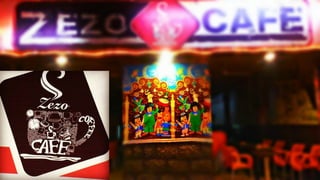
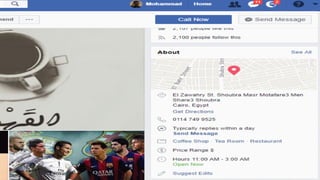
Zeco Cafe
Zeco Cafe
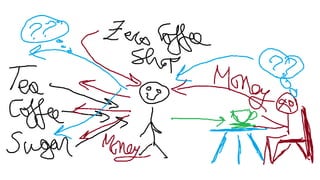
What is the supply chain of Zeco Cafe?
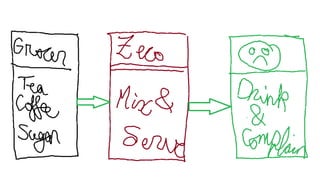
Zeco may focus on a much simpler chain!
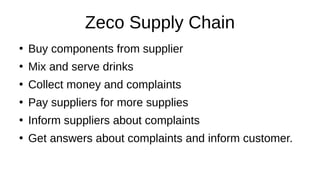
Zeco Supply Chain
●
Buy components from supplier
●
Mix and serve drinks
●
Collect money and complaints
●
Pay suppliers for more supplies
●
Inform suppliers about complaints
●
Get answers about complaints and inform customer.
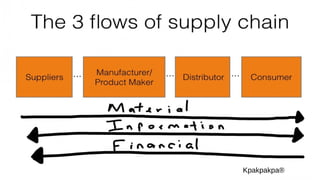
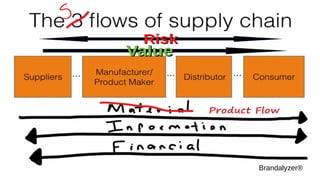
Three Flows
Kpakpakpa®
Or is it five flows?
Brandalyzer®
What risk does Zeco have?
●
He might not find customers!
●
Supplies may be spoiled
●
Money may be stolen :(
Zeco Risk
●
Zeco transfers the risk to the customer by
adding an extra charge on the bill
●
Zeco transfers risk to the supplier by buying on
credit
Customer and supplier risks
●
Customer risks having to pay without being
satisfied!
●
Not to mention the risk of food poisoning!!!
●
The suppliers risk not being paid or losing their
reputation by working with Zeco.
Values Transfer
●
Zeco adds value to the coffee and tee by:
– Mixing and serving – Food business
– Maintaining the cafe in acceptable conditions to
attract customers – Entertainment Business
Note the close relation between supply chain
supply chain
and value chain
value chain!
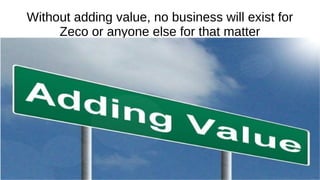
Without adding value, no business will exist for
Zeco or anyone else for that matter
What is Supply-Chain Management?
Definition
●
The management of upstream
upstream and
downstream
downstream value-added flows of materials,
final goods, and related information among
suppliers, company, resellers, and final
consumers.
WikiPedia
Or maybe ...
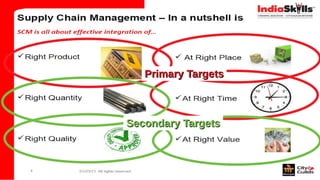
Primary Targets
Primary Targets
Secondary Targets
Secondary Targets
Primary and secondary targets are assigned
according to how scholars
scholars of SCM pay attention
to them
However, you can easily argue that they are both
important
important for any successful business
Supply-Chain Strategies
Top 3 Strategies
●
Improve Distribution Network
●
Monitor Cash Flow
●
Establish Information Conduits (channels)
Darren Woollard
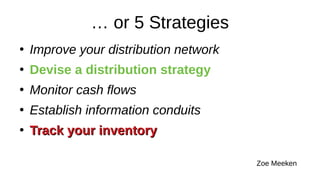
… or 5 Strategies
●
Improve your distribution network
●
Devise a distribution strategy
●
Monitor cash flows
●
Establish information conduits
●
Track your inventory
Zoe Meeken
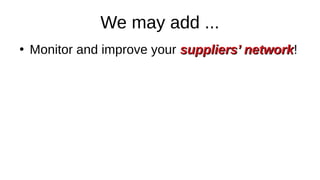
We may add ...
●
Monitor and improve your suppliers’ network
suppliers’ network!
Inventory Management
Back to Zeco :)
What inventory does Zeco have?
The most important question that YOU need to
answer is:
WHY do I need inventory?
The motive for inventory:
●
Transaction motive
Transaction motive: Economies of scale is
achieved when the number of set-ups are
reduced or the number of transactions are
minimized.
Donglei Du
Imagine having to buy sugar 10 times a day each
for 1 kg!
The motive for inventory:
●
Precautionary motive
Precautionary motive: hedge against
uncertainty, including demand uncertainty,
supply uncertainty
Donglei Du
What if you get to buy sugar, and your supplier is
out of it!!!
Or worse …
Customer have to wait until you purchase the
sugar each time a cup of coffee is ordered!!!
The motive for inventory:
●
Speculative motive
Speculative motive: hedge against price
increases in materials or labour
Donglei Du
Imagine having to say:
“Sorry sir, but the coffee price have changed
because the sugar price went up an hour ago”
What is the purpose of inventory management?
Purpose of Inventory Management
●
The objective of inventory is to achieve
satisfactory levels of customer service while
keeping inventory costs within reasonable
inventory costs within reasonable
bounds
bounds.
Donglei Du
Purpose of Inventory Management
●
Level of customer service:
– (1) in-stock rate
”Yes sir, coming right-away”
– (2) number of back orders
”Sorry sir, you need to wait until we buy the sugar”
– (3) inventory turnover rate: the ratio of average cost of
goods sold to average inventory investment
”Since we use sugar all the time, let’s build a sugar factory”
Donglei Du
Purpose of Inventory Management
●
Inventory cost: cost
cost of ordering
ordering and carrying
carrying
trade-off
Donglei Du
How to improve inventory management?
TradeGecko®
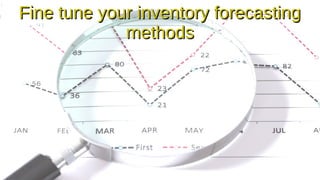
Fine tune your inventory forecasting
methods
methods
Keep the holidays in mind...all the
holidays
Re-evaluate lead times
Choose your supply chain partners
carefully
carefully
Find a local consultant
Do your research
Do your research
Move to the cloud
Move to the cloud
Lets talk about forecasting ...
Forecasting in Business
What is forecasting?
●
Forecasting is the process of making
statements about events whose actual
outcomes (typically) have not yet been
observed.
Wikipedia
Why Forecasting?
Predicting the future!
What will we need tomorrow?
What will the customer need next year?
What will the prices be next month?
Inventory requirements
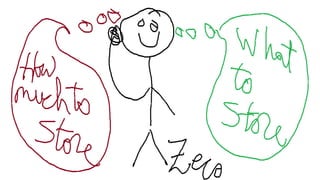
What should I store?
How much should I store?
Financial requirements
How much cash should I keep?
Should I keep that much cash?
How liquid is that asset?
Shipping requirements
If I need it NOW, when should I order it?
If the customer orders NOW, when should they get it?
How much does that matter?
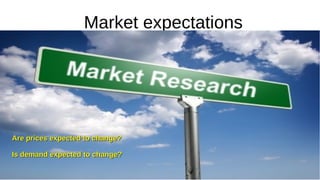
Market expectations
Are prices expected to change?
Is demand expected to change?
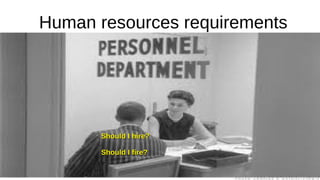
Human resources requirements
Should I hire?
Should I hire?
Should I fire?
Should I fire?
A good forecast must be ...
Meaningful
Reliable
Accurate
Timely
How?
Data, Data, Data!
Naive forecasting
“Yesterday we used 7 kg of sugar, let’s buy 7 for
today!”
Judgmental forecasting
“It seems that we use more sugar everyday, lets
buy more today”
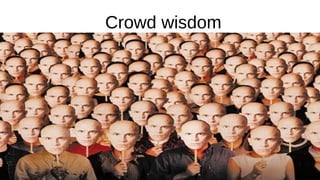
Crowd wisdom
“How did you do in that issue when you faced it?”
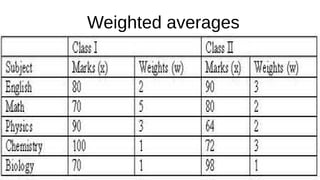
Weighted averages
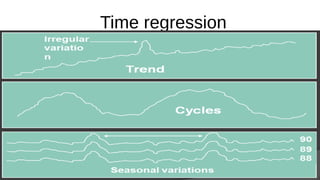
Time regression
We will get back to that when we talk about
regression
Steps of forecasting
Determine purpose
Establish time horizon
Select technique
Obtain data
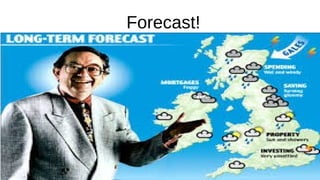
Forecast!
Follow up
Some Analytics
Some Analytics
Donglei Du
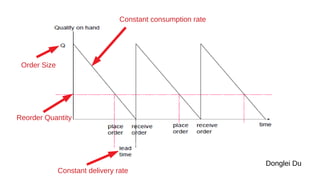
Constant consumption rate
Constant delivery rate
Reorder Quantity
Order Size
How much should the order quantity
be?
●
The larger the order quantity, the larger the total
holding cost (ch
*Average Stock)
●
The smaller the order quantity, the larger the
order cost (co
*Number of orders)
Where does holding cost come
from?
●
Lost investment opportunity
●
Storage rental and/or maintenance
●
Storage security
●
Material degradation due to storage
Where does operation cost come
from?
●
Time lost in procurement
●
Paper-work per operation
●
Risk associated with financial transactions
●
Risk of not being able to obtain the material
(delay and having to look for another supplier)
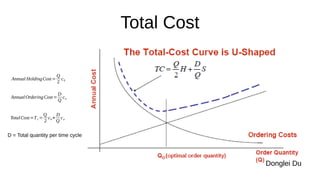
Total Cost
Annual HoldingCost=
Q
2
ch
AnnualOrderingCost=
D
Q
co
TotalCost=Tc =
Q
2
ch+
D
Q
co
D = Total quantity per time cycle
Donglei Du
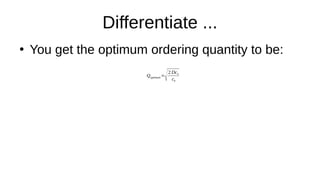
Differentiate ...
●
You get the optimum ordering quantity to be:
Qoptimum =
√2 Dco
ch
The above was all Deterministic
Deterministic!
Deterministic!!!
●
What if the consumption/demand is not
constant?
●
What if the delivery time is not constant?
Data, Data, Data
Data, Data, Data
Static
Static Problems
●
You collect the data, and evaluate the average!
●
How much do we consume per month?
●
How long does it take the supplier to deliver?
●
This way is simple and effective on the short term
and when you do not have much data
Quasi-Static
Quasi-Static Problem
●
Data is accumulating …
●
What matters more: how much did we consume last year or
last month?
●
Should I completely ignore last year?
●
How about two months ago?
●
Here weighted averaging comes handy
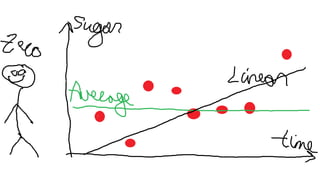
Trends ...
●
Is your business expanding or contracting?
●
How fast?
Which is better?
●
On the short term, average, or even just what
happened yesterday, may be good
●
On the long term, trends and seasonality mater
more!
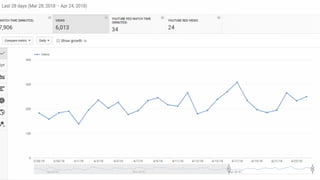
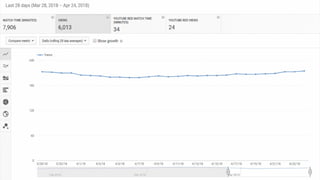
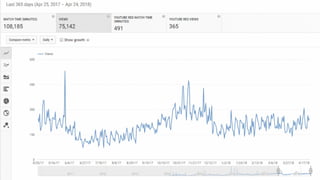
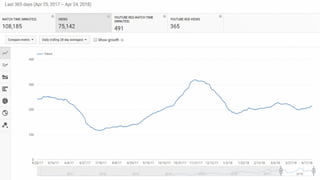
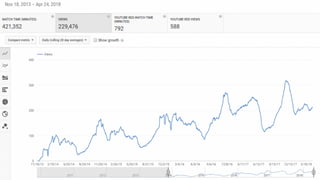
My YouTube Channel
References
References
References
●
“What does a Supply Chain Engineer do?”, StepStone,
https://www.stepstone.be/career-advice/article/supply-chain-engineer/
●
“Supply Chain Engineer job description template”, Hiring Resources,
https://recruitee.com/hiring-resources/job-description-templates/supply-chain-e
ngineer/
●
“What is supply chain management (SCM)?”, TechTarget®
https://searcherp.techtarget.com/definition/supply-chain-management-SCM
●
“Supply chain management”, WikiPedia,
https://en.wikipedia.org/wiki/Supply_chain_management
●
“The three flows of supply chain”, Nifemi Aluko,
https://kpakpakpa.com/spotlight/the-three-flows-of-supply-chain/
References
●
“Consumer Behaviour, Brand Management, Marketing and Psychology”,
Brandalyzer,
https://brandalyzer.blog/2016/03/23/the-five-major-flows-in-supply-chain/
●
“Top 3 Strategies To Improve The Supply Chain Performance In Your Business”,
Darren Woolard,
https://www.dmg-freight.com/top-3-strategies-to-improve-supply-chain-performan
ce-in-business/
●
“5 Ways to Increase Supply Chain Performance”, Zoe Meeken,
https://www.business.org/software/supplier/ways-to-increase-supply-chain-perfor
mance/
●
“7 Tips for Effective Inventory Management in Global Supply Chain”, TradeGecko,
https://www.tradegecko.com/blog/7-tips-for-effective-inventory-management-in-a-
global-supply-chain
References
●
“Supply Chain Management: Inventory Management”, Donglei Du
●
“Business-Plan Forecasting”, Steven D. Peterson, Peter E. Jaret, Barbara
Findlay Schenck
●
“Excel Sales Forecasting For Dummies”, Conrad Carlberg
●
“Sales Forecasting: A Practical Guide”, Mark Blessington
●
“Sales and Operations Planning The How-To Handbook”, Thomas F.
Wallace and Robert A Stahl
●
“Introduction to Financial Forecasting in Investment Analysis”, John
Guerard

Supply Chain Management for Engineers - INDE073

  • 1.
  • 2.
  • 6.
    What is thesupply chain of Zeco Cafe?
  • 10.
    Zeco may focuson a much simpler chain!
  • 12.
    Zeco Supply Chain ● Buycomponents from supplier ● Mix and serve drinks ● Collect money and complaints ● Pay suppliers for more supplies ● Inform suppliers about complaints ● Get answers about complaints and inform customer.
  • 14.
  • 15.
  • 16.
    Or is itfive flows?
  • 17.
  • 18.
    What risk doesZeco have? ● He might not find customers! ● Supplies may be spoiled ● Money may be stolen :(
  • 19.
    Zeco Risk ● Zeco transfersthe risk to the customer by adding an extra charge on the bill ● Zeco transfers risk to the supplier by buying on credit
  • 20.
    Customer and supplierrisks ● Customer risks having to pay without being satisfied! ● Not to mention the risk of food poisoning!!! ● The suppliers risk not being paid or losing their reputation by working with Zeco.
  • 21.
    Values Transfer ● Zeco addsvalue to the coffee and tee by: – Mixing and serving – Food business – Maintaining the cafe in acceptable conditions to attract customers – Entertainment Business
  • 22.
    Note the closerelation between supply chain supply chain and value chain value chain!
  • 23.
    Without adding value,no business will exist for Zeco or anyone else for that matter
  • 24.
  • 25.
    Definition ● The management ofupstream upstream and downstream downstream value-added flows of materials, final goods, and related information among suppliers, company, resellers, and final consumers. WikiPedia
  • 26.
  • 28.
  • 29.
    Primary and secondarytargets are assigned according to how scholars scholars of SCM pay attention to them However, you can easily argue that they are both important important for any successful business
  • 30.
  • 31.
    Top 3 Strategies ● ImproveDistribution Network ● Monitor Cash Flow ● Establish Information Conduits (channels) Darren Woollard
  • 32.
    … or 5Strategies ● Improve your distribution network ● Devise a distribution strategy ● Monitor cash flows ● Establish information conduits ● Track your inventory Track your inventory Zoe Meeken
  • 33.
    We may add... ● Monitor and improve your suppliers’ network suppliers’ network!
  • 34.
  • 35.
  • 37.
  • 38.
    The most importantquestion that YOU need to answer is: WHY do I need inventory? WHY do I need inventory?
  • 39.
    The motive forinventory: ● Transaction motive Transaction motive: Economies of scale is achieved when the number of set-ups are reduced or the number of transactions are minimized. Donglei Du
  • 40.
    Imagine having tobuy sugar 10 times a day each for 1 kg!
  • 41.
    The motive forinventory: ● Precautionary motive Precautionary motive: hedge against uncertainty, including demand uncertainty, supply uncertainty Donglei Du
  • 42.
    What if youget to buy sugar, and your supplier is out of it!!!
  • 43.
    Or worse … Customerhave to wait until you purchase the sugar each time a cup of coffee is ordered!!!
  • 44.
    The motive forinventory: ● Speculative motive Speculative motive: hedge against price increases in materials or labour Donglei Du
  • 45.
    Imagine having tosay: “Sorry sir, but the coffee price have changed because the sugar price went up an hour ago”
  • 46.
    What is thepurpose of inventory management?
  • 47.
    Purpose of InventoryManagement ● The objective of inventory is to achieve satisfactory levels of customer service while keeping inventory costs within reasonable inventory costs within reasonable bounds bounds. Donglei Du
  • 48.
    Purpose of InventoryManagement ● Level of customer service: – (1) in-stock rate ”Yes sir, coming right-away” ”Yes sir, coming right-away” – (2) number of back orders ”Sorry sir, you need to wait until we buy the sugar” ”Sorry sir, you need to wait until we buy the sugar” – (3) inventory turnover rate: the ratio of average cost of goods sold to average inventory investment ”Since we use sugar all the time, let’s build a sugar factory” ”Since we use sugar all the time, let’s build a sugar factory” Donglei Du
  • 49.
    Purpose of InventoryManagement ● Inventory cost: cost cost of ordering ordering and carrying carrying trade-off Donglei Du
  • 50.
    How to improveinventory management? TradeGecko®
  • 51.
    Fine tune yourinventory forecasting Fine tune your inventory forecasting methods methods
  • 52.
    Keep the holidaysin mind...all the holidays
  • 53.
  • 54.
    Choose your supplychain partners Choose your supply chain partners carefully carefully
  • 55.
    Find a localconsultant
  • 56.
    Do your research Doyour research
  • 57.
    Move to thecloud Move to the cloud
  • 58.
    Lets talk aboutforecasting ...
  • 59.
  • 60.
    What is forecasting? ● Forecastingis the process of making statements about events whose actual outcomes (typically) have not yet been observed. Wikipedia
  • 61.
  • 62.
    Predicting the future! Whatwill we need tomorrow? What will we need tomorrow? What will the customer need next year? What will the customer need next year? What will the prices be next month? What will the prices be next month?
  • 63.
    Inventory requirements What shouldI store? What should I store? How much should I store? How much should I store?
  • 64.
    Financial requirements How muchcash should I keep? How much cash should I keep? Should I keep that much cash? Should I keep that much cash? How liquid is that asset? How liquid is that asset?
  • 65.
    Shipping requirements If Ineed it NOW, when should I order it? If I need it NOW, when should I order it? If the customer orders NOW, when should they get it? If the customer orders NOW, when should they get it? How much does that matter? How much does that matter?
  • 66.
    Market expectations Are pricesexpected to change? Are prices expected to change? Is demand expected to change? Is demand expected to change?
  • 67.
    Human resources requirements ShouldI hire? Should I hire? Should I fire? Should I fire?
  • 68.
    A good forecastmust be ...
  • 69.
  • 70.
  • 71.
  • 72.
  • 73.
  • 74.
  • 75.
  • 76.
    “Yesterday we used7 kg of sugar, let’s buy 7 for today!”
  • 77.
  • 78.
    “It seems thatwe use more sugar everyday, lets buy more today”
  • 79.
  • 80.
    “How did youdo in that issue when you faced it?”
  • 81.
  • 82.
  • 83.
    We will getback to that when we talk about regression
  • 84.
  • 85.
  • 86.
  • 87.
  • 88.
  • 89.
  • 90.
  • 91.
  • 92.
    Donglei Du Constant consumptionrate Constant delivery rate Reorder Quantity Order Size
  • 93.
    How much shouldthe order quantity be? ● The larger the order quantity, the larger the total holding cost (ch *Average Stock) ● The smaller the order quantity, the larger the order cost (co *Number of orders)
  • 94.
    Where does holdingcost come from? ● Lost investment opportunity ● Storage rental and/or maintenance ● Storage security ● Material degradation due to storage
  • 95.
    Where does operationcost come from? ● Time lost in procurement ● Paper-work per operation ● Risk associated with financial transactions ● Risk of not being able to obtain the material (delay and having to look for another supplier)
  • 96.
    Total Cost Annual HoldingCost= Q 2 ch AnnualOrderingCost= D Q co TotalCost=Tc= Q 2 ch+ D Q co D = Total quantity per time cycle Donglei Du
  • 97.
    Differentiate ... ● You getthe optimum ordering quantity to be: Qoptimum = √2 Dco ch
  • 98.
    The above wasall Deterministic Deterministic!
  • 99.
    Deterministic!!! ● What if theconsumption/demand is not constant? ● What if the delivery time is not constant?
  • 100.
  • 101.
    Static Static Problems ● You collectthe data, and evaluate the average! ● How much do we consume per month? ● How long does it take the supplier to deliver? ● This way is simple and effective on the short term and when you do not have much data
  • 102.
    Quasi-Static Quasi-Static Problem ● Data isaccumulating … ● What matters more: how much did we consume last year or last month? ● Should I completely ignore last year? ● How about two months ago? ● Here weighted averaging comes handy
  • 103.
    Trends ... ● Is yourbusiness expanding or contracting? ● How fast?
  • 105.
    Which is better? ● Onthe short term, average, or even just what happened yesterday, may be good ● On the long term, trends and seasonality mater more!
  • 106.
  • 112.
  • 113.
    References ● “What does aSupply Chain Engineer do?”, StepStone, https://www.stepstone.be/career-advice/article/supply-chain-engineer/ ● “Supply Chain Engineer job description template”, Hiring Resources, https://recruitee.com/hiring-resources/job-description-templates/supply-chain-e ngineer/ ● “What is supply chain management (SCM)?”, TechTarget® https://searcherp.techtarget.com/definition/supply-chain-management-SCM ● “Supply chain management”, WikiPedia, https://en.wikipedia.org/wiki/Supply_chain_management ● “The three flows of supply chain”, Nifemi Aluko, https://kpakpakpa.com/spotlight/the-three-flows-of-supply-chain/
  • 114.
    References ● “Consumer Behaviour, BrandManagement, Marketing and Psychology”, Brandalyzer, https://brandalyzer.blog/2016/03/23/the-five-major-flows-in-supply-chain/ ● “Top 3 Strategies To Improve The Supply Chain Performance In Your Business”, Darren Woolard, https://www.dmg-freight.com/top-3-strategies-to-improve-supply-chain-performan ce-in-business/ ● “5 Ways to Increase Supply Chain Performance”, Zoe Meeken, https://www.business.org/software/supplier/ways-to-increase-supply-chain-perfor mance/ ● “7 Tips for Effective Inventory Management in Global Supply Chain”, TradeGecko, https://www.tradegecko.com/blog/7-tips-for-effective-inventory-management-in-a- global-supply-chain
  • 115.
    References ● “Supply Chain Management:Inventory Management”, Donglei Du ● “Business-Plan Forecasting”, Steven D. Peterson, Peter E. Jaret, Barbara Findlay Schenck ● “Excel Sales Forecasting For Dummies”, Conrad Carlberg ● “Sales Forecasting: A Practical Guide”, Mark Blessington ● “Sales and Operations Planning The How-To Handbook”, Thomas F. Wallace and Robert A Stahl ● “Introduction to Financial Forecasting in Investment Analysis”, John Guerard