Limits
“nearness”
Consider a polygon inscribed in a circle
The Idea of
Limits
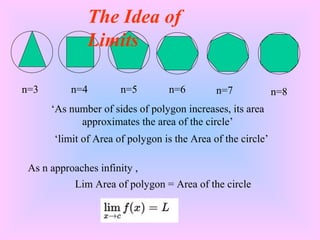
n=3 n=4 n=5 n=6 n=7 n=8
‘As number of sides of polygon increases, its area
approximates the area of the circle’
‘limit of Area of polygon is the Area of the circle’
As n approaches infinity ,
Lim Area of polygon = Area of the circle
The Idea of
Limits
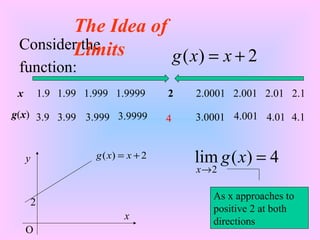
Consider the
function:
The Idea of
Limits 2)( += xxg
2)( += xxg
x
y
O
2
x 1.9 1.99 1.999 1.9999 2 2.0001 2.001 2.01 2.1
g(x) 3.9 3.99 3.999 3.9999 3.0001 4.001 4.01 4.14
4)(lim
2
=
→
xg
x
As x approaches to
positive 2 at both
directions
Fundamental Rules of Limits.
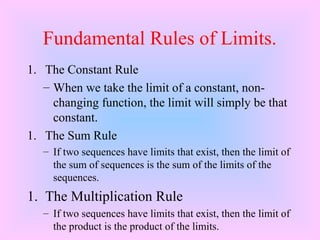
1. The Constant Rule
– When we take the limit of a constant, non-
changing function, the limit will simply be that
constant.
1. The Sum Rule
– If two sequences have limits that exist, then the limit of
the sum of sequences is the sum of the limits of the
sequences.
1. The Multiplication Rule
– If two sequences have limits that exist, then the limit of
the product is the product of the limits.
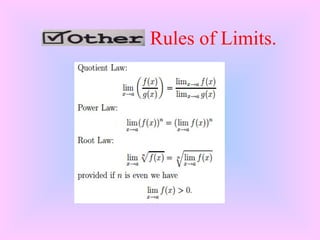
Fundamental Rules of Limits.
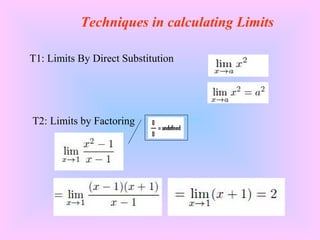
Techniques in calculating Limits
T1: Limits By Direct Substitution
T2: Limits by Factoring
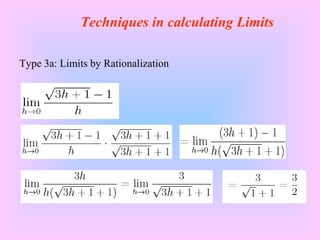
Type 3a: Limits by Rationalization
Techniques in calculating Limits
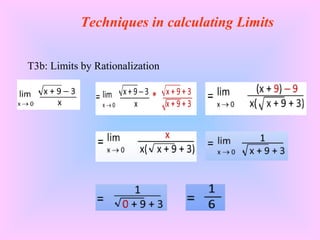
T3b: Limits by Rationalization
Techniques in calculating Limits
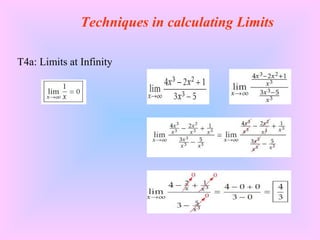
T4a: Limits at Infinity
Techniques in calculating Limits
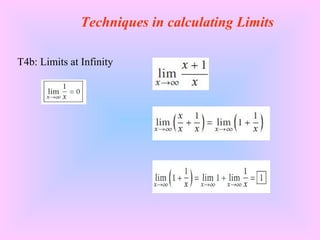
T4b: Limits at Infinity
Techniques in calculating Limits
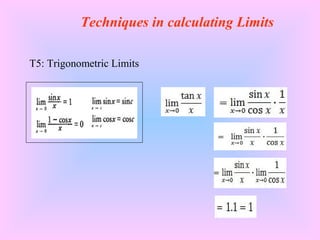
T5: Trigonometric Limits
Techniques in calculating Limits
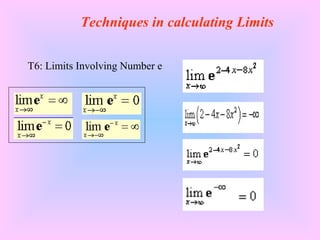
T6: Limits Involving Number e
Techniques in calculating Limits
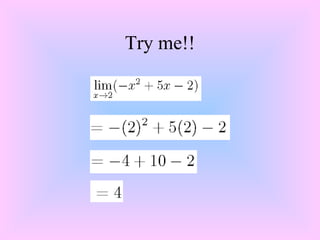
Try me!!
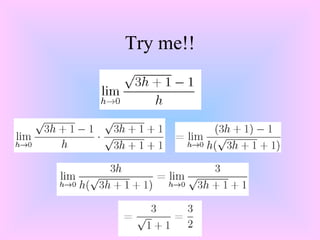
Try me!!
Try me!!
Try me!!
Try me!!
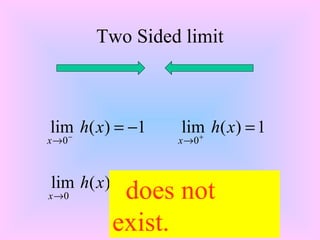
1)(lim
0
−=−
→
xh
x
1)(lim
0
=+
→
xh
x
)(lim
0
xh
x→ does not
exist.
Two Sided limit
THANK YOU

Limits