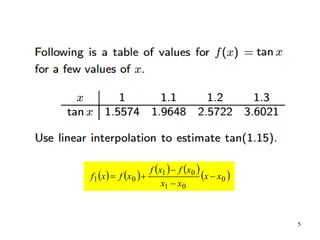
1
Interpolation
2
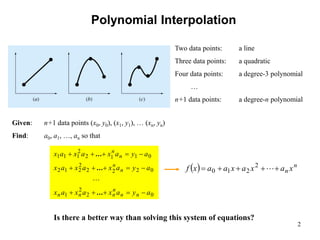
Polynomial Interpolation
Given: n+1 data points (x0, y0), (x1, y1), … (xn, yn)
Find: a0, a1, …, an so that
Two data points: a line
Three data points: a quadratic
Four data points: a degree-3 polynomial
…
n+1 data points: a degree-n polynomial
  n
n x
a
x
a
x
a
a
x
f 



 
2
2
1
0
0
2
2
1
0
2
2
2
2
2
1
2
0
1
1
2
2
1
1
1
a
y
a
x
a
x
a
x
a
y
a
x
a
x
a
x
a
y
a
x
a
x
a
x
n
n
n
n
n
n
n
n
n
n















...
...
...

Is there a better way than solving this system of equations?
3
Newton’s Divided-Difference Interpolating Polynomials
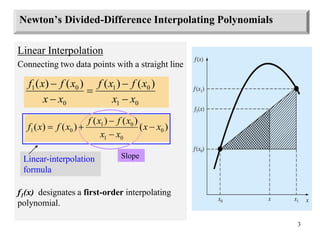
Linear Interpolation
Connecting two data points with a straight line
f1(x) designates a first-order interpolating
polynomial.
)
(
)
(
)
(
)
(
0
1
0
1
0
0
1
x
x
x
f
x
f
x
x
x
f
x
f





Linear-interpolation
formula
Slope
)
(
)
(
)
(
)
(
)
( 0
0
1
0
1
0
1 x
x
x
x
x
f
x
f
x
f
x
f 




4
Linear Interpolation
   
   
 
0
0
1
0
1
0
1 x
x
x
x
x
f
x
f
x
f
x
f 




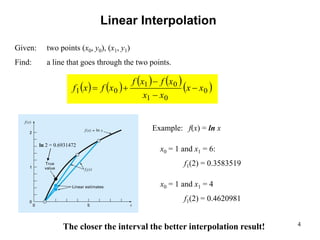
Given: two points (x0, y0), (x1, y1)
Find: a line that goes through the two points.
Example: f(x) = ln x
x0 = 1 and x1 = 6:
f1(2) = 0.3583519
x0 = 1 and x1 = 4
f1(2) = 0.4620981
ln 2 = 0.6931472
The closer the interval the better interpolation result!
5
   
   
 
0
0
1
0
1
0
1 x
x
x
x
x
f
x
f
x
f
x
f 




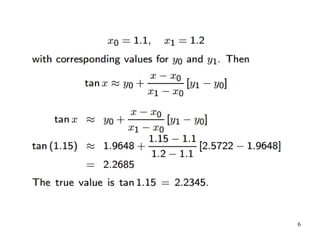
6
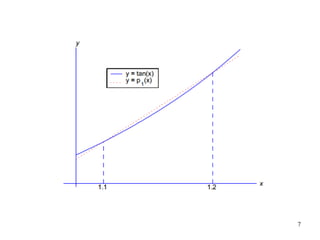
7
8
Quadratic Interpolation
 
   
       
0
2
0
1
0
1
1
2
1
2
2
0
1
0
1
1
0
0
x
x
x
x
x
f
x
f
x
x
x
f
x
f
b
x
x
x
f
x
f
b
x
f
b











      
1
0
2
0
1
0
2 x
x
x
x
b
x
x
b
b
x
f 





Given: three points (x0, y0), (x1, y1), (x2,y2)
Find: a quadratic f2(x) = a0 + a1x + a2x2 that goes through the three points.
Example: f(x) = ln x
Data points:
b0 = 0
b1 = (1.386294 – 0)/(4 – 1) = 0.4620981
b2 = [(1.791759 – 1.386294)/(6-4) – 0.4620981]/(6-1)
= -0.0518731
f2(2) = 0.5658444
ln 2 = 0.6931472
9
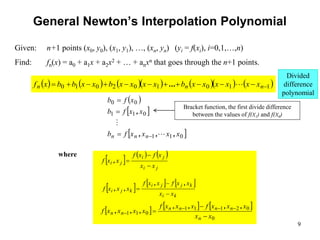
General Newton’s Interpolation Polynomial
 
 
 
0
1
1
0
1
1
0
0
x
x
x
x
f
b
x
x
f
b
x
f
b
n
n
n ,
,
,
,






           
1
1
0
1
0
2
0
1
0 










 n
n
n x
x
x
x
x
x
b
x
x
x
x
b
x
x
b
b
x
f 
...
     
j
i
j
i
j
i
x
x
x
f
x
f
x
x
f



,
Given: n+1 points (x0, y0), (x1, y1), …, (xn, yn) (yi = f(xi), i=0,1,…,n)
Find: fn(x) = a0 + a1x + a2x2 + … + anxn that goes through the n+1 points.
where
     
k
i
k
j
j
i
k
j
i
x
x
x
x
f
x
x
f
x
x
x
f



,
,
,
,
     
0
0
2
1
1
1
0
1
1
x
x
x
x
x
f
x
x
x
f
x
x
x
x
f
n
n
n
n
n
n
n


 



,
,
,
,
,
,
,
Bracket function, the first divide difference
between the values of f(X1) and f(X0)
Divided
difference
polynomial
10
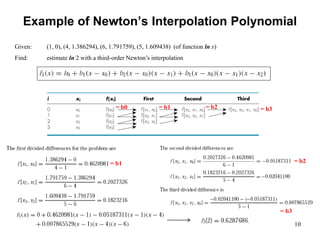
Example of Newton’s Interpolation Polynomial
Given: (1, 0), (4, 1.386294), (6, 1.791759), (5, 1.609438) (of function ln x)
Find: estimate ln 2 with a third-order Newton’s interpolation
= b1
= b0 = b1 = b2 = b3
= b2
= b3
11
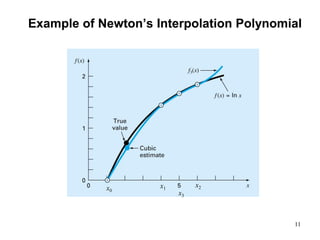
Example of Newton’s Interpolation Polynomial
x0
x1
x3
x2
12
13
14
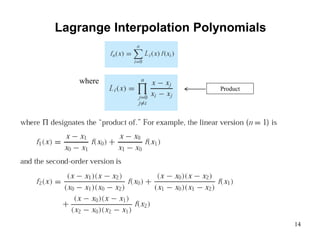
Lagrange Interpolation Polynomials
where
Product
15
16
17
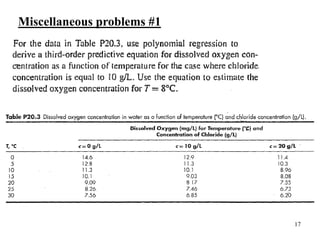
Miscellaneous problems #1
18
19
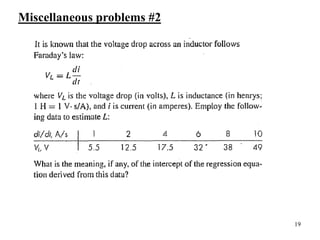
Miscellaneous problems #2
20
21
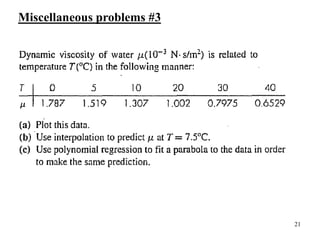
Miscellaneous problems #3
22
23
24
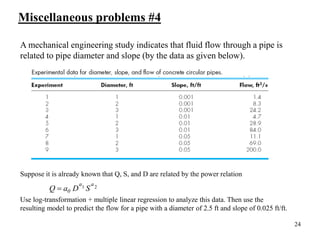
A mechanical engineering study indicates that fluid flow through a pipe is
related to pipe diameter and slope (by the data as given below).
Suppose it is already known that Q, S, and D are related by the power relation
Use log-transformation + multiple linear regression to analyze this data. Then use the
resulting model to predict the flow for a pipe with a diameter of 2.5 ft and slope of 0.025 ft/ft.
2
1
a
a
0 S
D
a
Q 
Miscellaneous problems #4
25
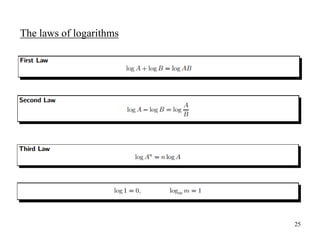
The laws of logarithms
26
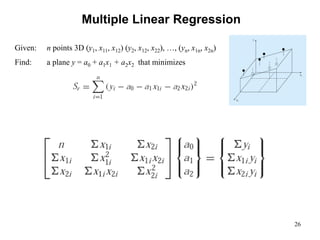
Multiple Linear Regression
Given: n points 3D (y1, x11, x12) (y2, x12, x22), …, (yn, x1n, x2n)
Find: a plane y = a0 + a1x1 + a2x2 that minimizes
27
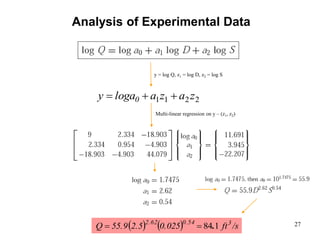
Analysis of Experimental Data
2
2
1
1 z
a
z
a
loga
y 0 


    /s
ft
0.025
2.5
55.9
Q 3
0.54
2.62
1
84.


y = log Q, z1 = log D, z2 = log S
Multi-linear regression on y – (z1, z2)
28
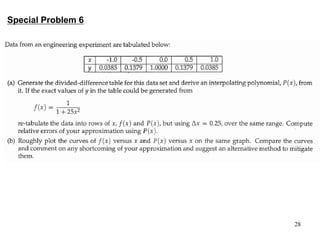
Special Problem 6
29
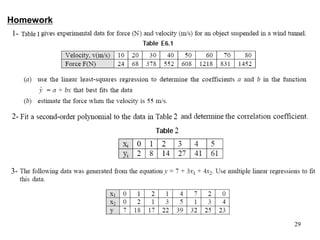
Homework
1-
2-
3-
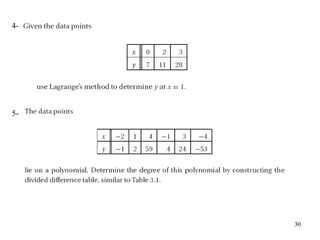
30
4-
5-

Applied numerical methods lec9

  • 1.
  • 2.
    2 Polynomial Interpolation Given: n+1data points (x0, y0), (x1, y1), … (xn, yn) Find: a0, a1, …, an so that Two data points: a line Three data points: a quadratic Four data points: a degree-3 polynomial … n+1 data points: a degree-n polynomial   n n x a x a x a a x f       2 2 1 0 0 2 2 1 0 2 2 2 2 2 1 2 0 1 1 2 2 1 1 1 a y a x a x a x a y a x a x a x a y a x a x a x n n n n n n n n n n                ... ... ...  Is there a better way than solving this system of equations?
  • 3.
    3 Newton’s Divided-Difference InterpolatingPolynomials Linear Interpolation Connecting two data points with a straight line f1(x) designates a first-order interpolating polynomial. ) ( ) ( ) ( ) ( 0 1 0 1 0 0 1 x x x f x f x x x f x f      Linear-interpolation formula Slope ) ( ) ( ) ( ) ( ) ( 0 0 1 0 1 0 1 x x x x x f x f x f x f     
  • 4.
    4 Linear Interpolation          0 0 1 0 1 0 1 x x x x x f x f x f x f      Given: two points (x0, y0), (x1, y1) Find: a line that goes through the two points. Example: f(x) = ln x x0 = 1 and x1 = 6: f1(2) = 0.3583519 x0 = 1 and x1 = 4 f1(2) = 0.4620981 ln 2 = 0.6931472 The closer the interval the better interpolation result!
  • 5.
    5          0 0 1 0 1 0 1 x x x x x f x f x f x f     
  • 6.
  • 7.
  • 8.
    8 Quadratic Interpolation              0 2 0 1 0 1 1 2 1 2 2 0 1 0 1 1 0 0 x x x x x f x f x x x f x f b x x x f x f b x f b                   1 0 2 0 1 0 2 x x x x b x x b b x f       Given: three points (x0, y0), (x1, y1), (x2,y2) Find: a quadratic f2(x) = a0 + a1x + a2x2 that goes through the three points. Example: f(x) = ln x Data points: b0 = 0 b1 = (1.386294 – 0)/(4 – 1) = 0.4620981 b2 = [(1.791759 – 1.386294)/(6-4) – 0.4620981]/(6-1) = -0.0518731 f2(2) = 0.5658444 ln 2 = 0.6931472
  • 9.
    9 General Newton’s InterpolationPolynomial       0 1 1 0 1 1 0 0 x x x x f b x x f b x f b n n n , , , ,                   1 1 0 1 0 2 0 1 0             n n n x x x x x x b x x x x b x x b b x f  ...       j i j i j i x x x f x f x x f    , Given: n+1 points (x0, y0), (x1, y1), …, (xn, yn) (yi = f(xi), i=0,1,…,n) Find: fn(x) = a0 + a1x + a2x2 + … + anxn that goes through the n+1 points. where       k i k j j i k j i x x x x f x x f x x x f    , , , ,       0 0 2 1 1 1 0 1 1 x x x x x f x x x f x x x x f n n n n n n n        , , , , , , , Bracket function, the first divide difference between the values of f(X1) and f(X0) Divided difference polynomial
  • 10.
    10 Example of Newton’sInterpolation Polynomial Given: (1, 0), (4, 1.386294), (6, 1.791759), (5, 1.609438) (of function ln x) Find: estimate ln 2 with a third-order Newton’s interpolation = b1 = b0 = b1 = b2 = b3 = b2 = b3
  • 11.
    11 Example of Newton’sInterpolation Polynomial x0 x1 x3 x2
  • 12.
  • 13.
  • 14.
  • 15.
  • 16.
  • 17.
  • 18.
  • 19.
  • 20.
  • 21.
  • 22.
  • 23.
  • 24.
    24 A mechanical engineeringstudy indicates that fluid flow through a pipe is related to pipe diameter and slope (by the data as given below). Suppose it is already known that Q, S, and D are related by the power relation Use log-transformation + multiple linear regression to analyze this data. Then use the resulting model to predict the flow for a pipe with a diameter of 2.5 ft and slope of 0.025 ft/ft. 2 1 a a 0 S D a Q  Miscellaneous problems #4
  • 25.
    25 The laws oflogarithms
  • 26.
    26 Multiple Linear Regression Given:n points 3D (y1, x11, x12) (y2, x12, x22), …, (yn, x1n, x2n) Find: a plane y = a0 + a1x1 + a2x2 that minimizes
  • 27.
    27 Analysis of ExperimentalData 2 2 1 1 z a z a loga y 0        /s ft 0.025 2.5 55.9 Q 3 0.54 2.62 1 84.   y = log Q, z1 = log D, z2 = log S Multi-linear regression on y – (z1, z2)
  • 28.
  • 29.
  • 30.