By Rinku
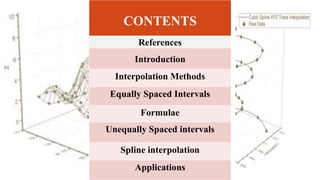
CONTENTS
Introduction
Interpolation Methods
Equally Spaced Intervals
Formulae
Unequally Spaced intervals
Spline interpolation
Applications
References
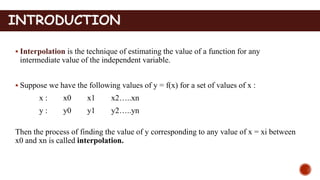
 Interpolation is the technique of estimating the value of a function for any
intermediate value of the independent variable.
 Suppose we have the following values of y = f(x) for a set of values of x :
x : x0 x1 x2…..xn
y : y0 y1 y2…..yn
Then the process of finding the value of y corresponding to any value of x = xi between
x0 and xn is called interpolation.
INTRODUCTION
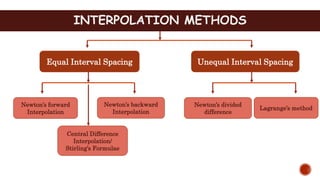
INTERPOLATION METHODS
Equal Interval Spacing Unequal Interval Spacing
Newton’s forward
Interpolation
Newton’s backward
Interpolation
Central Difference
Interpolation/
Stirling’s Formulae
Newton’s divided
difference
Lagrange’s method
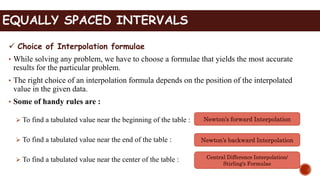
• While solving any problem, we have to choose a formulae that yields the most accurate
results for the particular problem.
• The right choice of an interpolation formula depends on the position of the interpolated
value in the given data.
• Some of handy rules are :
 To find a tabulated value near the beginning of the table :
 To find a tabulated value near the end of the table :
 To find a tabulated value near the center of the table :
EQUALLY SPACED INTERVALS
Newton’s forward Interpolation
Newton’s backward Interpolation
Central Difference Interpolation/
Stirling’s Formulae
 Choice of Interpolation formulae
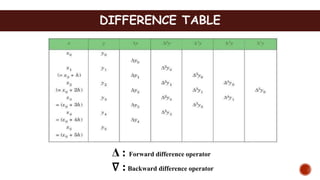
DIFFERENCE TABLE
Δ : Forward difference operator
∇ :Backward difference operator
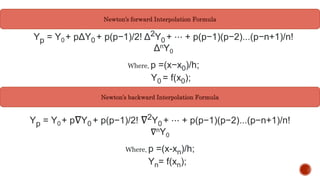
Newton’s forward Interpolation Formula
Yp = Y0+ pΔY0 + p(p−1)/2! Δ2Y0 + ⋯ + p(p−1)(p−2)...(p−n+1)/n!
ΔnY0
Where, p =(x−x0)/h;
Y0 = f(x0);
Newton’s backward Interpolation Formula
Yp = Y0+ p∇Y0 + p(p−1)/2! ∇2Y0 + ⋯ + p(p−1)(p−2)...(p−n+1)/n!
∇nY0
Where, p =(x-xn)/h;
Yn= f(xn);
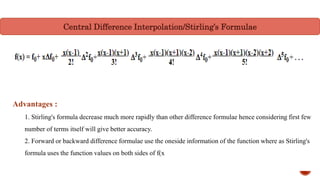
Central Difference Interpolation/Stirling’s Formulae
Advantages :
1. Stirling's formula decrease much more rapidly than other difference formulae hence considering first few
number of terms itself will give better accuracy.
2. Forward or backward difference formulae use the oneside information of the function where as Stirling's
formula uses the function values on both sides of f(x
• The disadvantage of the methods discussed till now is that they are applicable only
to the equally spaced values of arguments.
• Therefore, it is necessary to learn about the formulae applicable to unequally spaced
values.
1. Lagrange’s Formula
2. Divided difference method
UNEQUALLY SPACED INTERVALS
Newton’s divided difference method
Lagrange’s Interpolation Formulae
U
N
E
Q
U
A
L
I
N
T
E
R
V
A
L
S
For n points is a actually a polynomial of degree (n-1).
This polynomial is known as lagrangian polynomial and is very simple to implement on a computer.
• Drawback:
 If another interpolation value were inserted, then the interpolation coefficients are required to be
recalculated.
Overcomes the drawback of lagrange’s method by employing
divided differences.
 In the interpolation methods discussed so far, a single polynomial has been fitted to the
tabulated points.
 If the given set of points belong to the same polynomial then the method works well,
otherwise he results are rough approximations only.
 In computer graphics, a spline is a curve that connects two or more specific points, or
that is defined by two or more points. The term can also refer to the mathematical
equation that defines such a curve.
 Spline interpolation is a form of interpolation where the interpolant is a special type of
piecewise polynomial called a spline.
SPLINE INTERPOLATION
 Cubic spline interpolation is a special case for Spline interpolation that is used
very often to avoid the problem of Runge's phenomenon.
 This method gives an interpolating polynomial that is smoother and has smaller
error than some other interpolating polynomials such as Lagrange polynomial and
Newton’s polynomial.
S
P
L
I
N
E
I
N
T
E
R
P
O
L
A
T
I
O
N
CUBIC SPLINE INTERPOLATION
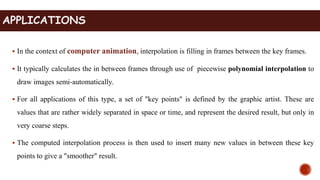
 In the context of computer animation, interpolation is filling in frames between the key frames.
 It typically calculates the in between frames through use of piecewise polynomial interpolation to
draw images semi-automatically.
 For all applications of this type, a set of "key points" is defined by the graphic artist. These are
values that are rather widely separated in space or time, and represent the desired result, but only in
very coarse steps.
 The computed interpolation process is then used to insert many new values in between these key
points to give a "smoother" result.
APPLICATIONS
 In computer programming, string interpolation is the process of evaluating a string
literal containing one or more placeholders, and yielding a result in which the placeholders are
replaced with their corresponding values.
 It is a form of simple template processing.
 String interpolation allows easier and more intuitive string formatting and content-
specification compared with string concatenation.
APPLICATIONS
REFERENCES
• Numerical methods in engineering and science by B.S. Grewal
• https://www.quora.com/What-is-interpolation-in-programming
• https://en.m.wikipedia.org/wiki/String_interpolation
• https://en.wikipedia.org/wiki/Interpolation_(computer_graphics)
• https://www.geeksforgeeks.org/newton-forward-backward-interpolation/
• https://whatis.techtarget.com/definition/spline
• https://math.stackexchange.com/questions/624894/newtons-interpolation-formula-difference-
between-the-forward-and-the-backward
THANK YOU

Interpolation and its applications

  • 1.
  • 2.
    CONTENTS Introduction Interpolation Methods Equally SpacedIntervals Formulae Unequally Spaced intervals Spline interpolation Applications References
  • 3.
     Interpolation isthe technique of estimating the value of a function for any intermediate value of the independent variable.  Suppose we have the following values of y = f(x) for a set of values of x : x : x0 x1 x2…..xn y : y0 y1 y2…..yn Then the process of finding the value of y corresponding to any value of x = xi between x0 and xn is called interpolation. INTRODUCTION
  • 4.
    INTERPOLATION METHODS Equal IntervalSpacing Unequal Interval Spacing Newton’s forward Interpolation Newton’s backward Interpolation Central Difference Interpolation/ Stirling’s Formulae Newton’s divided difference Lagrange’s method
  • 5.
    • While solvingany problem, we have to choose a formulae that yields the most accurate results for the particular problem. • The right choice of an interpolation formula depends on the position of the interpolated value in the given data. • Some of handy rules are :  To find a tabulated value near the beginning of the table :  To find a tabulated value near the end of the table :  To find a tabulated value near the center of the table : EQUALLY SPACED INTERVALS Newton’s forward Interpolation Newton’s backward Interpolation Central Difference Interpolation/ Stirling’s Formulae  Choice of Interpolation formulae
  • 6.
    DIFFERENCE TABLE Δ :Forward difference operator ∇ :Backward difference operator
  • 7.
    Newton’s forward InterpolationFormula Yp = Y0+ pΔY0 + p(p−1)/2! Δ2Y0 + ⋯ + p(p−1)(p−2)...(p−n+1)/n! ΔnY0 Where, p =(x−x0)/h; Y0 = f(x0); Newton’s backward Interpolation Formula Yp = Y0+ p∇Y0 + p(p−1)/2! ∇2Y0 + ⋯ + p(p−1)(p−2)...(p−n+1)/n! ∇nY0 Where, p =(x-xn)/h; Yn= f(xn);
  • 8.
    Central Difference Interpolation/Stirling’sFormulae Advantages : 1. Stirling's formula decrease much more rapidly than other difference formulae hence considering first few number of terms itself will give better accuracy. 2. Forward or backward difference formulae use the oneside information of the function where as Stirling's formula uses the function values on both sides of f(x
  • 9.
    • The disadvantageof the methods discussed till now is that they are applicable only to the equally spaced values of arguments. • Therefore, it is necessary to learn about the formulae applicable to unequally spaced values. 1. Lagrange’s Formula 2. Divided difference method UNEQUALLY SPACED INTERVALS
  • 10.
    Newton’s divided differencemethod Lagrange’s Interpolation Formulae U N E Q U A L I N T E R V A L S For n points is a actually a polynomial of degree (n-1). This polynomial is known as lagrangian polynomial and is very simple to implement on a computer. • Drawback:  If another interpolation value were inserted, then the interpolation coefficients are required to be recalculated. Overcomes the drawback of lagrange’s method by employing divided differences.
  • 11.
     In theinterpolation methods discussed so far, a single polynomial has been fitted to the tabulated points.  If the given set of points belong to the same polynomial then the method works well, otherwise he results are rough approximations only.  In computer graphics, a spline is a curve that connects two or more specific points, or that is defined by two or more points. The term can also refer to the mathematical equation that defines such a curve.  Spline interpolation is a form of interpolation where the interpolant is a special type of piecewise polynomial called a spline. SPLINE INTERPOLATION
  • 12.
     Cubic splineinterpolation is a special case for Spline interpolation that is used very often to avoid the problem of Runge's phenomenon.  This method gives an interpolating polynomial that is smoother and has smaller error than some other interpolating polynomials such as Lagrange polynomial and Newton’s polynomial. S P L I N E I N T E R P O L A T I O N CUBIC SPLINE INTERPOLATION
  • 13.
     In thecontext of computer animation, interpolation is filling in frames between the key frames.  It typically calculates the in between frames through use of piecewise polynomial interpolation to draw images semi-automatically.  For all applications of this type, a set of "key points" is defined by the graphic artist. These are values that are rather widely separated in space or time, and represent the desired result, but only in very coarse steps.  The computed interpolation process is then used to insert many new values in between these key points to give a "smoother" result. APPLICATIONS
  • 14.
     In computerprogramming, string interpolation is the process of evaluating a string literal containing one or more placeholders, and yielding a result in which the placeholders are replaced with their corresponding values.  It is a form of simple template processing.  String interpolation allows easier and more intuitive string formatting and content- specification compared with string concatenation. APPLICATIONS
  • 15.
    REFERENCES • Numerical methodsin engineering and science by B.S. Grewal • https://www.quora.com/What-is-interpolation-in-programming • https://en.m.wikipedia.org/wiki/String_interpolation • https://en.wikipedia.org/wiki/Interpolation_(computer_graphics) • https://www.geeksforgeeks.org/newton-forward-backward-interpolation/ • https://whatis.techtarget.com/definition/spline • https://math.stackexchange.com/questions/624894/newtons-interpolation-formula-difference- between-the-forward-and-the-backward
  • 16.