Numerical Analysis: Bracketing Methods
Mohammad Tawfik
#WikiCourses
http://WikiCourses.WikiSpaces.com
Roots of Nonlinear Equations
Numerical Analysis: Bracketing Methods
Mohammad Tawfik
#WikiCourses
http://WikiCourses.WikiSpaces.com
Objectives
• Understand the need for numerical solutions of
nonlinear equations
• Be able to use the bisection algorithm to find a
root of an equation
• Be able to use the false position method to find a
root of an equations
• Write down an algorithm to outline the method
being used
• Realize the need for termination criteria
Numerical Analysis: Bracketing Methods
Mohammad Tawfik
#WikiCourses
http://WikiCourses.WikiSpaces.com
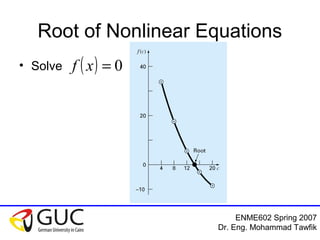
Root of Nonlinear Equations
• Solve   0xf
Numerical Analysis: Bracketing Methods
Mohammad Tawfik
#WikiCourses
http://WikiCourses.WikiSpaces.com
Bracketing Methods
Numerical Analysis: Bracketing Methods
Mohammad Tawfik
#WikiCourses
http://WikiCourses.WikiSpaces.com
Intermediate Value Theorem
• For our specific interest
If f(x) is continuous in the interval [a,b], and
f(a).f(b)<0, then there exists ‘c’ such that
a<c<b and f(c)=0.
Numerical Analysis: Bracketing Methods
Mohammad Tawfik
#WikiCourses
http://WikiCourses.WikiSpaces.com
Example
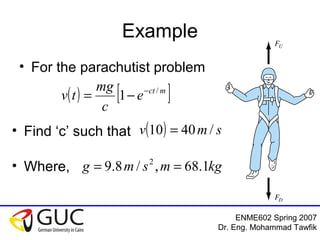
• For the parachutist problem
   mct
e
c
mg
tv /
1 

• Find ‘c’ such that   smv /4010 
• Where, kgmsmg 1.68,/8.9 2

Numerical Analysis: Bracketing Methods
Mohammad Tawfik
#WikiCourses
http://WikiCourses.WikiSpaces.com
Example (cont’d)
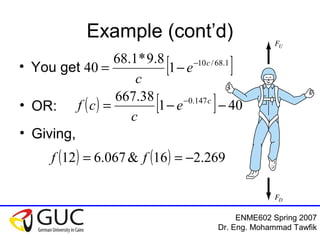
• You get  1.68/10
1
8.9*1.68
40 c
e
c


• OR:
• Giving,
    401
38.667 147.0
  c
e
c
cf
    269.216&067.612  ff
Numerical Analysis: Bracketing Methods
Mohammad Tawfik
#WikiCourses
http://WikiCourses.WikiSpaces.com
Example (cont’d)
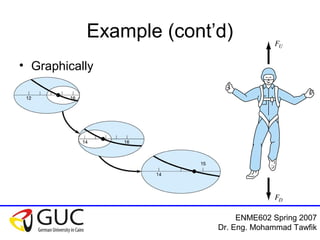
• Graphically
Numerical Analysis: Bracketing Methods
Mohammad Tawfik
#WikiCourses
http://WikiCourses.WikiSpaces.com
The Bisection Method
Numerical Analysis: Bracketing Methods
Mohammad Tawfik
#WikiCourses
http://WikiCourses.WikiSpaces.com
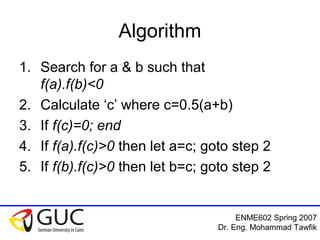
Algorithm
1. Search for a & b such that
f(a).f(b)<0
2. Calculate ‘c’ where c=0.5(a+b)
3. If f(c)=0; end
4. If f(a).f(c)>0 then let a=c; goto step 2
5. If f(b).f(c)>0 then let b=c; goto step 2
Numerical Analysis: Bracketing Methods
Mohammad Tawfik
#WikiCourses
http://WikiCourses.WikiSpaces.com
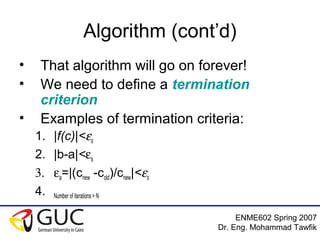
Algorithm (cont’d)
• That algorithm will go on forever!
• We need to define a termination
criterion
• Examples of termination criteria:
1. |f(c)|<es
2. |b-a|<es
3. ea=|(cnew -cold)/cnew|<es
4. Number of iterations > N
Numerical Analysis: Bracketing Methods
Mohammad Tawfik
#WikiCourses
http://WikiCourses.WikiSpaces.com
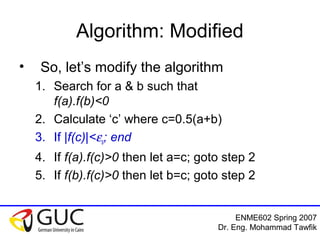
Algorithm: Modified
• So, let’s modify the algorithm
1. Search for a & b such that
f(a).f(b)<0
2. Calculate ‘c’ where c=0.5(a+b)
3. If |f(c)|<es; end
4. If f(a).f(c)>0 then let a=c; goto step 2
5. If f(b).f(c)>0 then let b=c; goto step 2
Numerical Analysis: Bracketing Methods
Mohammad Tawfik
#WikiCourses
http://WikiCourses.WikiSpaces.com
False-Position Method
Numerical Analysis: Bracketing Methods
Mohammad Tawfik
#WikiCourses
http://WikiCourses.WikiSpaces.com
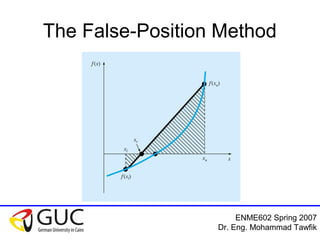
The False-Position Method
Numerical Analysis: Bracketing Methods
Mohammad Tawfik
#WikiCourses
http://WikiCourses.WikiSpaces.com
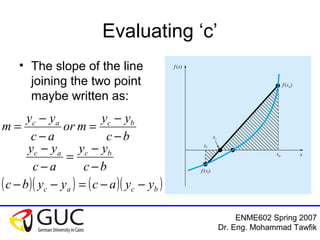
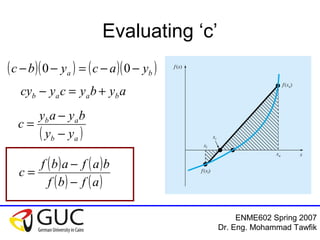
Evaluating ‘c’
• The slope of the line
joining the two point
maybe written as:
bc
yy
mor
ac
yy
m bcac






bc
yy
ac
yy bcac





     bcac yyacyybc 
Numerical Analysis: Bracketing Methods
Mohammad Tawfik
#WikiCourses
http://WikiCourses.WikiSpaces.com
Evaluating ‘c’
     ba yacybc  00
aybycycy baab 
 ab
ab
yy
byay
c



   
   afbf
bafabf
c



Numerical Analysis: Bracketing Methods
Mohammad Tawfik
#WikiCourses
http://WikiCourses.WikiSpaces.com
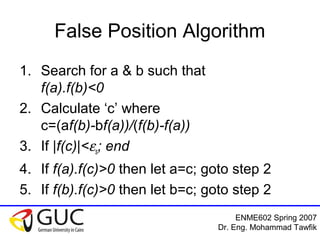
False Position Algorithm
1. Search for a & b such that
f(a).f(b)<0
2. Calculate ‘c’ where
c=(af(b)-bf(a))/(f(b)-f(a))
3. If |f(c)|<es; end
4. If f(a).f(c)>0 then let a=c; goto step 2
5. If f(b).f(c)>0 then let b=c; goto step 2
Numerical Analysis: Bracketing Methods
Mohammad Tawfik
#WikiCourses
http://WikiCourses.WikiSpaces.com
Conclusion
• The need for numerical solution of nonlinear
equations led to the invention of approximate
techniques!
• The bracketing techniques ensure that you will
find a solution for a continuous function if the
solution exists
• A termination criterion should be embedded into
the numerical algorithm to ensure its
termination!
Numerical Analysis: Bracketing Methods
Mohammad Tawfik
#WikiCourses
http://WikiCourses.WikiSpaces.com
Homework #1
• Chapter 5, page 139, numbers:
5.3,5.6,5.7,5.8,5.12
• You are not required to get the solution
graphically!
• Homework due Next week!

Bracketing Methods

  • 1.
    Numerical Analysis: BracketingMethods Mohammad Tawfik #WikiCourses http://WikiCourses.WikiSpaces.com Roots of Nonlinear Equations
  • 2.
    Numerical Analysis: BracketingMethods Mohammad Tawfik #WikiCourses http://WikiCourses.WikiSpaces.com Objectives • Understand the need for numerical solutions of nonlinear equations • Be able to use the bisection algorithm to find a root of an equation • Be able to use the false position method to find a root of an equations • Write down an algorithm to outline the method being used • Realize the need for termination criteria
  • 3.
    Numerical Analysis: BracketingMethods Mohammad Tawfik #WikiCourses http://WikiCourses.WikiSpaces.com Root of Nonlinear Equations • Solve   0xf
  • 4.
    Numerical Analysis: BracketingMethods Mohammad Tawfik #WikiCourses http://WikiCourses.WikiSpaces.com Bracketing Methods
  • 5.
    Numerical Analysis: BracketingMethods Mohammad Tawfik #WikiCourses http://WikiCourses.WikiSpaces.com Intermediate Value Theorem • For our specific interest If f(x) is continuous in the interval [a,b], and f(a).f(b)<0, then there exists ‘c’ such that a<c<b and f(c)=0.
  • 6.
    Numerical Analysis: BracketingMethods Mohammad Tawfik #WikiCourses http://WikiCourses.WikiSpaces.com Example • For the parachutist problem    mct e c mg tv / 1   • Find ‘c’ such that   smv /4010  • Where, kgmsmg 1.68,/8.9 2 
  • 7.
    Numerical Analysis: BracketingMethods Mohammad Tawfik #WikiCourses http://WikiCourses.WikiSpaces.com Example (cont’d) • You get  1.68/10 1 8.9*1.68 40 c e c   • OR: • Giving,     401 38.667 147.0   c e c cf     269.216&067.612  ff
  • 8.
    Numerical Analysis: BracketingMethods Mohammad Tawfik #WikiCourses http://WikiCourses.WikiSpaces.com Example (cont’d) • Graphically
  • 9.
    Numerical Analysis: BracketingMethods Mohammad Tawfik #WikiCourses http://WikiCourses.WikiSpaces.com The Bisection Method
  • 10.
    Numerical Analysis: BracketingMethods Mohammad Tawfik #WikiCourses http://WikiCourses.WikiSpaces.com Algorithm 1. Search for a & b such that f(a).f(b)<0 2. Calculate ‘c’ where c=0.5(a+b) 3. If f(c)=0; end 4. If f(a).f(c)>0 then let a=c; goto step 2 5. If f(b).f(c)>0 then let b=c; goto step 2
  • 11.
    Numerical Analysis: BracketingMethods Mohammad Tawfik #WikiCourses http://WikiCourses.WikiSpaces.com Algorithm (cont’d) • That algorithm will go on forever! • We need to define a termination criterion • Examples of termination criteria: 1. |f(c)|<es 2. |b-a|<es 3. ea=|(cnew -cold)/cnew|<es 4. Number of iterations > N
  • 12.
    Numerical Analysis: BracketingMethods Mohammad Tawfik #WikiCourses http://WikiCourses.WikiSpaces.com Algorithm: Modified • So, let’s modify the algorithm 1. Search for a & b such that f(a).f(b)<0 2. Calculate ‘c’ where c=0.5(a+b) 3. If |f(c)|<es; end 4. If f(a).f(c)>0 then let a=c; goto step 2 5. If f(b).f(c)>0 then let b=c; goto step 2
  • 13.
    Numerical Analysis: BracketingMethods Mohammad Tawfik #WikiCourses http://WikiCourses.WikiSpaces.com False-Position Method
  • 14.
    Numerical Analysis: BracketingMethods Mohammad Tawfik #WikiCourses http://WikiCourses.WikiSpaces.com The False-Position Method
  • 15.
    Numerical Analysis: BracketingMethods Mohammad Tawfik #WikiCourses http://WikiCourses.WikiSpaces.com Evaluating ‘c’ • The slope of the line joining the two point maybe written as: bc yy mor ac yy m bcac       bc yy ac yy bcac           bcac yyacyybc 
  • 16.
    Numerical Analysis: BracketingMethods Mohammad Tawfik #WikiCourses http://WikiCourses.WikiSpaces.com Evaluating ‘c’      ba yacybc  00 aybycycy baab   ab ab yy byay c           afbf bafabf c   
  • 17.
    Numerical Analysis: BracketingMethods Mohammad Tawfik #WikiCourses http://WikiCourses.WikiSpaces.com False Position Algorithm 1. Search for a & b such that f(a).f(b)<0 2. Calculate ‘c’ where c=(af(b)-bf(a))/(f(b)-f(a)) 3. If |f(c)|<es; end 4. If f(a).f(c)>0 then let a=c; goto step 2 5. If f(b).f(c)>0 then let b=c; goto step 2
  • 18.
    Numerical Analysis: BracketingMethods Mohammad Tawfik #WikiCourses http://WikiCourses.WikiSpaces.com Conclusion • The need for numerical solution of nonlinear equations led to the invention of approximate techniques! • The bracketing techniques ensure that you will find a solution for a continuous function if the solution exists • A termination criterion should be embedded into the numerical algorithm to ensure its termination!
  • 19.
    Numerical Analysis: BracketingMethods Mohammad Tawfik #WikiCourses http://WikiCourses.WikiSpaces.com Homework #1 • Chapter 5, page 139, numbers: 5.3,5.6,5.7,5.8,5.12 • You are not required to get the solution graphically! • Homework due Next week!