Chapter Three
Root Finding
Roots of Nonlinear Functions
• The most common real-life problems are nonlinear and
are not amenable to be handled by analytical methods to
obtain solutions of a variety of mathematical problems.
Iterative(reputation) methods are the foremost among the
methods developed to obtain approximate solutions.
• The method of finding a root of the non-linear
equations of the form
𝑓 𝑥 = 0
• where the function f(x) may be algebraic, transcendental
or combination of both, plays a major role in the
applications of mathematics as problems of such kind
occur more frequently in many scientific and
mathematical modeling.
Computational Physics Jifar R. 2
The following equations
i. 𝑥6– 𝑥 – 1 = 0
ii.𝑥𝑒𝑥
– cos 𝑥 = 0
iii.sin(𝑥)𝑒𝑥– 2𝑥 – 5 = 0
• can be classified as follows.
i.The equation 𝒙𝟔– 𝒙 – 𝟏 = 𝟎 is an algebraic equation of
degree 6 having one root nearly at x = 1.13472413.
ii.The equation 𝒙𝒆𝒙
– 𝒄𝒐𝒔 𝒙 = 𝟎 is a transcendental
equation as it contains transcendental functions which has
a root nearly about x = 0.51775736.
iii.The equation 𝒔𝒊𝒏(𝒙)𝒆𝒙– 𝟐𝒙 – 𝟓 = 𝟎 is an equation
combined of both algebraic and transcendental functions
and it has a root nearly about x = – 2.523245230.
Computational Physics Jifar R. 3
• If a number ‘𝜶’ makes the function of a scalar variable, i.e., 𝒇(𝒙) to
zero then ‘𝜶’ is called a zero or a root of the equation 𝒇(𝒙) = 𝟎.
• To obtain this root, if one obtains iterates {𝒙𝟏, 𝒙𝟐, … . 𝒙𝒏 … } starting
with an initial guess 𝑥0, then this sequence of iterates converge to the
root whenever
𝐥𝐢𝐦
𝒏→∞
𝒙𝒏 − 𝜶 = 𝟎 𝒐𝒓 𝐥𝐢𝐦
𝒏→∞
𝒙𝒏 = 𝜶
• In this chapter, we shall study the methods of obtaining
an approximate solution of equations of the form
𝑓 𝑥 = 0 and discuss the importance of each of these
methods comparing with one another when required,
through some examples.
Computational Physics Jifar R. 4
• Let f (x) be a real valued function defined for a ≤ x ≤ b.
• A number 𝑥0 is called a root of the function f (x) in this
interval if f (𝑥0) = 0 and, correspondingly, a number x
=𝑥0 that makes f (x) vanish is called a zero of f (x).
• The need to find roots of functions is fundamental to the
development and application in sciences
• Only in simple cases can the roots be determined
analytically, so in all other cases it is necessary to find
them numerically.
• Many different methods exist, of these only bisection
method, Secant method, & Newton’s method will be
described in any detail, as they are in everyday use and
are easily implemented on a computer.
Computational Physics Jifar R. 5
Roots of an equation
• In physics, we often encounter situations in which
we need to find the possible value of x that ensures
the equation f(x) = 0, where f(x) can either be an
explicit or an implicit function of x.
• If such a value exists, we call it a root or zero of the
equation
• In this section, we will discuss only single-variable
problems and leave the discussion of multivariable
cases to Chapter 5, after we have gained some basic
knowledge of matrix operations.
Computational Physics Jifar R. 6
The Bisection Method
• simplest systematic method for finding the roots of
a function
• based on the repeated application of the
intermediate value property.
• It applies to roots of f(x) with the property that f(x)
changes sign when x crosses a root.
• For a continuous function f(x) & numbers a < b:
f(a) and f(b) have opposite signs.
• f(x) must vanish at least once (have at least one root)
x b/n a and b
Computational Physics Jifar R. 7
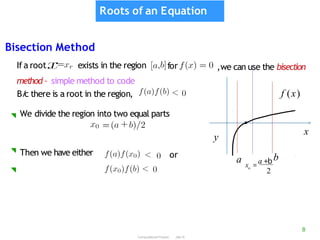
Bisection Method
If a root exists in the region
method – simple method to code
for ,we can use the bisection
B/
c there is a root in the region,
We divide the region into two equal parts
Then we have either or
Roots of an Equation
a b
2
o
x =
a+b
x
f (x)
y
•
8
Computational Physics Jifar R.
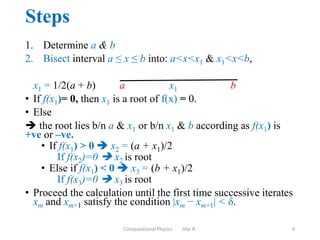
Steps
1. Determine a & b
2. Bisect interval a ≤ x ≤ b into: a<x<x1 & x1<x<b,
x1 = 1/2(a + b) a x1 b
• If f(x1)= 0, then x1 is a root of f(x) = 0.
• Else
 the root lies b/n a & x1 or b/n x1 & b according as f(x1) is
+ve or –ve.
• If f(x1) > 0  x2 = (a + x1)/2
If f(x2)=0  x2 is root
• Else if f(x1) < 0  x3 = (b + x1)/2
If f(x3)=0  x3 is root
• Proceed the calculation until the first time successive iterates
xm and xm+1 satisfy the condition |xm − xm+1| < δ.
Computational Physics Jifar R. 9
Example
• Root of f(x) = 𝑥3
− 4x − 9 = 0, using the bisection
method correct to 3 decimal places
• Find [a,b] by trial that gives f(𝒂)<0 and f(𝒃)>0
• f(2) = – 9 <0 , f(3) = 6>0.  a=2, b=3.
2 x1 3
• This shows a root lies between 2 & 3.
• 𝑥1 =
1
2
a+b =
1
2
(2 + 3) = 2.5.
• f(x1) = -3.375 < 0  root is b/n x1 & 3, [2.5,3.0]
• 𝑥2 =
1
2
(𝑥1 + 3) = 2.75
• f(x2) = 0.7969 > 0  root is b/n x1 & x2, [2.5,2.75]
Computational Physics Jifar R. 10
Example
• 𝑥3 =
1
2
(𝑥1 + 𝑥2) = 2.625
• f(x3)=-1.4121< 0  root b/n x2 & x3, [2.75,2.625]
• 𝑥4 =
1
2
(𝑥2 + 𝑥3) = 2.6875,
Repeating this process:
• x5=2.71875, x6=2.70313,
• x7=2.71094, x8=2.70703,
• x9= 2.70508, x10 = 2.70605,
• x11 = 2.70654, x12 = 2.70642
 The root is 2.70642
Computational Physics Jifar R. 11
Algorithm
1. Determine a & b
2. Bisect interval a ≤ x ≤ b into: a<x<x1 & x1<x<b,
x1 = 1/2(a + b)
a x1 b
3. Replace a by x1
If f(a) f(x1) > 0  f(x) changes sign in x1< x<b so this
interval contain root 𝑥𝑟.
If f(a) f(x1) < 0  replace b by x1, f(x) change sign in
α < x < x1, and so contain a root 𝑥𝑟
4. Proceed the calculation until the first time successive
iterates xm & xm+1 satisfy the condition |xm − xm+1| < δ.
Computational Physics Jifar R. 12
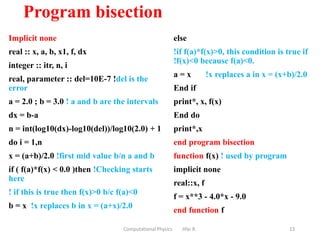
Program bisection
Implicit none
real :: x, a, b, x1, f, dx
integer :: itr, n, i
real, parameter :: del=10E-7 !del is the
error
a = 2.0 ; b = 3.0 ! a and b are the intervals
dx = b-a
n = int(log10(dx)-log10(del))/log10(2.0) + 1
do i = 1,n
x = (a+b)/2.0 !first mid value b/n a and b
if ( f(a)*f(x) < 0.0 )then !Checking starts
here
! if this is true then f(x)>0 b/c f(a)<0
b = x !x replaces b in x = (a+x)/2.0
else
!if f(a)*f(x)>0, this condition is true if
!f(x)<0 because f(a)<0.
a = x !x replaces a in x = (x+b)/2.0
End if
print*, x, f(x)
End do
print*,x
end program bisection
function f(x) ! used by program
implicit none
real::x, f
f = x**3 - 4.0*x - 9.0
end function f
Computational Physics Jifar R. 13
The Newton-Raphson method
• is based on linear approximation of a smooth function
around its root.
• Taylor expansion of 𝑓(𝑥𝑟) = 0 in the neighborhood of
𝑥𝑟
𝑓(𝑥𝑟) ≈ 𝑓(𝑥) + (𝑥𝑟 − 𝑥)𝑓′
(𝑥)+. . . = 0
• x is trial value for 𝑥𝑟 at 𝑘𝑡ℎ
step & approximate value of
the next step 𝑥𝑘+1 can be derived from:
𝑓(𝑥𝑘+1) = 𝑓(𝑥𝑘) + (𝑥𝑘+1 − 𝑥𝑘)𝑓′(𝑥𝑘) = 0,
that is,
𝒙𝒌+𝟏 = 𝒙𝒌 − 𝒇(𝒙𝒌) 𝒇′(𝒙𝒌)
• 𝑓′(𝑥𝑘) =
𝑑𝑓𝑘
𝑑𝑥
with k = 0, 1, . . . & 𝑓𝑘 = 𝑓(𝑥𝑘)
• The above iterative scheme is known as the Newton
method, or the Newton-Raphson method.
Computational Physics Jifar R. 14
Example: root of 𝑓(𝑥) = 𝑥3
− 4x − 9
• Use 𝑥0 =
𝑎+𝑏
2
= 2.5, from Bisection
• 𝑓𝑘
′
=
𝑑𝑓𝑘
𝑑𝑥
= 3𝑥𝑘
2
− 4
• 𝑥𝑘+1 = 𝑥𝑘 − 𝑓𝑘 𝑓𝑘
′
= 𝑥𝑘 −
𝑥𝑘
3−4x−9
3𝑥𝑘
2−4
• 𝑥𝑘+1 =
2𝑥𝑘
3+9
3𝑥𝑘
2−4
 𝑥1 =
2𝑥0
3+9
3𝑥0
2−4
=
2(2.5)3+9
3(2.5)2−4
= 2.7288136
 𝑥2 =
2𝑥1
3+9
3𝑥1
2−4
= 2.706749
Using the above
• x3 = 2.7065279
• x4 = 2.7065279 = 2.706528
• root is 2.706528, using Bisection it is 2.706482 almost the
same result, but Newton method converges faster
Computational Physics Jifar R. 15
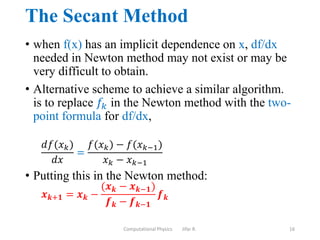
The Secant Method
• when f(x) has an implicit dependence on x, df/dx
needed in Newton method may not exist or may be
very difficult to obtain.
• Alternative scheme to achieve a similar algorithm.
is to replace 𝑓𝑘 in the Newton method with the two-
point formula for df/dx,
𝑑𝑓(𝑥𝑘)
𝑑𝑥
=
𝑓(𝑥𝑘) − 𝑓(𝑥𝑘−1)
𝑥𝑘 − 𝑥𝑘−1
• Putting this in the Newton method:
𝒙𝒌+𝟏 = 𝒙𝒌 −
(𝒙𝒌 − 𝒙𝒌−𝟏)
𝒇𝒌 − 𝒇𝒌−𝟏
𝒇𝒌
Computational Physics Jifar R. 16
Example: root of 𝑓(𝑥) = 𝑥3
− 4x − 9
• Using 𝑓𝑘 = 𝑥𝑘
3
− 4𝑥k − 9 and
• initial values x0 = 2, x1=3,
• f0 = f(x0)= f(2)=-9, f1 = f(x1)=f(3)=6
• Then using 𝑥𝑘+1 = 𝑥𝑘 −
(𝑥𝑘−𝑥𝑘−1)
𝑓𝑘−𝑓𝑘−1
𝑓𝑘
• We are given 𝑥 at k=0 and k=1, find 𝑥 at 𝑘 ≥ 2
• 𝑥2 = 𝑥1 −
𝑥1−𝑥0
𝑓1−𝑓0
𝑓1 = 3 −
3−2
6+9
6 = 2.6, 𝑓2=𝑓(𝑥2) = −1.824
• 𝑥3 = 𝑥2 −
𝑥2−1
𝑓2−𝑓1
𝑓2 = 2.6 −
2.6−3
−1.824−6
(−1.824) = 2.693252
• Following the same trend for x4, x5, x6 and x7
• x7 = 2.706528 the same with newton method.
Computational Physics Jifar R. 17
Exercise
Find the zeros of f 𝑥 = 1 − 3𝑥 +
1
2
𝑥𝑒𝑥 using
a) Bisection: use [0.43,0.47] and [1.53,1.57]
b) Newton: 𝑥0 = 0.5, and 𝑥0 = 1.6
c) Secant method: 𝑥0 = 0.43, 𝑥1 = 0.47
and 𝑥0 = 1.53, 𝑥1 = 1.57
To accurate to 5 decimal places. [two roots from the
graph can be shown]
Answer
𝑥4 =0.45154 1st root
𝑥4 =1.54954 2nd root
Computational Physics Jifar R. 18
Assignment [3,4,5] 10%
For the following functions(1-3) use bisection, Newton-
Raphson & secant methods correct to 3 decimal places to
find their root and write f90 code that gives its root.
1) f(x) = 3x2 − 7x + 3 = 0
2) f(x) = 𝑥 − 𝑐𝑜𝑠𝑥 = 0
3) f(x) = 𝑥log𝑥 − 1.2 = 0, which lies between 2 and 3
4) Apply the secant method to solve f(x) = ex2
lnx2
− x = 0
5) Apply any of the three methods t find their root and
write f90 program for each.
a) xsin(x)+cos(x)
b) x3
− x2
− x + 1
c) cos(x) - x ex
Computational Physics Jifar R. 19

Introduction to comp.physics ch 3.pdf

  • 1.
  • 2.
    Roots of NonlinearFunctions • The most common real-life problems are nonlinear and are not amenable to be handled by analytical methods to obtain solutions of a variety of mathematical problems. Iterative(reputation) methods are the foremost among the methods developed to obtain approximate solutions. • The method of finding a root of the non-linear equations of the form 𝑓 𝑥 = 0 • where the function f(x) may be algebraic, transcendental or combination of both, plays a major role in the applications of mathematics as problems of such kind occur more frequently in many scientific and mathematical modeling. Computational Physics Jifar R. 2
  • 3.
    The following equations i.𝑥6– 𝑥 – 1 = 0 ii.𝑥𝑒𝑥 – cos 𝑥 = 0 iii.sin(𝑥)𝑒𝑥– 2𝑥 – 5 = 0 • can be classified as follows. i.The equation 𝒙𝟔– 𝒙 – 𝟏 = 𝟎 is an algebraic equation of degree 6 having one root nearly at x = 1.13472413. ii.The equation 𝒙𝒆𝒙 – 𝒄𝒐𝒔 𝒙 = 𝟎 is a transcendental equation as it contains transcendental functions which has a root nearly about x = 0.51775736. iii.The equation 𝒔𝒊𝒏(𝒙)𝒆𝒙– 𝟐𝒙 – 𝟓 = 𝟎 is an equation combined of both algebraic and transcendental functions and it has a root nearly about x = – 2.523245230. Computational Physics Jifar R. 3
  • 4.
    • If anumber ‘𝜶’ makes the function of a scalar variable, i.e., 𝒇(𝒙) to zero then ‘𝜶’ is called a zero or a root of the equation 𝒇(𝒙) = 𝟎. • To obtain this root, if one obtains iterates {𝒙𝟏, 𝒙𝟐, … . 𝒙𝒏 … } starting with an initial guess 𝑥0, then this sequence of iterates converge to the root whenever 𝐥𝐢𝐦 𝒏→∞ 𝒙𝒏 − 𝜶 = 𝟎 𝒐𝒓 𝐥𝐢𝐦 𝒏→∞ 𝒙𝒏 = 𝜶 • In this chapter, we shall study the methods of obtaining an approximate solution of equations of the form 𝑓 𝑥 = 0 and discuss the importance of each of these methods comparing with one another when required, through some examples. Computational Physics Jifar R. 4
  • 5.
    • Let f(x) be a real valued function defined for a ≤ x ≤ b. • A number 𝑥0 is called a root of the function f (x) in this interval if f (𝑥0) = 0 and, correspondingly, a number x =𝑥0 that makes f (x) vanish is called a zero of f (x). • The need to find roots of functions is fundamental to the development and application in sciences • Only in simple cases can the roots be determined analytically, so in all other cases it is necessary to find them numerically. • Many different methods exist, of these only bisection method, Secant method, & Newton’s method will be described in any detail, as they are in everyday use and are easily implemented on a computer. Computational Physics Jifar R. 5
  • 6.
    Roots of anequation • In physics, we often encounter situations in which we need to find the possible value of x that ensures the equation f(x) = 0, where f(x) can either be an explicit or an implicit function of x. • If such a value exists, we call it a root or zero of the equation • In this section, we will discuss only single-variable problems and leave the discussion of multivariable cases to Chapter 5, after we have gained some basic knowledge of matrix operations. Computational Physics Jifar R. 6
  • 7.
    The Bisection Method •simplest systematic method for finding the roots of a function • based on the repeated application of the intermediate value property. • It applies to roots of f(x) with the property that f(x) changes sign when x crosses a root. • For a continuous function f(x) & numbers a < b: f(a) and f(b) have opposite signs. • f(x) must vanish at least once (have at least one root) x b/n a and b Computational Physics Jifar R. 7
  • 8.
    Bisection Method If aroot exists in the region method – simple method to code for ,we can use the bisection B/ c there is a root in the region, We divide the region into two equal parts Then we have either or Roots of an Equation a b 2 o x = a+b x f (x) y • 8 Computational Physics Jifar R.
  • 9.
    Steps 1. Determine a& b 2. Bisect interval a ≤ x ≤ b into: a<x<x1 & x1<x<b, x1 = 1/2(a + b) a x1 b • If f(x1)= 0, then x1 is a root of f(x) = 0. • Else  the root lies b/n a & x1 or b/n x1 & b according as f(x1) is +ve or –ve. • If f(x1) > 0  x2 = (a + x1)/2 If f(x2)=0  x2 is root • Else if f(x1) < 0  x3 = (b + x1)/2 If f(x3)=0  x3 is root • Proceed the calculation until the first time successive iterates xm and xm+1 satisfy the condition |xm − xm+1| < δ. Computational Physics Jifar R. 9
  • 10.
    Example • Root off(x) = 𝑥3 − 4x − 9 = 0, using the bisection method correct to 3 decimal places • Find [a,b] by trial that gives f(𝒂)<0 and f(𝒃)>0 • f(2) = – 9 <0 , f(3) = 6>0.  a=2, b=3. 2 x1 3 • This shows a root lies between 2 & 3. • 𝑥1 = 1 2 a+b = 1 2 (2 + 3) = 2.5. • f(x1) = -3.375 < 0  root is b/n x1 & 3, [2.5,3.0] • 𝑥2 = 1 2 (𝑥1 + 3) = 2.75 • f(x2) = 0.7969 > 0  root is b/n x1 & x2, [2.5,2.75] Computational Physics Jifar R. 10
  • 11.
    Example • 𝑥3 = 1 2 (𝑥1+ 𝑥2) = 2.625 • f(x3)=-1.4121< 0  root b/n x2 & x3, [2.75,2.625] • 𝑥4 = 1 2 (𝑥2 + 𝑥3) = 2.6875, Repeating this process: • x5=2.71875, x6=2.70313, • x7=2.71094, x8=2.70703, • x9= 2.70508, x10 = 2.70605, • x11 = 2.70654, x12 = 2.70642  The root is 2.70642 Computational Physics Jifar R. 11
  • 12.
    Algorithm 1. Determine a& b 2. Bisect interval a ≤ x ≤ b into: a<x<x1 & x1<x<b, x1 = 1/2(a + b) a x1 b 3. Replace a by x1 If f(a) f(x1) > 0  f(x) changes sign in x1< x<b so this interval contain root 𝑥𝑟. If f(a) f(x1) < 0  replace b by x1, f(x) change sign in α < x < x1, and so contain a root 𝑥𝑟 4. Proceed the calculation until the first time successive iterates xm & xm+1 satisfy the condition |xm − xm+1| < δ. Computational Physics Jifar R. 12
  • 13.
    Program bisection Implicit none real:: x, a, b, x1, f, dx integer :: itr, n, i real, parameter :: del=10E-7 !del is the error a = 2.0 ; b = 3.0 ! a and b are the intervals dx = b-a n = int(log10(dx)-log10(del))/log10(2.0) + 1 do i = 1,n x = (a+b)/2.0 !first mid value b/n a and b if ( f(a)*f(x) < 0.0 )then !Checking starts here ! if this is true then f(x)>0 b/c f(a)<0 b = x !x replaces b in x = (a+x)/2.0 else !if f(a)*f(x)>0, this condition is true if !f(x)<0 because f(a)<0. a = x !x replaces a in x = (x+b)/2.0 End if print*, x, f(x) End do print*,x end program bisection function f(x) ! used by program implicit none real::x, f f = x**3 - 4.0*x - 9.0 end function f Computational Physics Jifar R. 13
  • 14.
    The Newton-Raphson method •is based on linear approximation of a smooth function around its root. • Taylor expansion of 𝑓(𝑥𝑟) = 0 in the neighborhood of 𝑥𝑟 𝑓(𝑥𝑟) ≈ 𝑓(𝑥) + (𝑥𝑟 − 𝑥)𝑓′ (𝑥)+. . . = 0 • x is trial value for 𝑥𝑟 at 𝑘𝑡ℎ step & approximate value of the next step 𝑥𝑘+1 can be derived from: 𝑓(𝑥𝑘+1) = 𝑓(𝑥𝑘) + (𝑥𝑘+1 − 𝑥𝑘)𝑓′(𝑥𝑘) = 0, that is, 𝒙𝒌+𝟏 = 𝒙𝒌 − 𝒇(𝒙𝒌) 𝒇′(𝒙𝒌) • 𝑓′(𝑥𝑘) = 𝑑𝑓𝑘 𝑑𝑥 with k = 0, 1, . . . & 𝑓𝑘 = 𝑓(𝑥𝑘) • The above iterative scheme is known as the Newton method, or the Newton-Raphson method. Computational Physics Jifar R. 14
  • 15.
    Example: root of𝑓(𝑥) = 𝑥3 − 4x − 9 • Use 𝑥0 = 𝑎+𝑏 2 = 2.5, from Bisection • 𝑓𝑘 ′ = 𝑑𝑓𝑘 𝑑𝑥 = 3𝑥𝑘 2 − 4 • 𝑥𝑘+1 = 𝑥𝑘 − 𝑓𝑘 𝑓𝑘 ′ = 𝑥𝑘 − 𝑥𝑘 3−4x−9 3𝑥𝑘 2−4 • 𝑥𝑘+1 = 2𝑥𝑘 3+9 3𝑥𝑘 2−4  𝑥1 = 2𝑥0 3+9 3𝑥0 2−4 = 2(2.5)3+9 3(2.5)2−4 = 2.7288136  𝑥2 = 2𝑥1 3+9 3𝑥1 2−4 = 2.706749 Using the above • x3 = 2.7065279 • x4 = 2.7065279 = 2.706528 • root is 2.706528, using Bisection it is 2.706482 almost the same result, but Newton method converges faster Computational Physics Jifar R. 15
  • 16.
    The Secant Method •when f(x) has an implicit dependence on x, df/dx needed in Newton method may not exist or may be very difficult to obtain. • Alternative scheme to achieve a similar algorithm. is to replace 𝑓𝑘 in the Newton method with the two- point formula for df/dx, 𝑑𝑓(𝑥𝑘) 𝑑𝑥 = 𝑓(𝑥𝑘) − 𝑓(𝑥𝑘−1) 𝑥𝑘 − 𝑥𝑘−1 • Putting this in the Newton method: 𝒙𝒌+𝟏 = 𝒙𝒌 − (𝒙𝒌 − 𝒙𝒌−𝟏) 𝒇𝒌 − 𝒇𝒌−𝟏 𝒇𝒌 Computational Physics Jifar R. 16
  • 17.
    Example: root of𝑓(𝑥) = 𝑥3 − 4x − 9 • Using 𝑓𝑘 = 𝑥𝑘 3 − 4𝑥k − 9 and • initial values x0 = 2, x1=3, • f0 = f(x0)= f(2)=-9, f1 = f(x1)=f(3)=6 • Then using 𝑥𝑘+1 = 𝑥𝑘 − (𝑥𝑘−𝑥𝑘−1) 𝑓𝑘−𝑓𝑘−1 𝑓𝑘 • We are given 𝑥 at k=0 and k=1, find 𝑥 at 𝑘 ≥ 2 • 𝑥2 = 𝑥1 − 𝑥1−𝑥0 𝑓1−𝑓0 𝑓1 = 3 − 3−2 6+9 6 = 2.6, 𝑓2=𝑓(𝑥2) = −1.824 • 𝑥3 = 𝑥2 − 𝑥2−1 𝑓2−𝑓1 𝑓2 = 2.6 − 2.6−3 −1.824−6 (−1.824) = 2.693252 • Following the same trend for x4, x5, x6 and x7 • x7 = 2.706528 the same with newton method. Computational Physics Jifar R. 17
  • 18.
    Exercise Find the zerosof f 𝑥 = 1 − 3𝑥 + 1 2 𝑥𝑒𝑥 using a) Bisection: use [0.43,0.47] and [1.53,1.57] b) Newton: 𝑥0 = 0.5, and 𝑥0 = 1.6 c) Secant method: 𝑥0 = 0.43, 𝑥1 = 0.47 and 𝑥0 = 1.53, 𝑥1 = 1.57 To accurate to 5 decimal places. [two roots from the graph can be shown] Answer 𝑥4 =0.45154 1st root 𝑥4 =1.54954 2nd root Computational Physics Jifar R. 18
  • 19.
    Assignment [3,4,5] 10% Forthe following functions(1-3) use bisection, Newton- Raphson & secant methods correct to 3 decimal places to find their root and write f90 code that gives its root. 1) f(x) = 3x2 − 7x + 3 = 0 2) f(x) = 𝑥 − 𝑐𝑜𝑠𝑥 = 0 3) f(x) = 𝑥log𝑥 − 1.2 = 0, which lies between 2 and 3 4) Apply the secant method to solve f(x) = ex2 lnx2 − x = 0 5) Apply any of the three methods t find their root and write f90 program for each. a) xsin(x)+cos(x) b) x3 − x2 − x + 1 c) cos(x) - x ex Computational Physics Jifar R. 19