
08/18/14 http://numericalmethods.eng.usf.edu 1
Bisection Method
Major: All Engineering Majors
Authors: Autar Kaw, Jai Paul
http://numericalmethods.eng.usf.edu
Transforming Numerical Methods Education for STEM
Undergraduates
Bisection Method
http://numericalmethods.eng.usf.edu
http://numericalmethods.eng.usf.edu3
Basis of Bisection Method
Theorem
x
f(x)
xu
x
An equation f(x)=0, where f(x) is a real continuous function,
has at least one root between xl and xu if f(xl) f(xu) < 0.
Figure 1 At least one root exists between the two points if the function is
real, continuous, and changes sign.
x
f(x)
xu
x
http://numericalmethods.eng.usf.edu4
Basis of Bisection Method
Figure 2 If function does not change sign between two
points, roots of the equation may still exist between the two
points.
( )xf
( ) 0=xf
x
f(x)
xu
x
http://numericalmethods.eng.usf.edu5
Basis of Bisection Method
Figure 3 If the function does not change sign between two
points, there may not be any roots for the equation between the
two points.
x
f(x)
xu
x
( )xf
( ) 0=xf
x
f(x)
xu
x
http://numericalmethods.eng.usf.edu6
Basis of Bisection Method
Figure 4 If the function changes sign between two points,
more than one root for the equation may exist between the two
points.
( )xf
( ) 0=xf
http://numericalmethods.eng.usf.edu7
Algorithm for Bisection
Method
http://numericalmethods.eng.usf.edu8
Step 1
Choose x
and xu
as two guesses for the root such that
f(x
) f(xu
) < 0, or in other words, f(x) changes sign
between x
and xu
. This was demonstrated in Figure 1.
x
f(x)
xu
x
Figure 1
x
f(x)
xu
x
xm
http://numericalmethods.eng.usf.edu9
Step 2
Estimate the root, xm
of the equation f (x) = 0 as the mid
point between x
and xu
as
x
x
m =
xu +
2
Figure 5 Estimate of xm
http://numericalmethods.eng.usf.edu10
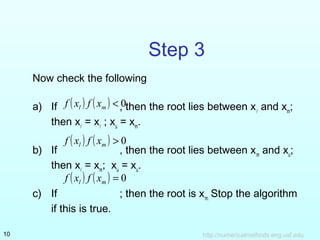
Step 3
Now check the following
a) If , then the root lies between x
and xm
;
then x
= x
; xu
= xm
.
b) If , then the root lies between xm
and xu
;
then x
= xm
; xu
= xu
.
c) If ; then the root is xm.
Stop the algorithm
if this is true.
( ) ( ) 0<ml xfxf
( ) ( ) 0>ml xfxf
( ) ( ) 0=ml xfxf
http://numericalmethods.eng.usf.edu11
Step 4
x
x
m =
xu +
2
100×
−
=∈ new
m
old
m
new
a
x
xxm
rootofestimatecurrent=new
mx
rootofestimateprevious=old
mx
Find the new estimate of the root
Find the absolute relative approximate error
where
http://numericalmethods.eng.usf.edu12
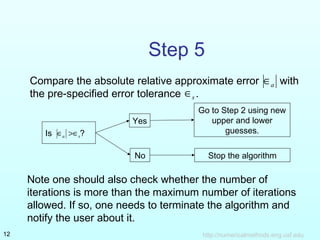
Step 5
Is ?
Yes
No
Go to Step 2 using new
upper and lower
guesses.
Stop the algorithm
Compare the absolute relative approximate error with
the pre-specified error tolerance .
a∈
s∈
sa >∈∈
Note one should also check whether the number of
iterations is more than the maximum number of iterations
allowed. If so, one needs to terminate the algorithm and
notify the user about it.
http://numericalmethods.eng.usf.edu13
Example 1
You are working for ‘DOWN THE TOILET COMPANY’
that makes floats for ABC commodes. The floating ball
has a specific gravity of 0.6 and has a radius of 5.5 cm.
You are asked to find the depth to which the ball is
submerged when floating in water.
Figure 6 Diagram of the floating ball
http://numericalmethods.eng.usf.edu14
Example 1 Cont.
The equation that gives the depth x to which the ball is
submerged under water is given by
a) Use the bisection method of finding roots of equations to
find the depth x to which the ball is submerged under
water. Conduct three iterations to estimate the root of the
above equation.
b) Find the absolute relative approximate error at the end of
each iteration, and the number of significant digits at
least correct at the end of each iteration.
010993.3165.0 423
=×+− −
xx
http://numericalmethods.eng.usf.edu15
Example 1 Cont.
From the physics of the problem, the ball would be
submerged between x = 0 and x = 2R,
where R = radius of the ball,
that is
( )
11.00
055.020
20
≤≤
≤≤
≤≤
x
x
Rx
Figure 6 Diagram of the floating ball
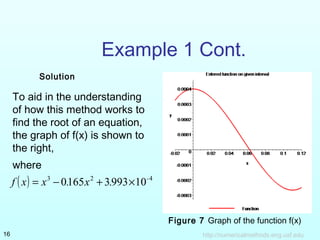
To aid in the understanding
of how this method works to
find the root of an equation,
the graph of f(x) is shown to
the right,
where
http://numericalmethods.eng.usf.edu16
Example 1 Cont.
( ) 423
1099331650 -
.x.xxf ×+−=
Figure 7 Graph of the function f(x)
Solution
http://numericalmethods.eng.usf.edu17
Example 1 Cont.
Let us assume
11.0
00.0
=
=
ux
x
Check if the function changes sign between x
and xu .
( ) ( ) ( ) ( )
( ) ( ) ( ) ( ) 4423
4423
10662.210993.311.0165.011.011.0
10993.310993.30165.000
−−
−−
×−=×+−==
×=×+−==
fxf
fxf
u
l
Hence
( ) ( ) ( ) ( ) ( )( ) 010662.210993.311.00 44
<×−×== −−
ffxfxf ul
So there is at least on root between x
and xu,
that is between 0 and 0.11
http://numericalmethods.eng.usf.edu18
Example 1 Cont.
Figure 8 Graph demonstrating sign change between initial limits
http://numericalmethods.eng.usf.edu19
Example 1 Cont.
055.0
2
11.00
2
=
+
=
+
= u
m
xx
x 
( ) ( ) ( ) ( )
( ) ( ) ( ) ( ) ( )( ) 010655.610993.3055.00
10655.610993.3055.0165.0055.0055.0
54
5423
>××==
×=×+−==
−−
−−
ffxfxf
fxf
ml
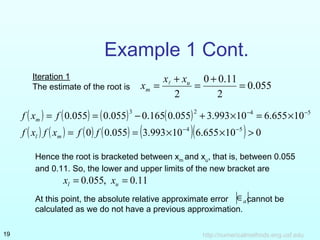
m
Iteration 1
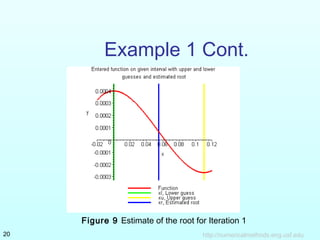
The estimate of the root is
Hence the root is bracketed between xm
and xu
, that is, between 0.055
and 0.11. So, the lower and upper limits of the new bracket are
At this point, the absolute relative approximate error cannot be
calculated as we do not have a previous approximation.
11.0,055.0 == ul xx
a∈
http://numericalmethods.eng.usf.edu20
Example 1 Cont.
Figure 9 Estimate of the root for Iteration 1
http://numericalmethods.eng.usf.edu21
Example 1 Cont.
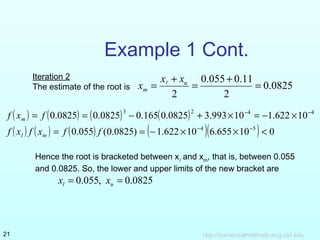
0825.0
2
11.0055.0
2
=
+
=
+
= u
m
xx
x 
( ) ( ) ( ) ( )
( ) ( ) ( ) ( )( ) 010655.610622.1)0825.0(055.0
10622.110993.30825.0165.00825.00825.0
54
4423
<××−==
×−=×+−==
−−
−−
ffxfxf
fxf
ml
m
Iteration 2
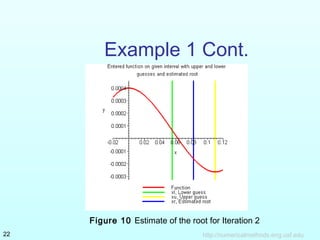
The estimate of the root is
Hence the root is bracketed between x
and xm
, that is, between 0.055
and 0.0825. So, the lower and upper limits of the new bracket are
0825.0,055.0 == ul xx
http://numericalmethods.eng.usf.edu22
Example 1 Cont.
Figure 10 Estimate of the root for Iteration 2
http://numericalmethods.eng.usf.edu23
Example 1 Cont.
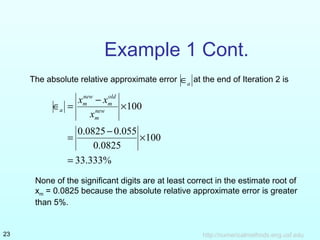
The absolute relative approximate error at the end of Iteration 2 isa∈
%333.33
100
0825.0
055.00825.0
100
=
×
−
=
×
−
=∈ new
m
old
m
new
m
a
x
xx
None of the significant digits are at least correct in the estimate root of
xm = 0.0825 because the absolute relative approximate error is greater
than 5%.
http://numericalmethods.eng.usf.edu24
Example 1 Cont.
06875.0
2
0825.0055.0
2
=
+
=
+
= u
m
xx
x 
( ) ( ) ( ) ( )
( ) ( ) ( ) ( ) ( )( ) 010563.510655.606875.0055.0
10563.510993.306875.0165.006875.006875.0
55
5423
<×−×==
×−=×+−==
−−
−−
ffxfxf
fxf
ml
m
Iteration 3
The estimate of the root is
Hence the root is bracketed between x
and xm
, that is, between 0.055
and 0.06875. So, the lower and upper limits of the new bracket are
06875.0,055.0 == ul xx
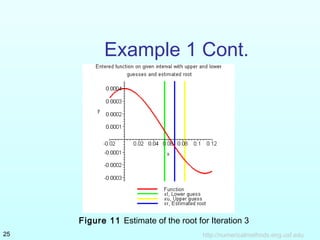
http://numericalmethods.eng.usf.edu25
Example 1 Cont.
Figure 11 Estimate of the root for Iteration 3
http://numericalmethods.eng.usf.edu26
Example 1 Cont.
The absolute relative approximate error at the end of Iteration 3 isa∈
%20
100
06875.0
0825.006875.0
100
=
×
−
=
×
−
=∈ new
m
old
m
new
m
a
x
xx
Still none of the significant digits are at least correct in the estimated
root of the equation as the absolute relative approximate error is greater
than 5%.
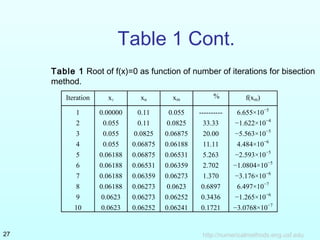
Seven more iterations were conducted and these iterations are shown in
Table 1.
http://numericalmethods.eng.usf.edu27
Table 1 Cont.
Table 1 Root of f(x)=0 as function of number of iterations for bisection
method.
Iteration x xu xm
% f(xm)
1
2
3
4
5
6
7
8
9
10
0.00000
0.055
0.055
0.055
0.06188
0.06188
0.06188
0.06188
0.0623
0.0623
0.11
0.11
0.0825
0.06875
0.06875
0.06531
0.06359
0.06273
0.06273
0.06252
0.055
0.0825
0.06875
0.06188
0.06531
0.06359
0.06273
0.0623
0.06252
0.06241
----------
33.33
20.00
11.11
5.263
2.702
1.370
0.6897
0.3436
0.1721
6.655×10⁻⁵
−1.622×10⁻⁴
−5.563×10⁻⁵
4.484×10⁻⁶
−2.593×10⁻⁵
−1.0804×10⁻⁵
−3.176×10⁻⁶
6.497×10⁻⁷
−1.265×10⁻⁶
−3.0768×10⁻⁷
http://numericalmethods.eng.usf.edu28
Table 1 Cont.
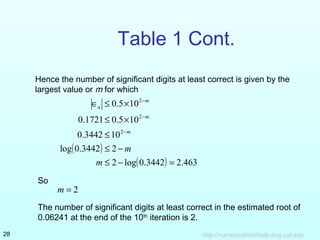
Hence the number of significant digits at least correct is given by the
largest value or m for which
( )
( ) 463.23442.0log2
23442.0log
103442.0
105.01721.0
105.0
2
2
2
=−≤
−≤
≤
×≤
×≤∈
−
−
−
m
m
m
m
m
a
2=m
So
The number of significant digits at least correct in the estimated root of
0.06241 at the end of the 10th
iteration is 2.
http://numericalmethods.eng.usf.edu29
Advantages
 Always convergent
 The root bracket gets halved with each
iteration - guaranteed.
http://numericalmethods.eng.usf.edu30
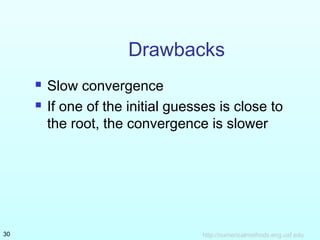
Drawbacks
 Slow convergence
 If one of the initial guesses is close to
the root, the convergence is slower
http://numericalmethods.eng.usf.edu31
Drawbacks (continued)
 If a function f(x) is such that it just
touches the x-axis it will be unable to find
the lower and upper guesses.
f(x)
x
( ) 2
xxf =
http://numericalmethods.eng.usf.edu32
Drawbacks (continued)
 Function changes sign but root does not
exist
f(x)
x
( )
x
xf
1
=
Additional Resources
For all resources on this topic such as digital
audiovisual lectures, primers, textbook chapters,
multiple-choice tests, worksheets in MATLAB,
MATHEMATICA, MathCad and MAPLE, blogs, related
physical problems, please visit
http://numericalmethods.eng.usf.edu/topics/bisection_metho
THE END
http://numericalmethods.eng.usf.edu

Mws gen nle_ppt_bisection