ROOTS OF EQUATIONS
General Purpose
Introduction The determination of the roots of an equation is one of the oldest problems in mathematics and there have been many efforts in this regard. Its importance is that if we can determine the roots of an equation we can also determine the maximum and minimum eigenvalues of matrices, solving systems of linear differential equations, etc ... The determination of the solutions of the equation can be a very difficult problem. If f (x) is a polynomial function of grade 1 or 2, know simple expressions that allow us to determine its roots. For polynomials of degree 3 or 4 is necessary to use complex and laborious methods. However, if f (x) is of degree greater than four is either not polynomial, there is no formula known to help identify the zeros of the equation (except in very special cases).
Types of Methods Graphics Methods •  Open methods •  Methods Closed
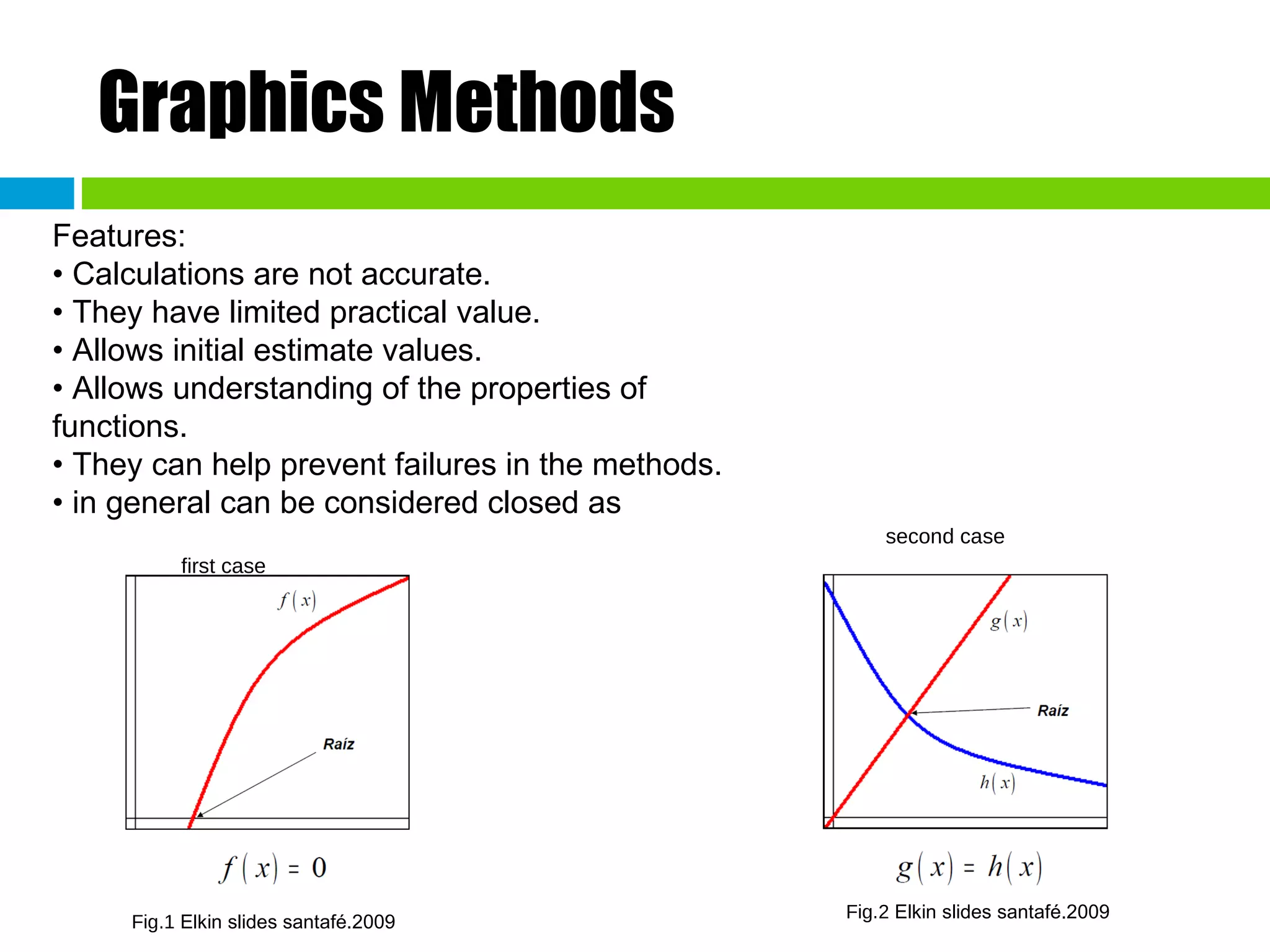
Graphics Methods Features: • Calculations are not accurate. • They have limited practical value. • Allows initial estimate values. • Allows understanding of the properties of functions. • They can help prevent failures in the methods. • in general can be considered closed as  first case second case Fig.1  Elkin slides santafé.2009 Fig.2  Elkin slides santafé.2009
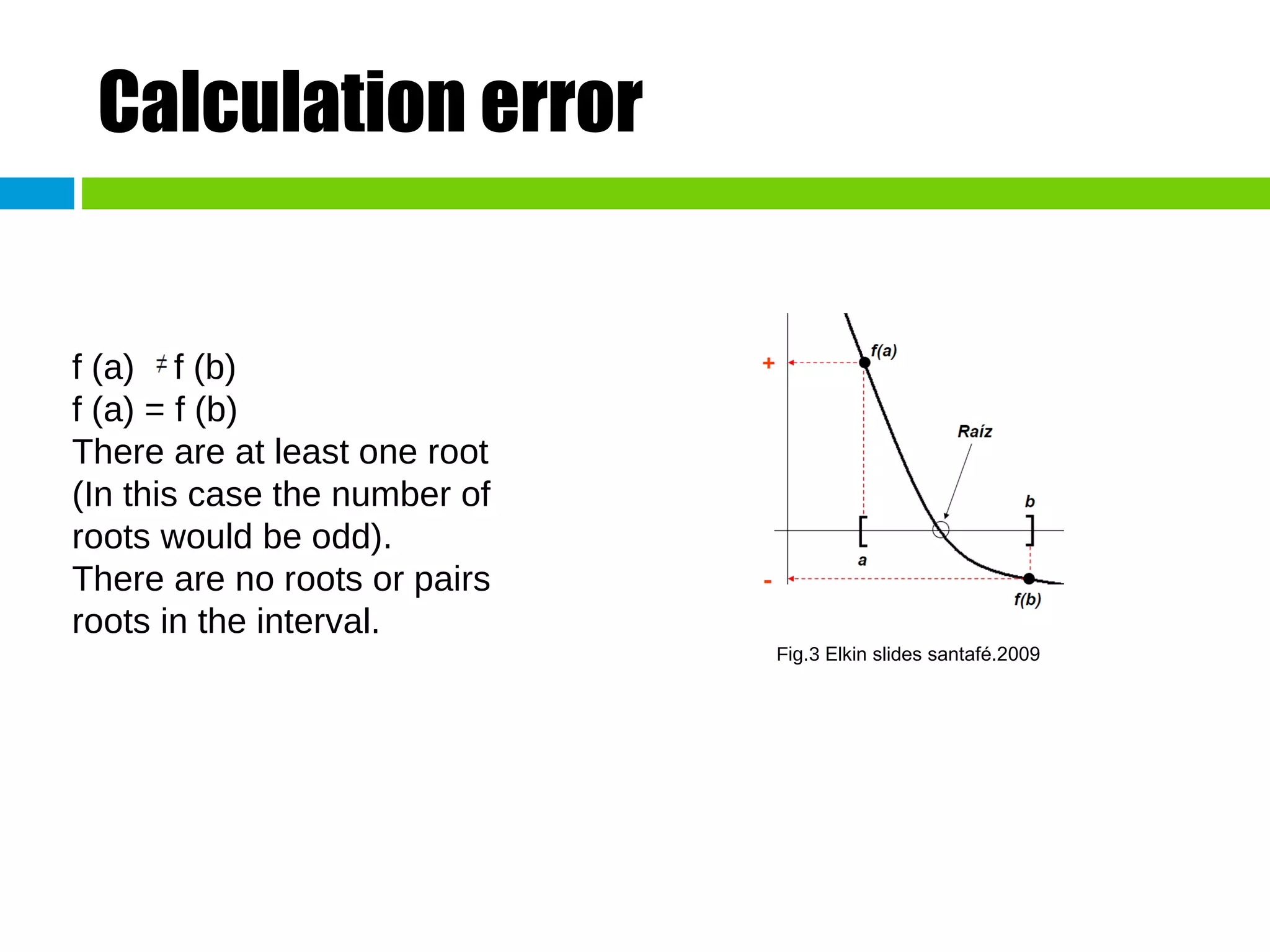
Calculation error f (a)  f (b) f (a) = f (b) There are at least one root (In this case the number of roots would be odd). There are no roots or pairs roots in the interval. Fig.3  Elkin slides santafé.2009
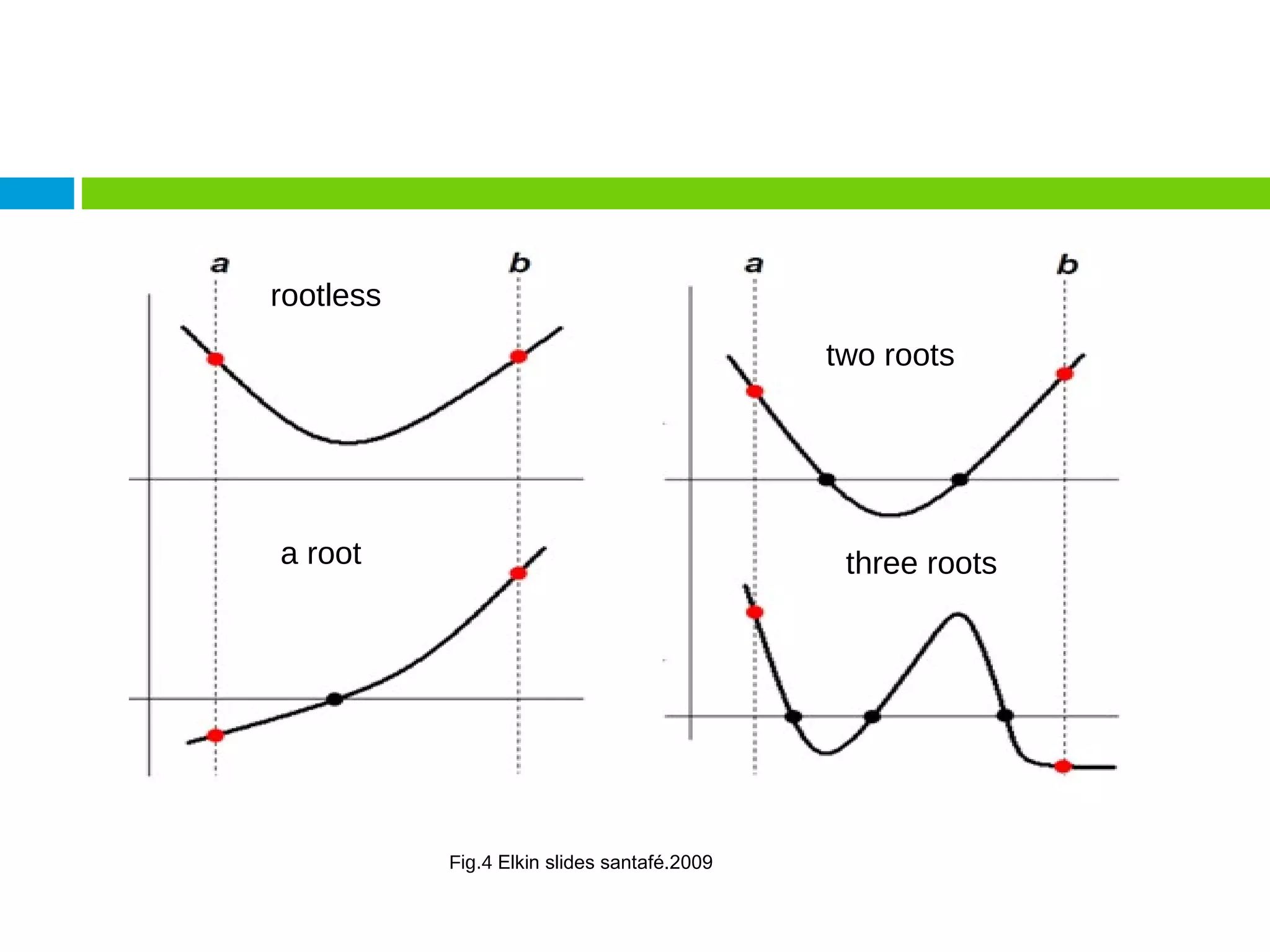
rootless a root two roots three roots Fig.4  Elkin slides santafé.2009
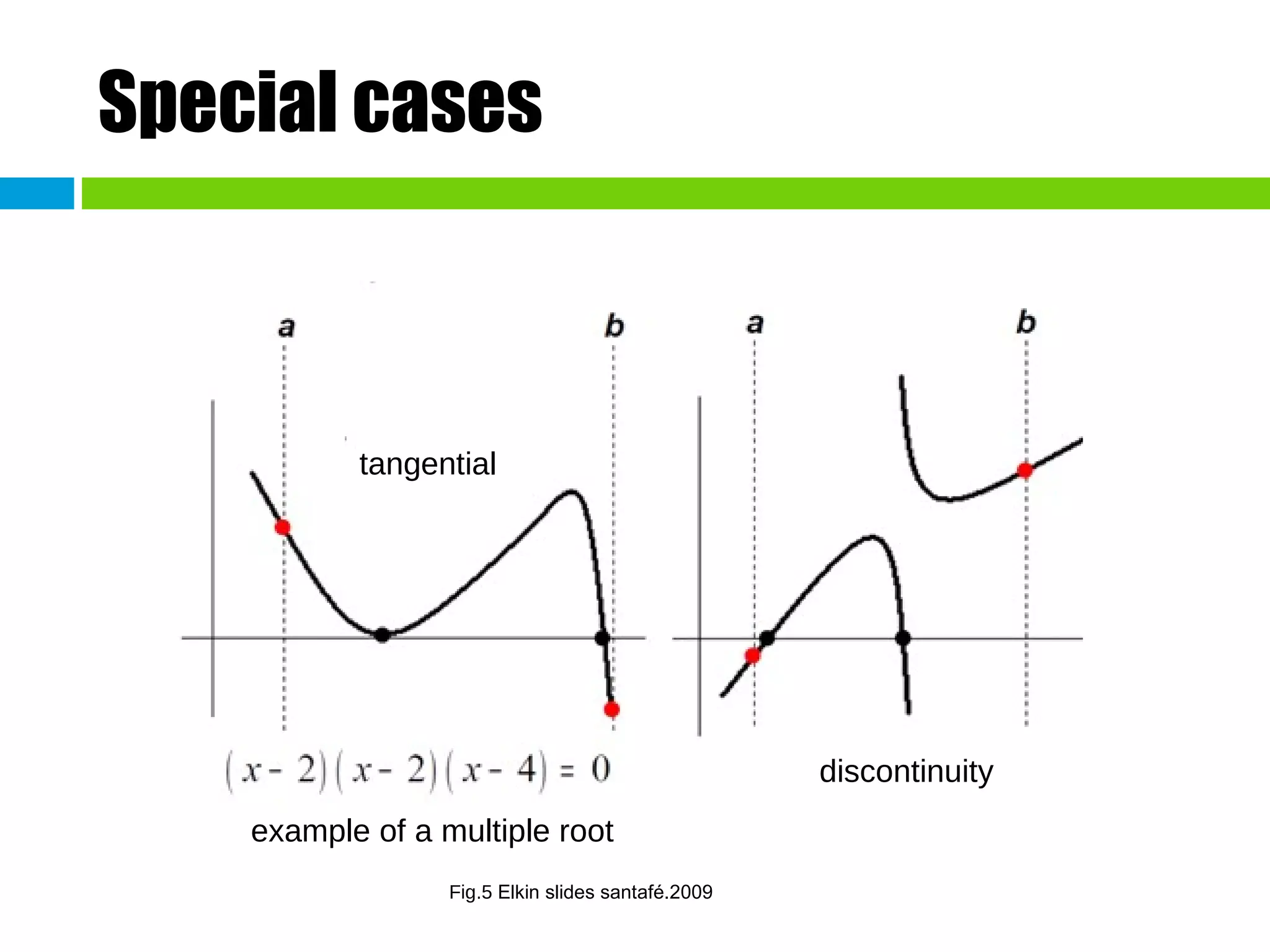
Special cases tangential discontinuity example of a multiple root Fig.5  Elkin slides santafé.2009
Closed Methods They are limiting the search domain. Most known are: • Bisection Method • Method of False Position
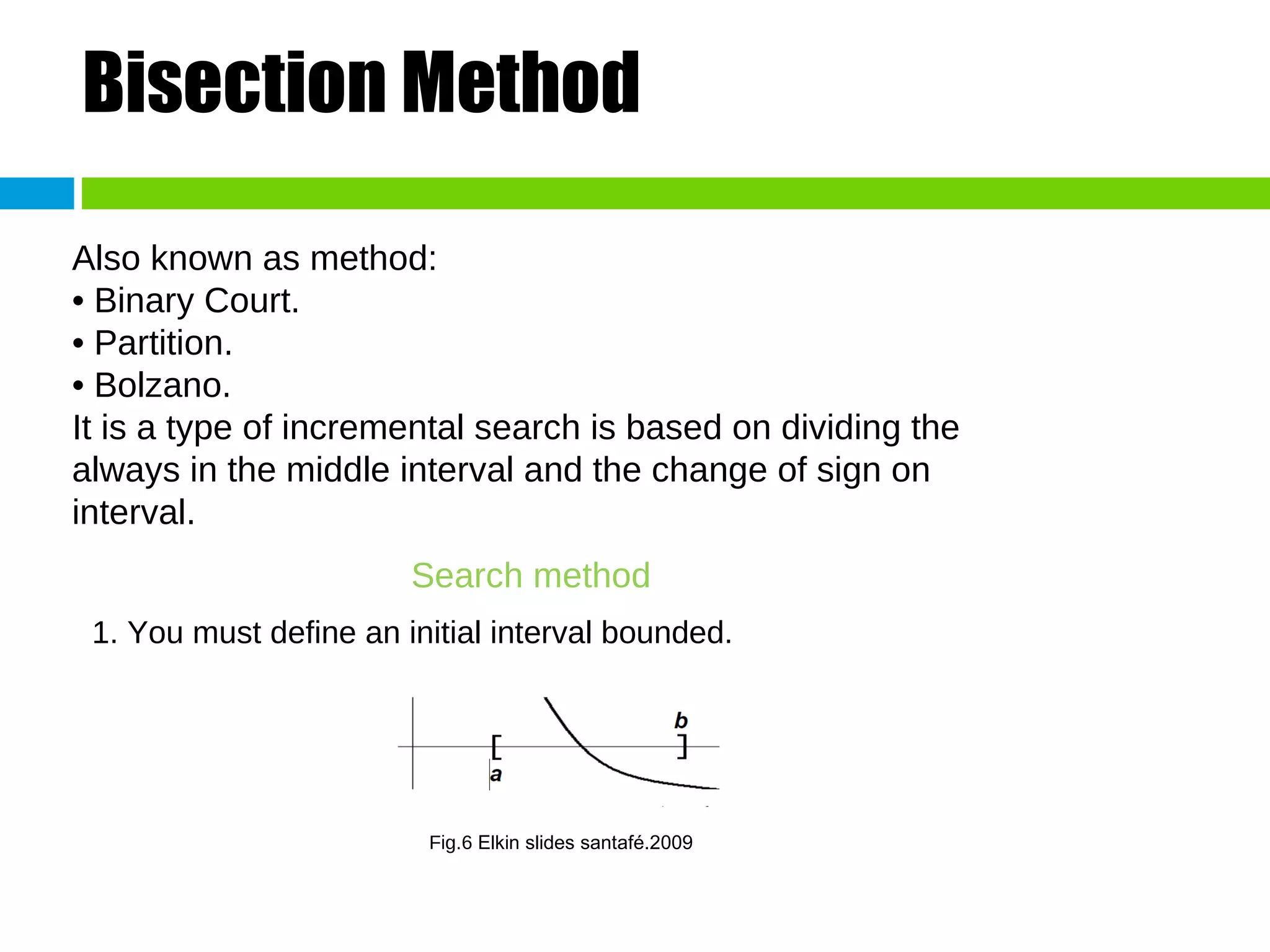
Bisection Method Also known as method: • Binary Court. • Partition. • Bolzano. It is a type of incremental search is based on dividing the always in the middle interval and the change of sign on interval. Search method 1. You must define an initial interval bounded. Fig.6  Elkin slides santafé.2009
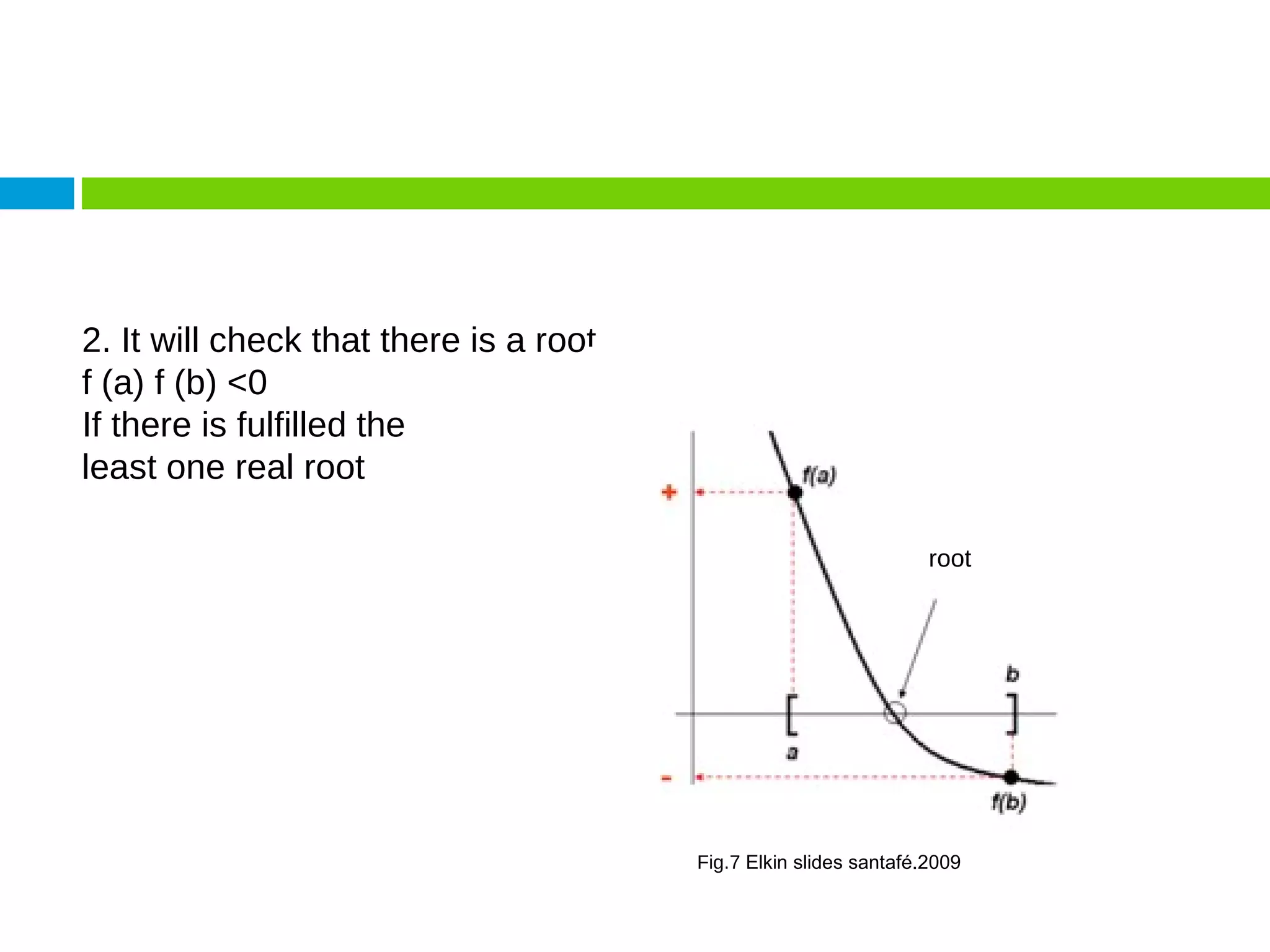
2. It will check that there is a root. f (a) f (b) <0 If there is fulfilled the least one real root root Fig.7  Elkin slides santafé.2009
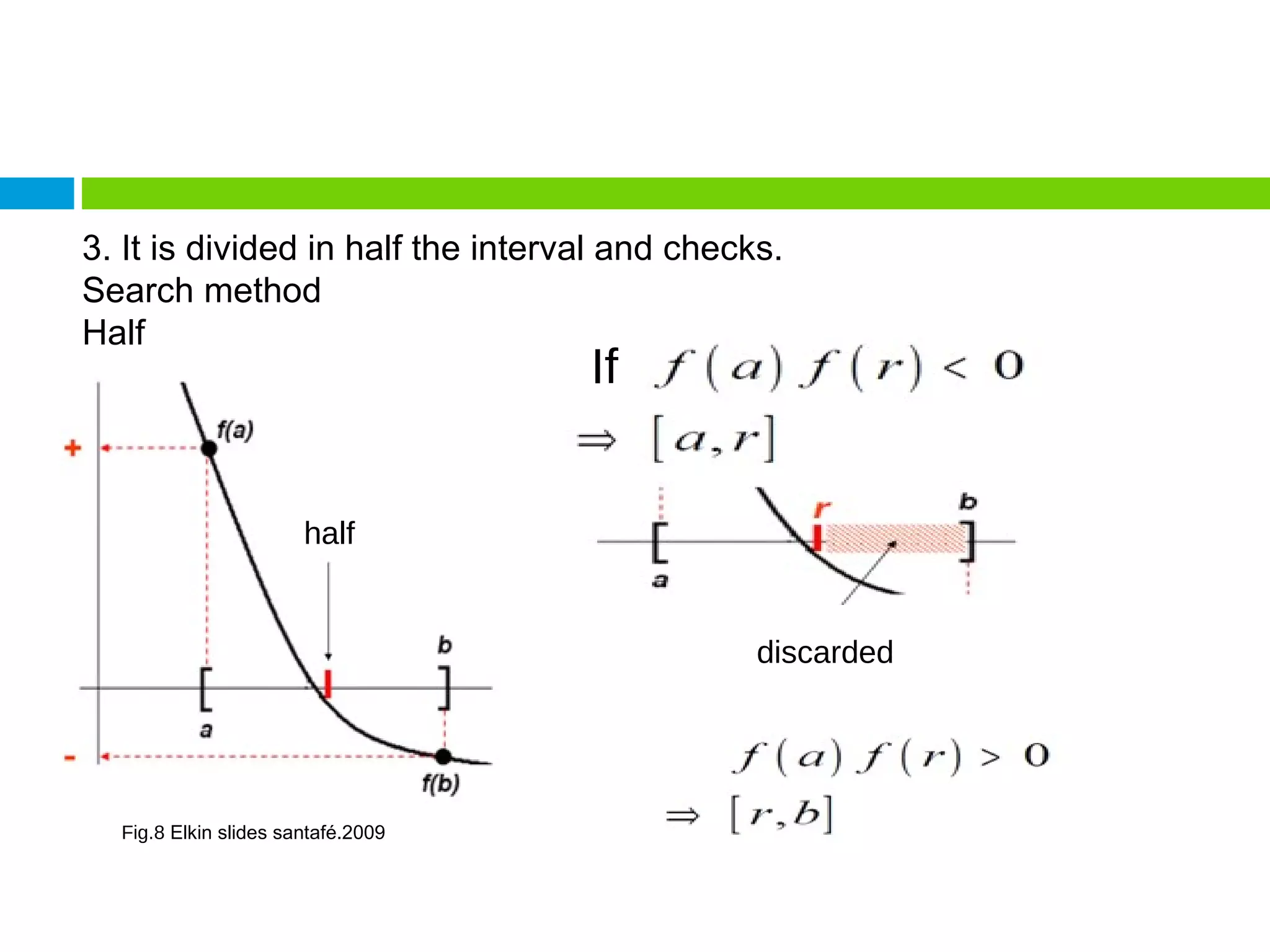
3. It is divided in half the interval and checks. Search method Half If discarded half Fig.8  Elkin slides santafé.2009
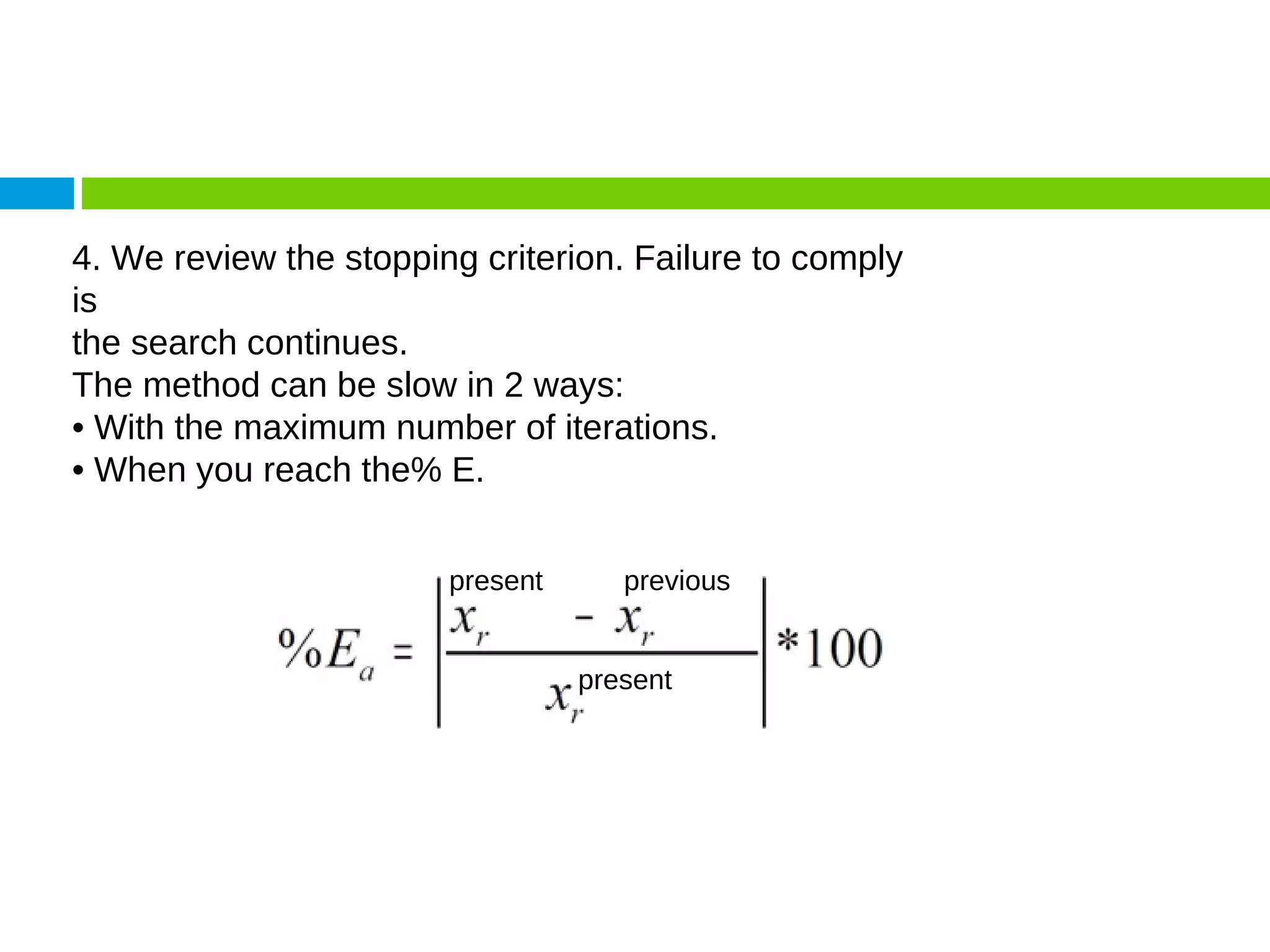
4. We review the stopping criterion. Failure to comply is the search continues. The method can be slow in 2 ways: • With the maximum number of iterations. • When you reach the% E. present present previous
Advantages and Disadvantages ADVANTAGES • You are guaranteed the convergence of the root lock. • Easy implementation. • management has a very clear error. DISADVANTAGES • The convergence can be long. • No account of the extreme values (dimensions) as possible roots.
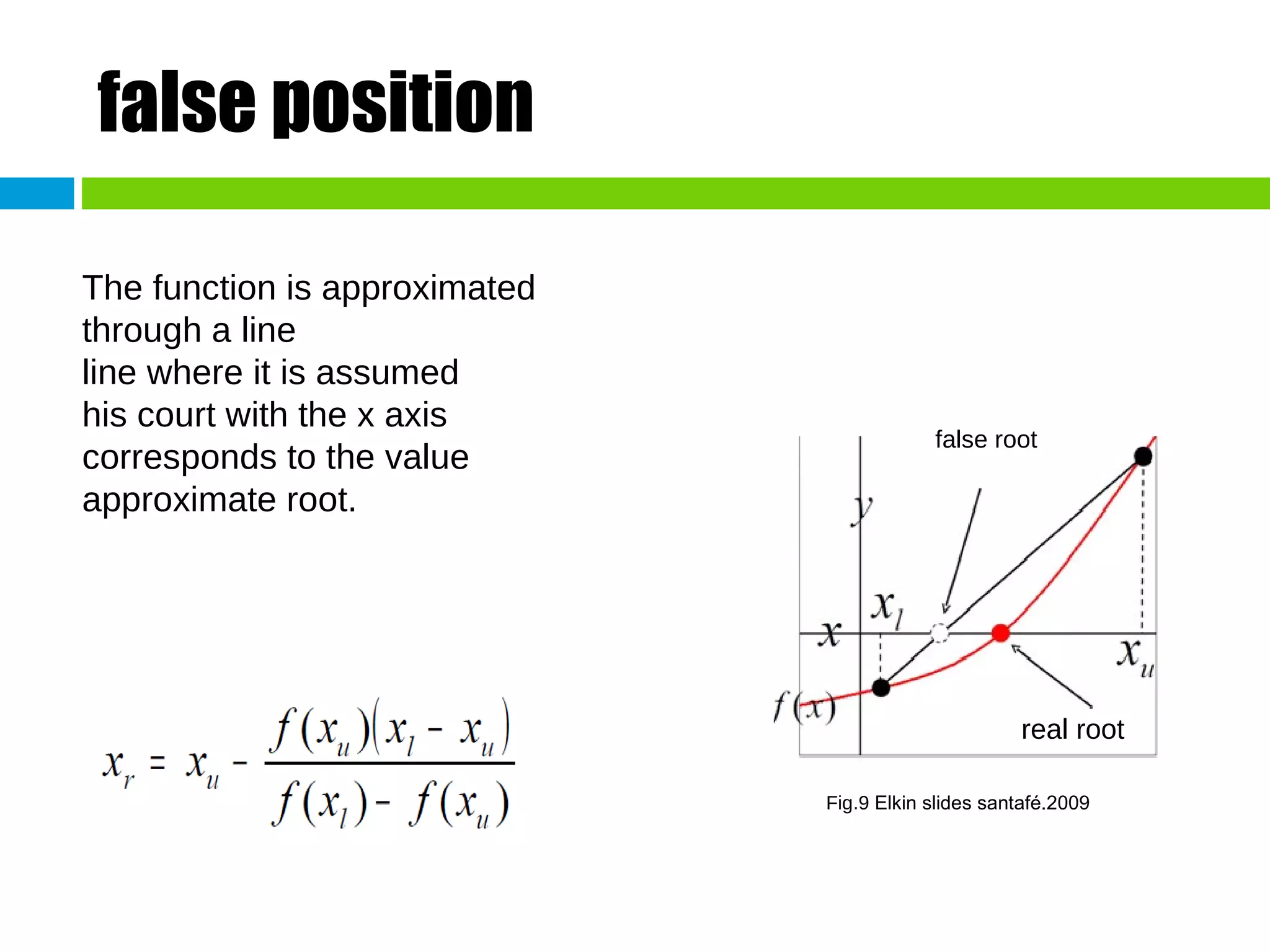
false position The function is approximated through a line line where it is assumed his court with the x axis corresponds to the value approximate root. false root real root Fig.9  Elkin slides santafé.2009
Open Methods They are limiting the search domain. Most known are: • Fixed Point Method • Newton Raphson Method • Drying Method
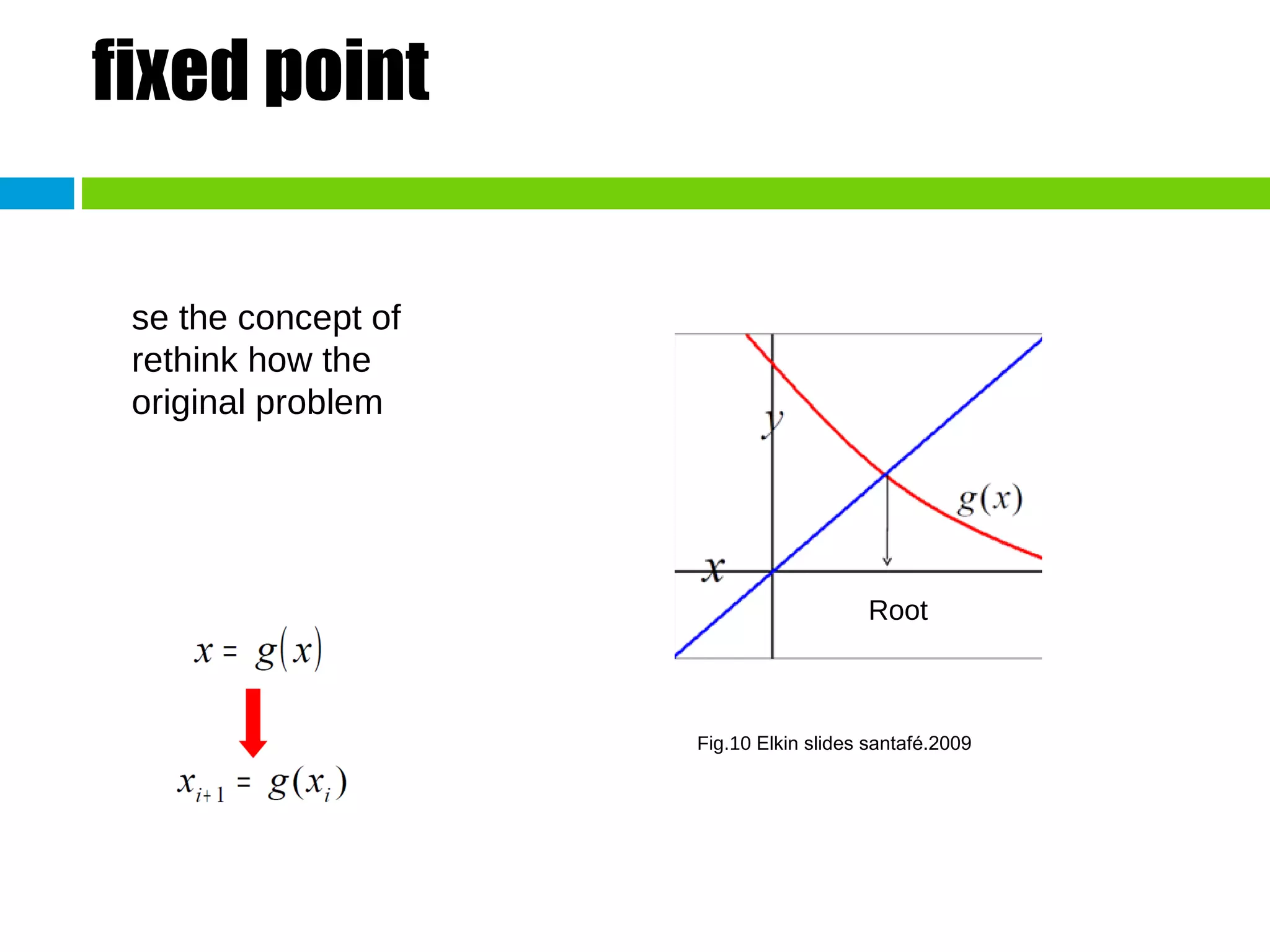
fixed point se the concept of rethink how the original problem Root Fig.10  Elkin slides santafé.2009
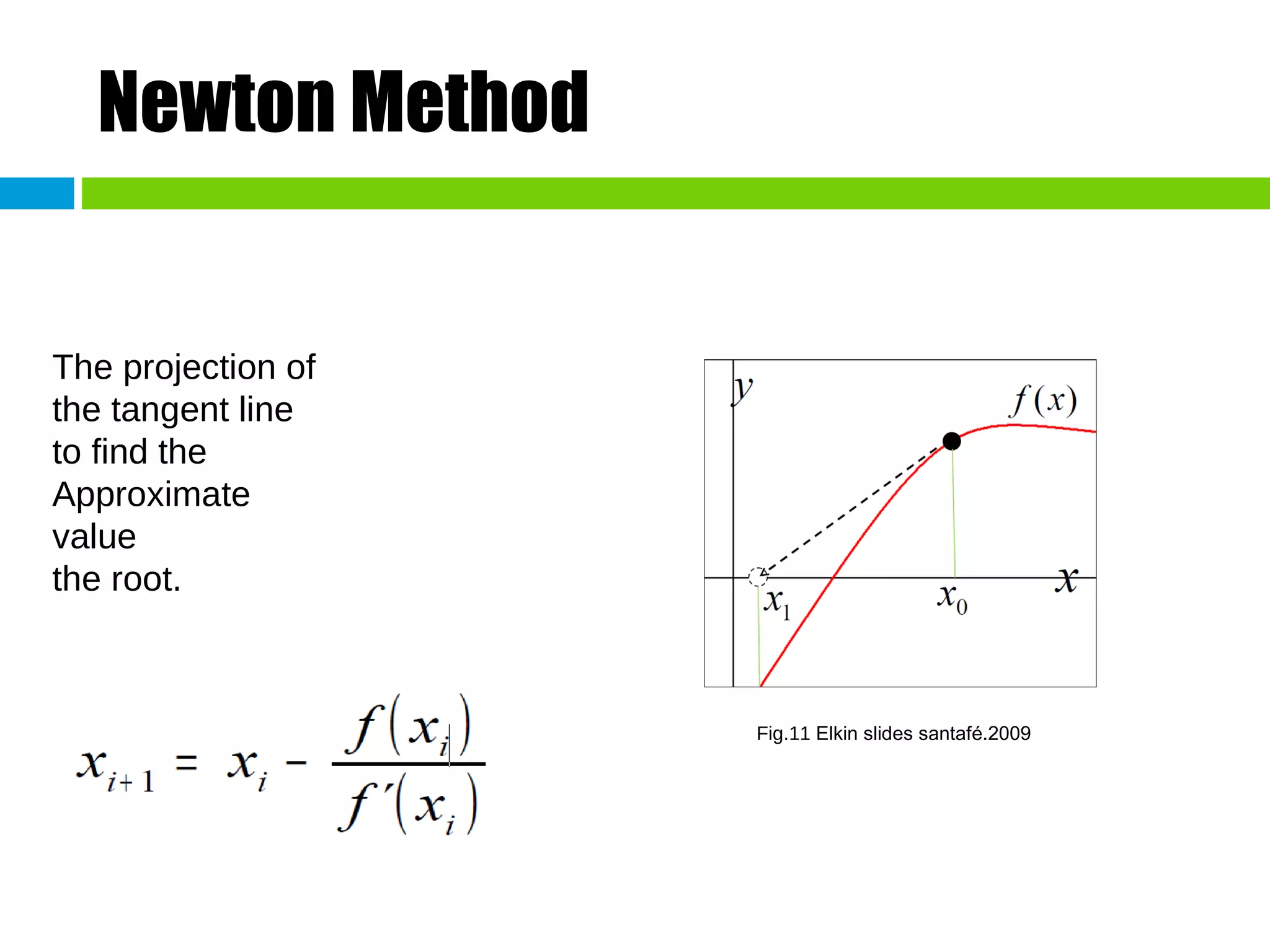
Newton Method c c The projection of the tangent line to find the Approximate value the root. Fig.11  Elkin slides santafé.2009
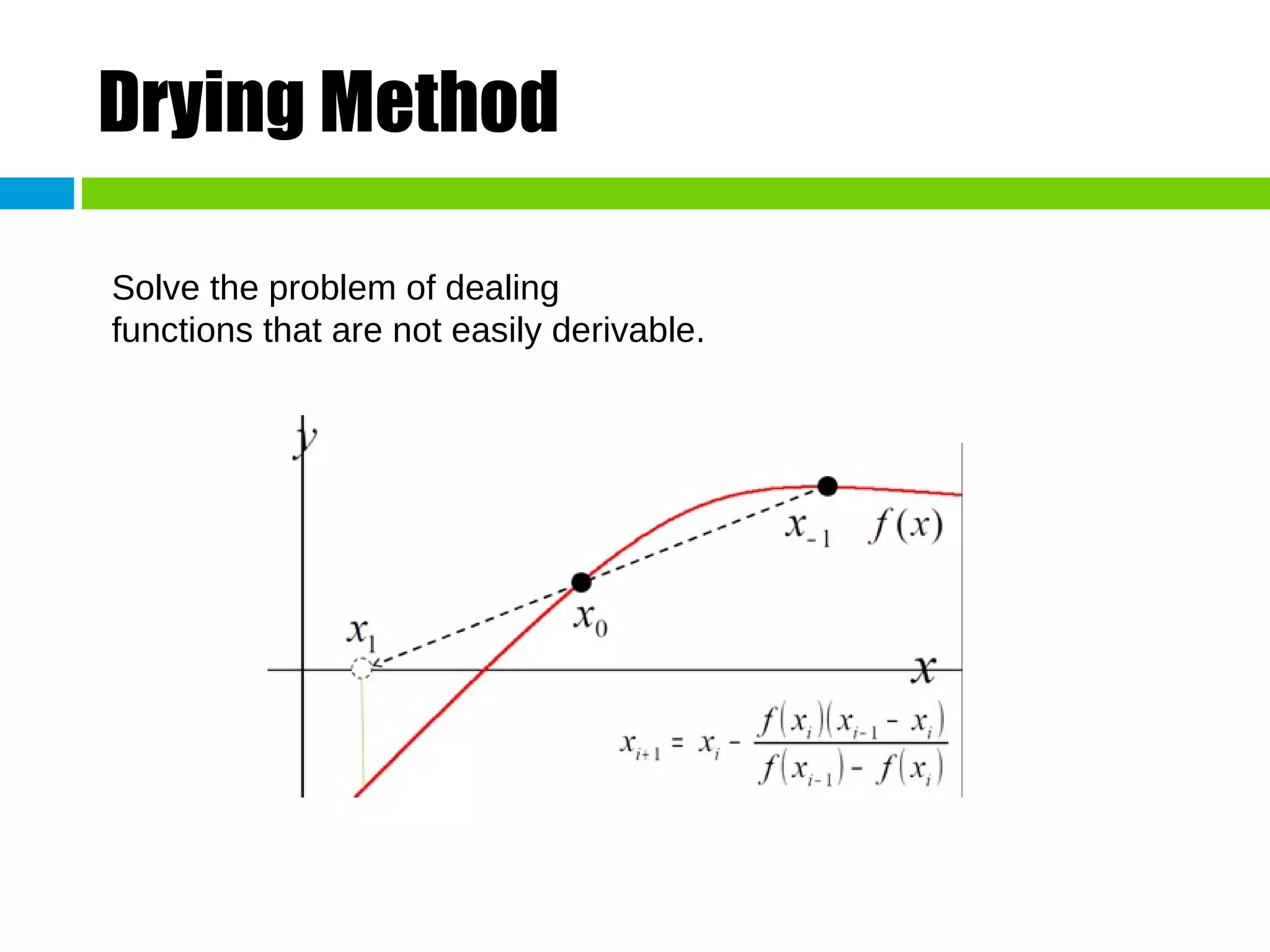
Drying Method Solve the problem of dealing functions that are not easily derivable.
Bibliography http://www.uv.es/diaz/mn /node17. ht ml  Elkin slides santafé.2009 http://sites.google.com/site/metnumeric/Home/2-aproximacion-numerica-errores-y-metodos-numericos-iniciales

Roots of equations

  • 1.
  • 2.
  • 3.
    Introduction The determinationof the roots of an equation is one of the oldest problems in mathematics and there have been many efforts in this regard. Its importance is that if we can determine the roots of an equation we can also determine the maximum and minimum eigenvalues of matrices, solving systems of linear differential equations, etc ... The determination of the solutions of the equation can be a very difficult problem. If f (x) is a polynomial function of grade 1 or 2, know simple expressions that allow us to determine its roots. For polynomials of degree 3 or 4 is necessary to use complex and laborious methods. However, if f (x) is of degree greater than four is either not polynomial, there is no formula known to help identify the zeros of the equation (except in very special cases).
  • 4.
    Types of MethodsGraphics Methods • Open methods • Methods Closed
  • 5.
    Graphics Methods Features:• Calculations are not accurate. • They have limited practical value. • Allows initial estimate values. • Allows understanding of the properties of functions. • They can help prevent failures in the methods. • in general can be considered closed as first case second case Fig.1 Elkin slides santafé.2009 Fig.2 Elkin slides santafé.2009
  • 6.
    Calculation error f(a) f (b) f (a) = f (b) There are at least one root (In this case the number of roots would be odd). There are no roots or pairs roots in the interval. Fig.3 Elkin slides santafé.2009
  • 7.
    rootless a roottwo roots three roots Fig.4 Elkin slides santafé.2009
  • 8.
    Special cases tangentialdiscontinuity example of a multiple root Fig.5 Elkin slides santafé.2009
  • 9.
    Closed Methods Theyare limiting the search domain. Most known are: • Bisection Method • Method of False Position
  • 10.
    Bisection Method Alsoknown as method: • Binary Court. • Partition. • Bolzano. It is a type of incremental search is based on dividing the always in the middle interval and the change of sign on interval. Search method 1. You must define an initial interval bounded. Fig.6 Elkin slides santafé.2009
  • 11.
    2. It willcheck that there is a root. f (a) f (b) <0 If there is fulfilled the least one real root root Fig.7 Elkin slides santafé.2009
  • 12.
    3. It isdivided in half the interval and checks. Search method Half If discarded half Fig.8 Elkin slides santafé.2009
  • 13.
    4. We reviewthe stopping criterion. Failure to comply is the search continues. The method can be slow in 2 ways: • With the maximum number of iterations. • When you reach the% E. present present previous
  • 14.
    Advantages and DisadvantagesADVANTAGES • You are guaranteed the convergence of the root lock. • Easy implementation. • management has a very clear error. DISADVANTAGES • The convergence can be long. • No account of the extreme values (dimensions) as possible roots.
  • 15.
    false position Thefunction is approximated through a line line where it is assumed his court with the x axis corresponds to the value approximate root. false root real root Fig.9 Elkin slides santafé.2009
  • 16.
    Open Methods Theyare limiting the search domain. Most known are: • Fixed Point Method • Newton Raphson Method • Drying Method
  • 17.
    fixed point sethe concept of rethink how the original problem Root Fig.10 Elkin slides santafé.2009
  • 18.
    Newton Method cc The projection of the tangent line to find the Approximate value the root. Fig.11 Elkin slides santafé.2009
  • 19.
    Drying Method Solvethe problem of dealing functions that are not easily derivable.
  • 20.
    Bibliography http://www.uv.es/diaz/mn /node17.ht ml Elkin slides santafé.2009 http://sites.google.com/site/metnumeric/Home/2-aproximacion-numerica-errores-y-metodos-numericos-iniciales