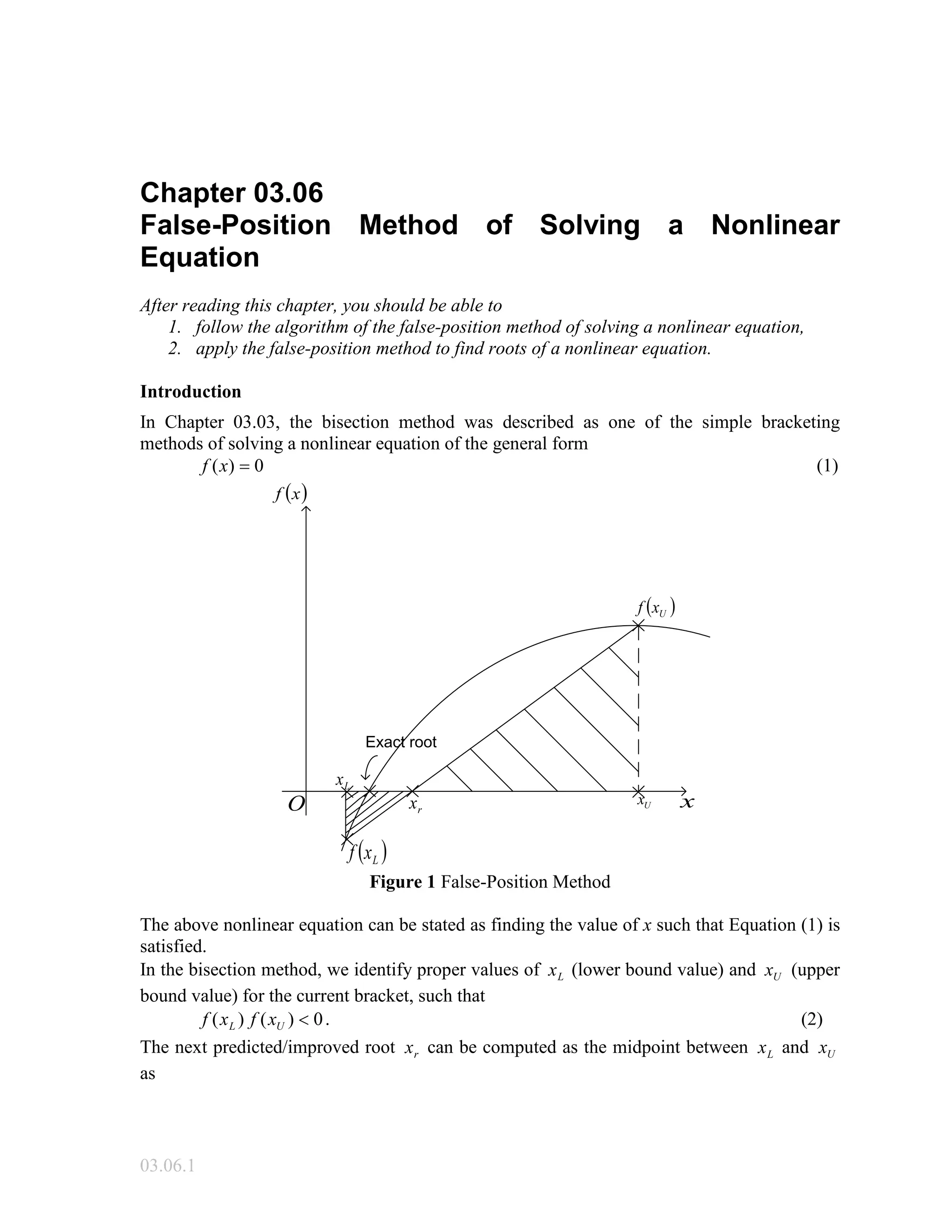
The false-position method is an iterative method for finding the roots of a nonlinear equation. It improves upon the bisection method by using the slopes of the function at the lower and upper bounds to estimate a new root, rather than taking the midpoint. The steps are: 1) choose initial lower and upper bounds where the function changes signs, 2) estimate the new root using the slopes, 3) update the bounds based on where the new root lies, 4) repeat until convergence within a tolerance. Examples show applying the method to find the depth a floating ball is submerged and the root of a quadratic equation.