

FALSE POSITION
METHOD
By SATYAJIT NAG-10.01.05.042

   H.M. ZUBAER -10.01.05.028

   MOSTOFA ZAMAN FAISAL-10.01.05.036
FINDING ROOTS / SOLVING
EQUATIONS
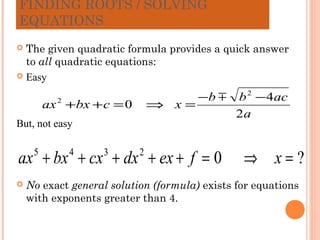
 The given quadratic formula provides a quick answer
  to all quadratic equations:
 Easy

                                       −b     b 2 − 4ac
         ax 2 +bx + c = 0       ⇒ x=
                                               2a
But, not easy


ax + bx + cx + dx + ex + f = 0
     5       4     3        2
                                                ⇒ x=?
   No exact general solution (formula) exists for equations
    with exponents greater than 4.
FINDING ROOTS…
   For this reason, we have to find out the root to
    solve the equation.

 However we can say how accurate our solution is
  as compared to the “exact” solution.
 One of the method is FALSE POSITION.
THE FALSE-POSITION METHOD               (REGULA-
FALSI)


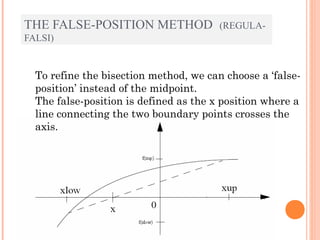
  To refine the bisection method, we can choose a ‘false-
  position’ instead of the midpoint.
  The false-position is defined as the x position where a
  line connecting the two boundary points crosses the
  axis.
REGULA FALSI

 For   example, if f(xlow) is much closer to zero
  than f(xup), it is likely that the root is closer
  to xlow than to xup.
 False position method is an alternative
  approach where f(xlow) and f(xup) are joined
  by a straight line; the intersection of
  which with the x-axis represents and
  improved estimate of the root.
 The intersection of this line with the x
  axis represents an improved estimate of
  the root.
LINEAR INTERPOLATION METHOD
 The fact that the replacement of the curve by a
  straight line gives the false position of the root is
  the origin of the name, method of false position,
  or in Latin, Regula Falsi.
 It is also called the Linear Interpolation Method.
FALSE POSITION FORMULAE
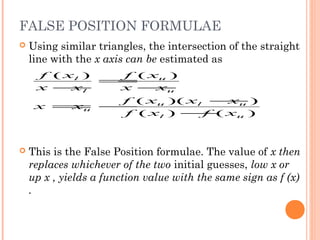
   Using similar triangles, the intersection of the straight
    line with the x axis can be estimated as
     f ( xl )  f ( xu )
              =
     x −  xl   x −  xu
           f ( xu )( xl − )xu
     x = −
        xu
           f ( xl ) − xu )
                       f (


   This is the False Position formulae. The value of x then
    replaces whichever of the two initial guesses, low x or
    up x , yields a function value with the same sign as f (x)
    .
ALGORITHM
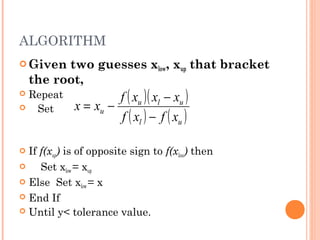
 Given   two guesses xlow, xup that bracket
    the root,
 Repeat              f ( xu )( xl − xu )
   Set       x = xu −
                      f ( xl ) − f ( xu )



 If f(xup) is of opposite sign to f(xlow) then
    Set xlow = xup
 Else Set xlow = x
 End If
 Until y< tolerance value.
CODE
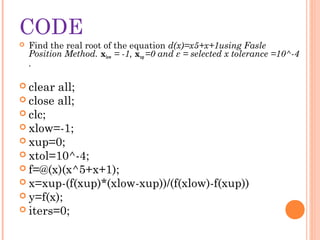
   Find the real root of the equation d(x)=x5+x+1using Fasle
    Position Method. xlow = -1, xup =0 and ε = selected x tolerance =10^-4
    .

 clear all;
 close all;
 clc;
 xlow=-1;
 xup=0;
 xtol=10^-4;
 f=@(x)(x^5+x+1);
 x=xup-(f(xup)*(xlow-xup))/(f(xlow)-f(xup))
 y=f(x);
 iters=0;
CODE CONTINUED…..
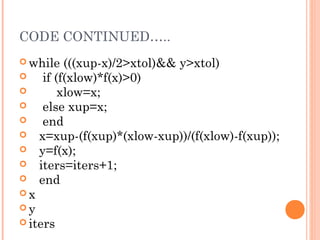
 while    (((xup-x)/2>xtol)&& y>xtol)
     if (f(xlow)*f(x)>0)
         xlow=x;
     else xup=x;
     end
    x=xup-(f(xup)*(xlow-xup))/(f(xlow)-f(xup));
    y=f(x);
    iters=iters+1;
    end
x
y
 iters
MERITS & DEMERITS
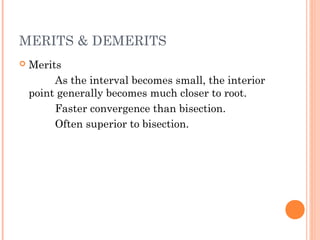
   Merits
         As the interval becomes small, the interior
    point generally becomes much closer to root.
         Faster convergence than bisection.
         Often superior to bisection.
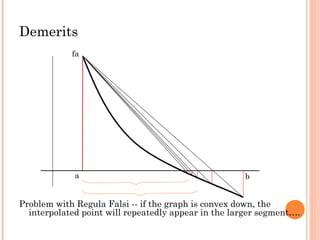
Demerits
            fa


             a                                       b


Problem with Regula Falsi -- if the graph is convex down, the
  interpolated point will repeatedly appear in the larger segment….
DEMERITS

   Demerits
          It can’t predict number of iterations to
    reach a give precision.
         It can be less precise than bisection – no
    strict precision guarantee.
 Though the difference between Bisection and
  False Position Method is little but for some cases
  False Position Method is useful and for some
  problems Bisection method is effective….
 In fact they both are necessary to solve any
  equation by ‘Bracketing method’.
THE END
Presentation aust final

Presentation aust final

  • 1.
    FALSE POSITION METHOD By SATYAJITNAG-10.01.05.042 H.M. ZUBAER -10.01.05.028 MOSTOFA ZAMAN FAISAL-10.01.05.036
  • 2.
    FINDING ROOTS /SOLVING EQUATIONS  The given quadratic formula provides a quick answer to all quadratic equations:  Easy −b  b 2 − 4ac ax 2 +bx + c = 0 ⇒ x= 2a But, not easy ax + bx + cx + dx + ex + f = 0 5 4 3 2 ⇒ x=?  No exact general solution (formula) exists for equations with exponents greater than 4.
  • 3.
    FINDING ROOTS…  For this reason, we have to find out the root to solve the equation.  However we can say how accurate our solution is as compared to the “exact” solution.  One of the method is FALSE POSITION.
  • 4.
    THE FALSE-POSITION METHOD (REGULA- FALSI) To refine the bisection method, we can choose a ‘false- position’ instead of the midpoint. The false-position is defined as the x position where a line connecting the two boundary points crosses the axis.
  • 5.
    REGULA FALSI  For example, if f(xlow) is much closer to zero than f(xup), it is likely that the root is closer to xlow than to xup.  False position method is an alternative approach where f(xlow) and f(xup) are joined by a straight line; the intersection of which with the x-axis represents and improved estimate of the root.  The intersection of this line with the x axis represents an improved estimate of the root.
  • 6.
    LINEAR INTERPOLATION METHOD The fact that the replacement of the curve by a straight line gives the false position of the root is the origin of the name, method of false position, or in Latin, Regula Falsi.  It is also called the Linear Interpolation Method.
  • 7.
    FALSE POSITION FORMULAE  Using similar triangles, the intersection of the straight line with the x axis can be estimated as f ( xl ) f ( xu ) = x − xl x − xu f ( xu )( xl − )xu x = − xu f ( xl ) − xu ) f (  This is the False Position formulae. The value of x then replaces whichever of the two initial guesses, low x or up x , yields a function value with the same sign as f (x) .
  • 8.
    ALGORITHM  Given two guesses xlow, xup that bracket the root,  Repeat f ( xu )( xl − xu ) Set x = xu − f ( xl ) − f ( xu )   If f(xup) is of opposite sign to f(xlow) then  Set xlow = xup  Else Set xlow = x  End If  Until y< tolerance value.
  • 9.
    CODE  Find the real root of the equation d(x)=x5+x+1using Fasle Position Method. xlow = -1, xup =0 and ε = selected x tolerance =10^-4 .  clear all;  close all;  clc;  xlow=-1;  xup=0;  xtol=10^-4;  f=@(x)(x^5+x+1);  x=xup-(f(xup)*(xlow-xup))/(f(xlow)-f(xup))  y=f(x);  iters=0;
  • 10.
    CODE CONTINUED…..  while (((xup-x)/2>xtol)&& y>xtol)  if (f(xlow)*f(x)>0)  xlow=x;  else xup=x;  end  x=xup-(f(xup)*(xlow-xup))/(f(xlow)-f(xup));  y=f(x);  iters=iters+1;  end x y  iters
  • 11.
    MERITS & DEMERITS  Merits As the interval becomes small, the interior point generally becomes much closer to root. Faster convergence than bisection. Often superior to bisection.
  • 12.
    Demerits fa a b Problem with Regula Falsi -- if the graph is convex down, the interpolated point will repeatedly appear in the larger segment….
  • 13.
    DEMERITS  Demerits It can’t predict number of iterations to reach a give precision. It can be less precise than bisection – no strict precision guarantee.
  • 14.
     Though thedifference between Bisection and False Position Method is little but for some cases False Position Method is useful and for some problems Bisection method is effective….  In fact they both are necessary to solve any equation by ‘Bracketing method’.
  • 15.