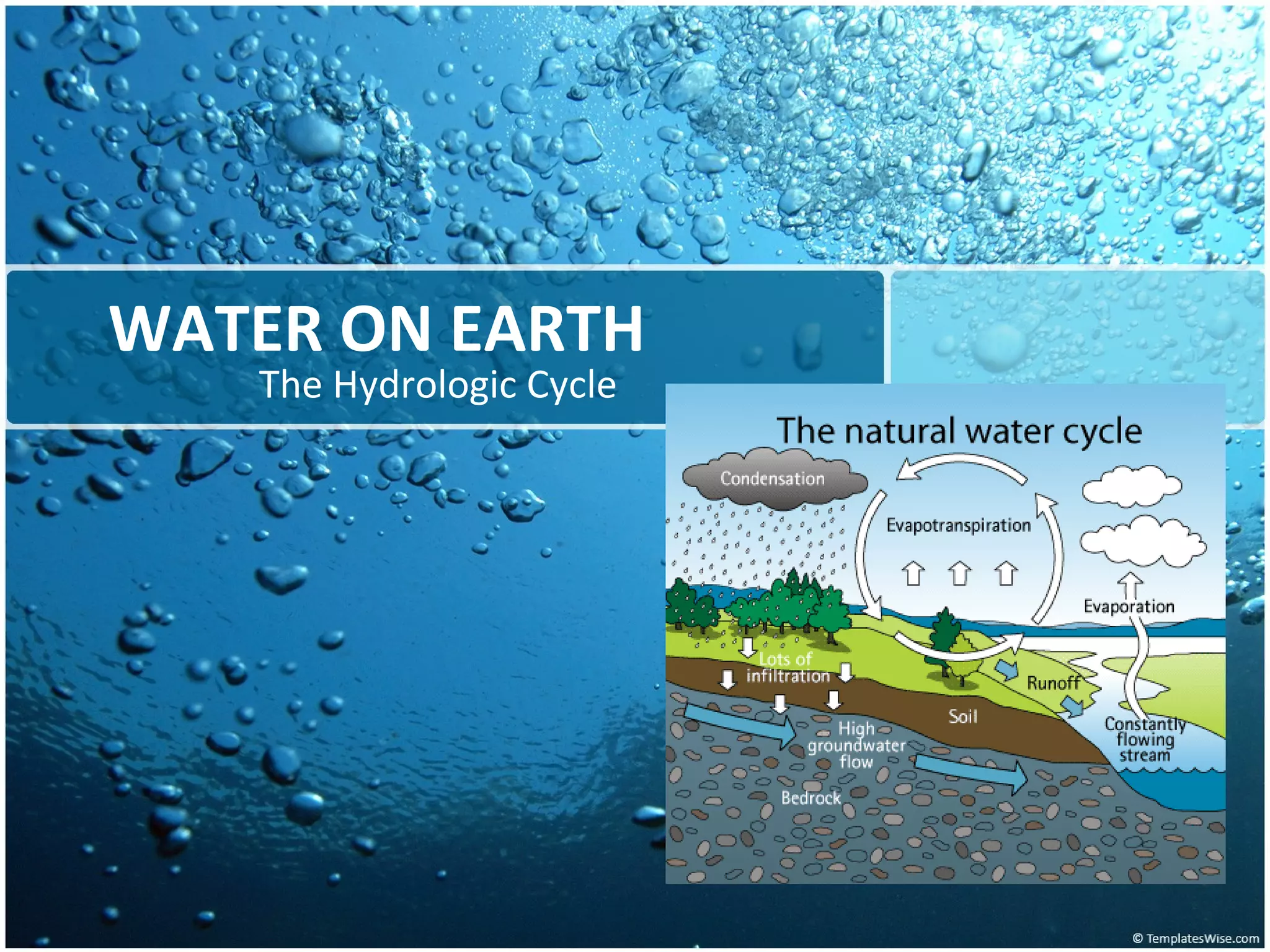
WATER ON EARTH The Hydrologic Cycle
The Blue Planet Review How much of Earth's surface is covered by water? How many days can a person survive without water? What are the different forms of water as they exist on Earth? How many planets in our solar system have liquid water on their surface? How many atoms form one water molecule?
 
Earth's Water Supply The vast majority of earth's  water supply  is contained in the  oceans  as saltwater.  The vast majority of earth's  freshwater supply  is stored in  icebergs and glaciers . The largest source of  liquid  freshwater  is  groundwater .
Water Cycle Overview
Evaporation  Water converted from liquid to gas (water vapor) Surface water (lakes, rivers, & mostly oceans)  Sun provides energy needed to change state
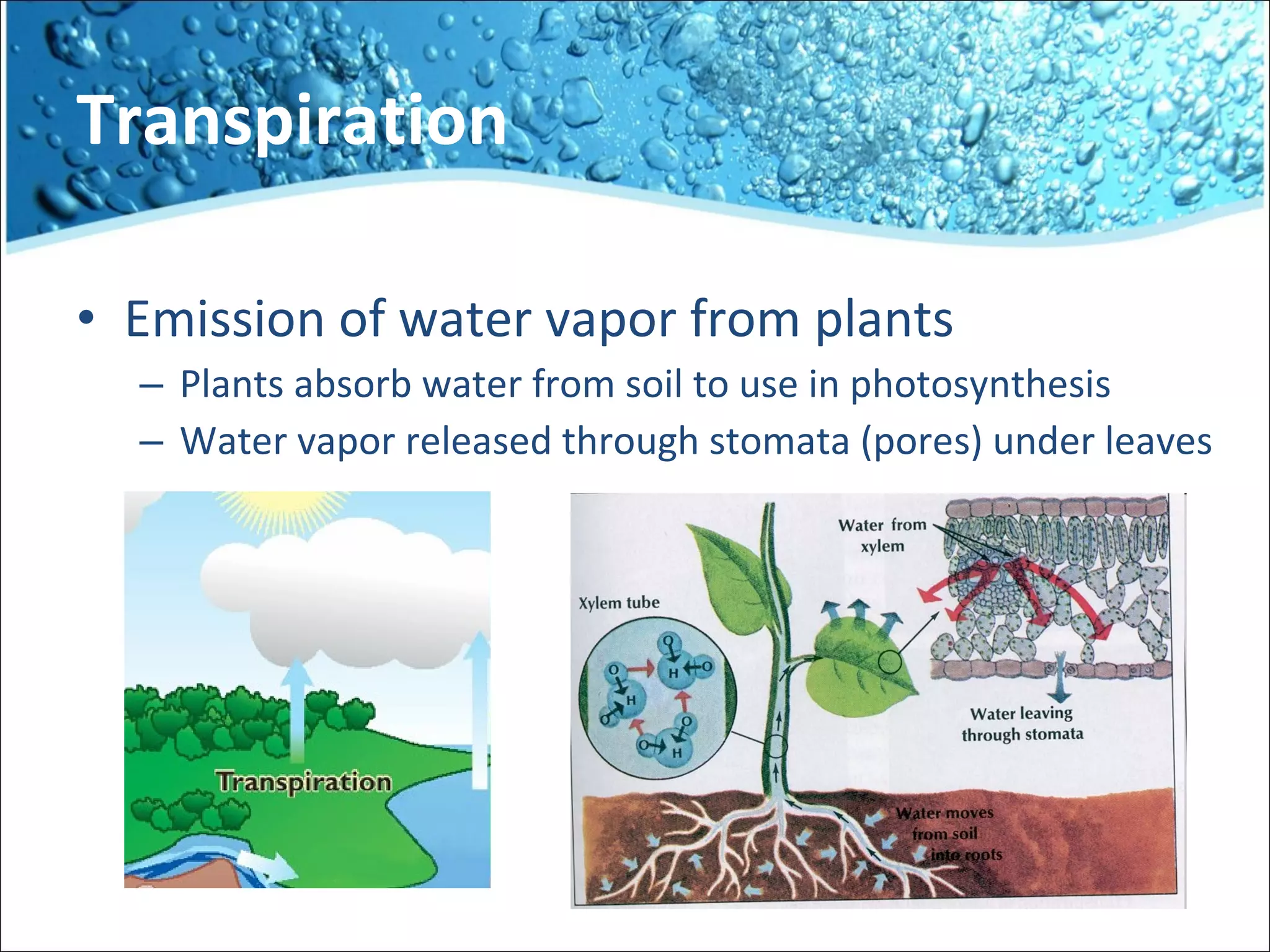
Transpiration  Emission of water vapor from plants  Plants absorb water from soil to use in photosynthesis Water vapor released through stomata (pores) under leaves
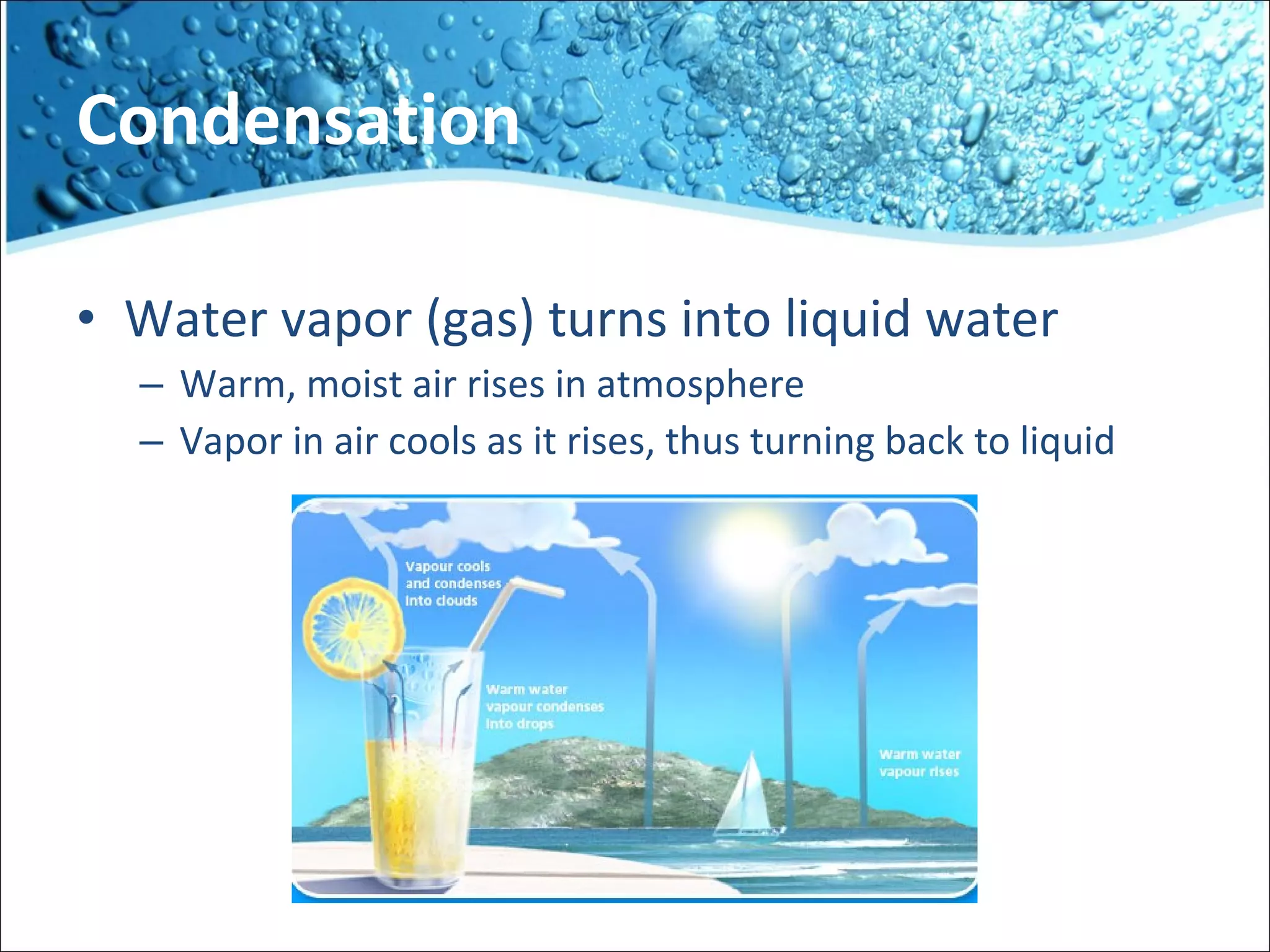
Condensation Water vapor (gas) turns into liquid water  Warm, moist air rises in atmosphere Vapor in air cools as it rises, thus turning back to liquid
Precipitation Water falling from the atmosphere  Vapor molecules collide & join to form droplets Falls as rain, snow, sleet, or hail
Infiltration Water absorbed into subsurface of dirt & rocks  Water percolates down between spaces in soil Groundwater  empties into streams/rivers/oceans or is stored underground in aquifers Saturation  = all the spaces in soil & rock are filled with water Flooding occurs: when soil becomes saturated, or when precipitation falls faster than infiltration can occur
Groundwater Precipitation seeps down through soil & rock Layers act as filters that trap contaminants Water table:  imaginary line between the water-logged soil and the soil not saturated with water  varies with seasonal precipitation, pumping, & geography Two types of  aquifers : unconfined : water supply which has a solid layer of rock under it, but a permeable layer of rocks above it confined : water supply sandwiched between two solid rock layers through which water cannot pass pressure builds up and can form an  artesian well
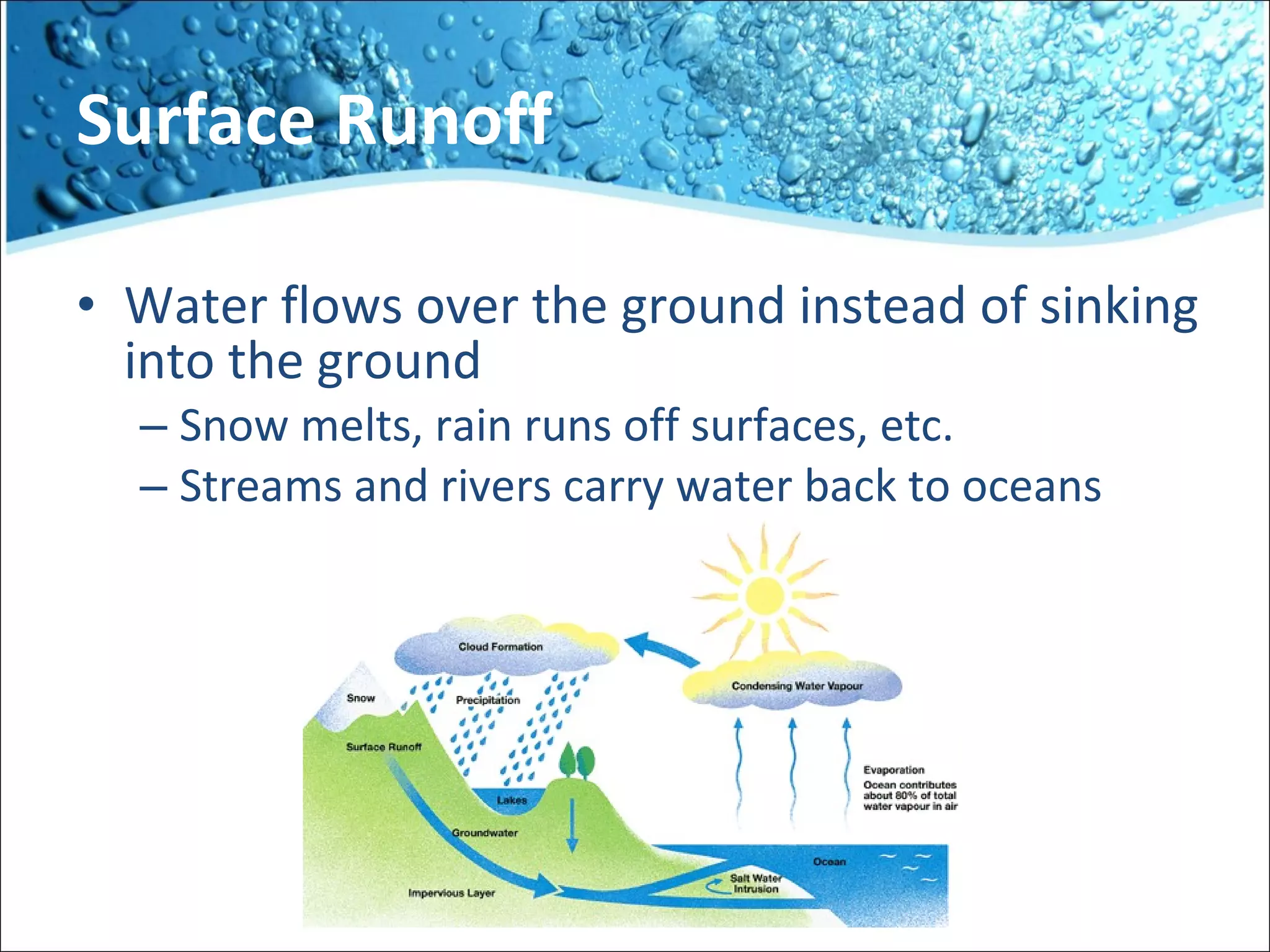
Surface Runoff Water flows over the ground instead of sinking into the ground Snow melts, rain runs off surfaces, etc. Streams and rivers carry water back to oceans
Residence Time The average time a given molecule of water will stay in a given water source  1 - 10 years Swamps 2 weeks Rivers 10 years Lakes 10 days Atmosphere 2 weeks - 1 year Soil  2 weeks - 1000 years Groundwater Up to 1000 years Glacier/Iceberg Up to 4,000 years Ocean Residence Time Water Source

The Hydrologic Cycle

  • 1.
    WATER ON EARTHThe Hydrologic Cycle
  • 2.
    The Blue PlanetReview How much of Earth's surface is covered by water? How many days can a person survive without water? What are the different forms of water as they exist on Earth? How many planets in our solar system have liquid water on their surface? How many atoms form one water molecule?
  • 3.
  • 4.
    Earth's Water SupplyThe vast majority of earth's water supply is contained in the oceans as saltwater. The vast majority of earth's freshwater supply is stored in icebergs and glaciers . The largest source of liquid freshwater is groundwater .
  • 5.
  • 6.
    Evaporation Waterconverted from liquid to gas (water vapor) Surface water (lakes, rivers, & mostly oceans) Sun provides energy needed to change state
  • 7.
    Transpiration Emissionof water vapor from plants Plants absorb water from soil to use in photosynthesis Water vapor released through stomata (pores) under leaves
  • 8.
    Condensation Water vapor(gas) turns into liquid water Warm, moist air rises in atmosphere Vapor in air cools as it rises, thus turning back to liquid
  • 9.
    Precipitation Water fallingfrom the atmosphere Vapor molecules collide & join to form droplets Falls as rain, snow, sleet, or hail
  • 10.
    Infiltration Water absorbedinto subsurface of dirt & rocks Water percolates down between spaces in soil Groundwater empties into streams/rivers/oceans or is stored underground in aquifers Saturation = all the spaces in soil & rock are filled with water Flooding occurs: when soil becomes saturated, or when precipitation falls faster than infiltration can occur
  • 11.
    Groundwater Precipitation seepsdown through soil & rock Layers act as filters that trap contaminants Water table: imaginary line between the water-logged soil and the soil not saturated with water varies with seasonal precipitation, pumping, & geography Two types of aquifers : unconfined : water supply which has a solid layer of rock under it, but a permeable layer of rocks above it confined : water supply sandwiched between two solid rock layers through which water cannot pass pressure builds up and can form an artesian well
  • 12.
    Surface Runoff Waterflows over the ground instead of sinking into the ground Snow melts, rain runs off surfaces, etc. Streams and rivers carry water back to oceans
  • 13.
    Residence Time Theaverage time a given molecule of water will stay in a given water source 1 - 10 years Swamps 2 weeks Rivers 10 years Lakes 10 days Atmosphere 2 weeks - 1 year Soil 2 weeks - 1000 years Groundwater Up to 1000 years Glacier/Iceberg Up to 4,000 years Ocean Residence Time Water Source

Editor's Notes

  • #6 Even though we can list them as different water sources and account for how much water is in each of them, they do interact with one another, which makes for some very interesting science. Hydrologic cycle - The process by which water is continuously exchanged between earth's various water sources
  • #9 What happens when water vapor cools? It condenses!
  • #11 One of two things that can happen to water: infiltration or runoff
  • #12 Perhaps the largest aquifer in the world is the Ogallala aquifer located in the Midwestern part of the United States. This aquifer is named after a Sioux Indian tribe. It is estimated to be more than two million years old and to hold about 650 trillion gallons (2,500 trillion liters)! It underlies parts of 8 states, stretching about 800 miles (1,288 km) from South Dakota to Texas. The Ogallala aquifer supplies vast amounts of water to irrigate the crops grown in this vitally important agricultural area.
  • #13 One of two things that can happen to water: infiltration or runoff
  • #14 Now the first thing you have to realize when looking at Table 5.2 is that they are only approximations. After all, there is no way to measure residence time. These numbers are based on calculations that make a lot of assumptions and use current theories of how the processes in the hydrologic cycle work. Only if the assumptions and theories used in the calculation are good will these numbers be accurate. If not, then you cannot rely on them. Nevertheless, the numbers at least illustrate what I am trying to say. The nature of the water source determines the length of the residence time. The next thing you need to realize is that these numbers are averages. The residence time in a small lake will be much shorter than the residence time in a large lake. Averaged over all lake sizes, however, the typical residence time for water in a lake is 10 years. Finally, you need to realize that I don't want you to memorize this table. Instead, I want you to look at the numbers and understand why the residence times are so different. Water in the atmosphere, for example, has a short residence time. Why? Well, the water in the atmosphere is constantly forming clouds and precipitating. Thus, a drop of water doesn't spend much time there. That's the kind of thinking I want you to develop in reference to residence times.