Ground Water
Prepared by- Md Shahab Alam Shamim
Ground Water
• Ground water: the water that lies beneath the
ground surface, filling the pore space between
grains in bodies of sediment and clastic (broken
pieces of older rock) sedimentary rock, and filling
cracks and crevices in all types of rock
• Ground water is an important source of water
supply throughout the world, its use in irrigation,
industries, municipalities and houses continues to
increase
• Source of ground water is rain and snow that falls
to the ground a portion of which percolates down
into the ground to become ground water
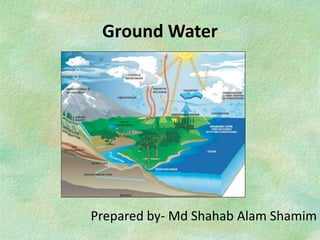
Groundwater in the hydrogeological cycle
Cont..
• Water evaporates from the oceans and land
surfaces to become water vapor that is carried
over the earth by atmospheric circulation. The
water vapor condenses and precipitates on
the land and oceans. The precipitated water
may become overland flow, infiltrate into the
ground, flow through the soil as subsurface
flow, or discharge as surface runoff
Rock properties affecting ground water
Aquifers
• An aquifer may be defined as a formation that contains
sufficient saturated permeable material to yield significant
quantities of water to wells and springs. Aquifers are
generally aerially extensive and may be overlain or underlain
by a confining bed.
• Simply an aquifer is a body of permeable rock which can
contain or transmit groundwater
• good aquifers include sandstone, conglomerate, well-joined
limestone, bodies of sand and gravel, and some fragmental or
fractured volcanic rocks such as columnar basalt
Types of confining beds
1. Aquiclude: A saturated but relatively
impermeable material that does not yield
appreciable quantities of water to wells; clay
is an example.
2. Aquifuge : A relatively impermeable
formation neither containing nor transmitting
water; solid granite belongs in this category.
Cont..
3. Aquitard : A saturated but poorly permeable
stratum that impedes (retard) groundwater
movement and does not yield water freely to
wells, that may transmit appreciable water to
or from adjacent aquifers and, where
sufficiently thick, may constitute an important
groundwater storage zone; sandy clay is an
example
Porosity and Permeability
• Porosity - the percentage of rock or sediment that
consists of voids or openings
– Measurement of a rock’s ability to hold water
– Loose sand has ~30-50% porosity
– Compacted sandstone may have only 10-20% porosity
• Permeability - the capacity of a rock to transmit fluid
through pores and fractures
– Interconnectedness of pore spaces
– Most sandstones and conglomerates are porous and permeable
– Granites, schists, unfractured limestones are impermeable
Porosity and Permeability
• Well-sorted sedimentary deposit having
high porosity.
• Poorly sorted sedimentary deposit having
low porosity.
Porosity and Permeability
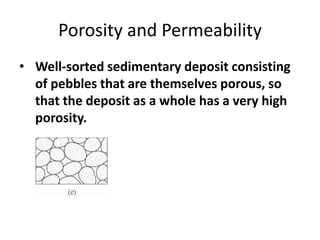
• Well-sorted sedimentary deposit consisting
of pebbles that are themselves porous, so
that the deposit as a whole has a very high
porosity.
Porosity and Permeability
• Well-sorted sedimentary deposit whose
porosity has been diminished by the
deposition of mineral matter in the
interstices.
Porosity and Permeability
• Rock rendered porous by solution.
(a)Rock rendered porous by fracturing
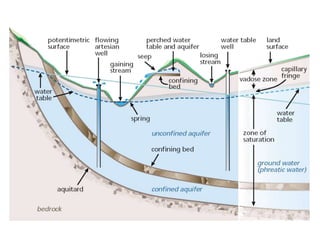
The Water Table
• saturated zone: the subsurface zone in which all
rock openings are filled with water
• water table: the upper surface of the zone of
saturation
• vadose zone: a subsurface zone in which rock
openings are generally unsaturated and filled
partly with air and partly with water; above the
saturated zone
• capillary fringe: a transition zone with higher
moisture content at the base of the vadose zone
just above the water table
The Water Table
The Water Table
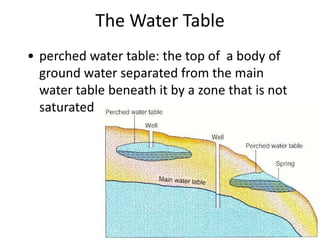
• perched water table: the top of a body of
ground water separated from the main
water table beneath it by a zone that is not
saturated
Ground Water Movement
• most ground water moves relatively slowly
through rock underground
• because it moves in response to differences
in water pressure and elevation, water
within the upper part of the saturated zone
tends to move downward following the
slope of the water table
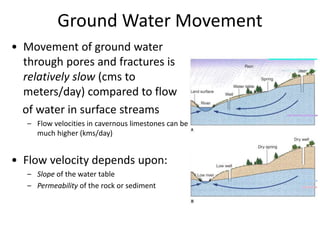
Movement of ground water beneath a sloping water table in uniformly permeable
rock. Near the surface the ground water tends to flow parallel to the sloping water
table
• Movement of ground water
through pores and fractures is
relatively slow (cms to
meters/day) compared to flow
of water in surface streams
– Flow velocities in cavernous limestones can be
much higher (kms/day)
• Flow velocity depends upon:
– Slope of the water table
– Permeability of the rock or sediment
Ground Water Movement
Darcy’s Law
dx
dh
AkQ t
v
Darcy’s Law defines groundwater flow:
where:
Q is discharge (L3 T-1)
kv is the hydraulic conductivity (L T-1)
A is area of flow (L2), and
dht/dx is the gradient of pressure, or head
Hydraulic Conductivity (kv)
Ground water

Ground water

  • 1.
    Ground Water Prepared by-Md Shahab Alam Shamim
  • 2.
    Ground Water • Groundwater: the water that lies beneath the ground surface, filling the pore space between grains in bodies of sediment and clastic (broken pieces of older rock) sedimentary rock, and filling cracks and crevices in all types of rock • Ground water is an important source of water supply throughout the world, its use in irrigation, industries, municipalities and houses continues to increase • Source of ground water is rain and snow that falls to the ground a portion of which percolates down into the ground to become ground water
  • 3.
    Groundwater in thehydrogeological cycle
  • 4.
    Cont.. • Water evaporatesfrom the oceans and land surfaces to become water vapor that is carried over the earth by atmospheric circulation. The water vapor condenses and precipitates on the land and oceans. The precipitated water may become overland flow, infiltrate into the ground, flow through the soil as subsurface flow, or discharge as surface runoff
  • 5.
    Rock properties affectingground water Aquifers • An aquifer may be defined as a formation that contains sufficient saturated permeable material to yield significant quantities of water to wells and springs. Aquifers are generally aerially extensive and may be overlain or underlain by a confining bed. • Simply an aquifer is a body of permeable rock which can contain or transmit groundwater • good aquifers include sandstone, conglomerate, well-joined limestone, bodies of sand and gravel, and some fragmental or fractured volcanic rocks such as columnar basalt
  • 7.
    Types of confiningbeds 1. Aquiclude: A saturated but relatively impermeable material that does not yield appreciable quantities of water to wells; clay is an example. 2. Aquifuge : A relatively impermeable formation neither containing nor transmitting water; solid granite belongs in this category.
  • 8.
    Cont.. 3. Aquitard :A saturated but poorly permeable stratum that impedes (retard) groundwater movement and does not yield water freely to wells, that may transmit appreciable water to or from adjacent aquifers and, where sufficiently thick, may constitute an important groundwater storage zone; sandy clay is an example
  • 11.
    Porosity and Permeability •Porosity - the percentage of rock or sediment that consists of voids or openings – Measurement of a rock’s ability to hold water – Loose sand has ~30-50% porosity – Compacted sandstone may have only 10-20% porosity • Permeability - the capacity of a rock to transmit fluid through pores and fractures – Interconnectedness of pore spaces – Most sandstones and conglomerates are porous and permeable – Granites, schists, unfractured limestones are impermeable
  • 13.
    Porosity and Permeability •Well-sorted sedimentary deposit having high porosity. • Poorly sorted sedimentary deposit having low porosity.
  • 14.
    Porosity and Permeability •Well-sorted sedimentary deposit consisting of pebbles that are themselves porous, so that the deposit as a whole has a very high porosity.
  • 15.
    Porosity and Permeability •Well-sorted sedimentary deposit whose porosity has been diminished by the deposition of mineral matter in the interstices.
  • 16.
    Porosity and Permeability •Rock rendered porous by solution. (a)Rock rendered porous by fracturing
  • 17.
    The Water Table •saturated zone: the subsurface zone in which all rock openings are filled with water • water table: the upper surface of the zone of saturation • vadose zone: a subsurface zone in which rock openings are generally unsaturated and filled partly with air and partly with water; above the saturated zone • capillary fringe: a transition zone with higher moisture content at the base of the vadose zone just above the water table
  • 18.
  • 19.
    The Water Table •perched water table: the top of a body of ground water separated from the main water table beneath it by a zone that is not saturated
  • 20.
    Ground Water Movement •most ground water moves relatively slowly through rock underground • because it moves in response to differences in water pressure and elevation, water within the upper part of the saturated zone tends to move downward following the slope of the water table Movement of ground water beneath a sloping water table in uniformly permeable rock. Near the surface the ground water tends to flow parallel to the sloping water table
  • 21.
    • Movement ofground water through pores and fractures is relatively slow (cms to meters/day) compared to flow of water in surface streams – Flow velocities in cavernous limestones can be much higher (kms/day) • Flow velocity depends upon: – Slope of the water table – Permeability of the rock or sediment Ground Water Movement
  • 22.
    Darcy’s Law dx dh AkQ t v Darcy’sLaw defines groundwater flow: where: Q is discharge (L3 T-1) kv is the hydraulic conductivity (L T-1) A is area of flow (L2), and dht/dx is the gradient of pressure, or head
  • 23.