Welcome to the presentation
course name: Principles of Hydrology
course code: Geo-3201
Presented by
ID: B180602041 to B180602051
Department of Geography and Environment
Jagannath University
Content
• Definition of Hydrology
• Concept of Hydrology
• Historical Development of Hydrology
• Scope of Hydrology
• The subject matter of hydrology includes
• Hydrology relationship with other subjects
• Hydrology And Weather
• Hydrology in engineering and social science
• Hydrology is the study of the distribution and movement of water both on
and below the Earth's surface, as well as the impact of human activity on
water availability and conditions.
• Hydrology is derived from two Greek word of ‘hydra’ meaning ththerebyereby
‘water’ and ‘logos’ meaning thereby ‘study’.
Definition of Hydrology
• The scientific study of the properties, distribution, and effects of water as a
liquid, solid, or gas on the Earth's surface, in the soil and underlying rocks,
and in the atmosphere.
• Hydrology is the science that treats of water of the earth, their occurrence,
circulation and distribution, their chemical and physical properties, and their
reaction with their environment , including their relation to living things.
–Ad Hoc Panel,1959
CONCEPT
Hydrology is an extremely important field of study, dealing with one of
the most valuable resources on Earth: water. All aspects of the Earth’s
available water are studied by experts from many disciplines ,
from geologists to engineers, to obtain the information needed to manage
this vital resource.
Hydrologists rely on their understanding of how water interacts with its
environment, including how it moves from the Earth’s surface, to
the atmosphere, and then back to Earth. This never-ending movement is
called the hydrologic cycle, or the water cycle.
Hydrology Concept
CONCEPT
• Hydrology is the branches of physical geography dealing with the
waters of the earth with spatial references to properties , phenomena
and distribution.
• Hydrology subdivided into
• Surface water hydrology
• Ground water hydrology
• Marine water hydrology
Ground Water Hydrology Surface Hydrology
Historical Development of Hydrology
V.T. Chow (1964) classified the historical development of hydrology in the following era:
 Period of speculation-(ancient to 1400 A.D.)
According to this time research the rain water store in soil. The people have idea of ground water and surface
water.
 Period of observation-(1400-1600 A.D.)
The precipitation, infiltration, water runoff is observed in that time by the experts.
 Period of measurements-(1600-1700 A. D.)
Hydrological and meteorological measurements are start that time . Measurements of precipitation evaporation
runoff etc.
 Period of examination-(1700-1800 A.D.)
By different types of testing of hydrology the result was founded about hydrology in that period.
Period of modernization-(1800-1900 A.D.)
An important branch of experimental hydrology was developed in this period.
Period of empiricism-(1900-1930 A.D.)
According to previous all times experiments and results the study of hydrology
was going on.
Period of rationalization-(1930-1950 A.D.)
Study and solve the problems of hydrology which were unsolved in previous
times. Infiltration theory was given in that time by R.E. Harton. So he called the
father of modern hydrology.
Period of theorization-(1950 to till date)
All problems are solved. All confusions are cleared. They are turned into ideas
and theory in this time.
Civilization settled on the bank
of river
(5000-6000 years ago)
Water management begun as
canal, wells condutis
(5000-600 years ago)
Flow rate and yields of rivers
were monitored by The
Egyptian
(3800 years ago)
Mathematics, Fluid mechanics
and hydraulics, groundwater
flow, more technical fact
(1600-1800 A.D.)
Hydrological cycle,
precipitation, river water comes
from precipitation
(1400-1600 A.D.)
First formal recognitions
of the scientific status of
hydrology
(During 1950)
Many new breakthroughs in the
hydrological science are
eminent
(During 21th century)
Rainfall measuring instrument
were first utilize
Kautilya of India
(2300 years ago)
Scope of Hydrology
• Flood management : The maximum probable flood that may occur at a given site and hydrology is
required for the safe design of drains and culverts, dams and reservoirs and other flood control structure.
• Ground water development: For the formation of soil, recharge facilities like streams and
reservoirs, rainfall pattern, climate, cropping pattern.
• Improvement of basin and water path: For the design of dams, municipal water supply, water
power, river navigation.
• Management of water resource: For irrigation, water supply, flood control, water logging and
salinity control.
 Channel development: For the design of a drainage project.
 Management of water: water law and policy, state and
international boundaries and water disputes.
 Hydro economics: Economic aspects of water.
The subject matter of hydrology includes -
• Groundwater is water that accumulates underground. It can exist in spaces
between loose particles of dirt and rock
• Evaporation is the process that changes liquid water to gaseous water
(water vapor). Water moves from the Earth's surface to the atmosphere
• Precipitation is any liquid or frozen water that forms in the atmosphere and
falls back to the Earth.
• Surface runoff is the flow of water occurring on the ground surface when
excess rainwater, storm water, melt water, or other sources, can no longer
sufficiently rapidly infiltrate in the soil.
• Infiltration is the flow of water from aboveground into the subsurface
Hydrology relationship with other
subjects
• Classification of hydrology according to its association with other
branches of science. (Source: Singh, 1994)
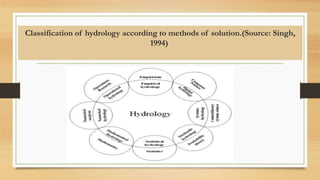
• Classification of hydrology according to methods of
solution.(Source: Singh, 1994)
Classification of hydrology according to its association with other
branches of science. (Source: Singh, 1994)
Classification of hydrology according to methods of solution.(Source: Singh,
1994)
Hydrology And Weather
Hydrology
The branch of science concerned with the properties of the earth's water,
and especially its movement in relation to land.
Hydrology is the study of the distribution and movement of water both on
and below the Earth's surface, as well as the impact of human activity on
water availability and conditions.
Hydrology means the science of water
• Hydrology is a multidisciplinary natural science that deals with the
occurrence ,properties, distribution and movement of surface and ground –
water on the earth (in the natural and man-made environment).
Weather
• Weather is the state of the atmosphere, including temperature, atmospheric
pressure, wind, humidity, precipitation, and cloud cover. It differs from
climate, which is all weather conditions for a particular location averaged
over about 30 years.
Hydrology and Weather
Hydrologic Information
• Static spatial info, time series at
points
• Data and models are not
connected
• Mostly historical data
Weather Information
• Continuous in space and time
• Combines data and simulation
models
• Delivered in real time
Hydrology in Engineering
• Hydrology is a diverse field that plays a vital role in society and, in particular,
the work of civil engineers in developing water resources infrastructure. At its
most basic definition, hydrology is the scientific study of movement,
distribution and water quality on Earth and other planets, including the water
cycle, water resources, and environmental watershed sustainability. It is an
important field where the people who study hydrology (which are called
hydrologists) use their knowledge and expertise to combat water pollution,
protect the earth’s water resources, and provide engineering hydrology – which
is an engineering specialty focusing on water resources. Specifically, they work
to find water supplies for towns and cities, design irrigation systems for farms
and vineyards, control flooding of streams and rivers, control soil erosion, and
protect the environment by preventing and cleaning up water pollution. And in
order for them to solve the water-related problems in society, they apply
scientific knowledge and mathematical equations.
Hydrology in social science
• Socio hydrology indicates the growing relevance of connections between
social and hydrological discipline.
• Hydrology is used to find out the history of a civilization development
around a water reservoir.
• Hydrology discuss about the quality of water,the pollutants and the national
basin management of area.
Hydrology.pptx
Hydrology.pptx
Hydrology.pptx

Hydrology.pptx

  • 1.
    Welcome to thepresentation course name: Principles of Hydrology course code: Geo-3201 Presented by ID: B180602041 to B180602051 Department of Geography and Environment Jagannath University
  • 2.
    Content • Definition ofHydrology • Concept of Hydrology • Historical Development of Hydrology • Scope of Hydrology • The subject matter of hydrology includes • Hydrology relationship with other subjects • Hydrology And Weather • Hydrology in engineering and social science
  • 3.
    • Hydrology isthe study of the distribution and movement of water both on and below the Earth's surface, as well as the impact of human activity on water availability and conditions. • Hydrology is derived from two Greek word of ‘hydra’ meaning ththerebyereby ‘water’ and ‘logos’ meaning thereby ‘study’. Definition of Hydrology
  • 4.
    • The scientificstudy of the properties, distribution, and effects of water as a liquid, solid, or gas on the Earth's surface, in the soil and underlying rocks, and in the atmosphere. • Hydrology is the science that treats of water of the earth, their occurrence, circulation and distribution, their chemical and physical properties, and their reaction with their environment , including their relation to living things. –Ad Hoc Panel,1959
  • 5.
    CONCEPT Hydrology is anextremely important field of study, dealing with one of the most valuable resources on Earth: water. All aspects of the Earth’s available water are studied by experts from many disciplines , from geologists to engineers, to obtain the information needed to manage this vital resource. Hydrologists rely on their understanding of how water interacts with its environment, including how it moves from the Earth’s surface, to the atmosphere, and then back to Earth. This never-ending movement is called the hydrologic cycle, or the water cycle.
  • 6.
  • 7.
    CONCEPT • Hydrology isthe branches of physical geography dealing with the waters of the earth with spatial references to properties , phenomena and distribution. • Hydrology subdivided into • Surface water hydrology • Ground water hydrology • Marine water hydrology
  • 8.
    Ground Water HydrologySurface Hydrology
  • 9.
    Historical Development ofHydrology V.T. Chow (1964) classified the historical development of hydrology in the following era:  Period of speculation-(ancient to 1400 A.D.) According to this time research the rain water store in soil. The people have idea of ground water and surface water.  Period of observation-(1400-1600 A.D.) The precipitation, infiltration, water runoff is observed in that time by the experts.  Period of measurements-(1600-1700 A. D.) Hydrological and meteorological measurements are start that time . Measurements of precipitation evaporation runoff etc.  Period of examination-(1700-1800 A.D.) By different types of testing of hydrology the result was founded about hydrology in that period.
  • 10.
    Period of modernization-(1800-1900A.D.) An important branch of experimental hydrology was developed in this period. Period of empiricism-(1900-1930 A.D.) According to previous all times experiments and results the study of hydrology was going on. Period of rationalization-(1930-1950 A.D.) Study and solve the problems of hydrology which were unsolved in previous times. Infiltration theory was given in that time by R.E. Harton. So he called the father of modern hydrology. Period of theorization-(1950 to till date) All problems are solved. All confusions are cleared. They are turned into ideas and theory in this time.
  • 11.
    Civilization settled onthe bank of river (5000-6000 years ago) Water management begun as canal, wells condutis (5000-600 years ago) Flow rate and yields of rivers were monitored by The Egyptian (3800 years ago) Mathematics, Fluid mechanics and hydraulics, groundwater flow, more technical fact (1600-1800 A.D.) Hydrological cycle, precipitation, river water comes from precipitation (1400-1600 A.D.) First formal recognitions of the scientific status of hydrology (During 1950) Many new breakthroughs in the hydrological science are eminent (During 21th century) Rainfall measuring instrument were first utilize Kautilya of India (2300 years ago)
  • 12.
    Scope of Hydrology •Flood management : The maximum probable flood that may occur at a given site and hydrology is required for the safe design of drains and culverts, dams and reservoirs and other flood control structure. • Ground water development: For the formation of soil, recharge facilities like streams and reservoirs, rainfall pattern, climate, cropping pattern. • Improvement of basin and water path: For the design of dams, municipal water supply, water power, river navigation. • Management of water resource: For irrigation, water supply, flood control, water logging and salinity control.
  • 13.
     Channel development:For the design of a drainage project.  Management of water: water law and policy, state and international boundaries and water disputes.  Hydro economics: Economic aspects of water.
  • 14.
    The subject matterof hydrology includes -
  • 15.
    • Groundwater iswater that accumulates underground. It can exist in spaces between loose particles of dirt and rock • Evaporation is the process that changes liquid water to gaseous water (water vapor). Water moves from the Earth's surface to the atmosphere • Precipitation is any liquid or frozen water that forms in the atmosphere and falls back to the Earth.
  • 16.
    • Surface runoffis the flow of water occurring on the ground surface when excess rainwater, storm water, melt water, or other sources, can no longer sufficiently rapidly infiltrate in the soil. • Infiltration is the flow of water from aboveground into the subsurface
  • 17.
    Hydrology relationship withother subjects • Classification of hydrology according to its association with other branches of science. (Source: Singh, 1994) • Classification of hydrology according to methods of solution.(Source: Singh, 1994)
  • 18.
    Classification of hydrologyaccording to its association with other branches of science. (Source: Singh, 1994)
  • 19.
    Classification of hydrologyaccording to methods of solution.(Source: Singh, 1994)
  • 20.
  • 21.
    Hydrology The branch ofscience concerned with the properties of the earth's water, and especially its movement in relation to land. Hydrology is the study of the distribution and movement of water both on and below the Earth's surface, as well as the impact of human activity on water availability and conditions.
  • 22.
    Hydrology means thescience of water • Hydrology is a multidisciplinary natural science that deals with the occurrence ,properties, distribution and movement of surface and ground – water on the earth (in the natural and man-made environment).
  • 23.
    Weather • Weather isthe state of the atmosphere, including temperature, atmospheric pressure, wind, humidity, precipitation, and cloud cover. It differs from climate, which is all weather conditions for a particular location averaged over about 30 years.
  • 24.
    Hydrology and Weather HydrologicInformation • Static spatial info, time series at points • Data and models are not connected • Mostly historical data Weather Information • Continuous in space and time • Combines data and simulation models • Delivered in real time
  • 25.
    Hydrology in Engineering •Hydrology is a diverse field that plays a vital role in society and, in particular, the work of civil engineers in developing water resources infrastructure. At its most basic definition, hydrology is the scientific study of movement, distribution and water quality on Earth and other planets, including the water cycle, water resources, and environmental watershed sustainability. It is an important field where the people who study hydrology (which are called hydrologists) use their knowledge and expertise to combat water pollution, protect the earth’s water resources, and provide engineering hydrology – which is an engineering specialty focusing on water resources. Specifically, they work to find water supplies for towns and cities, design irrigation systems for farms and vineyards, control flooding of streams and rivers, control soil erosion, and protect the environment by preventing and cleaning up water pollution. And in order for them to solve the water-related problems in society, they apply scientific knowledge and mathematical equations.
  • 27.
    Hydrology in socialscience • Socio hydrology indicates the growing relevance of connections between social and hydrological discipline. • Hydrology is used to find out the history of a civilization development around a water reservoir. • Hydrology discuss about the quality of water,the pollutants and the national basin management of area.