Topic of the lesson:
The Hydrologic Cycle
The Hydrologic
Cycle
By
Prof. A. Balasubramanian
Centre for Advanced Studies in Earth Science
University of Mysore, India
 Introduction
 The Earth as a Water Planet
 Concept of Hydrologic
Cycle
 Condensation
 Precipitation
 Evaporation
 Transpiration
 Evapotranspiration
 Surface Runoff
 Infiltration
 Interception
 Groundwater baseflow
 Sublimation
 Global Water Balance
 Earth’s Other Cyclic
Process
 River Basin as a Hydrologic
Unit
 Hydrologic Cycle and
Natural Hazards
 Units and measurements
Table of Contents
 Several processes and factors are involved in
driving the global water circulation. This lesson
is aimed at highlighting the world’s water cycle
and its major components and contributions.
The objectives of this lesson are to learn about:
 The basic concepts of the hydrologic cycle
 The components of the cycle
 The role of individual components
Objectives
(…Contd)
 The water balance estimation concepts
 The role of hydrological cycle in promoting the
other environmental and biogeochemical cycles
on the earth.
 After attending this lesson, the learner should
be able to describe about the world’s water
circulation, elements of water cycle and their
inter-relationships.
Objectives
 Earth contains enormous amounts of water in the
form of reservoirs. Water exists in the atmosphere,
lithosphere, hydrosphere and biosphere. Among
all these segments, water masses are in
continuous circulation. It is, in general, called as
the hydrologic cycle. It is also called as the
World’s Great Water Cycle, since it is the driving
wheel for all the movements of available water
resources on the planet earth
Introduction
(…Contd)
 It is necessary to identify the cyclic and circulatory
routes of water masses in all the spheres of the
earth. Several processes and factors are involved
in driving the global water circulation. This lesson
is aimed to highlight the world’s water cycle with
all its components and contributions.
Introduction
 The planet earth is called as the water planet.
 It is due to the fact that the earth is probably the
only planet, in the solar system, which has a
huge mass of water.
 On the planet earth, the primitive life got
originated only from the water mass.
 Most of the earth’s surface is covered with water.
The Earth as a Water Planet
(…Contd)
 Water exists in all the segments of the earth.
 The hydrosphere is the sphere of water on earth.
 It is a discontinuous layer containing both fresh
water and saline water.
 The subject hydrology deals with all aspects of
the hydrological cycle.
The Earth as a Water Planet
 The world’s water is not in static form.
 It is in continuous motion. It also transforms from
one state to the other.
 The water gets temporarily stored and moved in
the form of surface water in rivers, lakes, ponds,
ice caps, and below the surface as groundwater.
 Oceans form the biggest and largest water
reservoirs.
The World’s Water
(…Contd)
 All these water bodies are called as water
reservoirs.
 The duration of stay and storage of water in every
reservoir varies due to varying geological,
environmental and other conditions.
 This is called as the residence time of water.
 Water moves from one reservoir to the other.
 The sun’s radiant energy plays a very significant
role in this movement.
The World’s Water
(…Contd)
 Atmospheric pressure, wind blows, temperature
and the amount of water vapour present in the
air, all play a dominant role in these processes.
 The rates of movement of water and the
quantities involved in the cyclic processes are
the major aspects involved in the hydrological
sciences.
The World’s Water
(…Contd)
 There is an endless circulation of water among
all the spheres of the earth.
 It is popularly known as the hydrologic cycle.
 It is necessary to learn about the hydrologic
cycle, when we intend to analyse the water
resources of the region and the world.
The World’s Water
 Water gets transformed from liquid to solid, solid
to liquid, liquid to vapour, vapour to liquid and
vapour to solid states.
 The sun’s radiation, acceleration due to gravity,
ability of the water to flow and several other
properties of water, make this transformation
more effective and regular.
 The basic input to the world’s water masses
comes from precipitation.
Concept of Hydrologic Cycle
(…Contd)
 Precipitated rain (or) snow falls overland.
 Processes like infiltration and percolation
moves the water down to the groundwater
systems.
 Some amount of water flows towards the sea
as runoff.
 The surface water, collected in lakes, ponds,
swamps, seas and oceans, gets evaporated
into the atmosphere.
Concept of Hydrologic Cycle
(…Contd)
 The vegetation transpires the water collected from the soil
moisture.
 Evaporated and transported water enters into the
atmosphere as vapour.
 Collected water vapour gets condensed to form the clouds.
 Clouds move towards the land and starts precipitating
again.
 These processes continue.
Concept of Hydrologic Cycle
(…Contd)
 This endless circulation of water is known as
the hydrologic cycle.
 It is of two kinds as terrestrial hydrologic cycle
and global hydrologic cycle.
 The terrestrial hydrological cycle is of a special
interest as the mechanism of formation of water
resources on a given area of the land, like a
river basin or a watershed.
Concept of Hydrologic Cycle
(…Contd)
 The global hydrological cycle deals with its role
on the global climate and other geological and
physical processes.
 It is obvious that the role of different processes
involved in the hydrological cycle and their
description have to depend on the chosen
spatial- temporal scales.
Concept of Hydrologic Cycle
 The circulation of water masses seen in all spheres
of the earth involves several causative factors and
components. The major components (or) elements of
the hydrologic cycle are :
Components of the Hydrologic Cycle
 Precipitation
 Evaporation
 Transpiration
 Evapotranspiration
 Surface Runoff
 Condensation
 Infiltration
 Groundwater base flow
 Sublimation
 Interception.
 Most of the Earth’s water masses reside in the
oceans. Continental water makes up about 3.5
percent of the Earth’s water.
 About three-quarters of this amount (29 million
cubic kilometers) is present as polar ice caps and
glaciers. About 5.3 million cubic kilometers as deep
groundwater.
 Thus, only the remaining fraction can take part in
the water exchange between the oceans, the
atmosphere, and the continents.
Global hydrologic cycle
(…Contd)
 This remaining part includes shallow
groundwater and soil moisture, water in lakes,
reservoirs, and swamps, water storage in river
channels, biosphere water.
 The amount in the atmosphere is only 0.013
million cubic kilometres.
 But it plays a very crucial role in the global water
cycle.
Global hydrologic cycle
 The key component of the terrestrial
hydrological cycle is generation of river runoff
and movement of water in the river networks.
 As stated previously, the main land area units
may be river basins and watersheds.
 They are ideal hydrologic units.
Terrestrial hydrologic cycle
(…Contd)
 The sizes of these areas vary from tens of square
kms to several thousand square km.
 Within these hydrologic units, distinct spatial
differences, in topography, climate, geology,
structure, vegetation, soil properties, land use, land
cover and other features may occur.
 The terrestrial hydrological cycle considers all
aspects of the main processes, and factors that
control the processes as well.
Terrestrial hydrologic cycle
The following are the major factors involved in
controlling the movement of water masses in the
hydrologic cycle:
 Application of energy that promotes transformation
from one state of matter to the other state.
 Inherent properties of matter, i.e., water.
The Underlying Factors
(…Contd)
 Dimension and geo-environmental settings of
the reservoirs.
 Gravity which promotes flow.
 Air which promotes mobility of water molecules.
 Earths revocation and rotation, which are
responsible for climate and weather cycles.
The Underlying Factors
 The sun’s radiant energy evaporates water from
surface water resources, including seas and
oceans.
 This water rises upwards as water vapour and
reaches the atmosphere.
 The process of evaporation continues until the air
becomes fully saturated with maximum amount of
moisture.
 It is called as Saturation Humidity.
Condensation
(…Contd)
 It is directly proportional to the temperature of
the air.
 It is expressed in grams/ cubic metre of air. At 0
degree C, humidity of air is 4.874 gm/ cu.m and
at 30 degree C it is 30.38 gm/cu.m.
 Relative humidity is a term used to denote the
ratio of the water vapor content of the air to the
water vapor capacity of the air.
Condensation
(…Contd)
 The term absolute humidity is used to denote the
number of grams of water per cubic metre of air.
 If the air mass reaches the dew point, then the
condensation process begins.
 Humidity is measured using hygrometers.
 Through the process of condensation clouds are
formed and moved towards the land frontiers.
Condensation
(…Contd)
 Condensation in the atmosphere takes place around
small particles of substances present in the air, which
have the affinity for water.
 These form the hygroscopic nuclei surrounding the
condensation nuclei.
 These condensed water vapour masses get
precipitated in the form of water molecules.
 Precipitation is the process by which this
transformation happens in the atmosphere, under
certain specific conditions.
Condensation
(…Contd)
 Condensation depends on several factors.
The notable areas are:
1. Adiabatic cooling.
2. Mixture of two air masses of different temperatures
3. Contact cooling.
4. Radiational cooling.
 Among these, the most important condensation process is the
adiabatic cooling which leads to all kinds of precipitation.
 Condensation leads to cloud formation. Condensed clouds of
smaller sizes may quickly disappear on a hot day.
Condensation
(…Contd)
 Cloud condensation nuclei, which vary in size from
10^(-5) to 10^(-1) mm, are required to condense
water vapour at dew point.
 Typical cloud condensation nuclei are meteoric dust,
windblown clay and silt, volcanic material, sea salt
and combustion products.
 Natural concentrations of cloud condensation nuclei
vary from 100 to 300 cubic cm, but may locally
become 10 to 100 times larger due to human
activities.
Condensation
(…Contd)
 When a vapour condenses, heat is released.
Condensation also leads to the formation of fog.
 Before precipitation to happen, the cloud droplets
sized from 0.001 to 0.2 mm have to grow to 0.4 to
4mm in diameter to reach a fall velocity that exceeds
the rate of uplift.
Condensation
(…Contd)
 Cloud droplets may grow at temperatures above 0
degree Centigrade.
 The droplet collision occurs due to differences in fall
and lift velocities caused by the differences in droplet
size.
 The world’s water vapour is equal to about 2.5 cm
thickness, on an average, if it is distributed all over the
surface of the globe.
Condensation
 Precipitation is the process of transforming the
water vapour into a liquid or solid form, depending
upon the temperature of air near the clouds.
 The term precipitation is a common term. It
includes a variety of forms of precipitation.
 It includes mist, rain, hail, sleet and snow.
 The term precipitation and rainfall are always used
synonymously.
Precipitation
(…Contd)
 Precipitation mainly depends on the water vapour present
in the atmosphere. When the air temperature is well below
the freezing point, clouds may form tiny ice crystals.
 For precipitation to form, a sequence of four processes
must occur.
 Atmosphere must have sufficient water vapour present,
which is cooled to dewpoint,
 Condensation of water vapour on cloud condensation
nuclei
 Growth of water droplets, and importation of water vapour.
Precipitation
(…Contd)
 Whenever the water vapor in the air is cooled
down below the temperature corresponding to the
pressure of saturated vapor, condensation occurs
on dust particles, globules of water, grass, or other
foreign objects.
 Condensation of moisture out of the atmosphere
above the immediate surface of the earth occurs
on dust particles or suspended globules of water
and takes the form of fog, cloud, rain, snow or hail.
Precipitation
(…Contd)
 During warm weather, cyclonic areas are usually
accompanied by thunderstorms.
 A thunderstorm, as the name implies, is a storm
accompanied by lightning and thunder and,
usually, precipitation.
 The condensation which results in the precipitation
of moisture from clouds is caused by what is
known as "dynamic cooling," i.e., the cooling
resulting from the consumption of heat in the work
of expansion of the rising vapor, as previously
explained.
Precipitation
(…Contd)
 These conditioned are fulfilled in the atmosphere
every time during the monsoons.
 Though there are several mechanisms active in the
atmosphere which cool air, only the process of
adiabatic cooling due to vertical uplift is able to
produce precipitation of any significance.
 Three types of lifting mechanism(of lifting moist air) to
a level where condensation of water vapour to take
place are available as convective, cyclonic, and
orographic.
Precipitation
(…Contd)
 Under the convective process, the lifting occurs
due to differential heating of a region when the
warmer moist air rises in relation to colder
surroundings.
 Lifting in a cyclonic process occurs due to
convergence of moist air into a low pressure
area.
 Orographic rain occurs due to mechanical lifting
of moist air on mountain slopes.
Precipitation
 Rainfall is the most common form of precipitation
occurring in almost all parts of the world.
 In tropical regions, precipitation is expected
completely as rainfall.
 In the polar regions, precipitation is expected to be
completely as snowfall.
 In mid latitudes, at high altitudinal zones,
precipitation occurs as snowfall, sleet and ice.
 All these are called as forms of precipitation.
The Rainfall
(…Contd)
 Four conditions are necessary to get sufficient
amount of rainfall. They are:
 A mechanism to produce cooling of the air
 A mechanism to produce condensation
 A mechanism to produce growth of cloud
droplets
 A mechanism to produce accumulation of
moisture of sufficient intensity to generate
rainfall.
The Rainfall
(…Contd)
 The amount of rainfall occurring in a place is
measured using a raingauge.
 A network of rain gauges is needed to analyse the
rainfall of a larger region.
 The total rainfall on the earth’s land surfaces
amounts to 110,000 cubic km.
 It returns to the atmosphere via evaporation and
evapo-transpiration.
The Rainfall
 The snowfall is another form of precipitation.
 It comes as a percentage of annual precipitation.
 It accounts for 5% globally.
 The snow melts and creates stream flow. On the
prairies, the snowmelt accounts for about 80% of
the stream flow and water stored in sloughs.
 The snow falls are measured using snow gauges.
The Snowfall
(…Contd)
 The snow gauges are shielded and mounted on
brackets such that the gauge can be raised as
the snow accumulates inside and can be
measured.
 The most accurate method of determining
snowfall amounts, requires frequent
measurement of changes in the depth of snow on
ground ( because snow tends to quickly settle
and undergo metamorphosis).
The Snowfall
(…Contd)
 It is measured in depth of snow.
The hydrological significance of snow are:
 Total annual snowfall is only one factor
determining the contribution of snow to a water
budget.
 Snow is first stored for days to months before
participating in the hydrological cycle.
The Snowfall
 Evaporation is the process of converting a liquid (or)
solid into a gas, through the transfer of heat energy.
 In hydrologic cycle this conversion is towards water
vapour.
 Heat energy can convert water mass (or) ice into a
vapour. Evaporation occurs more rapidly when there
is increase in temperature and also flow of wind.
 It also depends on the boiling point and vapour
pressure.
Evaporation
(…Contd)
 The greater a substance’s vapour pressure, the more
rapid the substance gets evaporated and escape into
the air.
 Open water evaporation is the theoretical
evaporation flux from a smooth shallow water
surface (with no storage of energy) when subjected
to the ambient meteorological conditions.
 Pan evaporation is the evaporation flux from an
evaporation pan. Soil evaporation is the evaporation
flux from the soil.
Evaporation
(…Contd)
 Under the conditions of constant temperature,
humidity and wind, evaporation from the large water
surfaces of the earth must remain constant.
 A temporary increase in temperature results in
increased evaporation and also increased
precipitation.
 Water gets evaporated more rapidly in dry air.
 This is due to the fact that dry air has only a fraction
of the maximum vapour pressure of water.
Evaporation
(…Contd)
 It is also essential to note that the evaporating
molecules absorb heat from the surroundings.
 Huge volume of water evaporates from the
ocean surfaces.
 The amount varies from place to place. It is
called as evaporation discharge.
 The greatest amount is around the equator,
where the intensity of solar radiation is more.
Evaporation
(…Contd)
The factors affecting evaporation are
 Air Temperature
 Relative Humidity
 Incoming radiation
 Wind speed
 Duration of bright Sun shine
 Geomorphic conditions of the region.
The amount of water getting evaporated from a free
water surface is measured using evaporimeters or pans.
Evaporation
 The water molecules present in the soil matrix
also get evaporated with great difficulty, unlike
those which are released from the free water
surfaces.
 The amount of water vapor present in the
atmosphere varies greatly from time to time, but
the dry gases do not change materially in
quantity from season to season.
Evaporation from soil surface
(…Contd)
 It may be remarked at this point, however, that
about half of the total moisture present in the
atmosphere is found below an elevation of
about 6000 feet(around 2000m) , and less than
one tenth of it occurs above an elevation of
20,000 feet(around 6000m).
Evaporation from soil surface
 Transpiration is the process of releasing the water
absorbed by the plants through their root system
after utilizing the nutrients for building their tissues,
in a specified time.
 Vegetation including numerous growing plants, play
a significant role in the hydrologic cycle.
 The water which is drawn into the plants rootlets
from the soil moisture, owing to osmotic pressure
moves up through the plants stems and leaves.
Transpiration
(…Contd)
 Through the stomatal openings, the water is
released out as water vapour. The amount of
transpiration depends on the density and size of
the vegetation existing in place.
 The amount of water used for irrigating the crops
get transpired into the air.
 Transpiration is dominant during the growing
season of crops in agricultural lands.
Transpiration
(…Contd)
 Most of this happens during day time, when
photosynthesis is active in plants.
 Transpiration is limited due to the shortage of
soil moisture is some places.
 The controlling factors of transpiration are:
 Temperature
 Solar radiation
 Wind and
 Soil moisture.
Transpiration
 Evaporation is the evaporation flux from intercepted
water and from the soil.
 Transpiration is molecular diffusion of water vapour
through the stomatal aperture of leaves.
 Evapotranspiration is the combined effect of both
evaporation of water from the soil, surface water
bodies, snow, ice and transpiration from vegetation.
 In a well-irrigated land, it is difficult to separate
evaporation from transpiration.
Evapotranspiration
(…Contd)
 The total water loss due to both evaporation and
transpiration is called as Evapotranspiration.
 Majority of the water loss due to Evapotranspiration
happens during summer months and growing seasons.
 There will be no (or) little loss expected during winter
months / period.
 Two terms as potential Evapotranspiration and actual
evapotranspiration are used to denote these
conditions.
Evapotranspiration
(…Contd)
 Actual evapotranspiration is the total evaporation
flux of a cropped surface.
 The actual evapotranspiration depends mainly on
1. Atmospheric factors
2. Soil water characteristics and
3. Physiological factors of the crops and other
vegetation.
Evapotranspiration
(…Contd)
 The rate of evapotranspiration is controlled by
several climatic, hydrologic, soil and
geomorphological conditions of a region.
 Soil texture and permeability play the major
roles in this process.
 Potential soil evapotranspiration is the
theoretical evaporation flux from the soil, if the
soil would sufficiently be supplied with water.
Evapotranspiration
(…Contd)
 Potential evapotranspiration is the sum of the
potential soil evaporation and transpiration.
 The major use of potential evapo (transpi) ration
data is generally for:
 Water resources planning,
 Agricultural and irrigation management, and
 Research.
Evapotranspiration
 Runoff is the quantity of water that is discharged
(“runs off”) from a drainage basin during a given
time period.
 Runoff data may be presented as volumes in acre-
feet, as mean discharges per unit of drainage area
in cubic feet per second per square mile, or as
depths of water on the drainage basin in inches.
 It is measured by establishing stream gauges at
selected places of the river courses.
Surface Runoff
(…Contd)
 The term runoff refers to the overland flow of
water, after every rainfall or snowmelt.
 The overland flow starts when the rate of rainfall
is greater than the rate of infiltration of the soil
and increase in the amount of slope.
 Initially, Runoff starts as small streams and the
water gets added from many such streams.
Surface Runoff
(…Contd)
 Finally, all of these reach and confluence with a
lake or stream or directly with seas.
 The volume of water leaving through a river is
known as river discharge.
 It is considered as precipitation returning to the
sea.
Surface Runoff
(…Contd)
 Stream flow is the discharge that occurs in a
natural channel.
 Although the term “discharge” can be applied to
the flow of a canal, the word “stream flow”
uniquely describes the discharge in a surface
stream course.
 The term “stream flow” is more general than
“runoff” as stream flow may be applied to
discharge whether or not it is affected by diversion
or regulation.
Surface Runoff
 The flow of any stream is determined by two
major groups of factors.
 The first set belongs to the geomorphological
factors of the drainage basin.
 The second set of factors depend on the
climatological variables.
Factors Controlling Runoff
(…Contd)
The Climatological factors are :
 Rainfall – Intensity and Type
 Duration of Rainfall
 Distribution of Rainfall
 Direction of Storm Movement
 Soil Moisture Conditions.
 The geomorphological factors include land use land
cover, type of soil, area, shape, elevation, slope,
network of drainages and indirect influences for
runoff.
Factors Controlling Runoff
 Infiltration is the downward percolation of
rainwater (or) snow melt water into the soil
horizons.
 The downward movement of water happens in the
top soil layer, especially through the smaller pore
spaces present in the soils.
 Infiltration is governed by two forces as
gravity and capillary action.
Infiltration
(…Contd)
 The smaller pores offer greater resistance to
gravity, very small pores pull water through
capillary action in addition to and even against
the force of gravity.
 Tensiometer is used for the measurements of
soil water properties.
Infiltration
(…Contd)
 After every rain, the zone of soil moisture obtains
the first part of the rainfall. The rate of percolation
is known as infiltration rate.
 It is measured using infiltrometers or lysimeters.
Infiltration rates are measured by conducting
infiltration tests.
 The rate of infiltration varies from soil to soil. It
depends on the hydrologic properties of soils, like
porosity and permeability.
Infiltration
(…Contd)
 The process is also known as percolation. The
percolating rainwater ultimately reaches the
groundwater zone.
 The process of infiltration happens only when
there is space available for addition of water
within the soil surface.
 This depends on the porosity of the soil and the
rate at which previously infiltrated water can move
away from the surface through the soil.
Infiltration
(…Contd)
 The maximum rate that water can enter into a soil layer
in a given subsurface condition is known as the
infiltration capacity.
 Infiltration rate in soil science is a measure of the rate at
which a particular soil is able to absorb rainfall or
irrigation.
 It is measured in inches per hour or millimeters per hour.
The rate decreases as the soil becomes saturated.
 If the precipitation rate exceeds the infiltration rate,
runoff will usually occur unless there is some physical
barrier.
Infiltration
(…Contd)
 The factors that affect infiltration are:
 Porosity and permeability of the soils
 Structure and texture of the soils
 Surface entry possibilities of the soils
 Transmission through the soil
 Already available soil moisture and its depletion
 Characteristics of the fluid.
 All terrestrial plants and forest vegetation thrive due
to the presence of infiltrated water in the soil horizon.
Infiltration
(…Contd)
 The maximum rate at which a soil is capable of
absorbing water is called as its infiltration capacity.
 Percolation is favoured by
a) slow and steady precipitation,
b) permeable soil, and
c) a flat or very gentle slope.
 Steep slope may leave the water over the surface.
Infiltration
 Interception is the process of retaining water on
the leaves of vegetation. A small amount of rainfall
is intercepted by vegetation.
 The rainfall which is not intercepted is known as
through fall.
 The water which reaches the ground via steps and
thanks is called as stemflow. These are the three
Main Components of Interception.
Interception
(…Contd)
 When rain falls onto a forest land, a proportion of it
is intercepted by the canopy and evaporates back
into the atmosphere.
 This water is not playing any role in the terrestrial
portion of the hydrologic cycle.
 This is called as canopy interception loss.
Interception can amount up to 15-50% of
precipitation, which is a significant part of the water
balance.
Interception
(…Contd)
 Although interception storage is generally small,
the number of times that the storage is filled and
depleted can be so large that the interception flux
is generally of the same order of magnitude as the
transpiration flux(flow accounted as loss).
 Snowfall is also intercepted by trees, especially,
the coniferous trees can store much snow for
interception.
Interception
(…Contd)
 The storage capacities of vegetation while
intercepting rainfall vary with the type and structure
of vegetation and also with the meteorological
factors.
 The experiments have shown that about 8mm of
rainfall can be intercepted by the vegetative zones.
 This water is evaporated back to the atmosphere.
The rate at which it goes back to the atmosphere is
known as interception rate.
Interception
(…Contd)
The controls on interception rate are:
a) vegetation characteristics
1. growth form: of trees, shrubs, grasses, forbs
2. plant density
3. plant structure: number, size, flexibility, strength
and pattern of branches; texture, surface area
and orientation of leaves
4. plant community structure.
Interception
(…Contd)
b) meteorological factors
1. Precipitation intensity
2. Precipitation duration
3. wind speed
4. Type of rainfall: rain versus snow
5. Precipitation frequency
Interception
 The rainwater that is falling over the ground surface
percolates down through the soil and reaches the
groundwater zone.
 Depending upon the slope of the groundwater
system, the groundwater moves towards the rivers,
lakes or the oceans.
 This flow of groundwater is known as baseflow. It
depends on the hydrologic properties of rocks
forming the groundwater systems. This is an invisible
flow of water.
Groundwater baseflow
(…Contd)
 A river may become a loosing stream (or) a gaining
stream depending upon the contribution of stream
water down the earth (or) groundwater into the
stream respectively.
 The subject of groundwater hydrology deals with
all aspects of groundwater.
 Computation of groundwater balance is made to
utilize the available groundwater resources, when
there is no surface water facilities in a region.
Groundwater baseflow
(…Contd)
 Snow covered zones also experience losses of water
through direct evaporation. The process of direct
evaporation of snow into water vapour is known as
sublimation.
 The solid does not pass through a liquid state for
evaporation. It is very difficult to distinguish between
evaporation and sublimation from snow.
 Air temperature plays a significant role in addition to
wind, in sublimation to happen.
Sublimation
 The direct input sources of water for the lands and seas
are from precipitation. The major output sources are from
evaporation, transpiration, sublimation, interception and
evapotranspiration.
 There is a balance of water existing as storage in the
form of groundwater, surface water bodies as lakes and
streams, ice caps and glaciers and as seas and oceans.
 These components can be analysed using a simple mass
balance equation called as water balance equation. This
equation considers the inflow, outflow and changes in
storage reservoirs of fresh and saltwater.
Global Water Balance
(…Contd)
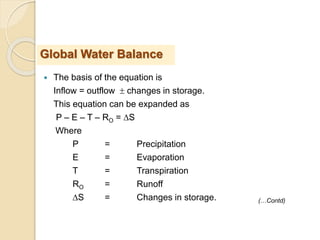
 The basis of the equation is
Inflow = outflow  changes in storage.
This equation can be expanded as
P – E – T – RO = S
Where
P = Precipitation
E = Evaporation
T = Transpiration
RO = Runoff
S = Changes in storage.
Global Water Balance
(…Contd)
 This equation balances the availability of water for
a specific period of time in any region of the world.
 Computation of a hydrological budget is needed
for all practical purposes of water resources
consumption and management.
Global Water Balance
 The hydrologic cycle is the primary cycle of the
planet earth. It becomes the focal concept and
dining mechanism for part of the rock cycle,
geochemical cycle and the sedimentary cycles of
biogeochemical cycle.
 In the rock cycle, weathering, mass wasting,
erosion, transportation and depositional aspects of
sediments are carried out by the components of
hydrologic cycle.
Earth’s Other Cyclic Process
(…Contd)
 The sulphur and phosphors cycles of
biogeochemical cycles are driven by the
components of hydrologic cycle.
 All trace elements and their motilities among rock,
soil, water, plant and animal are all controlled by
the hydrologic cycle.
Earth’s Other Cyclic Process
 Drainage basin is a part of the Earth’s surface that
contains a drainage system with a common outlet for its
surface runoff.
 Hydrologic unit is a geographic area representing part
or all of a surface drainage basin.
 Drainage area of a stream at a specific location is that
area upstream from the location, measured in a
horizontal plane, that has a common outlet at the site
for its surface runoff from precipitation that normally
drains by gravity into a stream.
River Basin as a Hydrologic Unit
(…Contd)
 Drainage areas given herein include all closed basins,
or non-contributing areas, within the area unless
otherwise specified.
 The total volume of water on the earth in its liquid, solid
and vapour forms has been the same since the
formation of the planet.
 Rivers are natural watercourses. River water flows over
the land surface in small channels after draining
discrete areas. The existence, size and flow of a river
water are influenced mainly by the availability of surface
water, a river channel in the ground, and an inclined
surface.
River Basin as a Hydrologic Unit
(…Contd)
 A river basin refers to the fall catchment zone of a
river and its tributaries with a clear cut water divide
separating it from other basins.
 All network of streams belonging to the main river
and its tributaries are enclosed well within the river
basin.
 The boundary of thee basin is denoted as basin
boundary. There will be a single outlet for any
drainage basin.
River Basin as a Hydrologic Unit
(…Contd)
 The main river may confluence with a reservoir, a
lake or an ocean. The stream of a large river basin
may have a very wide delta at the point of
confluence.
 The catchment zone of tributaries and their
streams are referred to as sub-basins.
 The small network of streams joining the tributaries
may have their own mini-catchment zones. These
are called as watersheds.
River Basin as a Hydrologic Unit
(…Contd)
 A watershed covers area above and below the
earth’s surface.
 The small channels and streams drain water
towards a surface water body like a pond or a
river.
 Bigger watersheds may contain numerous
tributaries and their corresponding catchment
areas.
River Basin as a Hydrologic Unit
(…Contd)
 The watersheds are considered to be the smallest
hydrological units of a large river basin.
 The contributions of all watersheds are
cumulatively considered for the yield (outflow) of
the river basin.
 A quantitative estimation of water balance of each
washed is possible as the parameters are
measureable, suitable and ideal for computations.
River Basin as a Hydrologic Unit
 Floods are the major natural hazards arising out of
the surface runoff of large basins and their rivers.
Floods cause server damage to life and properties.
 They also damage the grown up crops and rural/
urban settlements.
 It is a part of the hydrologic process that are
happening in a short span of time after a heavy
rainfall, along the river courses. Floodplains are the
zones severely affected due to this hazard.
Hydrologic Cycle and Natural Hazards
(…Contd)
 Thunderstorms are yet another hazard coming due
to hydrologic processes in the atmosphere. These
are issues requiring proper disaster management
methods.
 Sudden and heavy downpour of precipitation can
cause severe damage to the population.
 Drought is a major issue arising out of continuous
failure of monsoons in any area or a river basin.
Hydrologic Cycle and Natural Hazards
(…Contd)
 Landslides are hazards occurring after heavy
rainfall in hilly regions.
 Hailstorms and Snowfalls create a lot of problems
in the mountainous and polar regions for transport,
cultivation and other activities.
 Cyclones are depressions created in bays and
oceans due to atmospheric pressure belts.
Hydrologic Cycle and Natural Hazards
(…Contd)
 They move towards the condensed water masses.
 Both wind and storms create the damage to the
coastal belts.
 Proper disaster management plans are necessary
to mitigate the effects of these water-related
natural hazards.
Hydrologic Cycle and Natural Hazards
 While discussing about the components of hydrologic
cycle, it is necessary to know about the technical terms
which are used.
 The terms stream flow, runoff, discharge and yield of
drainage basin are almost used synonymously. Runoff,
here, refers to the surface runoff. Groundwater flow is
referred to as base flow.
 The term groundwater discharge refers to base flow and
pumping of water from the groundwater system. The
units in which all these quantities are expressed are
always in relation to volume per unit of time.
Units and measurements
(…Contd)
 Gallon is also the standard unit of measuring
liquids. It is used to express the storage and flow
capacity in cubic feet / cubic metre. It is a unit for
expressing volume.
 Acre – feet is yet another unit. It refers to the
quantity of water required to cover one acre to a
depth of 1 foot. It is the unit of volume for
expressing the storage in reservoirs also. The
forms are Inches / cm per area depth per unit area.
Volume units
 Rainfall and evapotranspiration are expressed as cm
depth on drainage area.
 Acre feet per day refers to the rate of flow of a
stream.
 Volume of water flow is normally expressed in Cu. m.
per second or Cu. Km per second or in million
gallons per day (or) million metre cube.
Common Hydrological Units
(…Contd)
 Appropriate conversion factors are available for
converting these components from one unit to the
other.
 In all the old text books, fps (feet – pound – second)
system might have been used by the authors.
 Now, the SI units (Systems International) are
invariably used by all.
Common Hydrological Units
Thank You

The Hydrologic Cycle

  • 1.
    Topic of thelesson: The Hydrologic Cycle The Hydrologic Cycle By Prof. A. Balasubramanian Centre for Advanced Studies in Earth Science University of Mysore, India
  • 2.
     Introduction  TheEarth as a Water Planet  Concept of Hydrologic Cycle  Condensation  Precipitation  Evaporation  Transpiration  Evapotranspiration  Surface Runoff  Infiltration  Interception  Groundwater baseflow  Sublimation  Global Water Balance  Earth’s Other Cyclic Process  River Basin as a Hydrologic Unit  Hydrologic Cycle and Natural Hazards  Units and measurements Table of Contents
  • 3.
     Several processesand factors are involved in driving the global water circulation. This lesson is aimed at highlighting the world’s water cycle and its major components and contributions. The objectives of this lesson are to learn about:  The basic concepts of the hydrologic cycle  The components of the cycle  The role of individual components Objectives (…Contd)
  • 4.
     The waterbalance estimation concepts  The role of hydrological cycle in promoting the other environmental and biogeochemical cycles on the earth.  After attending this lesson, the learner should be able to describe about the world’s water circulation, elements of water cycle and their inter-relationships. Objectives
  • 5.
     Earth containsenormous amounts of water in the form of reservoirs. Water exists in the atmosphere, lithosphere, hydrosphere and biosphere. Among all these segments, water masses are in continuous circulation. It is, in general, called as the hydrologic cycle. It is also called as the World’s Great Water Cycle, since it is the driving wheel for all the movements of available water resources on the planet earth Introduction (…Contd)
  • 6.
     It isnecessary to identify the cyclic and circulatory routes of water masses in all the spheres of the earth. Several processes and factors are involved in driving the global water circulation. This lesson is aimed to highlight the world’s water cycle with all its components and contributions. Introduction
  • 7.
     The planetearth is called as the water planet.  It is due to the fact that the earth is probably the only planet, in the solar system, which has a huge mass of water.  On the planet earth, the primitive life got originated only from the water mass.  Most of the earth’s surface is covered with water. The Earth as a Water Planet (…Contd)
  • 8.
     Water existsin all the segments of the earth.  The hydrosphere is the sphere of water on earth.  It is a discontinuous layer containing both fresh water and saline water.  The subject hydrology deals with all aspects of the hydrological cycle. The Earth as a Water Planet
  • 9.
     The world’swater is not in static form.  It is in continuous motion. It also transforms from one state to the other.  The water gets temporarily stored and moved in the form of surface water in rivers, lakes, ponds, ice caps, and below the surface as groundwater.  Oceans form the biggest and largest water reservoirs. The World’s Water (…Contd)
  • 10.
     All thesewater bodies are called as water reservoirs.  The duration of stay and storage of water in every reservoir varies due to varying geological, environmental and other conditions.  This is called as the residence time of water.  Water moves from one reservoir to the other.  The sun’s radiant energy plays a very significant role in this movement. The World’s Water (…Contd)
  • 11.
     Atmospheric pressure,wind blows, temperature and the amount of water vapour present in the air, all play a dominant role in these processes.  The rates of movement of water and the quantities involved in the cyclic processes are the major aspects involved in the hydrological sciences. The World’s Water (…Contd)
  • 12.
     There isan endless circulation of water among all the spheres of the earth.  It is popularly known as the hydrologic cycle.  It is necessary to learn about the hydrologic cycle, when we intend to analyse the water resources of the region and the world. The World’s Water
  • 13.
     Water getstransformed from liquid to solid, solid to liquid, liquid to vapour, vapour to liquid and vapour to solid states.  The sun’s radiation, acceleration due to gravity, ability of the water to flow and several other properties of water, make this transformation more effective and regular.  The basic input to the world’s water masses comes from precipitation. Concept of Hydrologic Cycle (…Contd)
  • 14.
     Precipitated rain(or) snow falls overland.  Processes like infiltration and percolation moves the water down to the groundwater systems.  Some amount of water flows towards the sea as runoff.  The surface water, collected in lakes, ponds, swamps, seas and oceans, gets evaporated into the atmosphere. Concept of Hydrologic Cycle (…Contd)
  • 15.
     The vegetationtranspires the water collected from the soil moisture.  Evaporated and transported water enters into the atmosphere as vapour.  Collected water vapour gets condensed to form the clouds.  Clouds move towards the land and starts precipitating again.  These processes continue. Concept of Hydrologic Cycle (…Contd)
  • 16.
     This endlesscirculation of water is known as the hydrologic cycle.  It is of two kinds as terrestrial hydrologic cycle and global hydrologic cycle.  The terrestrial hydrological cycle is of a special interest as the mechanism of formation of water resources on a given area of the land, like a river basin or a watershed. Concept of Hydrologic Cycle (…Contd)
  • 17.
     The globalhydrological cycle deals with its role on the global climate and other geological and physical processes.  It is obvious that the role of different processes involved in the hydrological cycle and their description have to depend on the chosen spatial- temporal scales. Concept of Hydrologic Cycle
  • 18.
     The circulationof water masses seen in all spheres of the earth involves several causative factors and components. The major components (or) elements of the hydrologic cycle are : Components of the Hydrologic Cycle  Precipitation  Evaporation  Transpiration  Evapotranspiration  Surface Runoff  Condensation  Infiltration  Groundwater base flow  Sublimation  Interception.
  • 19.
     Most ofthe Earth’s water masses reside in the oceans. Continental water makes up about 3.5 percent of the Earth’s water.  About three-quarters of this amount (29 million cubic kilometers) is present as polar ice caps and glaciers. About 5.3 million cubic kilometers as deep groundwater.  Thus, only the remaining fraction can take part in the water exchange between the oceans, the atmosphere, and the continents. Global hydrologic cycle (…Contd)
  • 20.
     This remainingpart includes shallow groundwater and soil moisture, water in lakes, reservoirs, and swamps, water storage in river channels, biosphere water.  The amount in the atmosphere is only 0.013 million cubic kilometres.  But it plays a very crucial role in the global water cycle. Global hydrologic cycle
  • 21.
     The keycomponent of the terrestrial hydrological cycle is generation of river runoff and movement of water in the river networks.  As stated previously, the main land area units may be river basins and watersheds.  They are ideal hydrologic units. Terrestrial hydrologic cycle (…Contd)
  • 22.
     The sizesof these areas vary from tens of square kms to several thousand square km.  Within these hydrologic units, distinct spatial differences, in topography, climate, geology, structure, vegetation, soil properties, land use, land cover and other features may occur.  The terrestrial hydrological cycle considers all aspects of the main processes, and factors that control the processes as well. Terrestrial hydrologic cycle
  • 23.
    The following arethe major factors involved in controlling the movement of water masses in the hydrologic cycle:  Application of energy that promotes transformation from one state of matter to the other state.  Inherent properties of matter, i.e., water. The Underlying Factors (…Contd)
  • 24.
     Dimension andgeo-environmental settings of the reservoirs.  Gravity which promotes flow.  Air which promotes mobility of water molecules.  Earths revocation and rotation, which are responsible for climate and weather cycles. The Underlying Factors
  • 25.
     The sun’sradiant energy evaporates water from surface water resources, including seas and oceans.  This water rises upwards as water vapour and reaches the atmosphere.  The process of evaporation continues until the air becomes fully saturated with maximum amount of moisture.  It is called as Saturation Humidity. Condensation (…Contd)
  • 26.
     It isdirectly proportional to the temperature of the air.  It is expressed in grams/ cubic metre of air. At 0 degree C, humidity of air is 4.874 gm/ cu.m and at 30 degree C it is 30.38 gm/cu.m.  Relative humidity is a term used to denote the ratio of the water vapor content of the air to the water vapor capacity of the air. Condensation (…Contd)
  • 27.
     The termabsolute humidity is used to denote the number of grams of water per cubic metre of air.  If the air mass reaches the dew point, then the condensation process begins.  Humidity is measured using hygrometers.  Through the process of condensation clouds are formed and moved towards the land frontiers. Condensation (…Contd)
  • 28.
     Condensation inthe atmosphere takes place around small particles of substances present in the air, which have the affinity for water.  These form the hygroscopic nuclei surrounding the condensation nuclei.  These condensed water vapour masses get precipitated in the form of water molecules.  Precipitation is the process by which this transformation happens in the atmosphere, under certain specific conditions. Condensation (…Contd)
  • 29.
     Condensation dependson several factors. The notable areas are: 1. Adiabatic cooling. 2. Mixture of two air masses of different temperatures 3. Contact cooling. 4. Radiational cooling.  Among these, the most important condensation process is the adiabatic cooling which leads to all kinds of precipitation.  Condensation leads to cloud formation. Condensed clouds of smaller sizes may quickly disappear on a hot day. Condensation (…Contd)
  • 30.
     Cloud condensationnuclei, which vary in size from 10^(-5) to 10^(-1) mm, are required to condense water vapour at dew point.  Typical cloud condensation nuclei are meteoric dust, windblown clay and silt, volcanic material, sea salt and combustion products.  Natural concentrations of cloud condensation nuclei vary from 100 to 300 cubic cm, but may locally become 10 to 100 times larger due to human activities. Condensation (…Contd)
  • 31.
     When avapour condenses, heat is released. Condensation also leads to the formation of fog.  Before precipitation to happen, the cloud droplets sized from 0.001 to 0.2 mm have to grow to 0.4 to 4mm in diameter to reach a fall velocity that exceeds the rate of uplift. Condensation (…Contd)
  • 32.
     Cloud dropletsmay grow at temperatures above 0 degree Centigrade.  The droplet collision occurs due to differences in fall and lift velocities caused by the differences in droplet size.  The world’s water vapour is equal to about 2.5 cm thickness, on an average, if it is distributed all over the surface of the globe. Condensation
  • 33.
     Precipitation isthe process of transforming the water vapour into a liquid or solid form, depending upon the temperature of air near the clouds.  The term precipitation is a common term. It includes a variety of forms of precipitation.  It includes mist, rain, hail, sleet and snow.  The term precipitation and rainfall are always used synonymously. Precipitation (…Contd)
  • 34.
     Precipitation mainlydepends on the water vapour present in the atmosphere. When the air temperature is well below the freezing point, clouds may form tiny ice crystals.  For precipitation to form, a sequence of four processes must occur.  Atmosphere must have sufficient water vapour present, which is cooled to dewpoint,  Condensation of water vapour on cloud condensation nuclei  Growth of water droplets, and importation of water vapour. Precipitation (…Contd)
  • 35.
     Whenever thewater vapor in the air is cooled down below the temperature corresponding to the pressure of saturated vapor, condensation occurs on dust particles, globules of water, grass, or other foreign objects.  Condensation of moisture out of the atmosphere above the immediate surface of the earth occurs on dust particles or suspended globules of water and takes the form of fog, cloud, rain, snow or hail. Precipitation (…Contd)
  • 36.
     During warmweather, cyclonic areas are usually accompanied by thunderstorms.  A thunderstorm, as the name implies, is a storm accompanied by lightning and thunder and, usually, precipitation.  The condensation which results in the precipitation of moisture from clouds is caused by what is known as "dynamic cooling," i.e., the cooling resulting from the consumption of heat in the work of expansion of the rising vapor, as previously explained. Precipitation (…Contd)
  • 37.
     These conditionedare fulfilled in the atmosphere every time during the monsoons.  Though there are several mechanisms active in the atmosphere which cool air, only the process of adiabatic cooling due to vertical uplift is able to produce precipitation of any significance.  Three types of lifting mechanism(of lifting moist air) to a level where condensation of water vapour to take place are available as convective, cyclonic, and orographic. Precipitation (…Contd)
  • 38.
     Under theconvective process, the lifting occurs due to differential heating of a region when the warmer moist air rises in relation to colder surroundings.  Lifting in a cyclonic process occurs due to convergence of moist air into a low pressure area.  Orographic rain occurs due to mechanical lifting of moist air on mountain slopes. Precipitation
  • 39.
     Rainfall isthe most common form of precipitation occurring in almost all parts of the world.  In tropical regions, precipitation is expected completely as rainfall.  In the polar regions, precipitation is expected to be completely as snowfall.  In mid latitudes, at high altitudinal zones, precipitation occurs as snowfall, sleet and ice.  All these are called as forms of precipitation. The Rainfall (…Contd)
  • 40.
     Four conditionsare necessary to get sufficient amount of rainfall. They are:  A mechanism to produce cooling of the air  A mechanism to produce condensation  A mechanism to produce growth of cloud droplets  A mechanism to produce accumulation of moisture of sufficient intensity to generate rainfall. The Rainfall (…Contd)
  • 41.
     The amountof rainfall occurring in a place is measured using a raingauge.  A network of rain gauges is needed to analyse the rainfall of a larger region.  The total rainfall on the earth’s land surfaces amounts to 110,000 cubic km.  It returns to the atmosphere via evaporation and evapo-transpiration. The Rainfall
  • 42.
     The snowfallis another form of precipitation.  It comes as a percentage of annual precipitation.  It accounts for 5% globally.  The snow melts and creates stream flow. On the prairies, the snowmelt accounts for about 80% of the stream flow and water stored in sloughs.  The snow falls are measured using snow gauges. The Snowfall (…Contd)
  • 43.
     The snowgauges are shielded and mounted on brackets such that the gauge can be raised as the snow accumulates inside and can be measured.  The most accurate method of determining snowfall amounts, requires frequent measurement of changes in the depth of snow on ground ( because snow tends to quickly settle and undergo metamorphosis). The Snowfall (…Contd)
  • 44.
     It ismeasured in depth of snow. The hydrological significance of snow are:  Total annual snowfall is only one factor determining the contribution of snow to a water budget.  Snow is first stored for days to months before participating in the hydrological cycle. The Snowfall
  • 45.
     Evaporation isthe process of converting a liquid (or) solid into a gas, through the transfer of heat energy.  In hydrologic cycle this conversion is towards water vapour.  Heat energy can convert water mass (or) ice into a vapour. Evaporation occurs more rapidly when there is increase in temperature and also flow of wind.  It also depends on the boiling point and vapour pressure. Evaporation (…Contd)
  • 46.
     The greatera substance’s vapour pressure, the more rapid the substance gets evaporated and escape into the air.  Open water evaporation is the theoretical evaporation flux from a smooth shallow water surface (with no storage of energy) when subjected to the ambient meteorological conditions.  Pan evaporation is the evaporation flux from an evaporation pan. Soil evaporation is the evaporation flux from the soil. Evaporation (…Contd)
  • 47.
     Under theconditions of constant temperature, humidity and wind, evaporation from the large water surfaces of the earth must remain constant.  A temporary increase in temperature results in increased evaporation and also increased precipitation.  Water gets evaporated more rapidly in dry air.  This is due to the fact that dry air has only a fraction of the maximum vapour pressure of water. Evaporation (…Contd)
  • 48.
     It isalso essential to note that the evaporating molecules absorb heat from the surroundings.  Huge volume of water evaporates from the ocean surfaces.  The amount varies from place to place. It is called as evaporation discharge.  The greatest amount is around the equator, where the intensity of solar radiation is more. Evaporation (…Contd)
  • 49.
    The factors affectingevaporation are  Air Temperature  Relative Humidity  Incoming radiation  Wind speed  Duration of bright Sun shine  Geomorphic conditions of the region. The amount of water getting evaporated from a free water surface is measured using evaporimeters or pans. Evaporation
  • 50.
     The watermolecules present in the soil matrix also get evaporated with great difficulty, unlike those which are released from the free water surfaces.  The amount of water vapor present in the atmosphere varies greatly from time to time, but the dry gases do not change materially in quantity from season to season. Evaporation from soil surface (…Contd)
  • 51.
     It maybe remarked at this point, however, that about half of the total moisture present in the atmosphere is found below an elevation of about 6000 feet(around 2000m) , and less than one tenth of it occurs above an elevation of 20,000 feet(around 6000m). Evaporation from soil surface
  • 52.
     Transpiration isthe process of releasing the water absorbed by the plants through their root system after utilizing the nutrients for building their tissues, in a specified time.  Vegetation including numerous growing plants, play a significant role in the hydrologic cycle.  The water which is drawn into the plants rootlets from the soil moisture, owing to osmotic pressure moves up through the plants stems and leaves. Transpiration (…Contd)
  • 53.
     Through thestomatal openings, the water is released out as water vapour. The amount of transpiration depends on the density and size of the vegetation existing in place.  The amount of water used for irrigating the crops get transpired into the air.  Transpiration is dominant during the growing season of crops in agricultural lands. Transpiration (…Contd)
  • 54.
     Most ofthis happens during day time, when photosynthesis is active in plants.  Transpiration is limited due to the shortage of soil moisture is some places.  The controlling factors of transpiration are:  Temperature  Solar radiation  Wind and  Soil moisture. Transpiration
  • 55.
     Evaporation isthe evaporation flux from intercepted water and from the soil.  Transpiration is molecular diffusion of water vapour through the stomatal aperture of leaves.  Evapotranspiration is the combined effect of both evaporation of water from the soil, surface water bodies, snow, ice and transpiration from vegetation.  In a well-irrigated land, it is difficult to separate evaporation from transpiration. Evapotranspiration (…Contd)
  • 56.
     The totalwater loss due to both evaporation and transpiration is called as Evapotranspiration.  Majority of the water loss due to Evapotranspiration happens during summer months and growing seasons.  There will be no (or) little loss expected during winter months / period.  Two terms as potential Evapotranspiration and actual evapotranspiration are used to denote these conditions. Evapotranspiration (…Contd)
  • 57.
     Actual evapotranspirationis the total evaporation flux of a cropped surface.  The actual evapotranspiration depends mainly on 1. Atmospheric factors 2. Soil water characteristics and 3. Physiological factors of the crops and other vegetation. Evapotranspiration (…Contd)
  • 58.
     The rateof evapotranspiration is controlled by several climatic, hydrologic, soil and geomorphological conditions of a region.  Soil texture and permeability play the major roles in this process.  Potential soil evapotranspiration is the theoretical evaporation flux from the soil, if the soil would sufficiently be supplied with water. Evapotranspiration (…Contd)
  • 59.
     Potential evapotranspirationis the sum of the potential soil evaporation and transpiration.  The major use of potential evapo (transpi) ration data is generally for:  Water resources planning,  Agricultural and irrigation management, and  Research. Evapotranspiration
  • 60.
     Runoff isthe quantity of water that is discharged (“runs off”) from a drainage basin during a given time period.  Runoff data may be presented as volumes in acre- feet, as mean discharges per unit of drainage area in cubic feet per second per square mile, or as depths of water on the drainage basin in inches.  It is measured by establishing stream gauges at selected places of the river courses. Surface Runoff (…Contd)
  • 61.
     The termrunoff refers to the overland flow of water, after every rainfall or snowmelt.  The overland flow starts when the rate of rainfall is greater than the rate of infiltration of the soil and increase in the amount of slope.  Initially, Runoff starts as small streams and the water gets added from many such streams. Surface Runoff (…Contd)
  • 62.
     Finally, allof these reach and confluence with a lake or stream or directly with seas.  The volume of water leaving through a river is known as river discharge.  It is considered as precipitation returning to the sea. Surface Runoff (…Contd)
  • 63.
     Stream flowis the discharge that occurs in a natural channel.  Although the term “discharge” can be applied to the flow of a canal, the word “stream flow” uniquely describes the discharge in a surface stream course.  The term “stream flow” is more general than “runoff” as stream flow may be applied to discharge whether or not it is affected by diversion or regulation. Surface Runoff
  • 64.
     The flowof any stream is determined by two major groups of factors.  The first set belongs to the geomorphological factors of the drainage basin.  The second set of factors depend on the climatological variables. Factors Controlling Runoff (…Contd)
  • 65.
    The Climatological factorsare :  Rainfall – Intensity and Type  Duration of Rainfall  Distribution of Rainfall  Direction of Storm Movement  Soil Moisture Conditions.  The geomorphological factors include land use land cover, type of soil, area, shape, elevation, slope, network of drainages and indirect influences for runoff. Factors Controlling Runoff
  • 66.
     Infiltration isthe downward percolation of rainwater (or) snow melt water into the soil horizons.  The downward movement of water happens in the top soil layer, especially through the smaller pore spaces present in the soils.  Infiltration is governed by two forces as gravity and capillary action. Infiltration (…Contd)
  • 67.
     The smallerpores offer greater resistance to gravity, very small pores pull water through capillary action in addition to and even against the force of gravity.  Tensiometer is used for the measurements of soil water properties. Infiltration (…Contd)
  • 68.
     After everyrain, the zone of soil moisture obtains the first part of the rainfall. The rate of percolation is known as infiltration rate.  It is measured using infiltrometers or lysimeters. Infiltration rates are measured by conducting infiltration tests.  The rate of infiltration varies from soil to soil. It depends on the hydrologic properties of soils, like porosity and permeability. Infiltration (…Contd)
  • 69.
     The processis also known as percolation. The percolating rainwater ultimately reaches the groundwater zone.  The process of infiltration happens only when there is space available for addition of water within the soil surface.  This depends on the porosity of the soil and the rate at which previously infiltrated water can move away from the surface through the soil. Infiltration (…Contd)
  • 70.
     The maximumrate that water can enter into a soil layer in a given subsurface condition is known as the infiltration capacity.  Infiltration rate in soil science is a measure of the rate at which a particular soil is able to absorb rainfall or irrigation.  It is measured in inches per hour or millimeters per hour. The rate decreases as the soil becomes saturated.  If the precipitation rate exceeds the infiltration rate, runoff will usually occur unless there is some physical barrier. Infiltration (…Contd)
  • 71.
     The factorsthat affect infiltration are:  Porosity and permeability of the soils  Structure and texture of the soils  Surface entry possibilities of the soils  Transmission through the soil  Already available soil moisture and its depletion  Characteristics of the fluid.  All terrestrial plants and forest vegetation thrive due to the presence of infiltrated water in the soil horizon. Infiltration (…Contd)
  • 72.
     The maximumrate at which a soil is capable of absorbing water is called as its infiltration capacity.  Percolation is favoured by a) slow and steady precipitation, b) permeable soil, and c) a flat or very gentle slope.  Steep slope may leave the water over the surface. Infiltration
  • 73.
     Interception isthe process of retaining water on the leaves of vegetation. A small amount of rainfall is intercepted by vegetation.  The rainfall which is not intercepted is known as through fall.  The water which reaches the ground via steps and thanks is called as stemflow. These are the three Main Components of Interception. Interception (…Contd)
  • 74.
     When rainfalls onto a forest land, a proportion of it is intercepted by the canopy and evaporates back into the atmosphere.  This water is not playing any role in the terrestrial portion of the hydrologic cycle.  This is called as canopy interception loss. Interception can amount up to 15-50% of precipitation, which is a significant part of the water balance. Interception (…Contd)
  • 75.
     Although interceptionstorage is generally small, the number of times that the storage is filled and depleted can be so large that the interception flux is generally of the same order of magnitude as the transpiration flux(flow accounted as loss).  Snowfall is also intercepted by trees, especially, the coniferous trees can store much snow for interception. Interception (…Contd)
  • 76.
     The storagecapacities of vegetation while intercepting rainfall vary with the type and structure of vegetation and also with the meteorological factors.  The experiments have shown that about 8mm of rainfall can be intercepted by the vegetative zones.  This water is evaporated back to the atmosphere. The rate at which it goes back to the atmosphere is known as interception rate. Interception (…Contd)
  • 77.
    The controls oninterception rate are: a) vegetation characteristics 1. growth form: of trees, shrubs, grasses, forbs 2. plant density 3. plant structure: number, size, flexibility, strength and pattern of branches; texture, surface area and orientation of leaves 4. plant community structure. Interception (…Contd)
  • 78.
    b) meteorological factors 1.Precipitation intensity 2. Precipitation duration 3. wind speed 4. Type of rainfall: rain versus snow 5. Precipitation frequency Interception
  • 79.
     The rainwaterthat is falling over the ground surface percolates down through the soil and reaches the groundwater zone.  Depending upon the slope of the groundwater system, the groundwater moves towards the rivers, lakes or the oceans.  This flow of groundwater is known as baseflow. It depends on the hydrologic properties of rocks forming the groundwater systems. This is an invisible flow of water. Groundwater baseflow (…Contd)
  • 80.
     A rivermay become a loosing stream (or) a gaining stream depending upon the contribution of stream water down the earth (or) groundwater into the stream respectively.  The subject of groundwater hydrology deals with all aspects of groundwater.  Computation of groundwater balance is made to utilize the available groundwater resources, when there is no surface water facilities in a region. Groundwater baseflow (…Contd)
  • 81.
     Snow coveredzones also experience losses of water through direct evaporation. The process of direct evaporation of snow into water vapour is known as sublimation.  The solid does not pass through a liquid state for evaporation. It is very difficult to distinguish between evaporation and sublimation from snow.  Air temperature plays a significant role in addition to wind, in sublimation to happen. Sublimation
  • 82.
     The directinput sources of water for the lands and seas are from precipitation. The major output sources are from evaporation, transpiration, sublimation, interception and evapotranspiration.  There is a balance of water existing as storage in the form of groundwater, surface water bodies as lakes and streams, ice caps and glaciers and as seas and oceans.  These components can be analysed using a simple mass balance equation called as water balance equation. This equation considers the inflow, outflow and changes in storage reservoirs of fresh and saltwater. Global Water Balance (…Contd)
  • 83.
     The basisof the equation is Inflow = outflow  changes in storage. This equation can be expanded as P – E – T – RO = S Where P = Precipitation E = Evaporation T = Transpiration RO = Runoff S = Changes in storage. Global Water Balance (…Contd)
  • 84.
     This equationbalances the availability of water for a specific period of time in any region of the world.  Computation of a hydrological budget is needed for all practical purposes of water resources consumption and management. Global Water Balance
  • 85.
     The hydrologiccycle is the primary cycle of the planet earth. It becomes the focal concept and dining mechanism for part of the rock cycle, geochemical cycle and the sedimentary cycles of biogeochemical cycle.  In the rock cycle, weathering, mass wasting, erosion, transportation and depositional aspects of sediments are carried out by the components of hydrologic cycle. Earth’s Other Cyclic Process (…Contd)
  • 86.
     The sulphurand phosphors cycles of biogeochemical cycles are driven by the components of hydrologic cycle.  All trace elements and their motilities among rock, soil, water, plant and animal are all controlled by the hydrologic cycle. Earth’s Other Cyclic Process
  • 87.
     Drainage basinis a part of the Earth’s surface that contains a drainage system with a common outlet for its surface runoff.  Hydrologic unit is a geographic area representing part or all of a surface drainage basin.  Drainage area of a stream at a specific location is that area upstream from the location, measured in a horizontal plane, that has a common outlet at the site for its surface runoff from precipitation that normally drains by gravity into a stream. River Basin as a Hydrologic Unit (…Contd)
  • 88.
     Drainage areasgiven herein include all closed basins, or non-contributing areas, within the area unless otherwise specified.  The total volume of water on the earth in its liquid, solid and vapour forms has been the same since the formation of the planet.  Rivers are natural watercourses. River water flows over the land surface in small channels after draining discrete areas. The existence, size and flow of a river water are influenced mainly by the availability of surface water, a river channel in the ground, and an inclined surface. River Basin as a Hydrologic Unit (…Contd)
  • 89.
     A riverbasin refers to the fall catchment zone of a river and its tributaries with a clear cut water divide separating it from other basins.  All network of streams belonging to the main river and its tributaries are enclosed well within the river basin.  The boundary of thee basin is denoted as basin boundary. There will be a single outlet for any drainage basin. River Basin as a Hydrologic Unit (…Contd)
  • 90.
     The mainriver may confluence with a reservoir, a lake or an ocean. The stream of a large river basin may have a very wide delta at the point of confluence.  The catchment zone of tributaries and their streams are referred to as sub-basins.  The small network of streams joining the tributaries may have their own mini-catchment zones. These are called as watersheds. River Basin as a Hydrologic Unit (…Contd)
  • 91.
     A watershedcovers area above and below the earth’s surface.  The small channels and streams drain water towards a surface water body like a pond or a river.  Bigger watersheds may contain numerous tributaries and their corresponding catchment areas. River Basin as a Hydrologic Unit (…Contd)
  • 92.
     The watershedsare considered to be the smallest hydrological units of a large river basin.  The contributions of all watersheds are cumulatively considered for the yield (outflow) of the river basin.  A quantitative estimation of water balance of each washed is possible as the parameters are measureable, suitable and ideal for computations. River Basin as a Hydrologic Unit
  • 93.
     Floods arethe major natural hazards arising out of the surface runoff of large basins and their rivers. Floods cause server damage to life and properties.  They also damage the grown up crops and rural/ urban settlements.  It is a part of the hydrologic process that are happening in a short span of time after a heavy rainfall, along the river courses. Floodplains are the zones severely affected due to this hazard. Hydrologic Cycle and Natural Hazards (…Contd)
  • 94.
     Thunderstorms areyet another hazard coming due to hydrologic processes in the atmosphere. These are issues requiring proper disaster management methods.  Sudden and heavy downpour of precipitation can cause severe damage to the population.  Drought is a major issue arising out of continuous failure of monsoons in any area or a river basin. Hydrologic Cycle and Natural Hazards (…Contd)
  • 95.
     Landslides arehazards occurring after heavy rainfall in hilly regions.  Hailstorms and Snowfalls create a lot of problems in the mountainous and polar regions for transport, cultivation and other activities.  Cyclones are depressions created in bays and oceans due to atmospheric pressure belts. Hydrologic Cycle and Natural Hazards (…Contd)
  • 96.
     They movetowards the condensed water masses.  Both wind and storms create the damage to the coastal belts.  Proper disaster management plans are necessary to mitigate the effects of these water-related natural hazards. Hydrologic Cycle and Natural Hazards
  • 97.
     While discussingabout the components of hydrologic cycle, it is necessary to know about the technical terms which are used.  The terms stream flow, runoff, discharge and yield of drainage basin are almost used synonymously. Runoff, here, refers to the surface runoff. Groundwater flow is referred to as base flow.  The term groundwater discharge refers to base flow and pumping of water from the groundwater system. The units in which all these quantities are expressed are always in relation to volume per unit of time. Units and measurements (…Contd)
  • 98.
     Gallon isalso the standard unit of measuring liquids. It is used to express the storage and flow capacity in cubic feet / cubic metre. It is a unit for expressing volume.  Acre – feet is yet another unit. It refers to the quantity of water required to cover one acre to a depth of 1 foot. It is the unit of volume for expressing the storage in reservoirs also. The forms are Inches / cm per area depth per unit area. Volume units
  • 99.
     Rainfall andevapotranspiration are expressed as cm depth on drainage area.  Acre feet per day refers to the rate of flow of a stream.  Volume of water flow is normally expressed in Cu. m. per second or Cu. Km per second or in million gallons per day (or) million metre cube. Common Hydrological Units (…Contd)
  • 100.
     Appropriate conversionfactors are available for converting these components from one unit to the other.  In all the old text books, fps (feet – pound – second) system might have been used by the authors.  Now, the SI units (Systems International) are invariably used by all. Common Hydrological Units
  • 101.