Freshwater Resources and
Water Pollution
Properties of Water
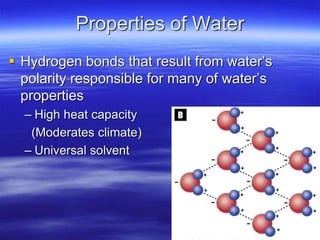
 Molecules of water: H2O
– 2 Hydrogen atoms
– 1 Oxygen atom
 Polar molecule
– One end slightly positive
– One end slightly negative
Properties of Water
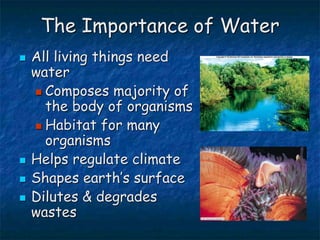
 Hydrogen bonds that result from water’s
polarity responsible for many of water’s
properties
– High heat capacity
(Moderates climate)
– Universal solvent
The Importance of Water
 All living things need
water
 Composes majority of
the body of organisms
 Habitat for many
organisms
 Helps regulate climate
 Shapes earth’s surface
 Dilutes & degrades
wastes
Water on Earth
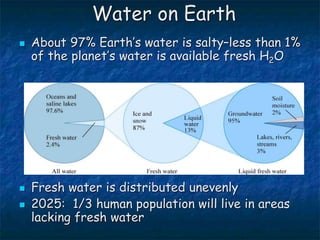
 About 97% Earth’s water is salty–less than 1%
of the planet’s water is available fresh H2O
 Fresh water is distributed unevenly
 2025: 1/3 human population will live in areas
lacking fresh water
Water, water, everywhere?
(NOT)
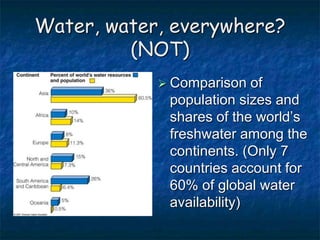
 Comparison of
population sizes and
shares of the world’s
freshwater among the
continents. (Only 7
countries account for
60% of global water
availability)
Water Wars
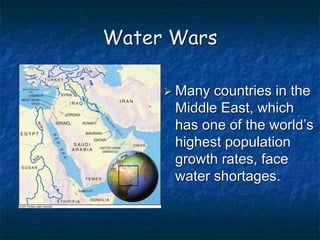
 Many countries in the
Middle East, which
has one of the world’s
highest population
growth rates, face
water shortages.
Water wars cont…
 Most water in this dry region comes
from the Nile, Jordan or Tigris rivers.
 Countries are in disagreement as to who
has water rights.
 Currently, there are no cooperative
agreements for use of 158 of the
world’s 263 water basins that are
shared by two or more countries.
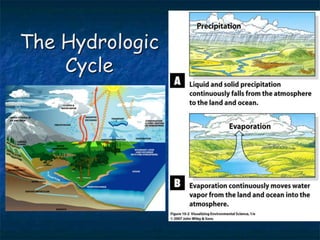
The Hydrologic
Cycle
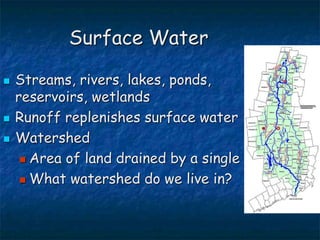
Surface Water
 Streams, rivers, lakes, ponds,
reservoirs, wetlands
 Runoff replenishes surface water
 Watershed
 Area of land drained by a single river
 What watershed do we live in?
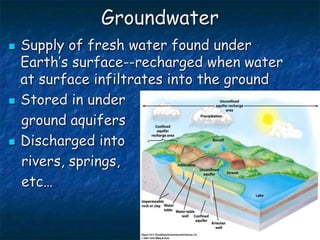
Groundwater
 Supply of fresh water found under
Earth’s surface--recharged when water
at surface infiltrates into the ground
 Stored in under
ground aquifers
 Discharged into
rivers, springs,
etc…
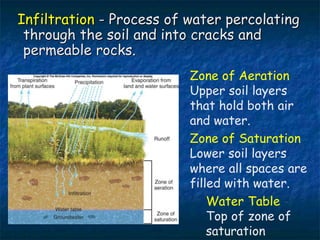
Infiltration - Process of water percolating
through the soil and into cracks and
permeable rocks.
Zone of Aeration -
Upper soil layers
that hold both air
and water.
Zone of Saturation
Lower soil layers
where all spaces are
filled with water.
Water Table -
Top of zone of
saturation
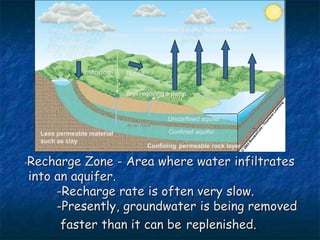
•Recharge Zone - Area where water infiltrates
into an aquifer.
-Recharge rate is often very slow.
-Presently, groundwater is being removed
faster than it can be replenished.
Evaporation and transpiration
Evaporation
Infiltration
Unconfined aquifer
Confined aquifer
Well requiring a pump
Flowing
artesian well
Runoff
Precipitation
Confined
Recharge Area
Less permeable material
such as clay
Confining permeable rock layer
Unconfined Aquifer Recharge Area
Water table
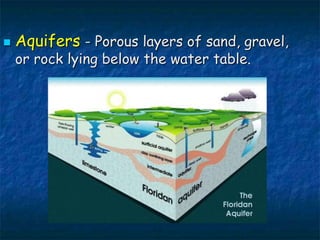
 Aquifers - Porous layers of sand, gravel,
or rock lying below the water table.
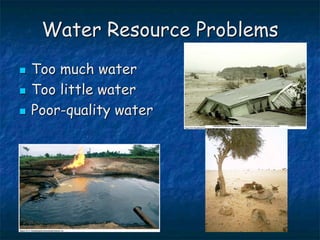
Water Resource Problems
 Too much water
 Too little water
 Poor-quality water
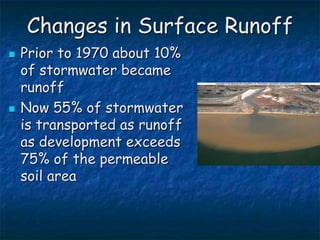
Changes in Surface Runoff
 Prior to 1970 about 10%
of stormwater became
runoff
 Now 55% of stormwater
is transported as runoff
as development exceeds
75% of the permeable
soil area
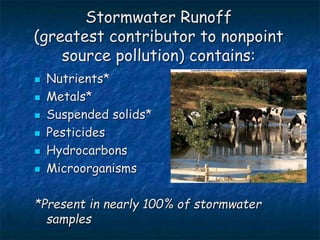
Stormwater Runoff
(greatest contributor to nonpoint
source pollution) contains:
 Nutrients*
 Metals*
 Suspended solids*
 Pesticides
 Hydrocarbons
 Microorganisms
*Present in nearly 100% of stormwater
samples
Too Much Water
 Heavy rainfall, rapid snowmelt, removal of
vegetation, and destruction of wetlands cause
flooding.
 Floodplains, which usually include highly
productive wetlands, help provide natural
flood and erosion control, maintain high water
quality, and recharge groundwater.
 To minimize floods, rivers have been narrowed
with levees and walls, and dammed to store
water.
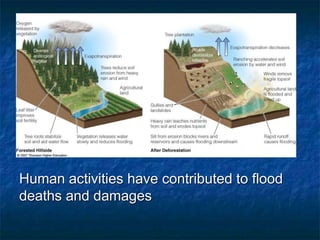
Human activities have contributed to flood
deaths and damages
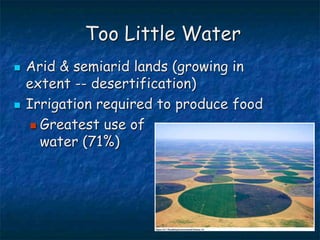
Too Little Water
 Arid & semiarid lands (growing in
extent -- desertification)
 Irrigation required to produce food
 Greatest use of
water (71%)
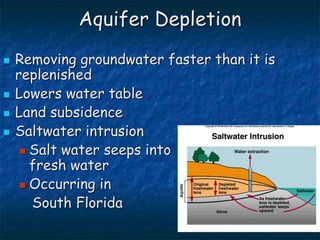
Aquifer Depletion
 Removing groundwater faster than it is
replenished
 Lowers water table
 Land subsidence
 Saltwater intrusion
 Salt water seeps into
fresh water
 Occurring in
South Florida
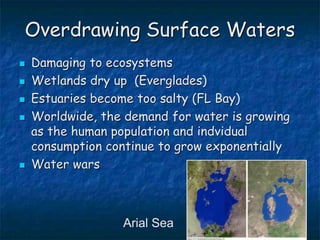
Overdrawing Surface Waters
 Damaging to ecosystems
 Wetlands dry up (Everglades)
 Estuaries become too salty (FL Bay)
 Worldwide, the demand for water is growing
as the human population and indvidual
consumption continue to grow exponentially
 Water wars
Arial Sea
Water Management
 Goal: sustainable supply of high quality
water
 How do we supply water?
 Building dams (ex: Columbia River)
 Diversion (ex: Colorado River)
 Desalination (ex: FL Keys) - very
expensive to build & operate plants
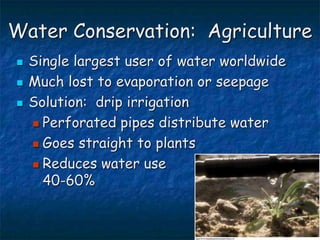
Water Conservation: Agriculture
 Single largest user of water worldwide
 Much lost to evaporation or seepage
 Solution: drip irrigation
 Perforated pipes distribute water
 Goes straight to plants
 Reduces water use
40-60%
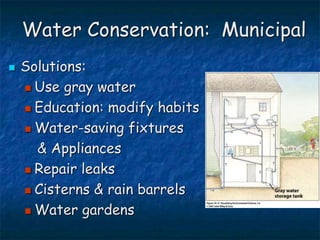
Water Conservation: Municipal
 Solutions:
 Use gray water
 Education: modify habits
 Water-saving fixtures
& Appliances
 Repair leaks
 Cisterns & rain barrels
 Water gardens
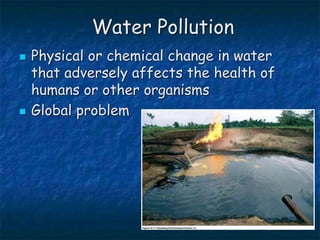
Water Pollution
 Physical or chemical change in water
that adversely affects the health of
humans or other organisms
 Global problem
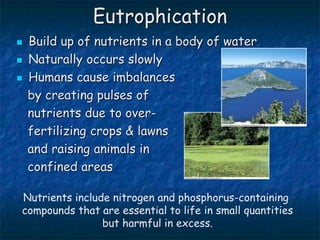
Eutrophication
 Build up of nutrients in a body of water
 Naturally occurs slowly
 Humans cause imbalances
by creating pulses of
nutrients due to over-
fertilizing crops & lawns
and raising animals in
confined areas
Nutrients include nitrogen and phosphorus-containing
compounds that are essential to life in small quantities
but harmful in excess.
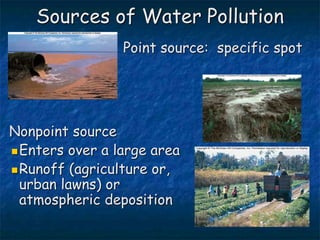
Sources of Water Pollution
Nonpoint source
Enters over a large area
Runoff (agriculture or,
urban lawns) or
atmospheric deposition
Point source: specific spot
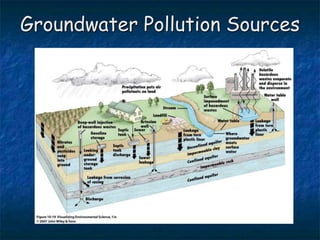
Groundwater Pollution Sources
Controlling Water Pollution
1. Source Reduction (Pollution Prevention)
 Cheapest and most effective way to
reduce pollution is to avoid producing
it or releasing it into the environment.
Design products that do not pollute
Soil Conservation
2.Ban release of pollutants
3.Reward purchasing environmentally
preferable products (e.g. rebates)
The End

water_resource_management_chapter_4es.ppt

  • 1.
  • 2.
    Properties of Water Molecules of water: H2O – 2 Hydrogen atoms – 1 Oxygen atom  Polar molecule – One end slightly positive – One end slightly negative
  • 3.
    Properties of Water Hydrogen bonds that result from water’s polarity responsible for many of water’s properties – High heat capacity (Moderates climate) – Universal solvent
  • 4.
    The Importance ofWater  All living things need water  Composes majority of the body of organisms  Habitat for many organisms  Helps regulate climate  Shapes earth’s surface  Dilutes & degrades wastes
  • 5.
    Water on Earth About 97% Earth’s water is salty–less than 1% of the planet’s water is available fresh H2O  Fresh water is distributed unevenly  2025: 1/3 human population will live in areas lacking fresh water
  • 6.
    Water, water, everywhere? (NOT) Comparison of population sizes and shares of the world’s freshwater among the continents. (Only 7 countries account for 60% of global water availability)
  • 7.
    Water Wars  Manycountries in the Middle East, which has one of the world’s highest population growth rates, face water shortages.
  • 8.
    Water wars cont… Most water in this dry region comes from the Nile, Jordan or Tigris rivers.  Countries are in disagreement as to who has water rights.  Currently, there are no cooperative agreements for use of 158 of the world’s 263 water basins that are shared by two or more countries.
  • 9.
  • 10.
    Surface Water  Streams,rivers, lakes, ponds, reservoirs, wetlands  Runoff replenishes surface water  Watershed  Area of land drained by a single river  What watershed do we live in?
  • 11.
    Groundwater  Supply offresh water found under Earth’s surface--recharged when water at surface infiltrates into the ground  Stored in under ground aquifers  Discharged into rivers, springs, etc…
  • 12.
    Infiltration - Processof water percolating through the soil and into cracks and permeable rocks. Zone of Aeration - Upper soil layers that hold both air and water. Zone of Saturation Lower soil layers where all spaces are filled with water. Water Table - Top of zone of saturation
  • 13.
    •Recharge Zone -Area where water infiltrates into an aquifer. -Recharge rate is often very slow. -Presently, groundwater is being removed faster than it can be replenished. Evaporation and transpiration Evaporation Infiltration Unconfined aquifer Confined aquifer Well requiring a pump Flowing artesian well Runoff Precipitation Confined Recharge Area Less permeable material such as clay Confining permeable rock layer Unconfined Aquifer Recharge Area Water table
  • 14.
     Aquifers -Porous layers of sand, gravel, or rock lying below the water table.
  • 15.
    Water Resource Problems Too much water  Too little water  Poor-quality water
  • 16.
    Changes in SurfaceRunoff  Prior to 1970 about 10% of stormwater became runoff  Now 55% of stormwater is transported as runoff as development exceeds 75% of the permeable soil area
  • 17.
    Stormwater Runoff (greatest contributorto nonpoint source pollution) contains:  Nutrients*  Metals*  Suspended solids*  Pesticides  Hydrocarbons  Microorganisms *Present in nearly 100% of stormwater samples
  • 18.
    Too Much Water Heavy rainfall, rapid snowmelt, removal of vegetation, and destruction of wetlands cause flooding.  Floodplains, which usually include highly productive wetlands, help provide natural flood and erosion control, maintain high water quality, and recharge groundwater.  To minimize floods, rivers have been narrowed with levees and walls, and dammed to store water.
  • 19.
    Human activities havecontributed to flood deaths and damages
  • 20.
    Too Little Water Arid & semiarid lands (growing in extent -- desertification)  Irrigation required to produce food  Greatest use of water (71%)
  • 21.
    Aquifer Depletion  Removinggroundwater faster than it is replenished  Lowers water table  Land subsidence  Saltwater intrusion  Salt water seeps into fresh water  Occurring in South Florida
  • 22.
    Overdrawing Surface Waters Damaging to ecosystems  Wetlands dry up (Everglades)  Estuaries become too salty (FL Bay)  Worldwide, the demand for water is growing as the human population and indvidual consumption continue to grow exponentially  Water wars Arial Sea
  • 23.
    Water Management  Goal:sustainable supply of high quality water  How do we supply water?  Building dams (ex: Columbia River)  Diversion (ex: Colorado River)  Desalination (ex: FL Keys) - very expensive to build & operate plants
  • 24.
    Water Conservation: Agriculture Single largest user of water worldwide  Much lost to evaporation or seepage  Solution: drip irrigation  Perforated pipes distribute water  Goes straight to plants  Reduces water use 40-60%
  • 25.
    Water Conservation: Municipal Solutions:  Use gray water  Education: modify habits  Water-saving fixtures & Appliances  Repair leaks  Cisterns & rain barrels  Water gardens
  • 26.
    Water Pollution  Physicalor chemical change in water that adversely affects the health of humans or other organisms  Global problem
  • 27.
    Eutrophication  Build upof nutrients in a body of water  Naturally occurs slowly  Humans cause imbalances by creating pulses of nutrients due to over- fertilizing crops & lawns and raising animals in confined areas Nutrients include nitrogen and phosphorus-containing compounds that are essential to life in small quantities but harmful in excess.
  • 28.
    Sources of WaterPollution Nonpoint source Enters over a large area Runoff (agriculture or, urban lawns) or atmospheric deposition Point source: specific spot
  • 29.
  • 30.
    Controlling Water Pollution 1.Source Reduction (Pollution Prevention)  Cheapest and most effective way to reduce pollution is to avoid producing it or releasing it into the environment. Design products that do not pollute Soil Conservation 2.Ban release of pollutants 3.Reward purchasing environmentally preferable products (e.g. rebates)
  • 31.