
BACTERIA
Zulcaif Ahmad
CONTENT
   History of Bacteria.
   Introduction of bacteria.
   Ways of classification.
   Groups of Bacteria.
   Comparison b/w Prokaryotes & Eukaryotes.
   Comparison with other Kingdoms.
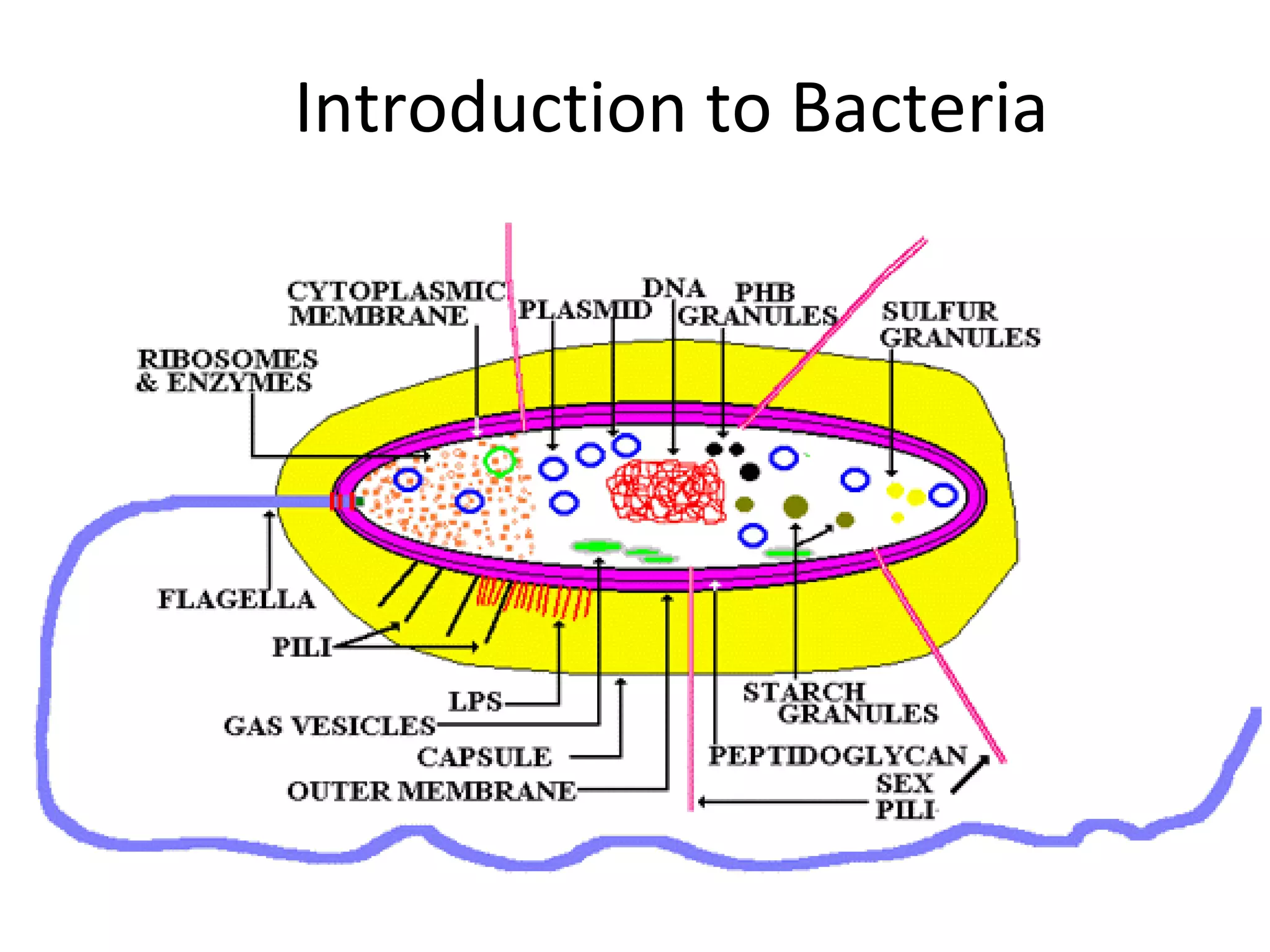
Introduction to Bacteria
What are bacteria?
• Single celled organisms

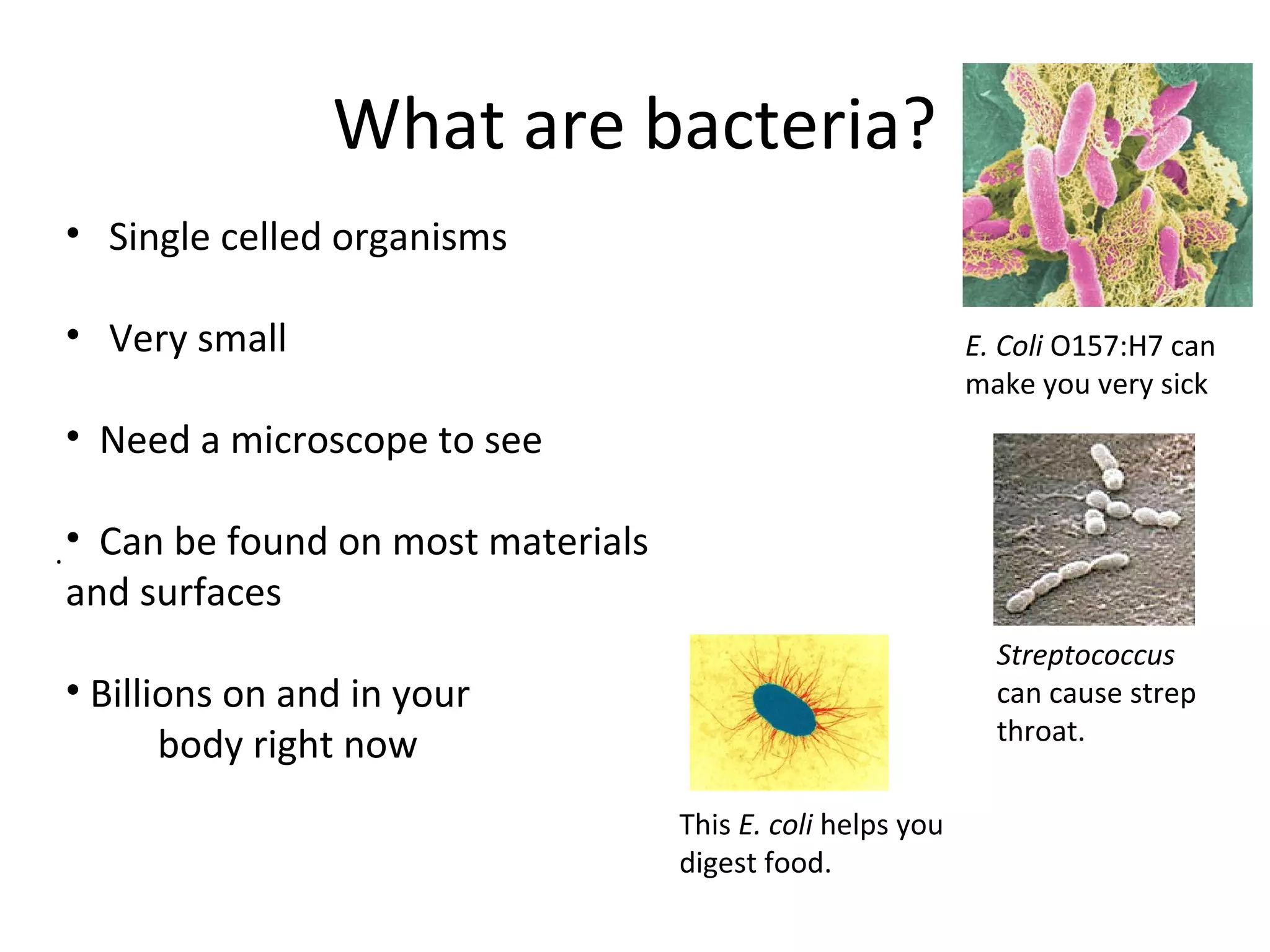
• Very small                                                E. Coli O157:H7 can
                                                            make you very sick
• Need a microscope to see

.•Can be found on most materials
and surfaces
                                                              Streptococcus
• Billions on and in your                                     can cause strep
                                                              throat.
       body right now
                                   This E. coli helps you
                                   digest food.
What do they look like?
                                                        Bacilli
• Three basic shapes
  –   Rod shaped called bacilli
  –    (buh-sill-eye)
  –   Round shaped called cocci
                                       Cocci
  –   (cox-eye)
  –   Spiral shaped

• Some exist as single cells,
  others
cluster together                               Spiral
                    Cluster of cocci
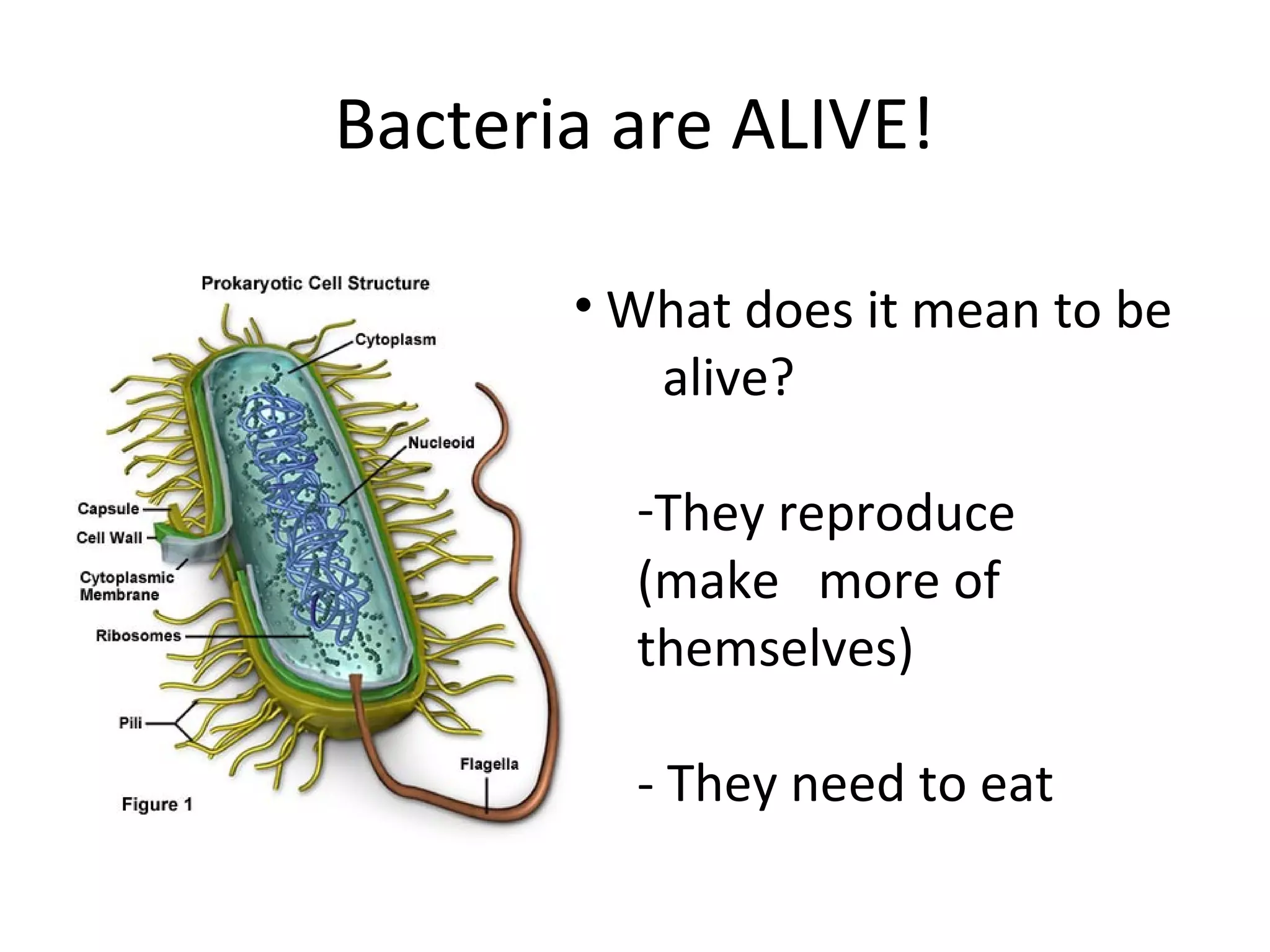
Bacteria are ALIVE!

       • What does it mean to be
          alive?

         -They reproduce
         (make more of
         themselves)

         - They need to eat
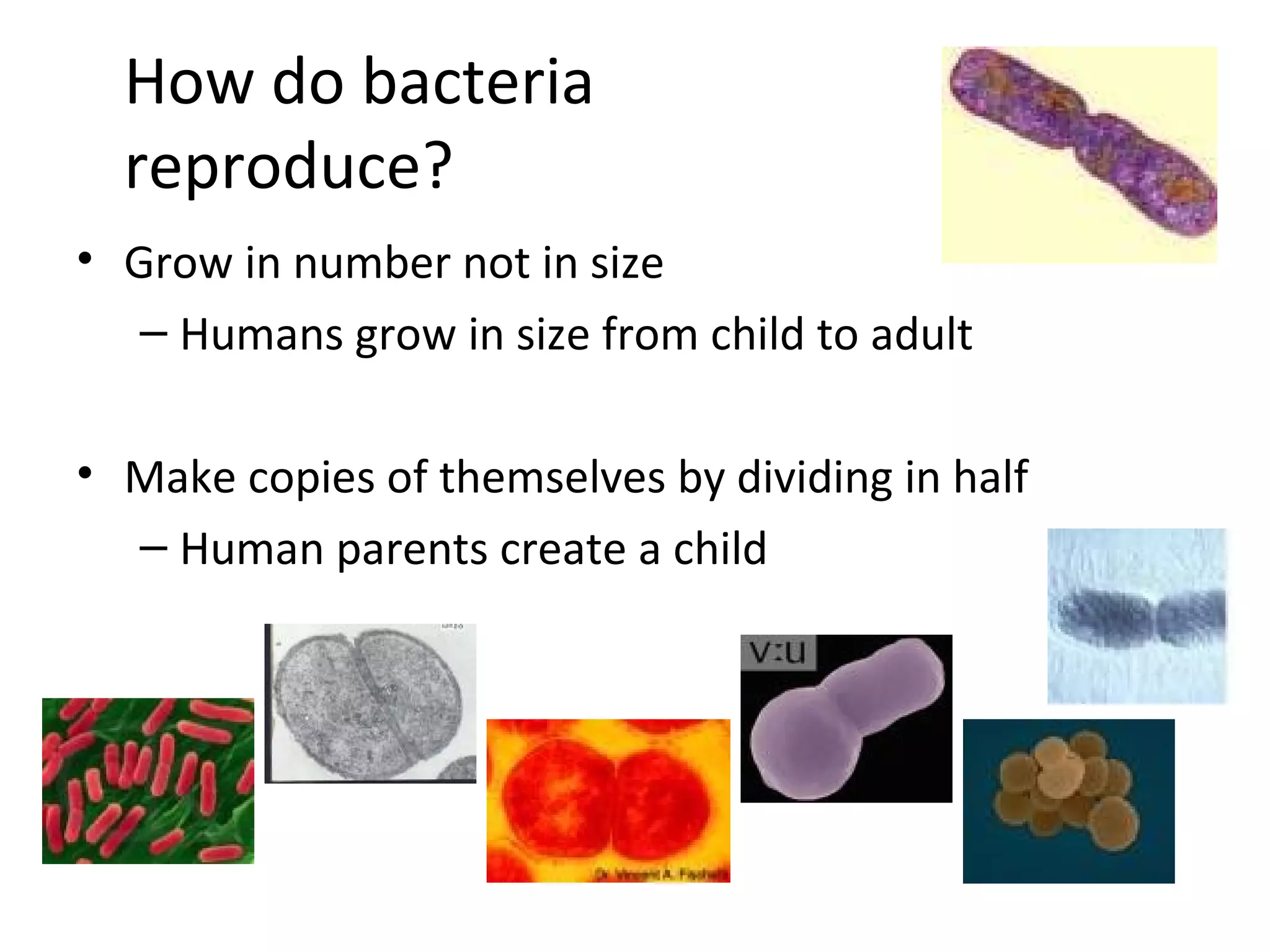
How do bacteria
  reproduce?
• Grow in number not in size
   – Humans grow in size from child to adult

• Make copies of themselves by dividing in half
  – Human parents create a child
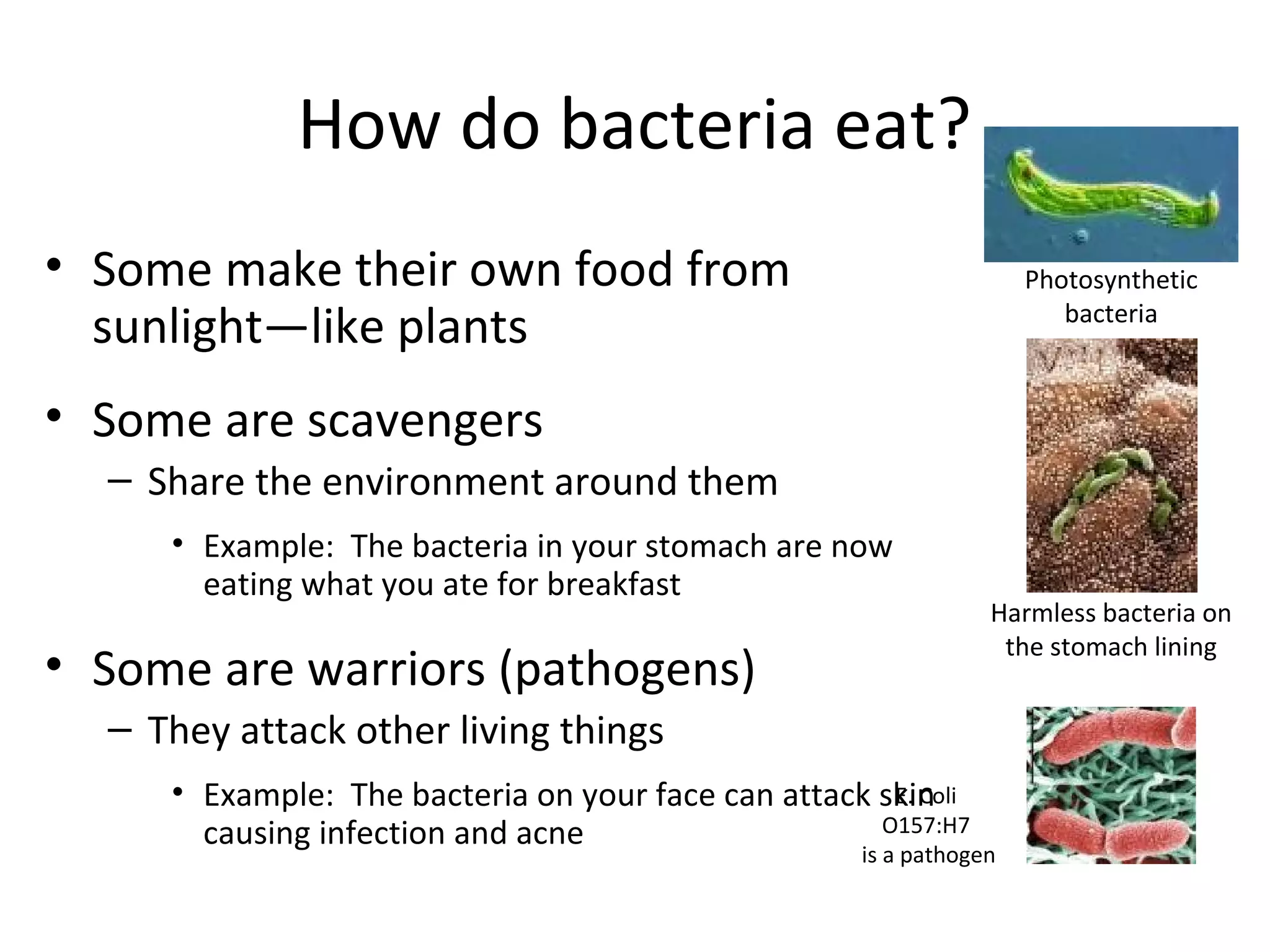
How do bacteria eat?
• Some make their own food from                                      Photosynthetic
  sunlight—like plants                                                  bacteria


• Some are scavengers
  – Share the environment around them
     • Example: The bacteria in your stomach are now
       eating what you ate for breakfast
                                                                 Harmless bacteria on
                                                                  the stomach lining
• Some are warriors (pathogens)
  – They attack other living things
     • Example: The bacteria on your face can attack skin
                                                      E. Coli
       causing infection and acne                    O157:H7
                                                     is a pathogen
BRIEF HISTORY:
          In a 1683 letter to the Royal
          Society
          Of London, Anton van
          Leeuwenhoek
          Described microscopic
          “STREAKS &
          THREADS”, among his tiny
          animals.
          The streaks and threads
          remained nameless until
          1773,
In 1773, when the Danish
scientist
Otto Frederick Muller
christened them bacilli.
Bacilli is the plural form
of the Latin word Bacillus
meaning but not all
“bacilli” were rods. Some
were spiral and some
were circular, & “bacilli”
would not do.
Therefore, in the 1850s, The
French investigator Casimir
Davaine began calling a
microscopic creatures
“BACTERIA”, even though this
derivatives of the Greek
bacterion also means rod. In
the next few decades
“bacteria” came to refer to all
the micro-organisms in that
group, and the word “Bcillus”
was reserved for rod forms
only.
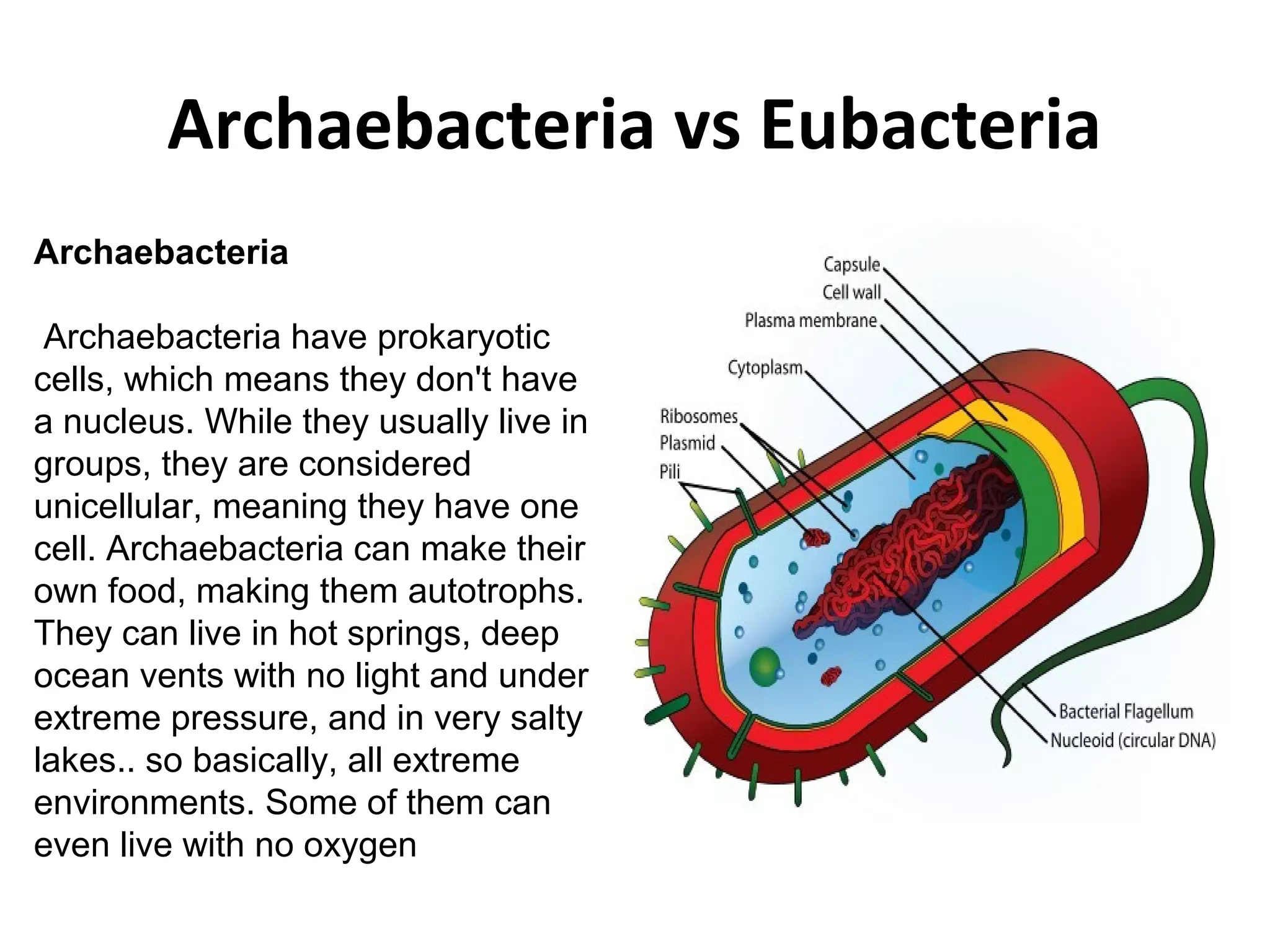
Archaebacteria vs Eubacteria
Archaebacteria

 Archaebacteria have prokaryotic
cells, which means they don't have
a nucleus. While they usually live in
groups, they are considered
unicellular, meaning they have one
cell. Archaebacteria can make their
own food, making them autotrophs.
They can live in hot springs, deep
ocean vents with no light and under
extreme pressure, and in very salty
lakes.. so basically, all extreme
environments. Some of them can
even live with no oxygen
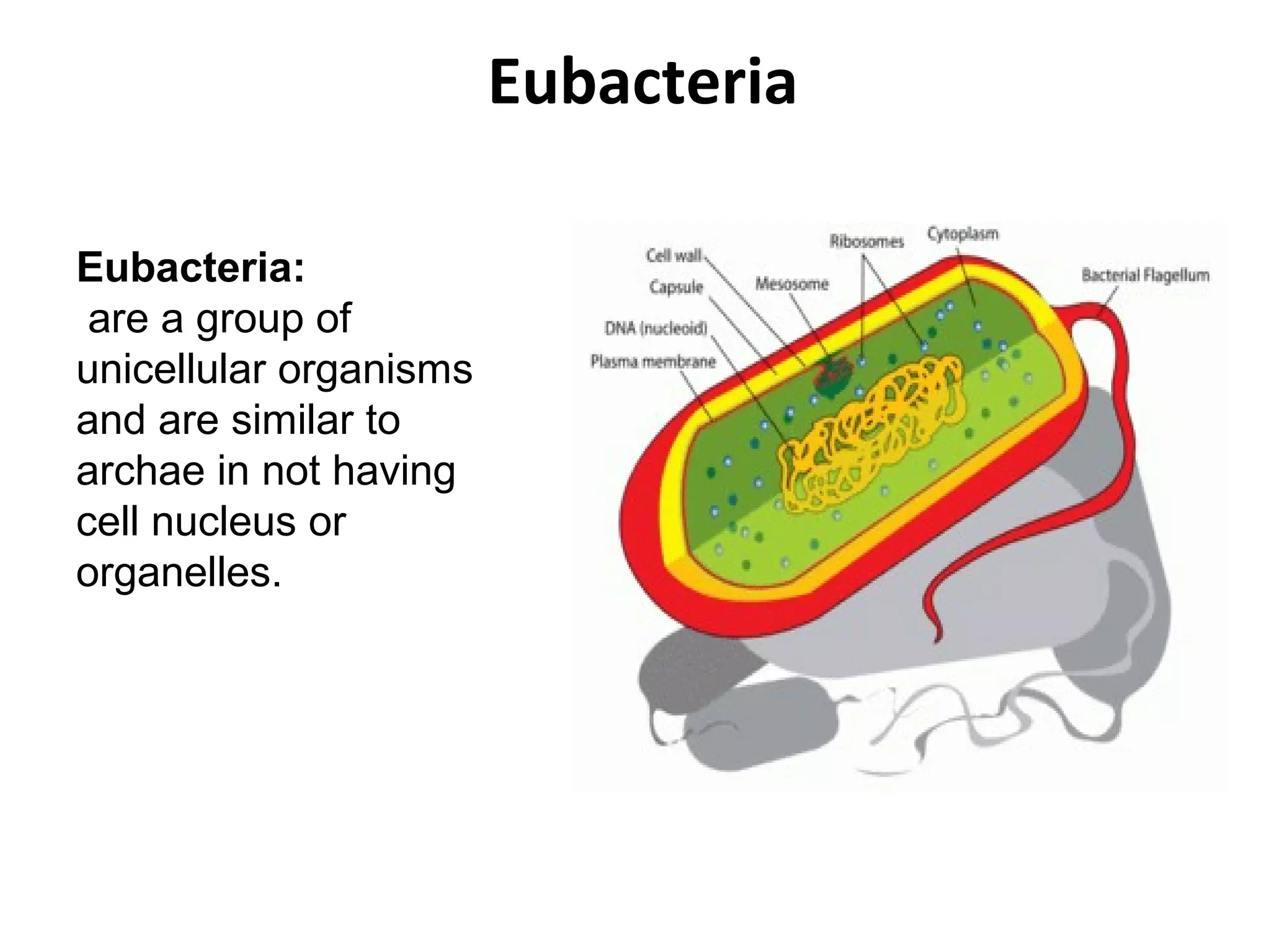
 Eubacteria

Eubacteria:
 are a group of 
unicellular organisms 
and are similar to 
archae in not having 
cell nucleus or 
organelles.
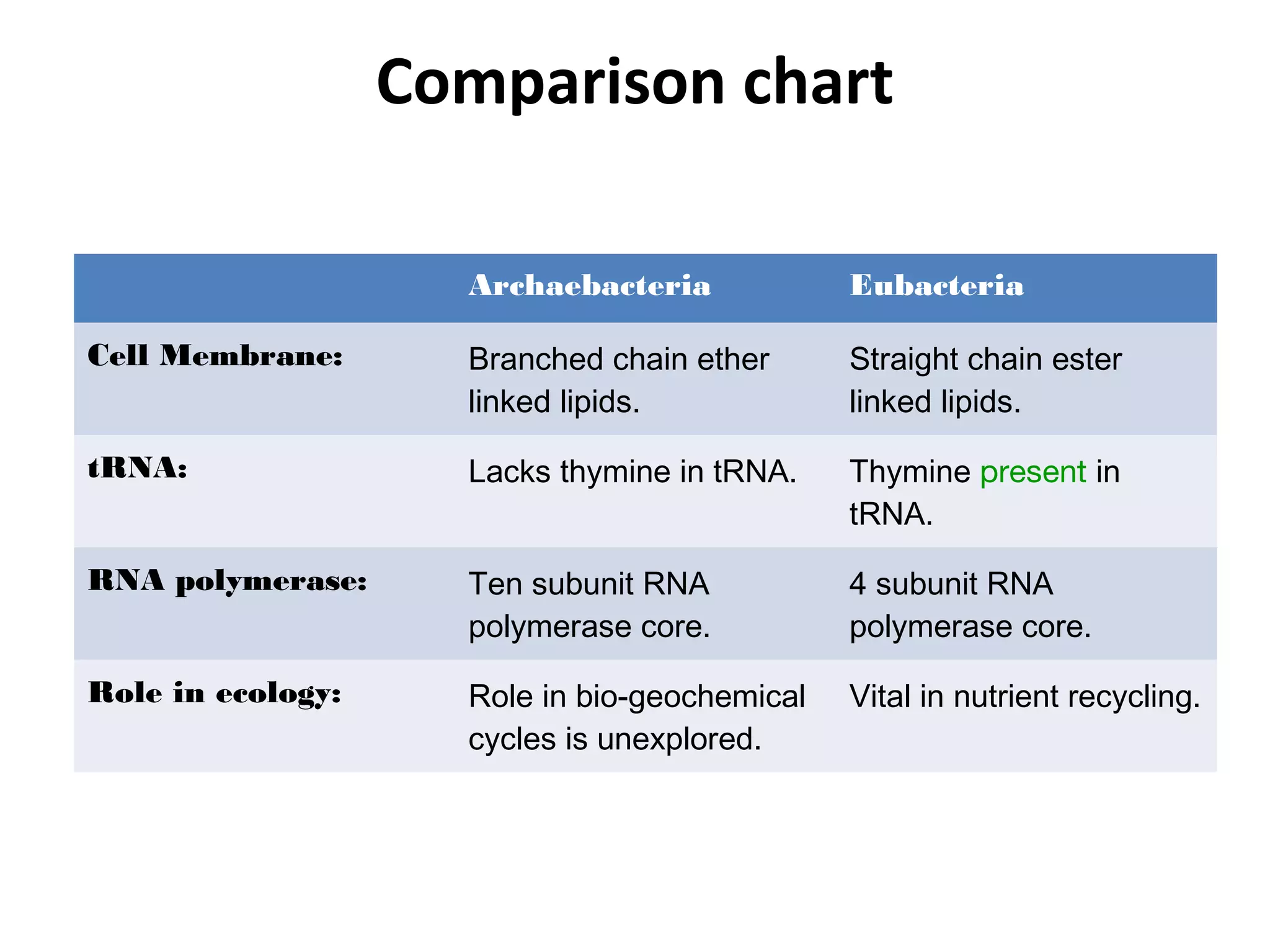
Comparison chart

                     Archaebacteria            Eubacteria

Cell Membrane:       Branched chain ether      Straight chain ester
                     linked lipids.            linked lipids.

tRNA:                Lacks thymine in tRNA.    Thymine present in
                                               tRNA.

RNA polymerase:      Ten subunit RNA           4 subunit RNA
                     polymerase core.          polymerase core.

Role in ecology:     Role in bio-geochemical   Vital in nutrient recycling.
                     cycles is unexplored.
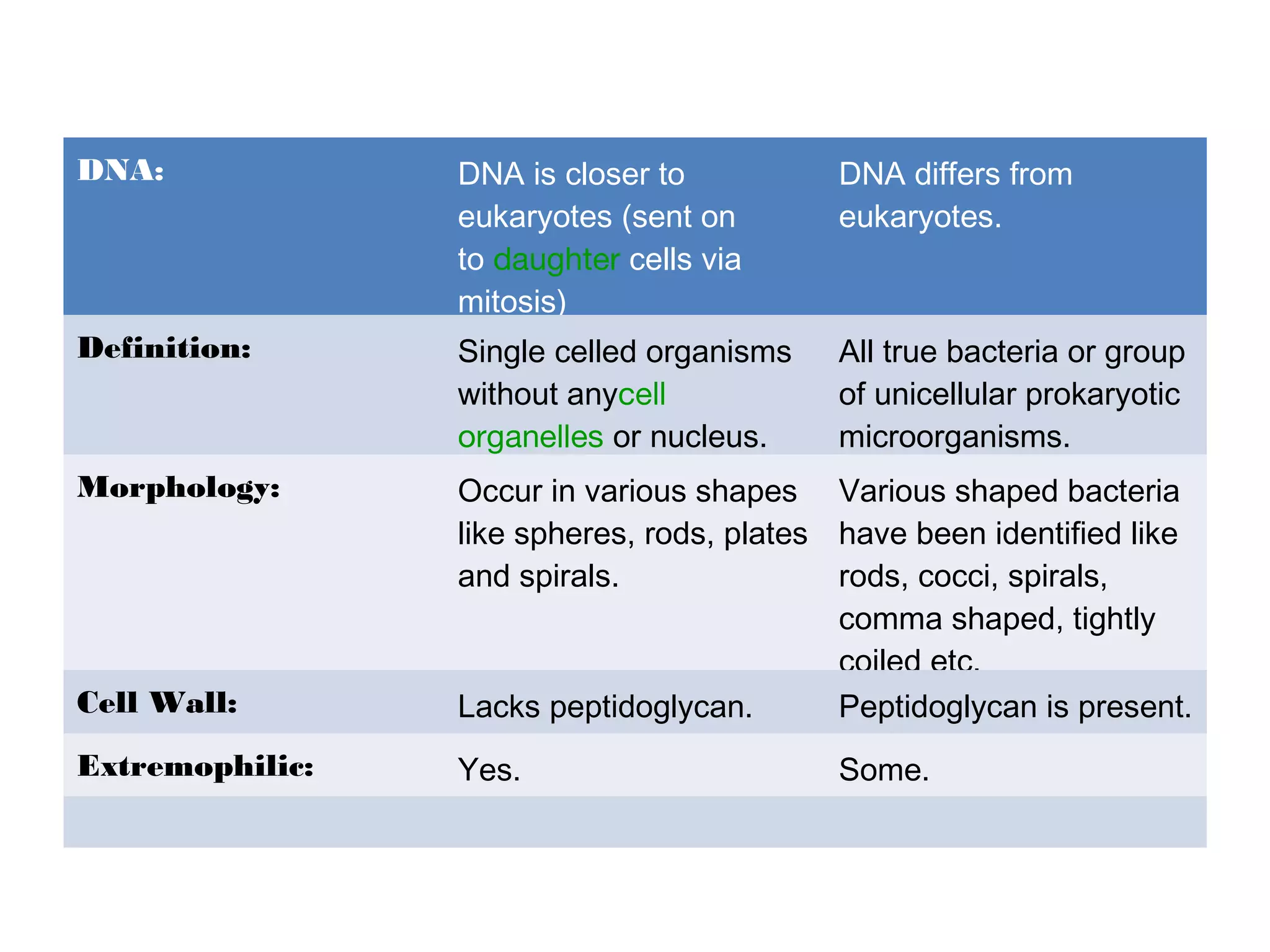
DNA:             DNA is closer to          DNA differs from
                 eukaryotes (sent on       eukaryotes.
                 to daughter cells via
                 mitosis)
Definition:      Single celled organisms   All true bacteria or group
                 without anycell           of unicellular prokaryotic
                 organelles or nucleus.    microorganisms.
Morphology:      Occur in various shapes Various shaped bacteria
                 like spheres, rods, plates have been identified like
                 and spirals.               rods, cocci, spirals,
                                            comma shaped, tightly
                                            coiled etc.
Cell Wall:       Lacks peptidoglycan.       Peptidoglycan is present.
Extremophilic:   Yes.                      Some.
WAYS OF CLASSIFICATION

Bacterial Classification Based 
on Shapes

Rod shaped bacteria's are 
also called Bacilli

e.g. E.coli 
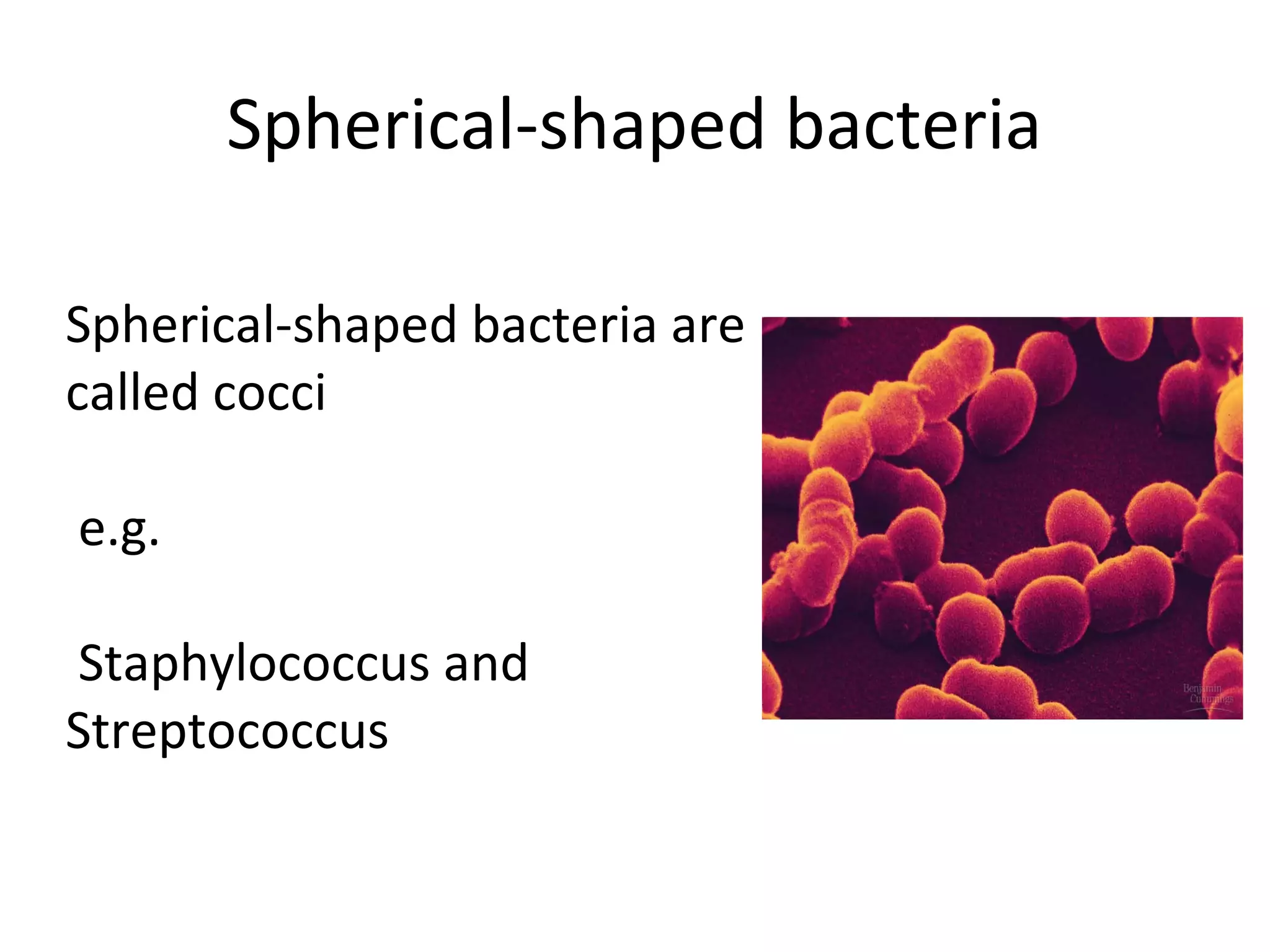
Spherical-shaped bacteria

Spherical-shaped bacteria are 
called cocci 

 e.g.

 Staphylococcus and 
Streptococcus
Spiral-shaped bacteria

 Spiral-shaped bacteria are 
called      

  spirilla

  e.g.

 Treponema
Bacterial Classification Based on 
             Staining Methods
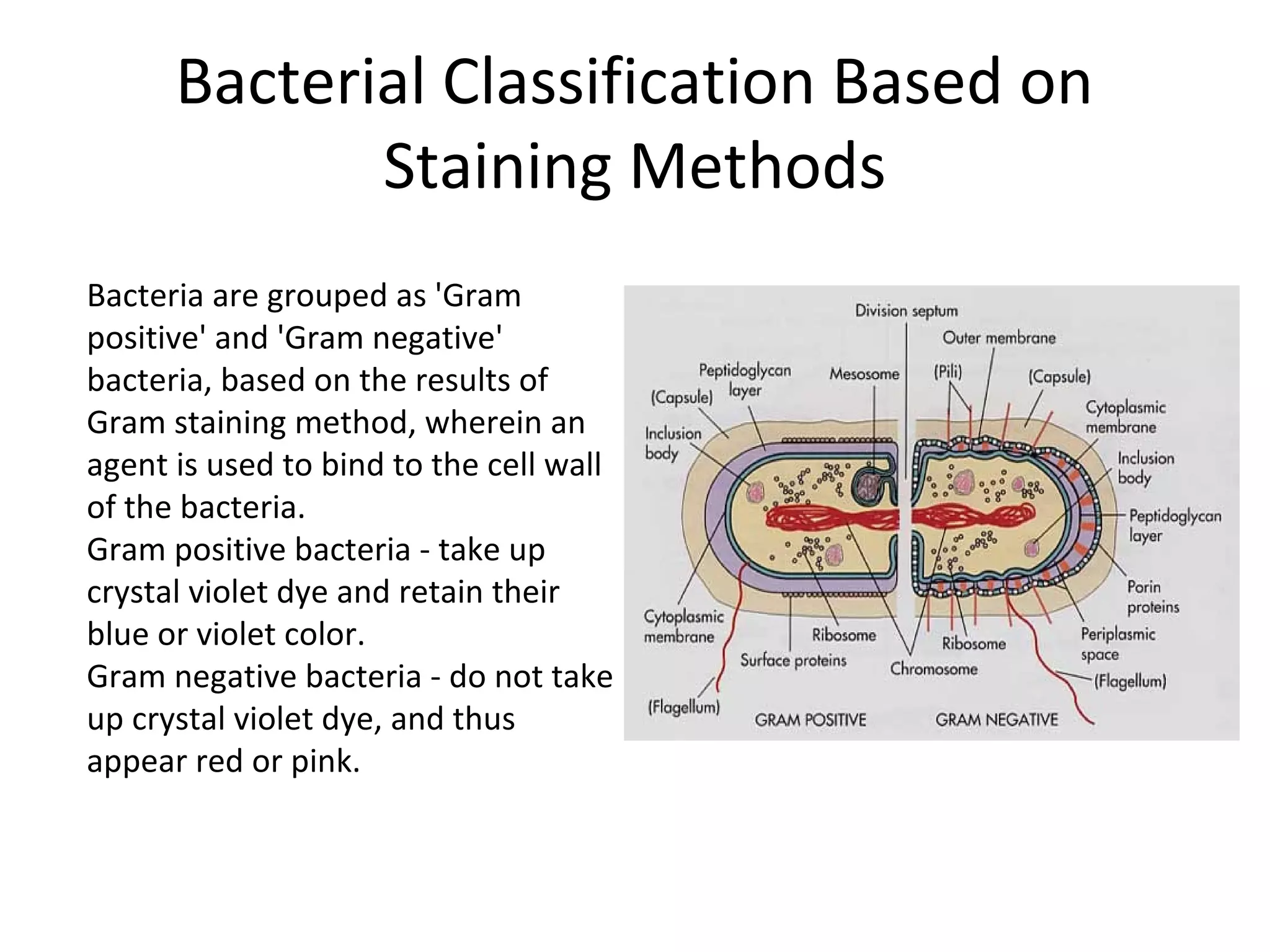
Bacteria are grouped as 'Gram 
positive' and 'Gram negative' 
bacteria, based on the results of 
Gram staining method, wherein an 
agent is used to bind to the cell wall 
of the bacteria.
Gram positive bacteria - take up 
crystal violet dye and retain their 
blue or violet color.
Gram negative bacteria - do not take 
up crystal violet dye, and thus 
appear red or pink.
Bacteria are also classified based on the 
           requirement of oxygen for their survival
                                 Anaerobic bacteria 
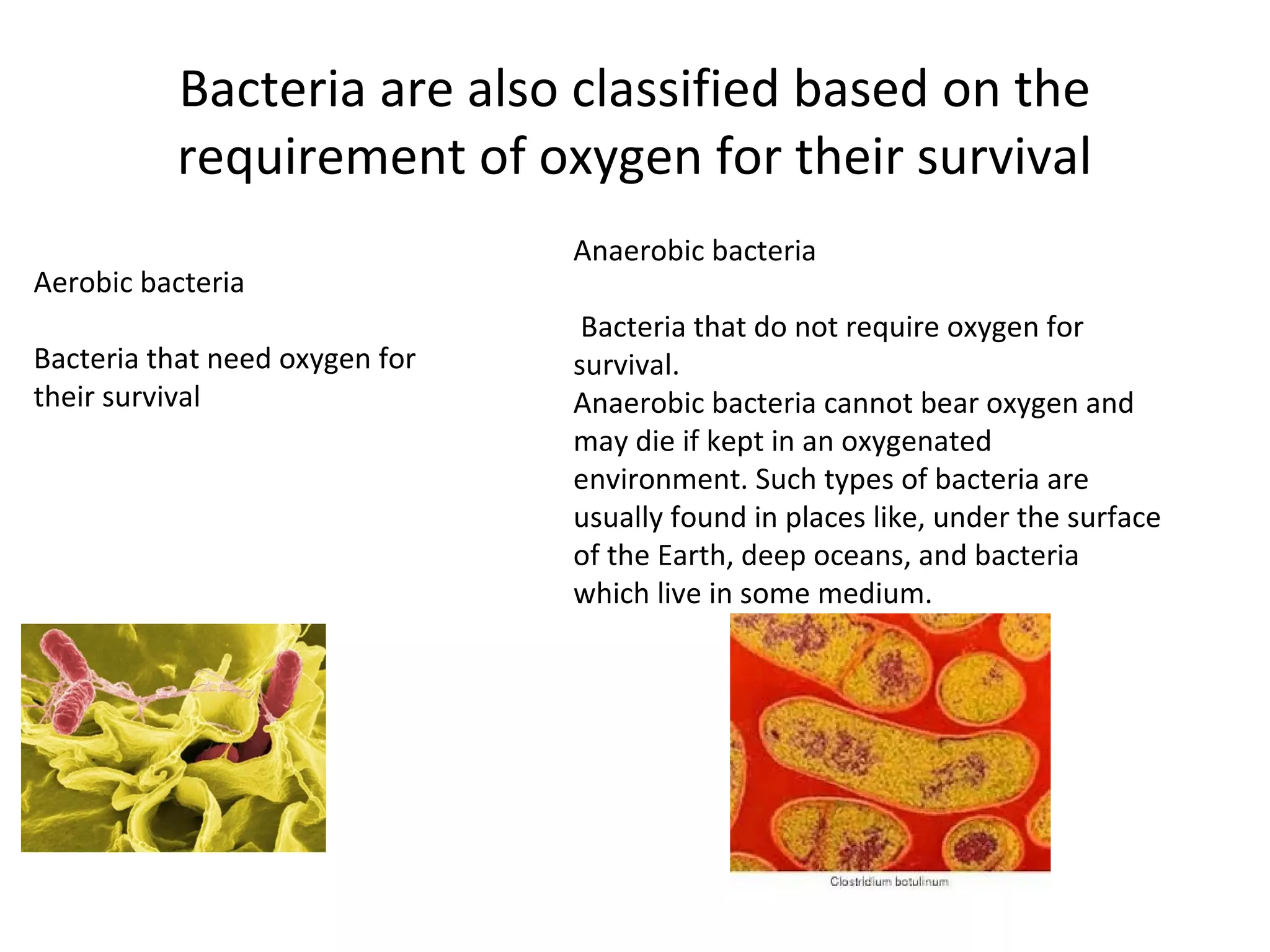
Aerobic bacteria 
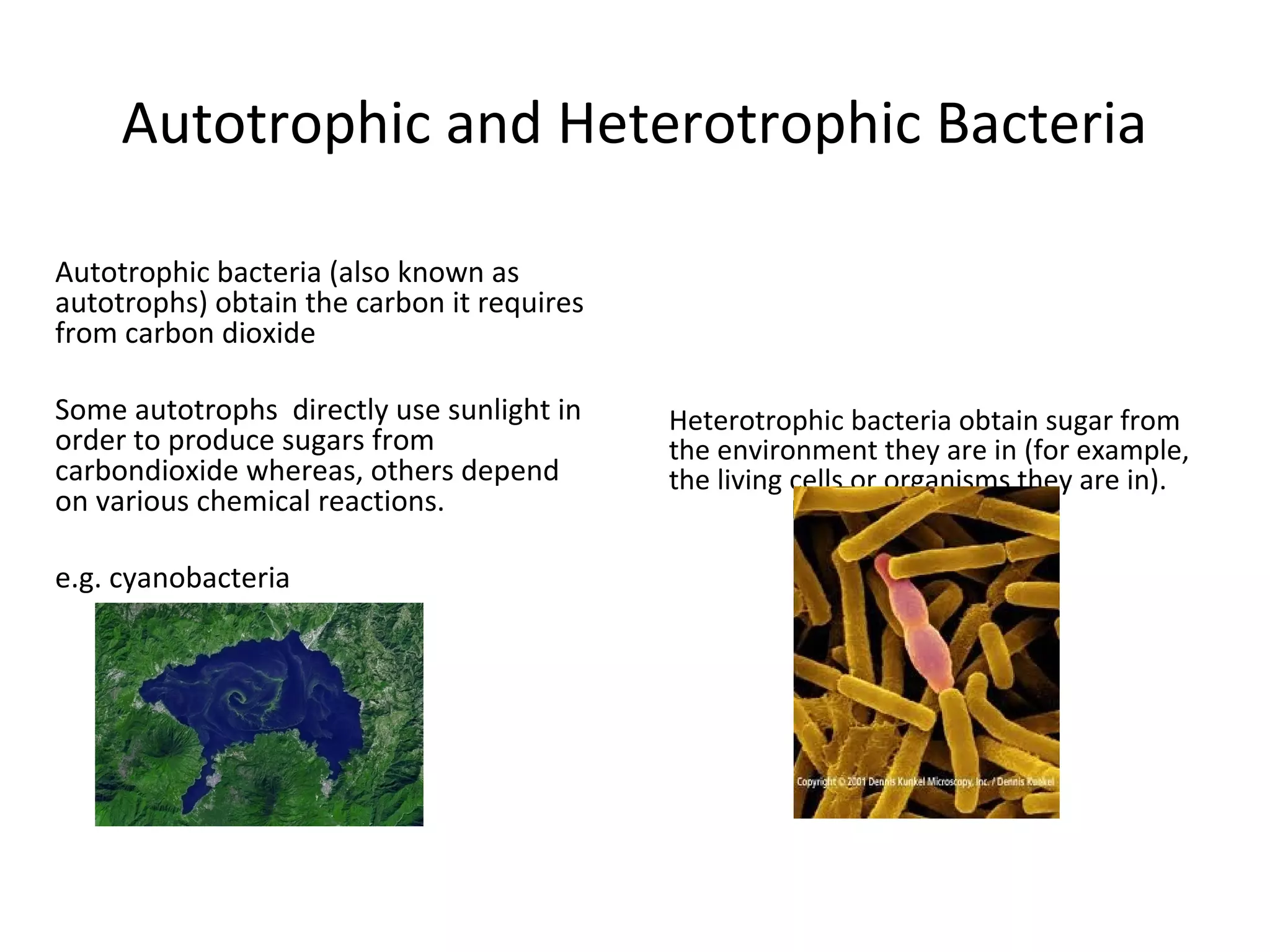
                                  Bacteria that do not require oxygen for 
Bacteria that need oxygen for    survival.
their survival                   Anaerobic bacteria cannot bear oxygen and 
                                 may die if kept in an oxygenated 
                                 environment. Such types of bacteria are 
                                 usually found in places like, under the surface 
                                 of the Earth, deep oceans, and bacteria 
                                 which live in some medium.
Autotrophic and Heterotrophic Bacteria

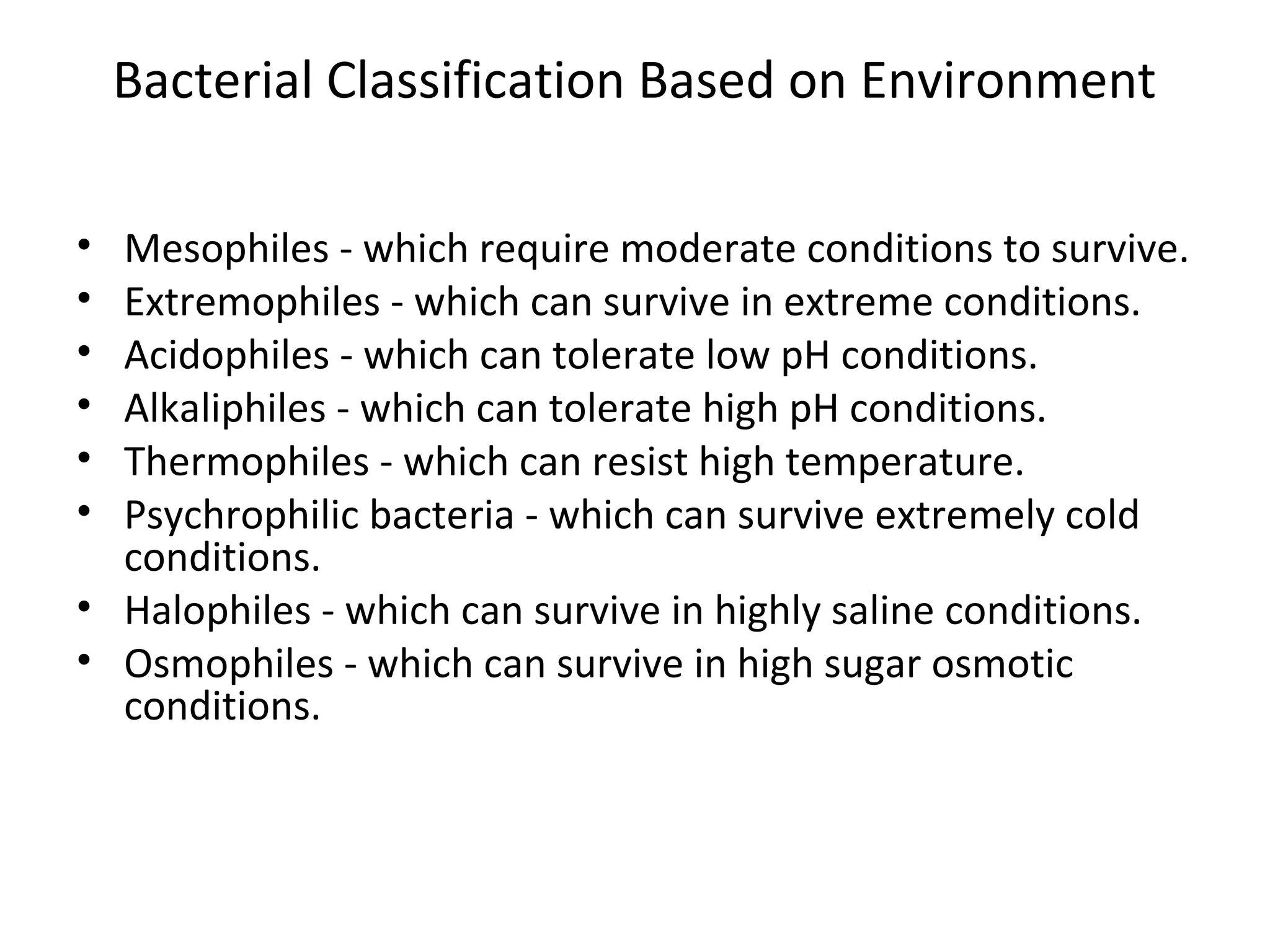
Autotrophic bacteria (also known as 
autotrophs) obtain the carbon it requires 
from carbon dioxide

Some autotrophs  directly use sunlight in    Heterotrophic bacteria obtain sugar from 
order to produce sugars from                 the environment they are in (for example, 
carbondioxide whereas, others depend         the living cells or organisms they are in).
on various chemical reactions.                          E.g. bacillus anthracia

e.g. cyanobacteria
Bacterial Classification Based on Environment

• Mesophiles - which require moderate conditions to survive.
• Extremophiles - which can survive in extreme conditions.
• Acidophiles - which can tolerate low pH conditions.
• Alkaliphiles - which can tolerate high pH conditions.
• Thermophiles - which can resist high temperature.
• Psychrophilic bacteria - which can survive extremely cold 
  conditions.
• Halophiles - which can survive in highly saline conditions.
• Osmophiles - which can survive in high sugar osmotic 
  conditions.
Classification of bacteria


Bacteria are arranged into 19 groups 
1. Phototrophic bacteria 

•  Cell shapes :
  
spherical,rod,vibrio,or
   spiral.
•  Gram negative 
•  Habitat : aquatic
   environment

                          Example : rhodospirillum species
2.Gliding bacteria
• Cell shapes :
  rod,spherical,or
  filamentous.
• Gram negative
• Habitat : soil, decomposing
  plant material, aquatic
  environment


                                Example: stigmatella
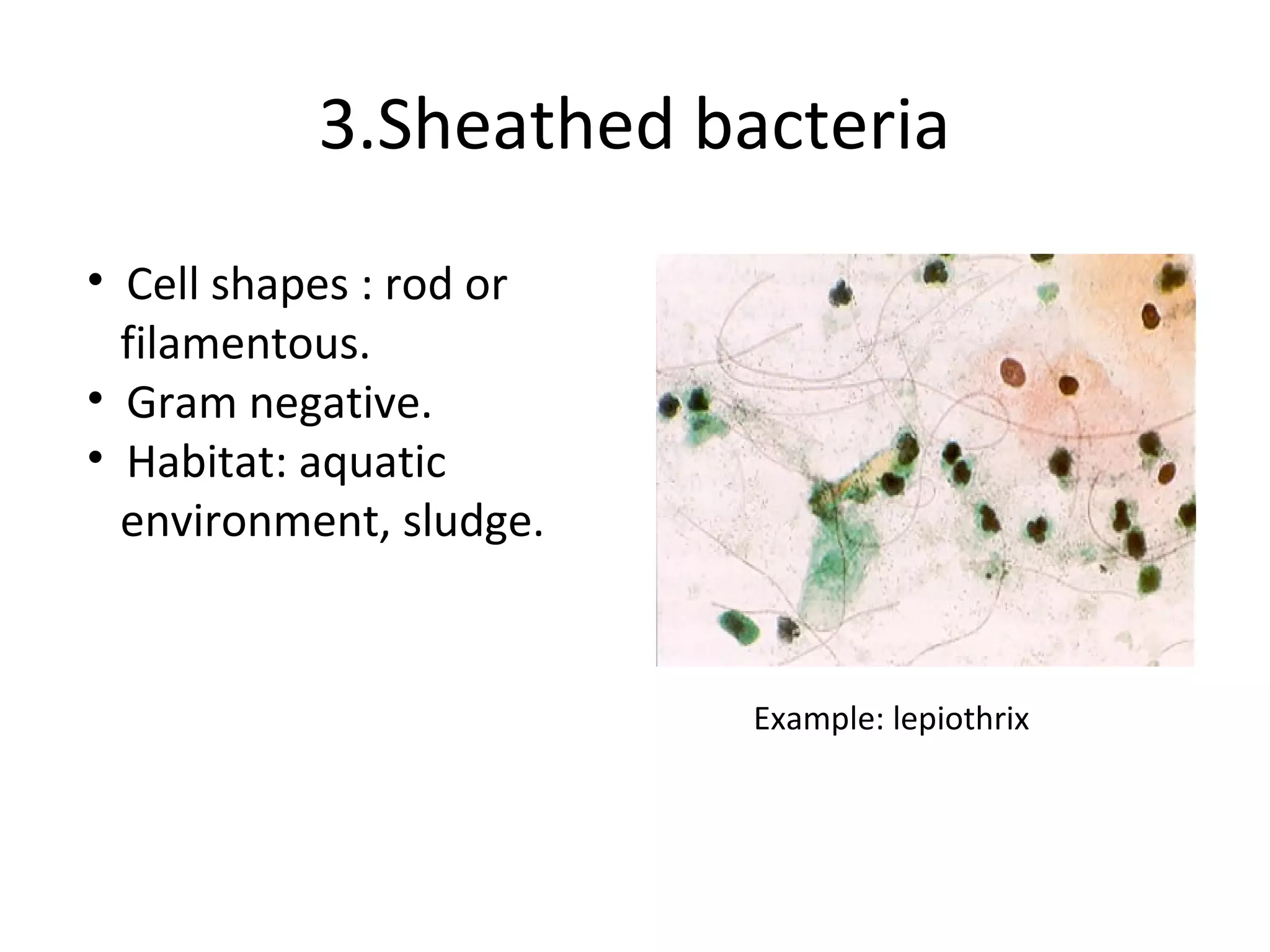
3.Sheathed bacteria
• Cell shapes : rod or
  filamentous.
• Gram negative.
• Habitat: aquatic
  environment, sludge.


                         Example: lepiothrix
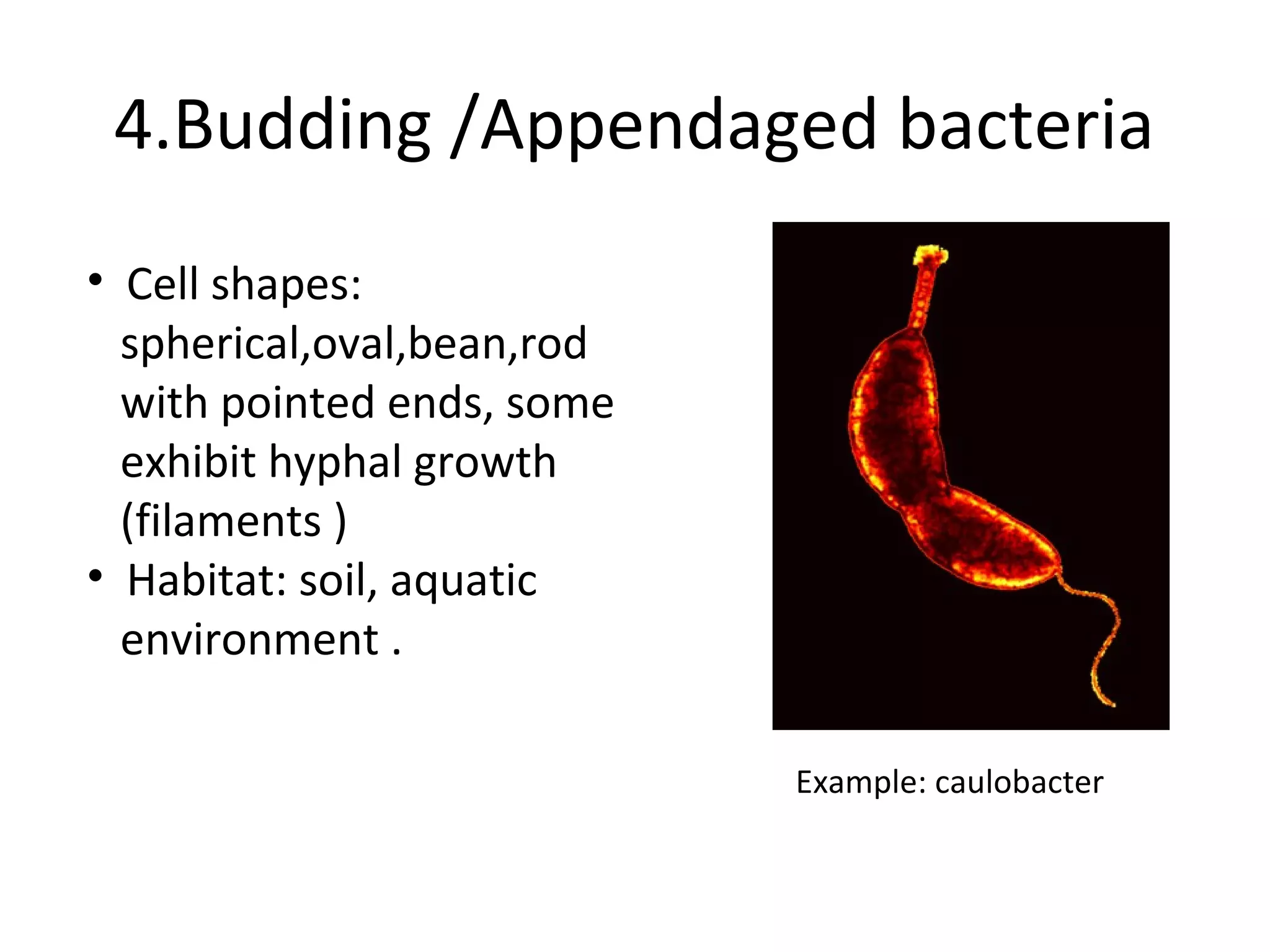
4.Budding /Appendaged bacteria
• Cell shapes:
  spherical,oval,bean,rod
  with pointed ends, some
  exhibit hyphal growth
  (filaments )
• Habitat: soil, aquatic
  environment .

                            Example: caulobacter
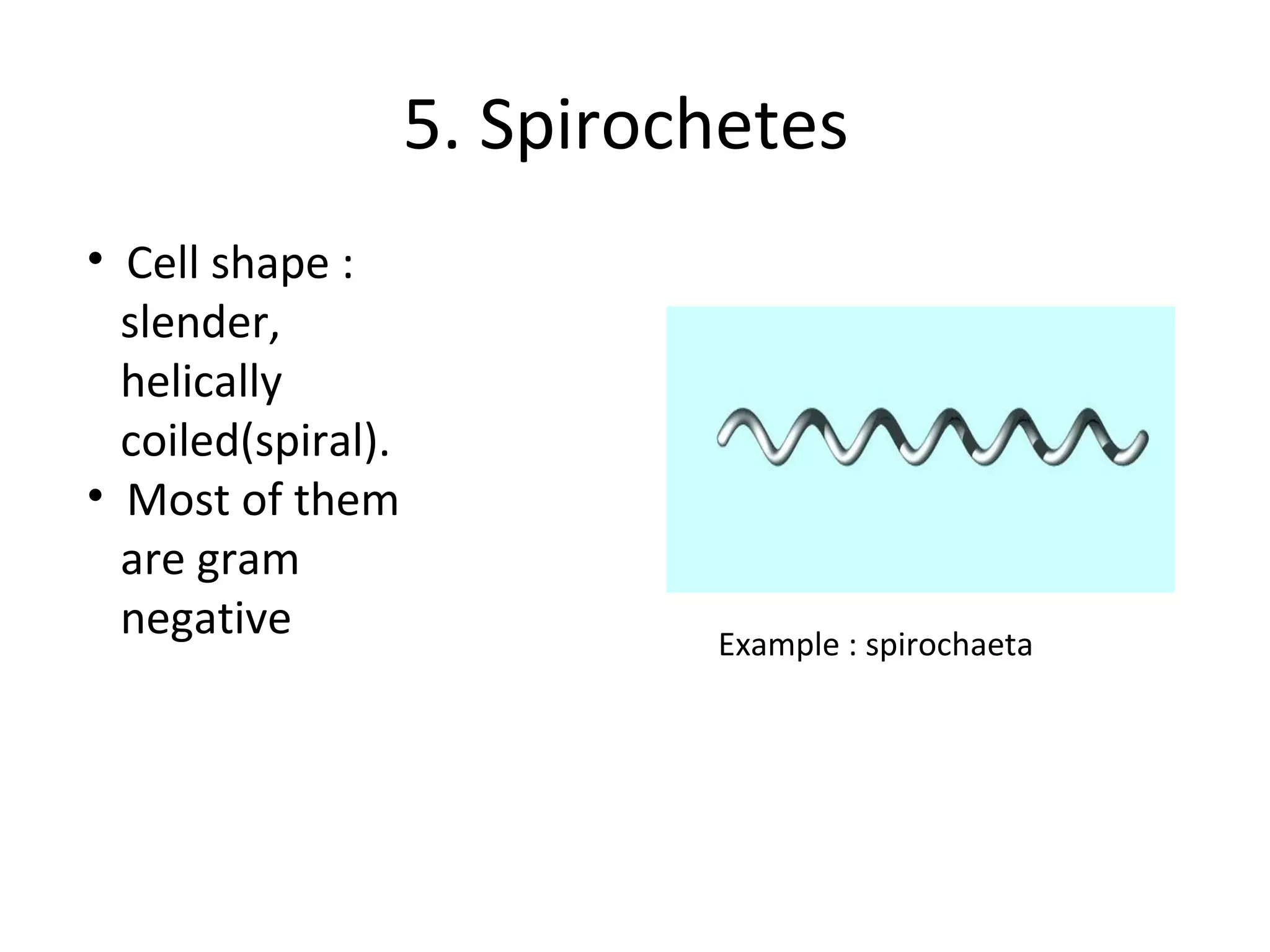
5. Spirochetes
• Cell shape :
  slender,
  helically
  coiled(spiral).
• Most of them
  are gram
  negative                   Example : spirochaeta
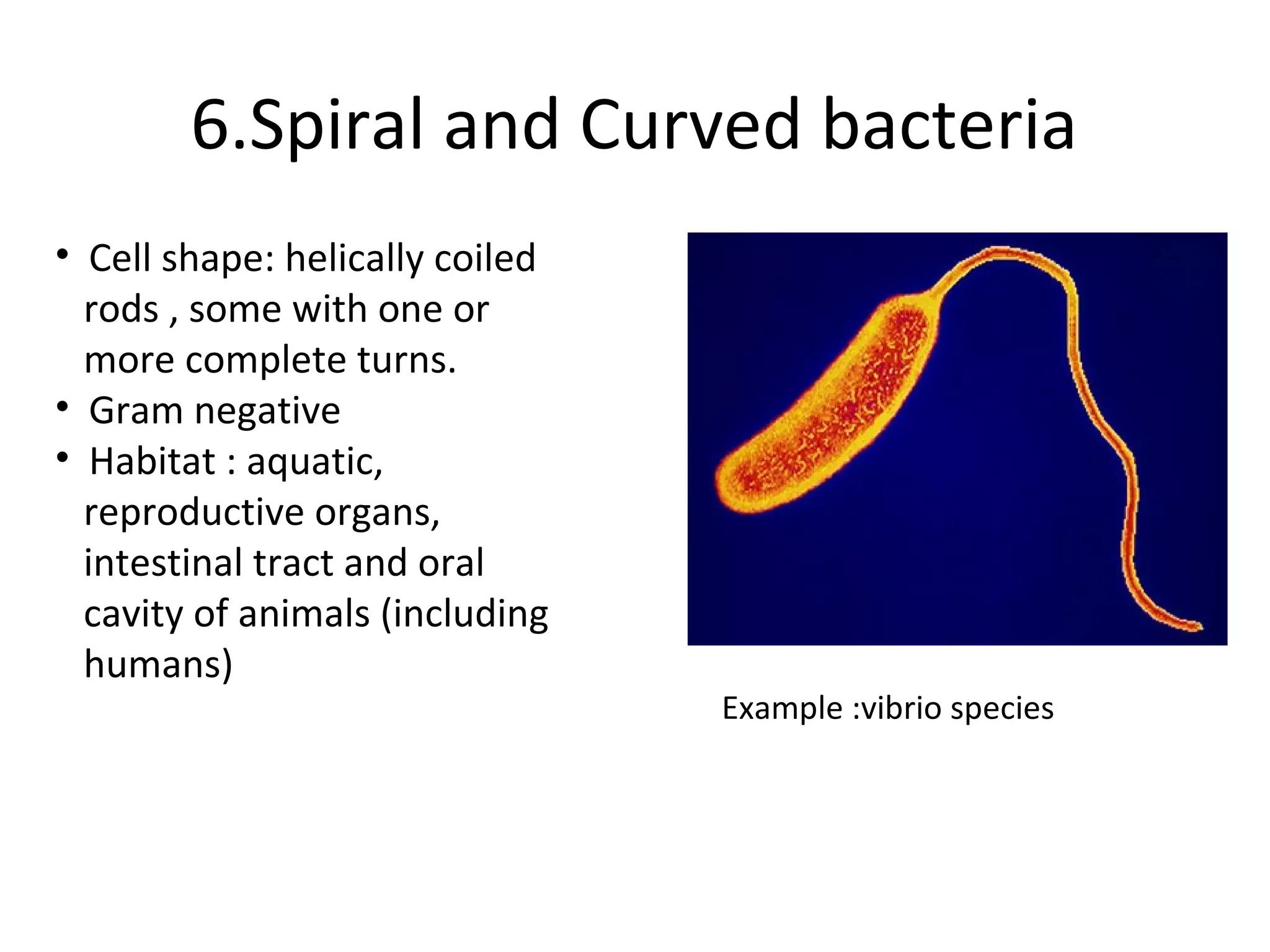
6.Spiral and Curved bacteria
• Cell shape: helically coiled
  rods , some with one or
  more complete turns.
• Gram negative
• Habitat : aquatic,
  reproductive organs,
  intestinal tract and oral
  cavity of animals (including
  humans)
                                 Example :vibrio species
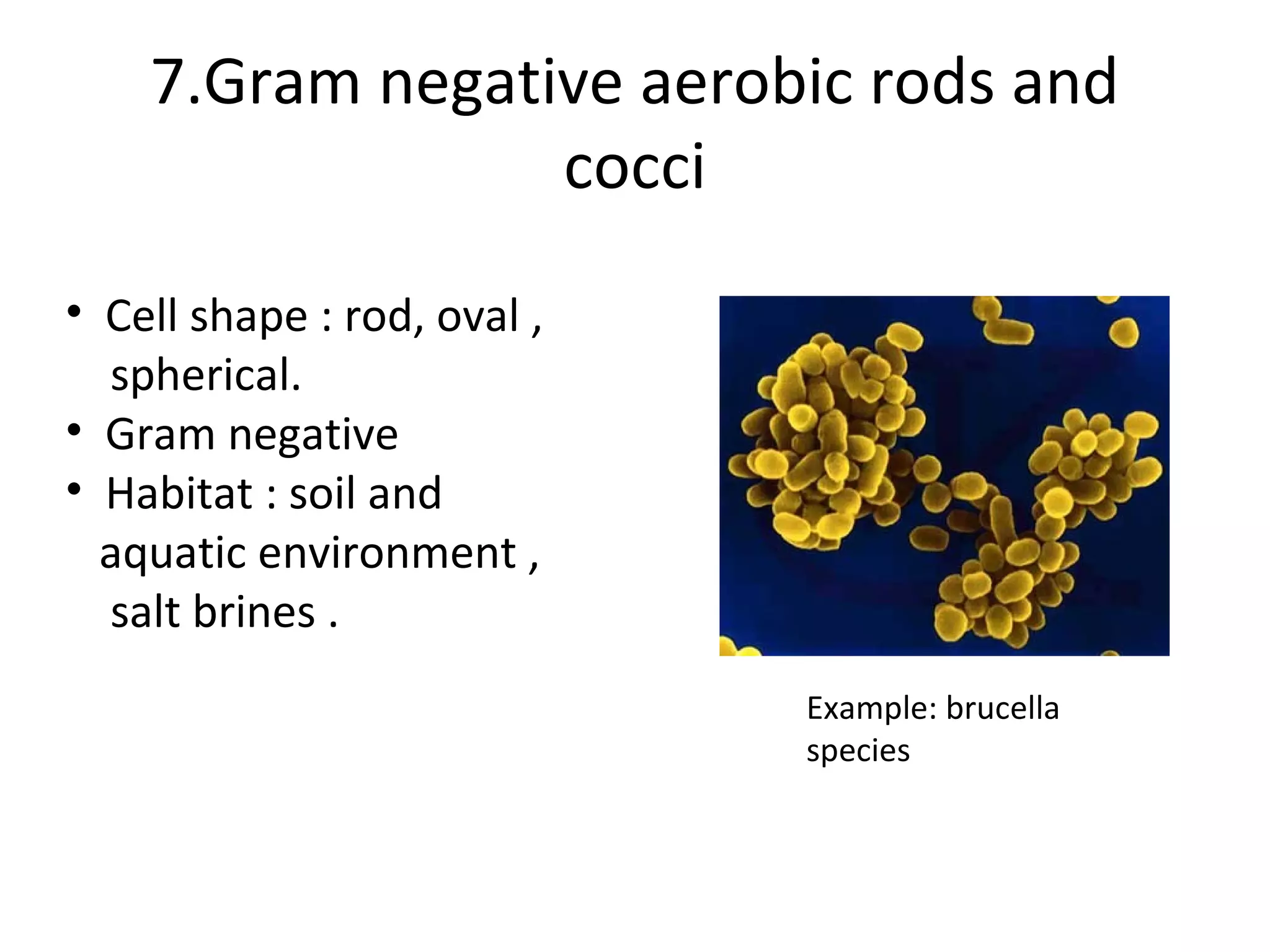
7.Gram negative aerobic rods and
                 cocci
• Cell shape : rod, oval ,
  spherical.
• Gram negative
• Habitat : soil and
  aquatic environment ,
  salt brines .
                             Example: brucella
                             species
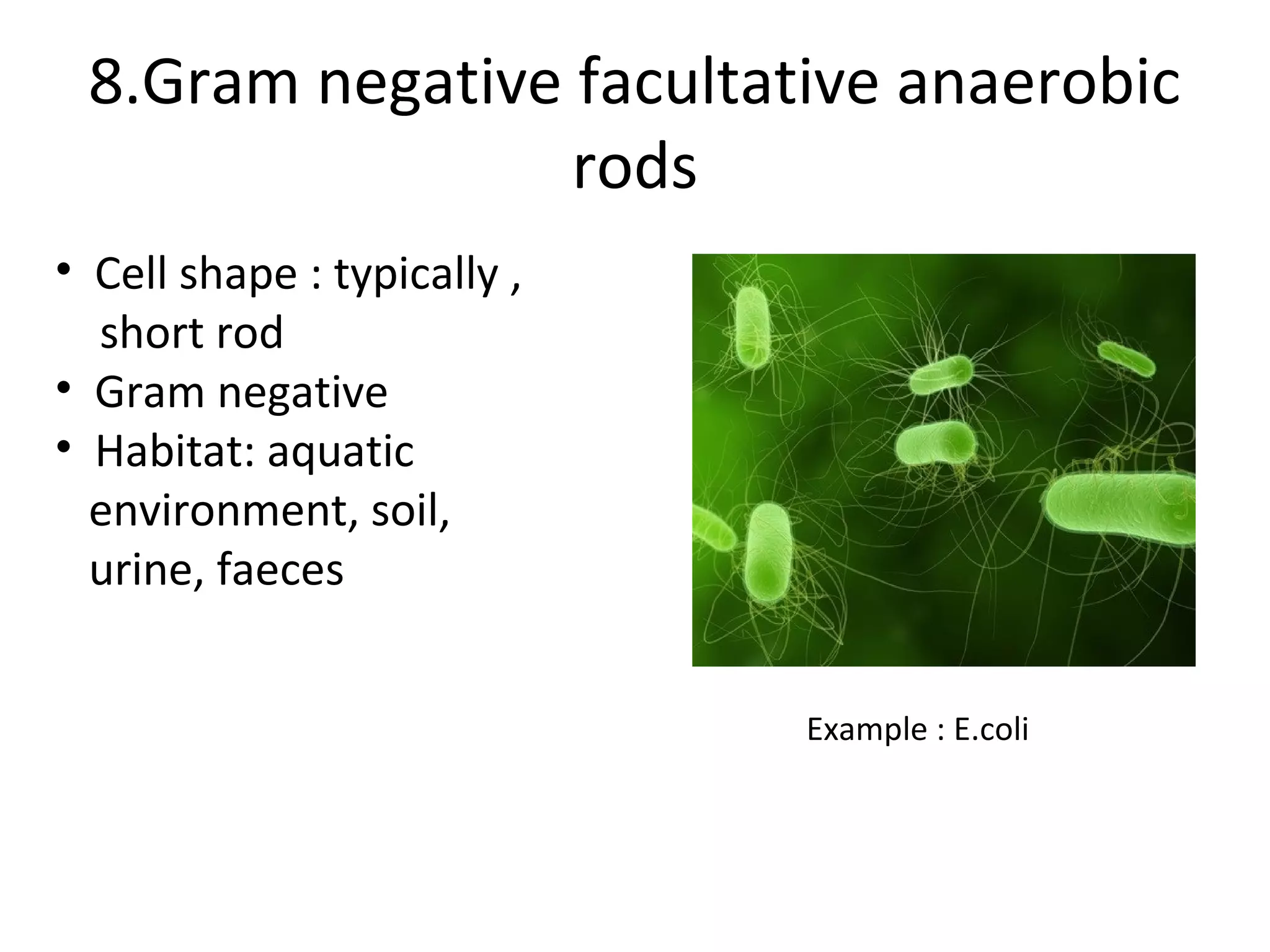
8.Gram negative facultative anaerobic
                 rods
• Cell shape : typically ,
  short rod
• Gram negative
• Habitat: aquatic
  environment, soil,
  urine, faeces


                             Example : E.coli
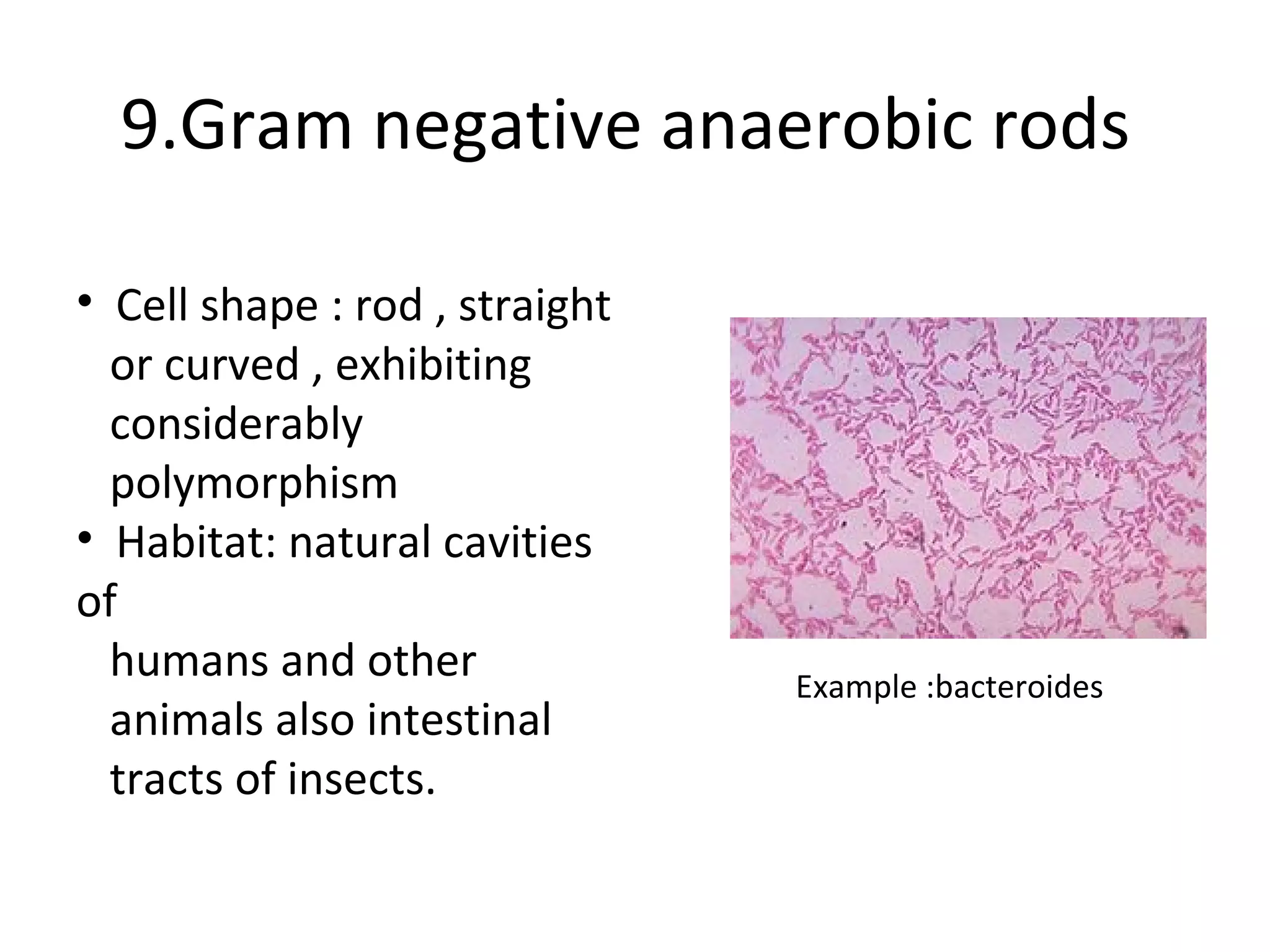
9.Gram negative anaerobic rods

• Cell shape : rod , straight
  or curved , exhibiting
  considerably
  polymorphism
• Habitat: natural cavities
of
  humans and other              Example :bacteroides
  animals also intestinal
  tracts of insects.
10.Gram negative cocci and
                  coccobacilli
• Cell shape : cocci in pairs
  (diplococci )some coccobacilli
  occur single and in pairs
• Gram negative
• Habitat : on mucous
  membrane of humans and
  other animals

                                   Example : neisseria
                                   gonorrhoaea
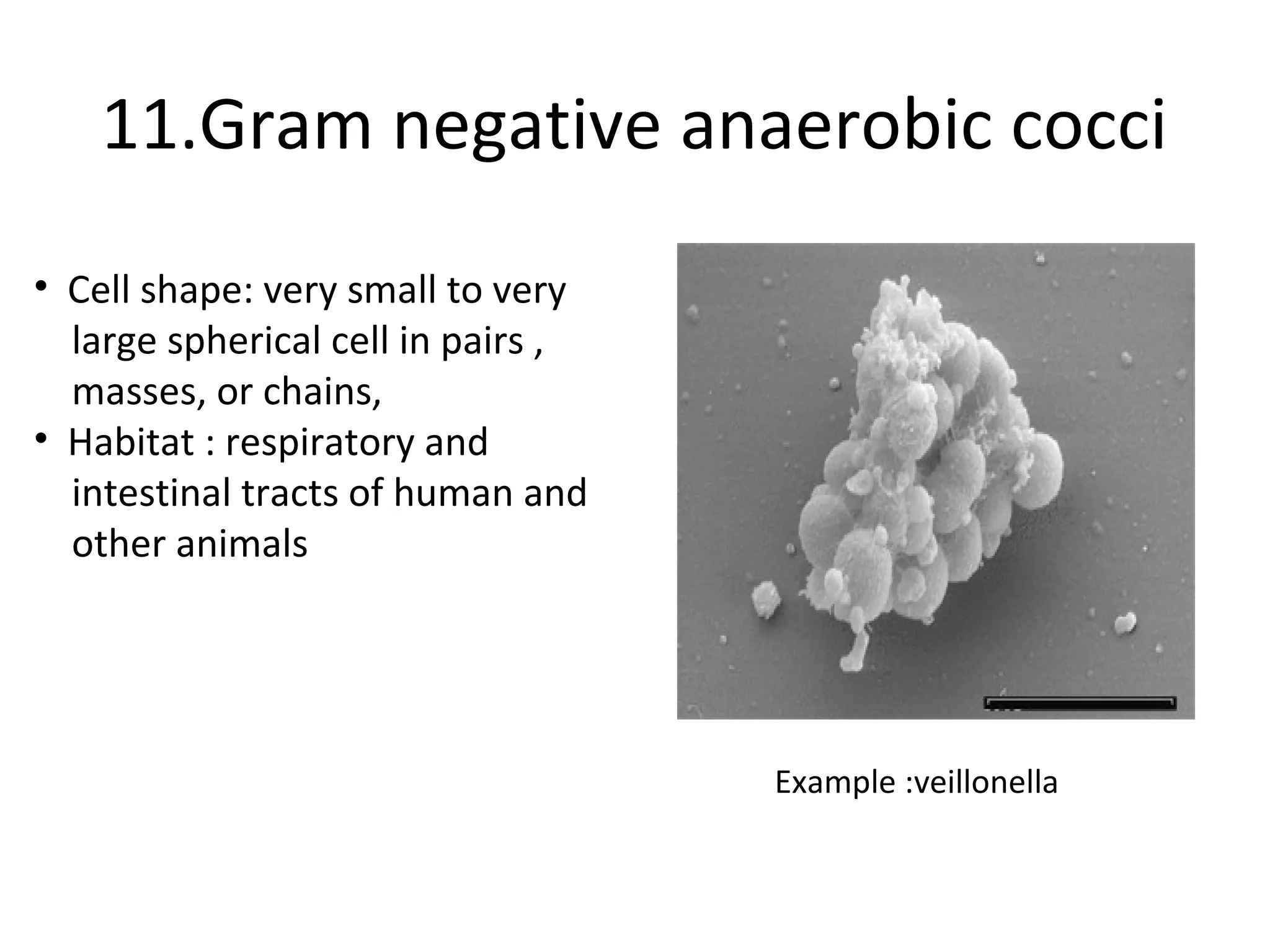
11.Gram negative anaerobic cocci
• Cell shape: very small to very
  large spherical cell in pairs ,
  masses, or chains,
• Habitat : respiratory and
  intestinal tracts of human and
  other animals


                                    Example :veillonella
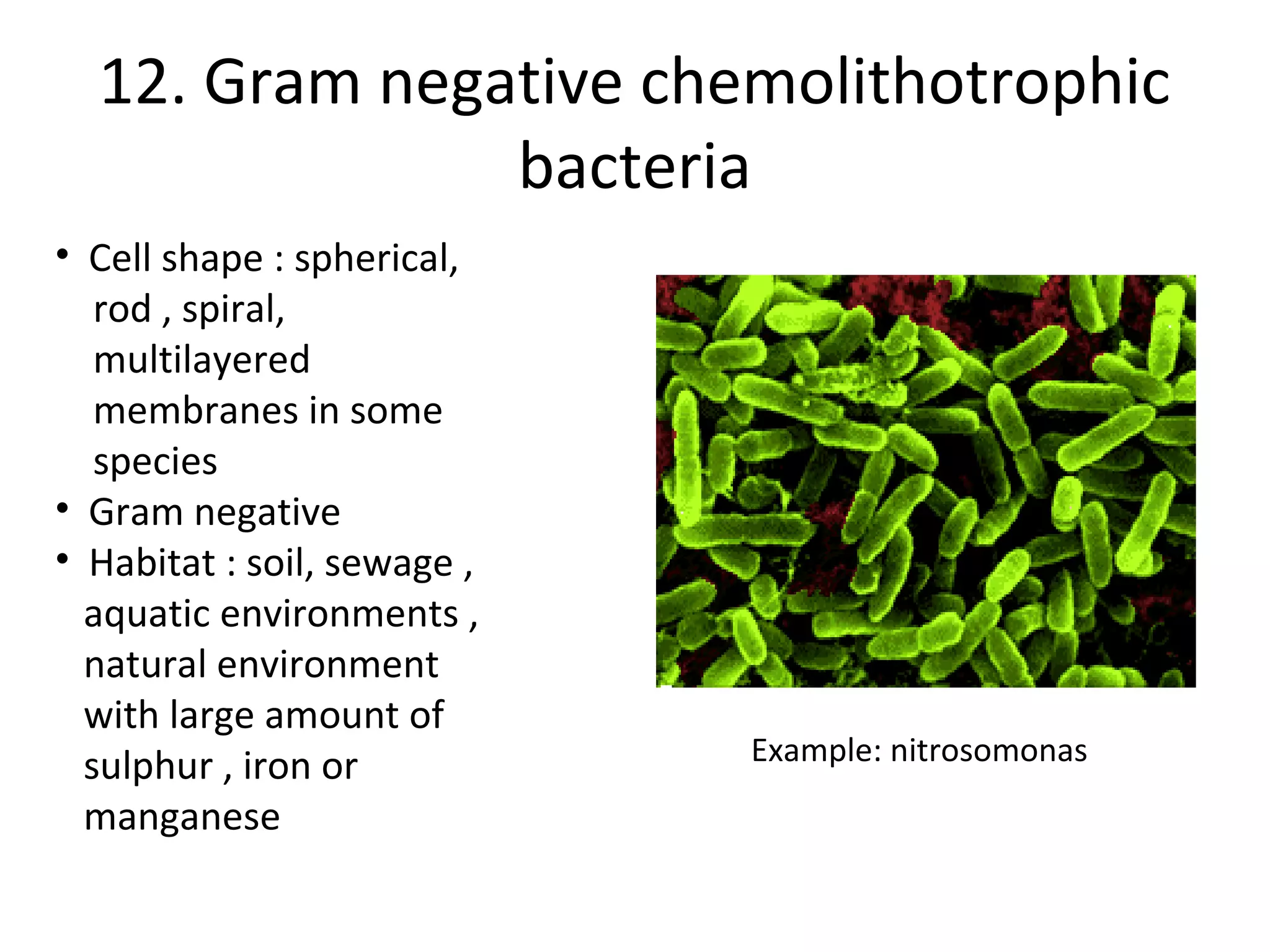
12. Gram negative chemolithotrophic
               bacteria
• Cell shape : spherical,
   rod , spiral,
   multilayered
   membranes in some
   species
• Gram negative
• Habitat : soil, sewage ,
  aquatic environments ,
  natural environment
  with large amount of
                             Example: nitrosomonas
  sulphur , iron or
  manganese
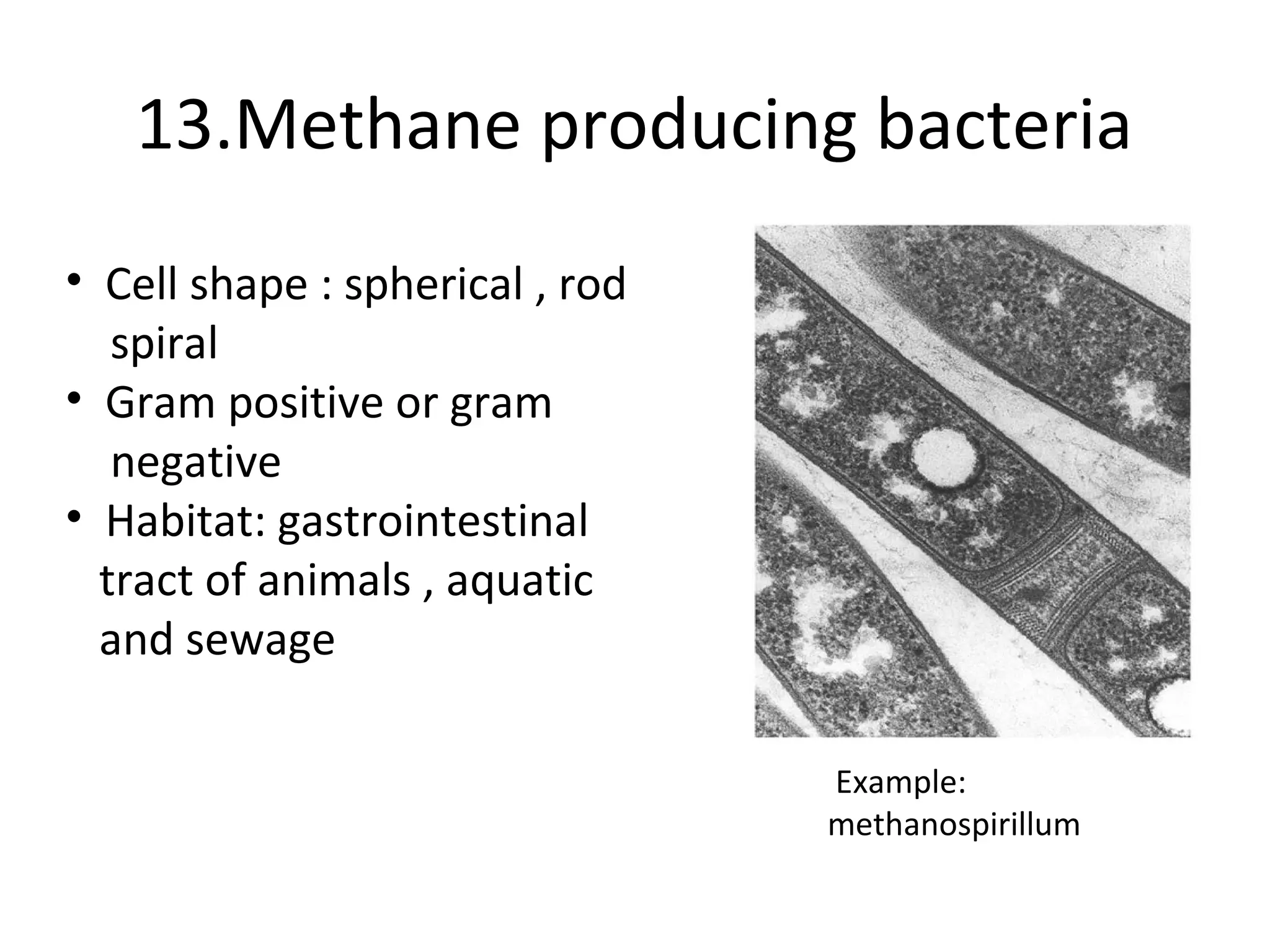
13.Methane producing bacteria
• Cell shape : spherical , rod
   spiral
• Gram positive or gram
   negative
• Habitat: gastrointestinal
  tract of animals , aquatic
  and sewage

                                 Example:
                                 methanospirillum
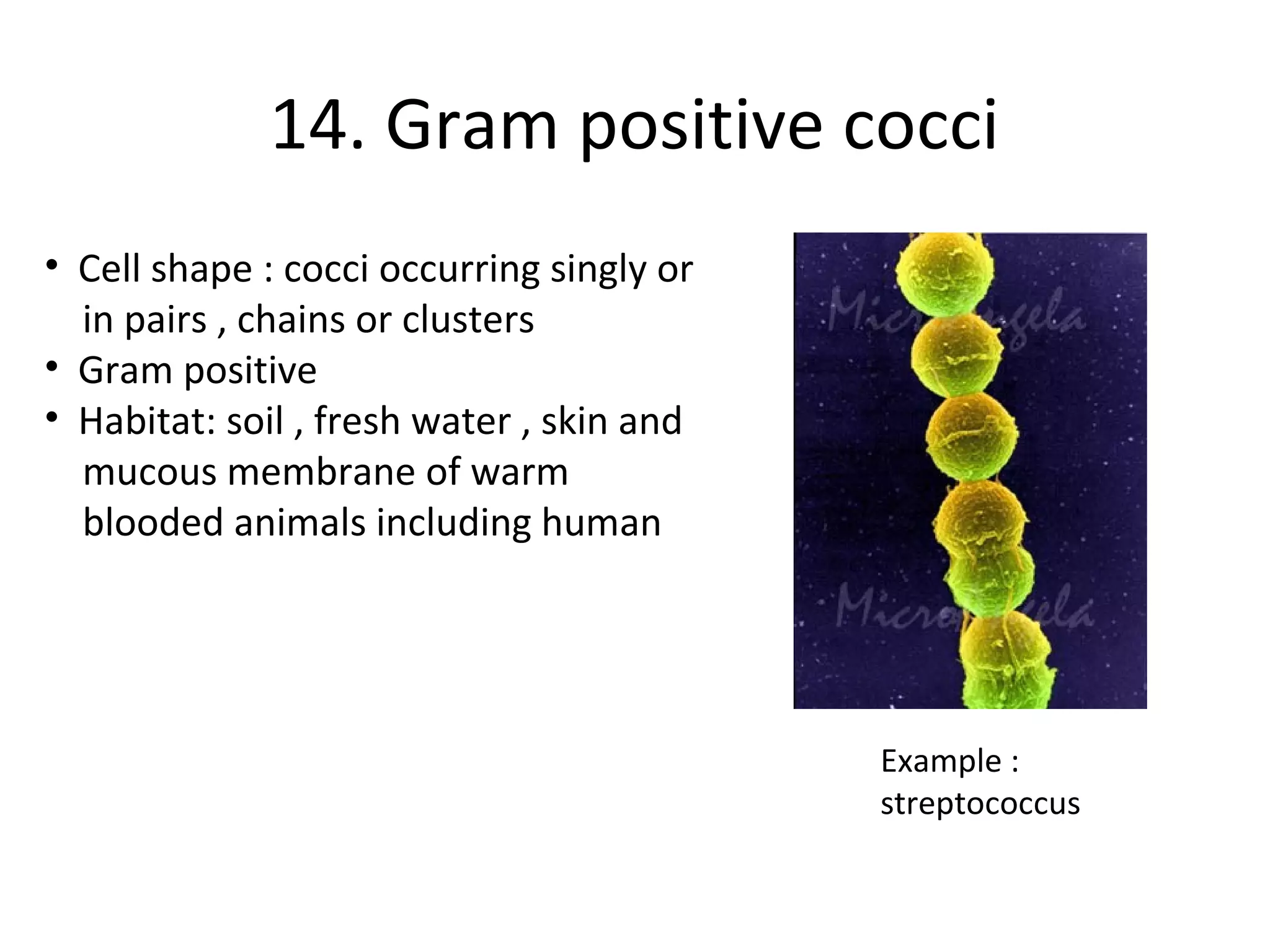
14. Gram positive cocci
• Cell shape : cocci occurring singly or
  in pairs , chains or clusters
• Gram positive
• Habitat: soil , fresh water , skin and
  mucous membrane of warm
  blooded animals including human


                                           Example :
                                           streptococcus
15. Endospore forming rods and cocci

• Cell shape; rods
• Gram positive
• Habitat :soil , air , aquatic,
  intestinal tracts of animals


                                   Example : bacillus
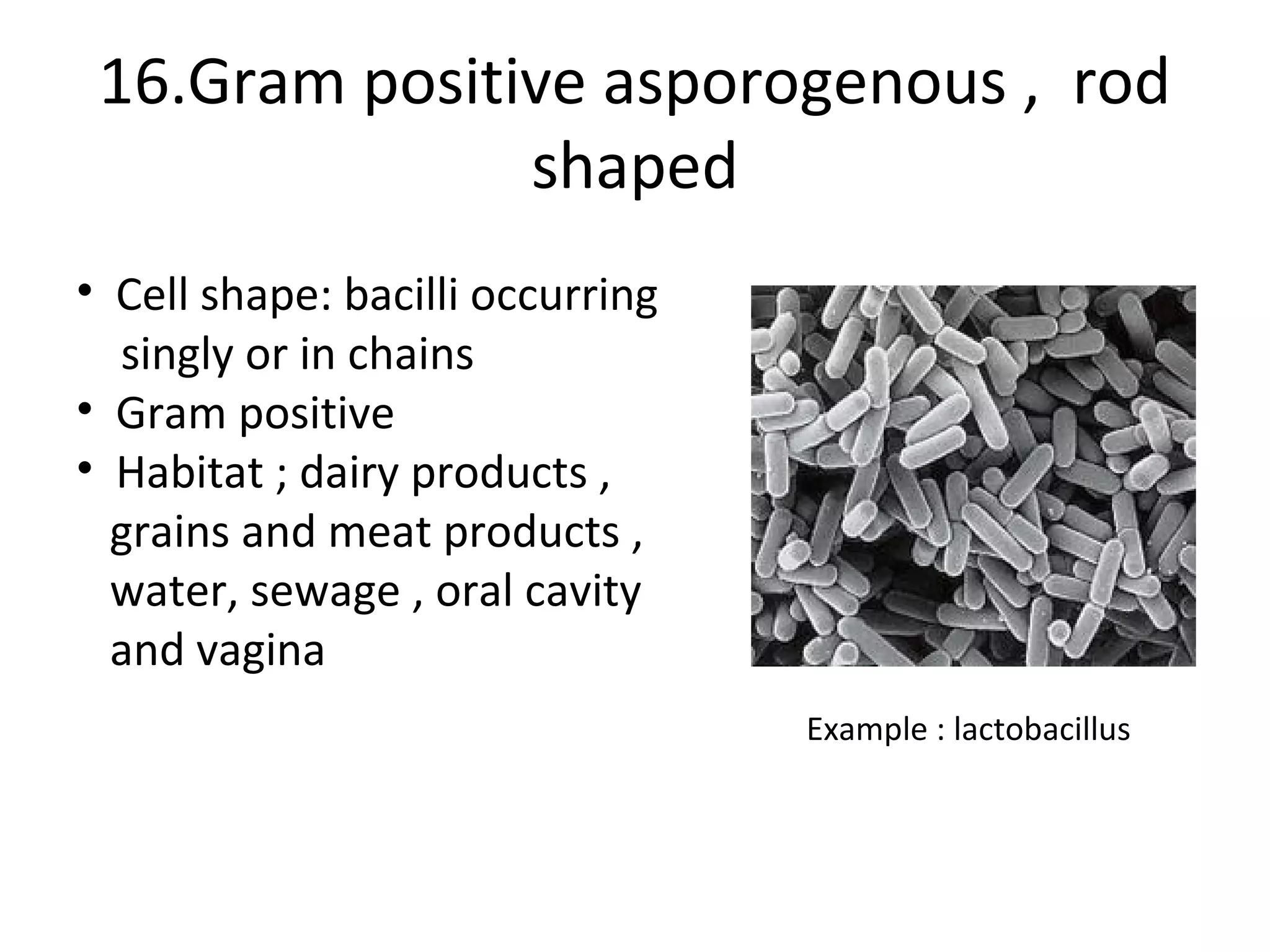
16.Gram positive asporogenous , rod
               shaped
• Cell shape: bacilli occurring
  singly or in chains
• Gram positive
• Habitat ; dairy products ,
  grains and meat products ,
  water, sewage , oral cavity
  and vagina
                                  Example : lactobacillus
17.Actinomycetes and related
                  organisms
• Cell shape: irregular
  rod shaped ,
  filaments and
  branched filaments
• Gram positive
• Habitat: soil , aquatic ,
  air and animals


                              mycobacterium tuberculosis .
18.The Rickettsias
• Cell shape : short rods or
  ovals , often pleomorphic
• Gram negative
• Habitat: insect carriers , birds
  and mammals


                                     Example: rickettsia akari
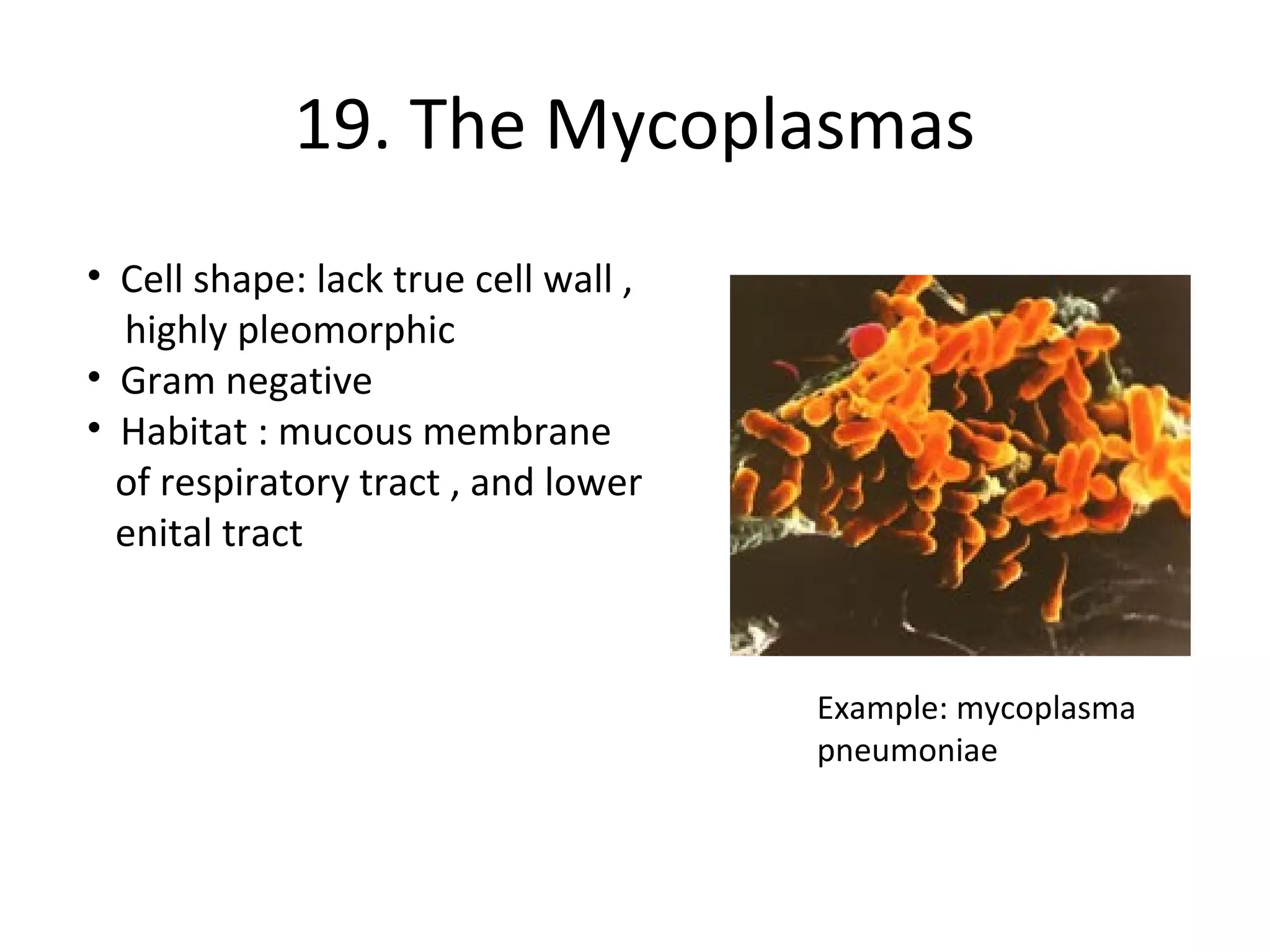
19. The Mycoplasmas
• Cell shape: lack true cell wall ,
  highly pleomorphic
• Gram negative
• Habitat : mucous membrane
  of respiratory tract , and lower
  enital tract


                                      Example: mycoplasma
                                      pneumoniae
Differences between prokaryotes and
             eukaryotes
How six kingdoms differ from each
             other ?
References
• Concise & Conceptual Microbiology
   ( First edition volume one by Dr Tariq Javed)
     ( Section 2)
http://www.google.com.pk/imgres?imgurl=http://images.tutorvista.com/content/cell-
    structure/comparisonof-prokaryotic-cells-and-eukaryotic-
    cells.gif&imgrefurl=http://www.tutorvista.com/content/biology/biology-i/cell-
    structure/prokaryotic-eukaryotic-
    cells.php&h=248&w=529&sz=6&tbnid=7nQkJJDEIg15mM:&tbnh=62&tbnw=132&prev=/searc
    h%3Fq%3Ddifference%2Bbetween%2Bprokaryotes%2Band%2Beukaryotes%26tbm%3Disch
    %26tbo%3Du&zoom=1&q=difference+between+prokaryotes+and+eukaryotes&usg=__-
    RcCUDdWGwzy4qHCfeFZ0gjyDR8=&docid=tHNWfgpf6HoBKM&hl=en&sa=X&ei=qdPSUOmoE
    6r-2QX59IDoBA&sqi=2&ved=0CC4Q9QEwAA&dur=726
• http://www.diffen.com/difference/Archaebac
  teria_vs_Eubacteria
• http://www.ucmp.berkeley.edu/bacteria/bact
  eria.html

Bacteria

  • 1.
  • 2.
    CONTENT  History of Bacteria.  Introduction of bacteria.  Ways of classification.  Groups of Bacteria.  Comparison b/w Prokaryotes & Eukaryotes.  Comparison with other Kingdoms.
  • 3.
  • 4.
    What are bacteria? •Single celled organisms • Very small E. Coli O157:H7 can make you very sick • Need a microscope to see .•Can be found on most materials and surfaces Streptococcus • Billions on and in your can cause strep throat. body right now This E. coli helps you digest food.
  • 5.
    What do theylook like? Bacilli • Three basic shapes – Rod shaped called bacilli – (buh-sill-eye) – Round shaped called cocci Cocci – (cox-eye) – Spiral shaped • Some exist as single cells, others cluster together Spiral Cluster of cocci
  • 6.
    Bacteria are ALIVE! • What does it mean to be alive? -They reproduce (make more of themselves) - They need to eat
  • 7.
    How do bacteria reproduce? • Grow in number not in size – Humans grow in size from child to adult • Make copies of themselves by dividing in half – Human parents create a child
  • 8.
    How do bacteriaeat? • Some make their own food from Photosynthetic sunlight—like plants bacteria • Some are scavengers – Share the environment around them • Example: The bacteria in your stomach are now eating what you ate for breakfast Harmless bacteria on the stomach lining • Some are warriors (pathogens) – They attack other living things • Example: The bacteria on your face can attack skin E. Coli causing infection and acne O157:H7 is a pathogen
  • 9.
    BRIEF HISTORY: In a 1683 letter to the Royal Society Of London, Anton van Leeuwenhoek Described microscopic “STREAKS & THREADS”, among his tiny animals. The streaks and threads remained nameless until 1773,
  • 10.
    In 1773, whenthe Danish scientist Otto Frederick Muller christened them bacilli. Bacilli is the plural form of the Latin word Bacillus meaning but not all “bacilli” were rods. Some were spiral and some were circular, & “bacilli” would not do.
  • 11.
    Therefore, in the1850s, The French investigator Casimir Davaine began calling a microscopic creatures “BACTERIA”, even though this derivatives of the Greek bacterion also means rod. In the next few decades “bacteria” came to refer to all the micro-organisms in that group, and the word “Bcillus” was reserved for rod forms only.
  • 12.
    Archaebacteria vs Eubacteria Archaebacteria Archaebacteria have prokaryotic cells, which means they don't have a nucleus. While they usually live in groups, they are considered unicellular, meaning they have one cell. Archaebacteria can make their own food, making them autotrophs. They can live in hot springs, deep ocean vents with no light and under extreme pressure, and in very salty lakes.. so basically, all extreme environments. Some of them can even live with no oxygen
  • 13.
  • 14.
    Comparison chart Archaebacteria Eubacteria Cell Membrane: Branched chain ether Straight chain ester linked lipids. linked lipids. tRNA: Lacks thymine in tRNA. Thymine present in tRNA. RNA polymerase: Ten subunit RNA 4 subunit RNA polymerase core. polymerase core. Role in ecology: Role in bio-geochemical Vital in nutrient recycling. cycles is unexplored.
  • 15.
    DNA: DNA is closer to DNA differs from eukaryotes (sent on eukaryotes. to daughter cells via mitosis) Definition: Single celled organisms All true bacteria or group without anycell of unicellular prokaryotic organelles or nucleus. microorganisms. Morphology: Occur in various shapes Various shaped bacteria like spheres, rods, plates have been identified like and spirals. rods, cocci, spirals, comma shaped, tightly coiled etc. Cell Wall: Lacks peptidoglycan. Peptidoglycan is present. Extremophilic: Yes. Some.
  • 16.
  • 17.
  • 18.
  • 19.
    Bacterial Classification Based on  Staining Methods Bacteria are grouped as 'Gram  positive' and 'Gram negative'  bacteria, based on the results of  Gram staining method, wherein an  agent is used to bind to the cell wall  of the bacteria. Gram positive bacteria - take up  crystal violet dye and retain their  blue or violet color. Gram negative bacteria - do not take  up crystal violet dye, and thus  appear red or pink.
  • 20.
    Bacteria are also classified based on the  requirement of oxygen for their survival Anaerobic bacteria  Aerobic bacteria   Bacteria that do not require oxygen for  Bacteria that need oxygen for  survival. their survival Anaerobic bacteria cannot bear oxygen and  may die if kept in an oxygenated  environment. Such types of bacteria are  usually found in places like, under the surface  of the Earth, deep oceans, and bacteria  which live in some medium.
  • 21.
    Autotrophic and Heterotrophic Bacteria Autotrophic bacteria (also known as  autotrophs) obtain the carbon it requires  from carbon dioxide Some autotrophs  directly use sunlight in  Heterotrophic bacteria obtain sugar from  order to produce sugars from  the environment they are in (for example,  carbondioxide whereas, others depend  the living cells or organisms they are in). on various chemical reactions. E.g. bacillus anthracia e.g. cyanobacteria
  • 22.
    Bacterial Classification Based on Environment • Mesophiles - which require moderate conditions to survive. • Extremophiles - which can survive in extreme conditions. •Acidophiles - which can tolerate low pH conditions. • Alkaliphiles - which can tolerate high pH conditions. • Thermophiles - which can resist high temperature. • Psychrophilic bacteria - which can survive extremely cold  conditions. • Halophiles - which can survive in highly saline conditions. • Osmophiles - which can survive in high sugar osmotic  conditions.
  • 23.
  • 24.
  • 25.
    2.Gliding bacteria • Cellshapes : rod,spherical,or filamentous. • Gram negative • Habitat : soil, decomposing plant material, aquatic environment Example: stigmatella
  • 26.
    3.Sheathed bacteria • Cellshapes : rod or filamentous. • Gram negative. • Habitat: aquatic environment, sludge. Example: lepiothrix
  • 27.
    4.Budding /Appendaged bacteria •Cell shapes: spherical,oval,bean,rod with pointed ends, some exhibit hyphal growth (filaments ) • Habitat: soil, aquatic environment . Example: caulobacter
  • 28.
    5. Spirochetes • Cellshape : slender, helically coiled(spiral). • Most of them are gram negative Example : spirochaeta
  • 29.
    6.Spiral and Curvedbacteria • Cell shape: helically coiled rods , some with one or more complete turns. • Gram negative • Habitat : aquatic, reproductive organs, intestinal tract and oral cavity of animals (including humans) Example :vibrio species
  • 30.
    7.Gram negative aerobicrods and cocci • Cell shape : rod, oval , spherical. • Gram negative • Habitat : soil and aquatic environment , salt brines . Example: brucella species
  • 31.
    8.Gram negative facultativeanaerobic rods • Cell shape : typically , short rod • Gram negative • Habitat: aquatic environment, soil, urine, faeces Example : E.coli
  • 32.
    9.Gram negative anaerobicrods • Cell shape : rod , straight or curved , exhibiting considerably polymorphism • Habitat: natural cavities of humans and other Example :bacteroides animals also intestinal tracts of insects.
  • 33.
    10.Gram negative cocciand coccobacilli • Cell shape : cocci in pairs (diplococci )some coccobacilli occur single and in pairs • Gram negative • Habitat : on mucous membrane of humans and other animals Example : neisseria gonorrhoaea
  • 34.
    11.Gram negative anaerobiccocci • Cell shape: very small to very large spherical cell in pairs , masses, or chains, • Habitat : respiratory and intestinal tracts of human and other animals Example :veillonella
  • 35.
    12. Gram negativechemolithotrophic bacteria • Cell shape : spherical, rod , spiral, multilayered membranes in some species • Gram negative • Habitat : soil, sewage , aquatic environments , natural environment with large amount of Example: nitrosomonas sulphur , iron or manganese
  • 36.
    13.Methane producing bacteria •Cell shape : spherical , rod spiral • Gram positive or gram negative • Habitat: gastrointestinal tract of animals , aquatic and sewage Example: methanospirillum
  • 37.
    14. Gram positivecocci • Cell shape : cocci occurring singly or in pairs , chains or clusters • Gram positive • Habitat: soil , fresh water , skin and mucous membrane of warm blooded animals including human Example : streptococcus
  • 38.
    15. Endospore formingrods and cocci • Cell shape; rods • Gram positive • Habitat :soil , air , aquatic, intestinal tracts of animals Example : bacillus
  • 39.
    16.Gram positive asporogenous, rod shaped • Cell shape: bacilli occurring singly or in chains • Gram positive • Habitat ; dairy products , grains and meat products , water, sewage , oral cavity and vagina Example : lactobacillus
  • 40.
    17.Actinomycetes and related organisms • Cell shape: irregular rod shaped , filaments and branched filaments • Gram positive • Habitat: soil , aquatic , air and animals mycobacterium tuberculosis .
  • 41.
    18.The Rickettsias • Cellshape : short rods or ovals , often pleomorphic • Gram negative • Habitat: insect carriers , birds and mammals Example: rickettsia akari
  • 42.
    19. The Mycoplasmas •Cell shape: lack true cell wall , highly pleomorphic • Gram negative • Habitat : mucous membrane of respiratory tract , and lower enital tract Example: mycoplasma pneumoniae
  • 43.
  • 45.
    How six kingdomsdiffer from each other ?
  • 46.
    References • Concise &Conceptual Microbiology ( First edition volume one by Dr Tariq Javed) ( Section 2) http://www.google.com.pk/imgres?imgurl=http://images.tutorvista.com/content/cell- structure/comparisonof-prokaryotic-cells-and-eukaryotic- cells.gif&imgrefurl=http://www.tutorvista.com/content/biology/biology-i/cell- structure/prokaryotic-eukaryotic- cells.php&h=248&w=529&sz=6&tbnid=7nQkJJDEIg15mM:&tbnh=62&tbnw=132&prev=/searc h%3Fq%3Ddifference%2Bbetween%2Bprokaryotes%2Band%2Beukaryotes%26tbm%3Disch %26tbo%3Du&zoom=1&q=difference+between+prokaryotes+and+eukaryotes&usg=__- RcCUDdWGwzy4qHCfeFZ0gjyDR8=&docid=tHNWfgpf6HoBKM&hl=en&sa=X&ei=qdPSUOmoE 6r-2QX59IDoBA&sqi=2&ved=0CC4Q9QEwAA&dur=726
  • 47.
    • http://www.diffen.com/difference/Archaebac teria_vs_Eubacteria • http://www.ucmp.berkeley.edu/bacteria/bact eria.html