Temperature Regulation 
Dr Elizabeth J 
Prof & HOD 
Dept of Physiology 
AIMS &RC , Bangalore 
4 / 09 /14
Scheme 
• Introduction 
• General Considerations 
• Mechanisms of heat loss & heat gain 
• Control of heat production, by radiation, 
conduction & evaporation 
• Skin &Temperature regulating reflexes 
• Thermoneutral Zone 
• Control mechanisms of temperature regulation 
• Fever & Hyperthermia 
• Heat exhaustion, heat stroke & hypothermia
Introduction 
• Homeothermic- Humans capable of maintaining 
their body temperatures within narrow limits. 
• Poikilothermic- (Cold blooded) 
• Biochemical reactions do not fluctuate due to the 
constant & high temperatures. 
• 410 C (1060F) – 430C convulsions are seen 
• Nerve malfunction & protein denaturation seen 
with higher temperature.
General Considerations 
Temperature can be expressed as 0C or 0F. 
C = ( F - 32) x 5/9 and F = (C x 9/5) + 32 
Normal is 370C or 98.60F 
• Measured under tongue, axilla or rectum 
• Oral temp is 0.50C less than core body temperature (rectal temp). 
• Internal temp varies with activity pattern and changes in ext temp. 
• Circadian fluctuation of about 10C - lowest at night and highest during 
the day. 
• Women show higher temp during second half of menstrual cycle
General Considerations 
Considering temp as a measure of heat concentration 
Total heat content gained / lost by the body 
is determined by NET DIFFERENCE 
in heat produced and lost 
STEADY STATE- heat production must equal heat loss
Mechanisms of heat loss / heat gain 
• Radiation- Surface of all objects emit heat in form of 
Electromagnetic radiation. 
Rate of emission α Temperature 
• Conduction- Loss/ gain by transfer of thermal 
energy during collisions between adjacent molecules 
– Heat is conducted from Molecule to Molecule
Mechanisms of heat loss / heat gain 
• Convection- Conductive heat loss or gain is aided by 
movement of air / water next to body. 
-Cool air replacing warm air. 
• Evaporation- Water evaporates from skin & 
membrane lining the respiratory tract MAJOR 
PROCESS for Loss of body heat. 
• 600Kcal/L reqd to transfer water from fluid to 
gaseous state. 
- Heat reqd to evaporate water from the surface is conducted 
from the surface cooling it.
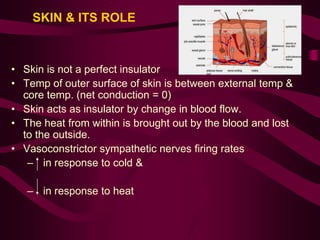
SKIN & ITS ROLE 
• Skin is not a perfect insulator 
• Temp of outer surface of skin is between external temp & 
core temp. (net conduction = 0) 
• Skin acts as insulator by change in blood flow. 
• The heat from within is brought out by the blood and lost 
to the outside. 
• Vasoconstrictor sympathetic nerves firing rates 
– in response to cold & 
– in response to heat
Temperature – Regulating reflexes 
• Thermoreceptors detect changes in the balance 
between heat loss & production due to metabolic rate 
(exercise). 
• Two types 
– Peripheral on Skin 
– Central in hypothalamus (integrating center), spinal cord, 
abdominal organs. 
• Output from hypothalamus is sent to effectors via 
– sympathetic nerves to sweat glands, 
– skin arterioles & adrenal medulla. 
– Motor neuron to skeletal muscles. 
• Core temp is maintained relatively constantly. 
• Peripheral thermoreceptors help identify heat & cold.
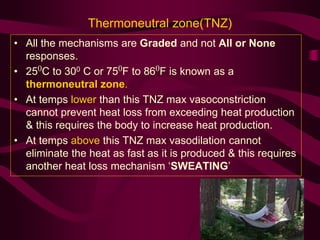
Thermoneutral zone(TNZ) 
• All the mechanisms are Graded and not All or None 
responses. 
• 250C to 300 C or 750F to 860F is known as a 
thermoneutral zone. 
• At temps lower than this TNZ max vasoconstriction 
cannot prevent heat loss from exceeding heat production 
& this requires the body to increase heat production. 
• At temps above this TNZ max vasodilation cannot 
eliminate the heat as fast as it is produced & this requires 
another heat loss mechanism ‘SWEATING’
Control Mechanisms of Temperature Regulation 
• Nervous Mechanisms 
– Thermoregulatory centers 
• Direct Action 
• Reflex Mechanisms 
• Efferent Nerves 
– Endocrine and Temperature Control 
• Adrenal Medulla 
• Adrenal Cortex 
• Thyroid 
• Behavioral & Voluntary control
Scheme 
• Introduction 
• General Considerations 
• Mechanisms of heat loss & heat gain 
• Control of heat production, by radiation, 
conduction & evaporation 
• Skin &Temperature regulating reflexes 
• Thermoneutral Zone 
• Control mechanisms of temperature regulation 
• Fever & Hyperthermia 
• Heat exhaustion, heat stroke & hypothermia
Hypothalamus control 
• Warming of anterior hypothalamus (Heat loss) 
– Vasodilatation 
– Sweating 
– Hyperpnoea 
– Injury abolishes the heat loss responses to hot environment. 
• Stimulation of Posterior hypothalamus (Heat production) 
– Vasoconstriction 
– Injury abolishes responses to cold & interferes with the 
responses to heat. 
• Preoptic region of Ant. Hypothalamus is regarded as 
the thermostat. 
• SET POINT is maintained by this region
Hypothalamic temperature Regulation (contd) 
• Direct action: 
When environmental temp 
– Is high, warm blood flowing through hypothalamus 
causes HEAT LOSS responses. 
– Is low, cool blood causes 
HEAT PRODUCTION / CONSERVATION responses.
Hypothalamic temperature Regulation (contd) 
• Reflex Mechanisms 
– Sensitive thermoreceptors 
• in the skin carry information via cutaneous nerves 
and hypothalamus 
– Efferent Nerves 
• Autonomic 
– Sympathetic adrenergic vasomotor nerves 
(cutaneous vasoconstriction & vasodilatation) 
– Sympathetic cholinergic nerves to sweat glands 
• Somatic 
– Nerves to skeletal muscle ( tone, activity, shivering) 
– Nerves to respiratory muscles
Endocrine control 
• Adrenal medulla- 
– immediate adrenaline release (Calorigenic) 
– Exposure to cold leads to 
• Cutaneous vasoconstriction the heat loss 
• metabolic rate & heat production 
• Adrenal Cortex 
– BMR is low in adrenal cortical insufficiency 
– Patients do not tolerate cold well & body temp is subnormal. 
• Thyroid 
– Calorigenic 
– Permissive action on adrenaline calorigenesis 
– Hyperthyroidism-skin is warm
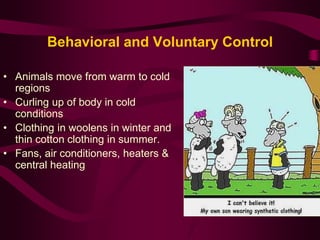
Behavioral and Voluntary Control 
• Animals move from warm to cold 
regions 
• Curling up of body in cold 
conditions 
• Clothing in woolens in winter and 
thin cotton clothing in summer. 
• Fans, air conditioners, heaters & 
central heating
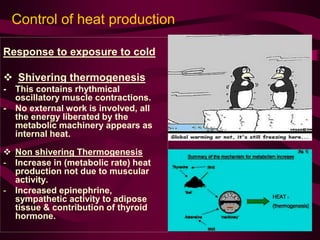
Control of heat production 
Response to exposure to cold 
 Shivering thermogenesis 
- This contains rhythmical 
oscillatory muscle contractions. 
- No external work is involved, all 
the energy liberated by the 
metabolic machinery appears as 
internal heat. 
 Non shivering Thermogenesis 
- Increase in (metabolic rate) heat 
production not due to muscular 
activity. 
- Increased epinephrine, 
sympathetic activity to adipose 
tissue & contribution of thyroid 
hormone.
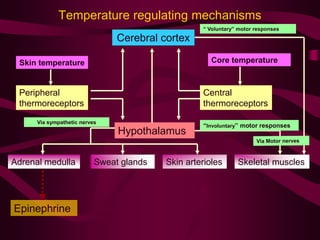
Temperature regulating mechanisms 
Skin temperature 
Cerebral cortex 
“ Voluntary” motor responses 
Core temperature 
Peripheral 
thermoreceptors 
Hypothalamus 
Central 
thermoreceptors 
Via sympathetic nerves 
Adrenal medulla Sweat glands Skin arterioles Skeletal muscles 
Epinephrine 
“Involuntary” motor responses
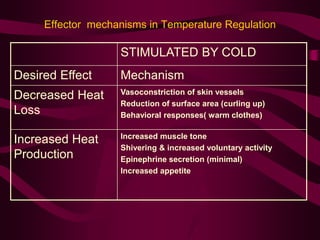
Effector mechanisms in Temperature Regulation 
STIMULATED BY COLD 
Desired Effect Mechanism 
Decreased Heat 
Loss 
Vasoconstriction of skin vessels 
Reduction of surface area (curling up) 
Behavioral responses( warm clothes) 
Increased Heat 
Production 
Increased muscle tone 
Shivering & increased voluntary activity 
Epinephrine secretion (minimal) 
Increased appetite
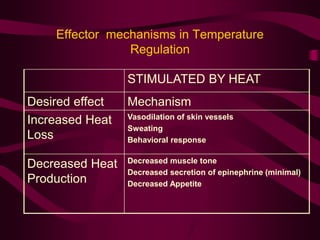
Effector mechanisms in Temperature 
Regulation 
STIMULATED BY HEAT 
Desired effect Mechanism 
Increased Heat 
Loss 
Vasodilation of skin vessels 
Sweating 
Behavioral response 
Decreased Heat 
Production 
Decreased muscle tone 
Decreased secretion of epinephrine (minimal) 
Decreased Appetite
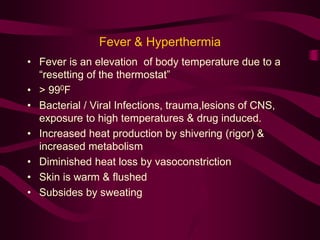
Fever & Hyperthermia 
• Fever is an elevation of body temperature due to a 
“resetting of the thermostat” 
• > 990F 
• Bacterial / Viral Infections, trauma,lesions of CNS, 
exposure to high temperatures & drug induced. 
• Increased heat production by shivering (rigor) & 
increased metabolism 
• Diminished heat loss by vasoconstriction 
• Skin is warm & flushed 
• Subsides by sweating
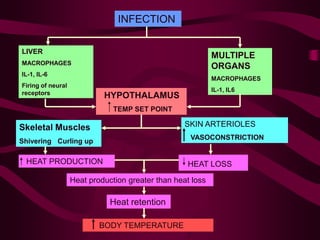
INFECTION 
LIVER 
MACROPHAGES 
IL-1, IL-6 
Firing of neural 
receptors 
MULTIPLE 
ORGANS 
MACROPHAGES 
IL-1, IL6 
HYPOTHALAMUS 
TEMP SET POINT 
Skeletal Muscles 
Shivering Curling up 
SKIN ARTERIOLES 
VASOCONSTRICTION 
HEAT PRODUCTION HEAT LOSS 
Heat production greater than heat loss 
Heat retention 
BODY TEMPERATURE
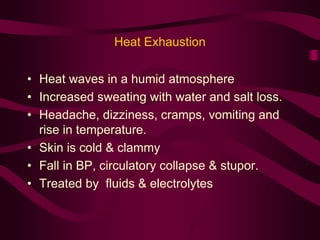
Heat Exhaustion 
• Heat waves in a humid atmosphere 
• Increased sweating with water and salt loss. 
• Headache, dizziness, cramps, vomiting and 
rise in temperature. 
• Skin is cold & clammy 
• Fall in BP, circulatory collapse & stupor. 
• Treated by fluids & electrolytes
Heat Stroke 
• Serious Condition,high environmental temp 
• Overheating of body, impaired sweating 
• Headache, restlessness & mental confusion 
• Hyperpyrexia (410C or 1060F) 
• Delirium, convulsions,CV collapse & COMA 
• Death results if untreated 
• Temp to be brought down to 1020C with ice 
packs
Hypothermia 
• Reduction in temp < 350C 
• At 270C the metabolism is greatly reduced 
(<280C unable to correct by itself) 
• HR,BP & RR are decreased 
• Unconscious state 
• Exposure to low temps 
• Cardiac surgery where heart is stopped

Temperature regulation

  • 1.
    Temperature Regulation DrElizabeth J Prof & HOD Dept of Physiology AIMS &RC , Bangalore 4 / 09 /14
  • 2.
    Scheme • Introduction • General Considerations • Mechanisms of heat loss & heat gain • Control of heat production, by radiation, conduction & evaporation • Skin &Temperature regulating reflexes • Thermoneutral Zone • Control mechanisms of temperature regulation • Fever & Hyperthermia • Heat exhaustion, heat stroke & hypothermia
  • 3.
    Introduction • Homeothermic-Humans capable of maintaining their body temperatures within narrow limits. • Poikilothermic- (Cold blooded) • Biochemical reactions do not fluctuate due to the constant & high temperatures. • 410 C (1060F) – 430C convulsions are seen • Nerve malfunction & protein denaturation seen with higher temperature.
  • 4.
    General Considerations Temperaturecan be expressed as 0C or 0F. C = ( F - 32) x 5/9 and F = (C x 9/5) + 32 Normal is 370C or 98.60F • Measured under tongue, axilla or rectum • Oral temp is 0.50C less than core body temperature (rectal temp). • Internal temp varies with activity pattern and changes in ext temp. • Circadian fluctuation of about 10C - lowest at night and highest during the day. • Women show higher temp during second half of menstrual cycle
  • 5.
    General Considerations Consideringtemp as a measure of heat concentration Total heat content gained / lost by the body is determined by NET DIFFERENCE in heat produced and lost STEADY STATE- heat production must equal heat loss
  • 6.
    Mechanisms of heatloss / heat gain • Radiation- Surface of all objects emit heat in form of Electromagnetic radiation. Rate of emission α Temperature • Conduction- Loss/ gain by transfer of thermal energy during collisions between adjacent molecules – Heat is conducted from Molecule to Molecule
  • 7.
    Mechanisms of heatloss / heat gain • Convection- Conductive heat loss or gain is aided by movement of air / water next to body. -Cool air replacing warm air. • Evaporation- Water evaporates from skin & membrane lining the respiratory tract MAJOR PROCESS for Loss of body heat. • 600Kcal/L reqd to transfer water from fluid to gaseous state. - Heat reqd to evaporate water from the surface is conducted from the surface cooling it.
  • 8.
    SKIN & ITSROLE • Skin is not a perfect insulator • Temp of outer surface of skin is between external temp & core temp. (net conduction = 0) • Skin acts as insulator by change in blood flow. • The heat from within is brought out by the blood and lost to the outside. • Vasoconstrictor sympathetic nerves firing rates – in response to cold & – in response to heat
  • 9.
    Temperature – Regulatingreflexes • Thermoreceptors detect changes in the balance between heat loss & production due to metabolic rate (exercise). • Two types – Peripheral on Skin – Central in hypothalamus (integrating center), spinal cord, abdominal organs. • Output from hypothalamus is sent to effectors via – sympathetic nerves to sweat glands, – skin arterioles & adrenal medulla. – Motor neuron to skeletal muscles. • Core temp is maintained relatively constantly. • Peripheral thermoreceptors help identify heat & cold.
  • 10.
    Thermoneutral zone(TNZ) •All the mechanisms are Graded and not All or None responses. • 250C to 300 C or 750F to 860F is known as a thermoneutral zone. • At temps lower than this TNZ max vasoconstriction cannot prevent heat loss from exceeding heat production & this requires the body to increase heat production. • At temps above this TNZ max vasodilation cannot eliminate the heat as fast as it is produced & this requires another heat loss mechanism ‘SWEATING’
  • 11.
    Control Mechanisms ofTemperature Regulation • Nervous Mechanisms – Thermoregulatory centers • Direct Action • Reflex Mechanisms • Efferent Nerves – Endocrine and Temperature Control • Adrenal Medulla • Adrenal Cortex • Thyroid • Behavioral & Voluntary control
  • 12.
    Scheme • Introduction • General Considerations • Mechanisms of heat loss & heat gain • Control of heat production, by radiation, conduction & evaporation • Skin &Temperature regulating reflexes • Thermoneutral Zone • Control mechanisms of temperature regulation • Fever & Hyperthermia • Heat exhaustion, heat stroke & hypothermia
  • 13.
    Hypothalamus control •Warming of anterior hypothalamus (Heat loss) – Vasodilatation – Sweating – Hyperpnoea – Injury abolishes the heat loss responses to hot environment. • Stimulation of Posterior hypothalamus (Heat production) – Vasoconstriction – Injury abolishes responses to cold & interferes with the responses to heat. • Preoptic region of Ant. Hypothalamus is regarded as the thermostat. • SET POINT is maintained by this region
  • 14.
    Hypothalamic temperature Regulation(contd) • Direct action: When environmental temp – Is high, warm blood flowing through hypothalamus causes HEAT LOSS responses. – Is low, cool blood causes HEAT PRODUCTION / CONSERVATION responses.
  • 15.
    Hypothalamic temperature Regulation(contd) • Reflex Mechanisms – Sensitive thermoreceptors • in the skin carry information via cutaneous nerves and hypothalamus – Efferent Nerves • Autonomic – Sympathetic adrenergic vasomotor nerves (cutaneous vasoconstriction & vasodilatation) – Sympathetic cholinergic nerves to sweat glands • Somatic – Nerves to skeletal muscle ( tone, activity, shivering) – Nerves to respiratory muscles
  • 16.
    Endocrine control •Adrenal medulla- – immediate adrenaline release (Calorigenic) – Exposure to cold leads to • Cutaneous vasoconstriction the heat loss • metabolic rate & heat production • Adrenal Cortex – BMR is low in adrenal cortical insufficiency – Patients do not tolerate cold well & body temp is subnormal. • Thyroid – Calorigenic – Permissive action on adrenaline calorigenesis – Hyperthyroidism-skin is warm
  • 17.
    Behavioral and VoluntaryControl • Animals move from warm to cold regions • Curling up of body in cold conditions • Clothing in woolens in winter and thin cotton clothing in summer. • Fans, air conditioners, heaters & central heating
  • 19.
    Control of heatproduction Response to exposure to cold  Shivering thermogenesis - This contains rhythmical oscillatory muscle contractions. - No external work is involved, all the energy liberated by the metabolic machinery appears as internal heat.  Non shivering Thermogenesis - Increase in (metabolic rate) heat production not due to muscular activity. - Increased epinephrine, sympathetic activity to adipose tissue & contribution of thyroid hormone.
  • 20.
    Temperature regulating mechanisms Skin temperature Cerebral cortex “ Voluntary” motor responses Core temperature Peripheral thermoreceptors Hypothalamus Central thermoreceptors Via sympathetic nerves Adrenal medulla Sweat glands Skin arterioles Skeletal muscles Epinephrine “Involuntary” motor responses
  • 21.
    Effector mechanisms inTemperature Regulation STIMULATED BY COLD Desired Effect Mechanism Decreased Heat Loss Vasoconstriction of skin vessels Reduction of surface area (curling up) Behavioral responses( warm clothes) Increased Heat Production Increased muscle tone Shivering & increased voluntary activity Epinephrine secretion (minimal) Increased appetite
  • 22.
    Effector mechanisms inTemperature Regulation STIMULATED BY HEAT Desired effect Mechanism Increased Heat Loss Vasodilation of skin vessels Sweating Behavioral response Decreased Heat Production Decreased muscle tone Decreased secretion of epinephrine (minimal) Decreased Appetite
  • 23.
    Fever & Hyperthermia • Fever is an elevation of body temperature due to a “resetting of the thermostat” • > 990F • Bacterial / Viral Infections, trauma,lesions of CNS, exposure to high temperatures & drug induced. • Increased heat production by shivering (rigor) & increased metabolism • Diminished heat loss by vasoconstriction • Skin is warm & flushed • Subsides by sweating
  • 24.
    INFECTION LIVER MACROPHAGES IL-1, IL-6 Firing of neural receptors MULTIPLE ORGANS MACROPHAGES IL-1, IL6 HYPOTHALAMUS TEMP SET POINT Skeletal Muscles Shivering Curling up SKIN ARTERIOLES VASOCONSTRICTION HEAT PRODUCTION HEAT LOSS Heat production greater than heat loss Heat retention BODY TEMPERATURE
  • 25.
    Heat Exhaustion •Heat waves in a humid atmosphere • Increased sweating with water and salt loss. • Headache, dizziness, cramps, vomiting and rise in temperature. • Skin is cold & clammy • Fall in BP, circulatory collapse & stupor. • Treated by fluids & electrolytes
  • 26.
    Heat Stroke •Serious Condition,high environmental temp • Overheating of body, impaired sweating • Headache, restlessness & mental confusion • Hyperpyrexia (410C or 1060F) • Delirium, convulsions,CV collapse & COMA • Death results if untreated • Temp to be brought down to 1020C with ice packs
  • 27.
    Hypothermia • Reductionin temp < 350C • At 270C the metabolism is greatly reduced (<280C unable to correct by itself) • HR,BP & RR are decreased • Unconscious state • Exposure to low temps • Cardiac surgery where heart is stopped