Kingdom Monera
Monera are the only kingdom composed of prokaryotic organisms

The major group of this kingdom is the bacteria that have a cell wall, and
lack both membrane- bound organelles and multi-cellular forms

     Bacteria may be solitary cells, filamentous, or colonial, Aerobic or
                anaerobic, Autotrophic or heterotrophic

Other groups of Monera include the cyanobacteria (autotrophic) and
eubacteria (heterotrophic)

The Archaebacteria, the most ancient of this kingdom, are so different that
they may belong to a separate     kingdom
1. Size
• Bacterial cells are very small,
• about 1-2µm in diameter and 10 µm long
   – One micrometer = 1/1000 mm.
      • Imagine looking at a dime from its thinnest side
        and trying to slice it into a thousand pieces; that is
        the same as 1 µm.
Shapes of Prokaryotes
                 • Cocci =
                   spherical
                   (round)
                 • Bacillus =
                   (rod
                   shaped)
                 • Spirilla =
                   helical
                   (spiral)
Shapes
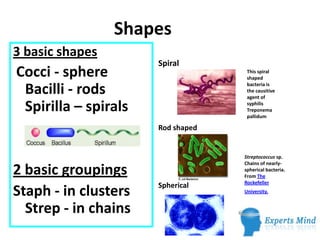
3 basic shapes
                      Spiral
Cocci - sphere                      This spiral
                                    shaped

 Bacilli - rods                     bacteria is
                                    the causitive
                                    agent of

 Spirilla – spirals                 syphilis
                                    Treponema
                                    pallidum

                      Rod shaped


                                   Streptococcus sp.
                                   Chains of nearly-
2 basic groupings                  spherical bacteria.
                                   From The
                                   Rockefeller
                      Spherical
Staph - in clusters                University.


  Strep - in chains
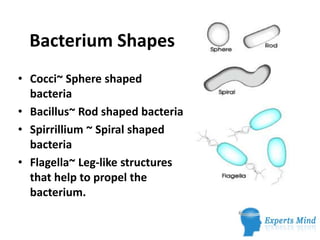
Bacterium Shapes
• Cocci~ Sphere shaped
  bacteria
• Bacillus~ Rod shaped bacteria
• Spirrillium ~ Spiral shaped
  bacteria
• Flagella~ Leg-like structures
  that help to propel the
  bacterium.
2. Lack membrane-bound organelles
inside the cell
3. have few internal structures that are
          distinguishable under a
                microscope.
4. genetic information is in a circular
          loop called a plasmid

                    • E. coli cell dividing.

                    • E. Coli Grows in
                      human intestine;
                       – Has a single, circular
                         chromosome
                       – contains DNA as
                         plasmids
                           • Plasmids are extra-
                             chromosomal DNA
5. Strong cell walls: resistant to
       environmental changes

Kingdom monera

  • 1.
    Kingdom Monera Monera arethe only kingdom composed of prokaryotic organisms The major group of this kingdom is the bacteria that have a cell wall, and lack both membrane- bound organelles and multi-cellular forms Bacteria may be solitary cells, filamentous, or colonial, Aerobic or anaerobic, Autotrophic or heterotrophic Other groups of Monera include the cyanobacteria (autotrophic) and eubacteria (heterotrophic) The Archaebacteria, the most ancient of this kingdom, are so different that they may belong to a separate kingdom
  • 2.
    1. Size • Bacterialcells are very small, • about 1-2µm in diameter and 10 µm long – One micrometer = 1/1000 mm. • Imagine looking at a dime from its thinnest side and trying to slice it into a thousand pieces; that is the same as 1 µm.
  • 3.
    Shapes of Prokaryotes • Cocci = spherical (round) • Bacillus = (rod shaped) • Spirilla = helical (spiral)
  • 4.
    Shapes 3 basic shapes Spiral Cocci - sphere This spiral shaped Bacilli - rods bacteria is the causitive agent of Spirilla – spirals syphilis Treponema pallidum Rod shaped Streptococcus sp. Chains of nearly- 2 basic groupings spherical bacteria. From The Rockefeller Spherical Staph - in clusters University. Strep - in chains
  • 5.
    Bacterium Shapes • Cocci~Sphere shaped bacteria • Bacillus~ Rod shaped bacteria • Spirrillium ~ Spiral shaped bacteria • Flagella~ Leg-like structures that help to propel the bacterium.
  • 6.
    2. Lack membrane-boundorganelles inside the cell
  • 7.
    3. have fewinternal structures that are distinguishable under a microscope.
  • 8.
    4. genetic informationis in a circular loop called a plasmid • E. coli cell dividing. • E. Coli Grows in human intestine; – Has a single, circular chromosome – contains DNA as plasmids • Plasmids are extra- chromosomal DNA
  • 9.
    5. Strong cellwalls: resistant to environmental changes