Types of Microbes
BACTERIA
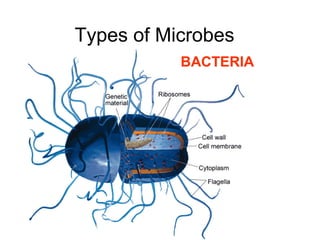
The Cell Structures
• Bacteria are PROKARYOTES = genetic
material is not contained in a nucleus.
• DNA in a bacteria cell is found floating in
the cytoplasm.
• A FLAGELLUM = a long whip-like
structure that helps a cell to move.
FLAGELLA = plural of FLAGELLUM
• A bacteria can have many flagella, one
flagellum, or no flagella.
Cell Shapes
The three basic shapes of bacteria are:
Sphere shaped
bacteria
Spiral shaped
bacteria

Rod shaped
bacteria
Cell Shapes
• The chemical make-up of the cell wall
determines the shape of a bacterial cell.
The shape helps Scientists identify the
type of bacteria.
Cell Sizes
The size of bacteria vary greatly:
The largest bacteria = as big as a period at
the end of a sentence.
Average bacteria = much smaller
They are usually measured in micrometers
(μm) or millionths of a meter.
OBTAINING FOOD AND ENERGY
All bacteria need the following to survive:
1. A source of food
2. A way of breaking down the food to
release energy.
Obtaining Food
•
•

Some bacteria are AUTOTROPHS
An AUTOTROPH = organisms that make
their own food.
Q: Are humans autotrophs?
• The 2 ways autotrophic bacteria make
food are:
1. Some capture and use the Sun’s energy to
make food
2. Some use the energy from chemicals in their
environment to make their food.
Obtaining Food
• A HETEROTROPH = organisms that
cannot make their own food.
Q: Are humans heterotrophs?
• Heterotrophic bacteria must consume
other organisms or the food that other
organisms make.
Respiration (remember this?)
• Respiration = the process of breaking
down food with the use of oxygen.
• All bacteria do not need oxygen. Some
use FERMENTATION! Do you
remember???
REPRODUCTION
Bacteria reproduce frequently when:
1. They have plenty of food
2. The right temperature
3. Other conditions (water, the right
chemicals)
• Under the best conditions (ideal) bacteria
can reproduce as often as once every 20
minutes.
Asexual Reproduction
• BINARY FISSION = the process of
reproduction in bacteria where 1 cell
divides to form 2 identical cells. It is a
type of ASEXUAL REPRODUCTION =
the reproductive process that involves only
1 parent and produces offspring that are
identical to the parent.
Asexual Reproduction
• Binary Fission (a type of Asexual
Reproduction) is just like CELL DIVISION,
what we studied not too long ago.
CELL DIVISION
For Animal and
Plant Cells

PARENT

BINARY FISSION
(a type of Asexual
Reproduction)
For Bacteria
2 DAUGHTERS
Sexual Reproduction
• SEXUAL REPRODUCTION = involves 2
parents who combine their DNA to
produce a new organism. The new
organism is different from both of the
parents.
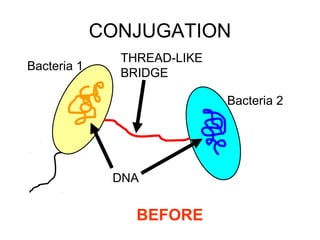
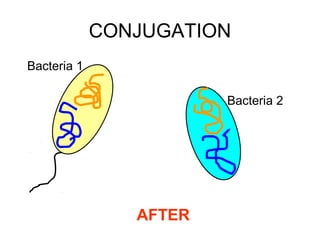
• CONJUGATION = the process where 1
bacterium gives some of its DNA into
another bacterium through a thread-like
bridge
CONJUGATION
Bacteria 1

THREAD-LIKE
BRIDGE
Bacteria 2

DNA

BEFORE
CONJUGATION
Bacteria 1
Bacteria 2

AFTER
Sexual Reproduction
1.Conjugation results in bacteria with new
combinations of DNA.
• Then, when the bacteria reproduce by
Binary Fission, the resulting daughter
bacteria have the new DNA in them.
Sexual Reproduction
2. Conjugation results in genetically different
bacteria cells, not an increase in the
number of bacteria cells.
• These NEW bacteria may be more fit to
survive than the parent bacteria.
Endospore Formation
Unfavorable conditions for bacteria growth
are:
1. No food
2. No water
3. A huge change in temperature
Endospore Formation
• An ENDOSPORE = a small, rounded,
thick-walled resting cell that forms inside a
bacterial cell. It contains the DNA and
some cytoplasm
Endospore
Endospore Formation
• The formation of an Endospore allows the
bacterium to stay alive in terrible
conditions for years. Once the terrible
conditions get better, the bacterium can
begin to grow and reproduce again.
• Its kind of like HIBERNATION.
THE ROLE OF BACTERIA IN
NATURE
GOOD THINGS BACTERIA DO:
1. Make Oxygen
2. Make Food
3. Environmental recycling & clean-up
4. Health & Medicine
THE ROLE OF BACTERIA IN
NATURE
BAD THINGS BACTERIA DO:
1. Cause disease
2. Spoil Food – waste money

Bacteria

  • 1.
  • 2.
    The Cell Structures •Bacteria are PROKARYOTES = genetic material is not contained in a nucleus. • DNA in a bacteria cell is found floating in the cytoplasm. • A FLAGELLUM = a long whip-like structure that helps a cell to move. FLAGELLA = plural of FLAGELLUM • A bacteria can have many flagella, one flagellum, or no flagella.
  • 3.
    Cell Shapes The threebasic shapes of bacteria are: Sphere shaped bacteria Spiral shaped bacteria Rod shaped bacteria
  • 4.
    Cell Shapes • Thechemical make-up of the cell wall determines the shape of a bacterial cell. The shape helps Scientists identify the type of bacteria.
  • 5.
    Cell Sizes The sizeof bacteria vary greatly: The largest bacteria = as big as a period at the end of a sentence. Average bacteria = much smaller They are usually measured in micrometers (μm) or millionths of a meter.
  • 6.
    OBTAINING FOOD ANDENERGY All bacteria need the following to survive: 1. A source of food 2. A way of breaking down the food to release energy.
  • 7.
    Obtaining Food • • Some bacteriaare AUTOTROPHS An AUTOTROPH = organisms that make their own food. Q: Are humans autotrophs? • The 2 ways autotrophic bacteria make food are: 1. Some capture and use the Sun’s energy to make food 2. Some use the energy from chemicals in their environment to make their food.
  • 8.
    Obtaining Food • AHETEROTROPH = organisms that cannot make their own food. Q: Are humans heterotrophs? • Heterotrophic bacteria must consume other organisms or the food that other organisms make.
  • 9.
    Respiration (remember this?) •Respiration = the process of breaking down food with the use of oxygen. • All bacteria do not need oxygen. Some use FERMENTATION! Do you remember???
  • 10.
    REPRODUCTION Bacteria reproduce frequentlywhen: 1. They have plenty of food 2. The right temperature 3. Other conditions (water, the right chemicals) • Under the best conditions (ideal) bacteria can reproduce as often as once every 20 minutes.
  • 11.
    Asexual Reproduction • BINARYFISSION = the process of reproduction in bacteria where 1 cell divides to form 2 identical cells. It is a type of ASEXUAL REPRODUCTION = the reproductive process that involves only 1 parent and produces offspring that are identical to the parent.
  • 12.
    Asexual Reproduction • BinaryFission (a type of Asexual Reproduction) is just like CELL DIVISION, what we studied not too long ago. CELL DIVISION For Animal and Plant Cells PARENT BINARY FISSION (a type of Asexual Reproduction) For Bacteria 2 DAUGHTERS
  • 13.
    Sexual Reproduction • SEXUALREPRODUCTION = involves 2 parents who combine their DNA to produce a new organism. The new organism is different from both of the parents. • CONJUGATION = the process where 1 bacterium gives some of its DNA into another bacterium through a thread-like bridge
  • 14.
  • 15.
  • 16.
    Sexual Reproduction 1.Conjugation resultsin bacteria with new combinations of DNA. • Then, when the bacteria reproduce by Binary Fission, the resulting daughter bacteria have the new DNA in them.
  • 17.
    Sexual Reproduction 2. Conjugationresults in genetically different bacteria cells, not an increase in the number of bacteria cells. • These NEW bacteria may be more fit to survive than the parent bacteria.
  • 18.
    Endospore Formation Unfavorable conditionsfor bacteria growth are: 1. No food 2. No water 3. A huge change in temperature
  • 19.
    Endospore Formation • AnENDOSPORE = a small, rounded, thick-walled resting cell that forms inside a bacterial cell. It contains the DNA and some cytoplasm Endospore
  • 20.
    Endospore Formation • Theformation of an Endospore allows the bacterium to stay alive in terrible conditions for years. Once the terrible conditions get better, the bacterium can begin to grow and reproduce again. • Its kind of like HIBERNATION.
  • 21.
    THE ROLE OFBACTERIA IN NATURE GOOD THINGS BACTERIA DO: 1. Make Oxygen 2. Make Food 3. Environmental recycling & clean-up 4. Health & Medicine
  • 22.
    THE ROLE OFBACTERIA IN NATURE BAD THINGS BACTERIA DO: 1. Cause disease 2. Spoil Food – waste money