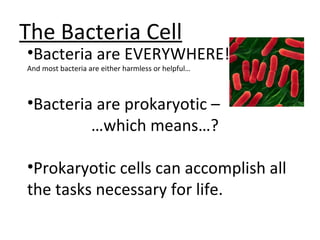
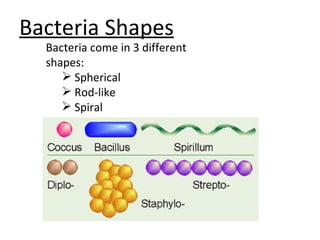
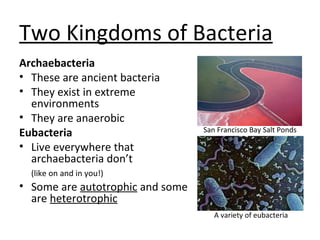
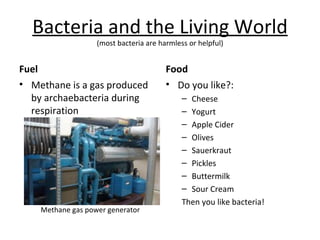
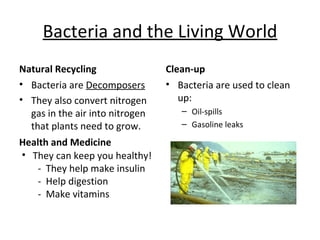
Bacteria are prokaryotic single-celled organisms that come in three shapes and have a cell wall, cell membrane, and cytoplasm but no nucleus. There are two kingdoms of bacteria: Archaebacteria, which live in extreme environments, and Eubacteria, which live everywhere else, including in and on humans. Bacteria can reproduce asexually through binary fission or sexually through conjugation. They need to obtain food, survive harsh conditions, and have various roles in the living world such as decomposition, nitrogen fixation, and uses in health and medicine.





![THREE DOMAINS OF LIFE-[BP211525].pptx](https://cdn.slidesharecdn.com/ss_thumbnails/threedomainsoflife-bp211525-220327144103-thumbnail.jpg?width=640&height=640&fit=bounds)


