1. Variety oforganisms on Earth
2. ______ means life
3. _______ means variety
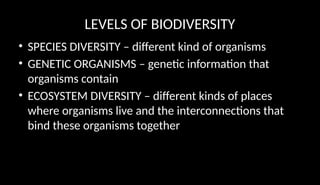
4-6. Levels of Biodiversity
7. Different habitats, niches and species interaction
8. Different kinds of organisms, relationship among
organisms
9. Different genes and combination of genes within a
population
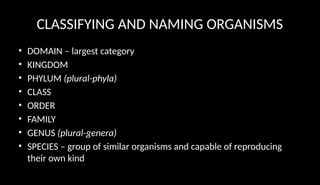
10. Largest category in classifying and naming organisms
3.
11. Smallest category/Groupof similar organisms
and capable of reproducing their own kind
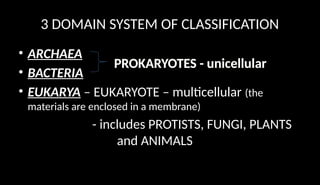
12-14. Domain System of Classification
15. A process that happens when an entire species
permanently disappears
16-20. Threats to Biodiversity
21-28. Hierarchy in Naming and Classifying an
Organism
29. Multicellular organism
30. Unicellular Organism
5.
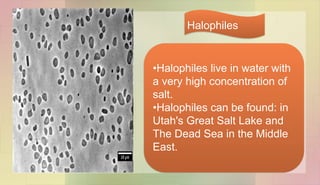
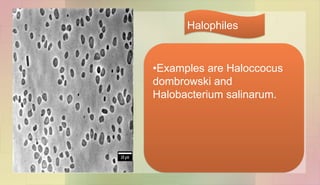
11.They can livein water with a very high concentration
of salt.
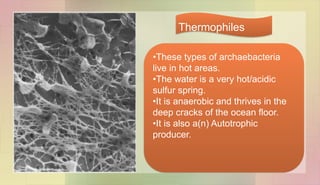
12. These types of archaebacteria live in hot areas. The
water is a very hot/acidic sulfur spring.
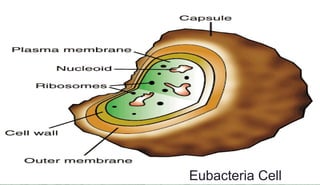
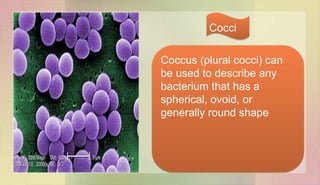
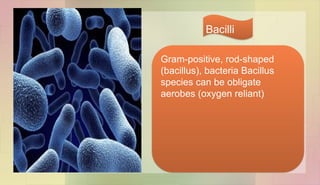
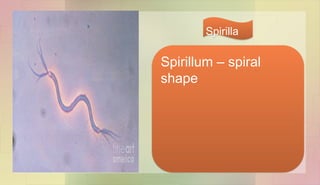
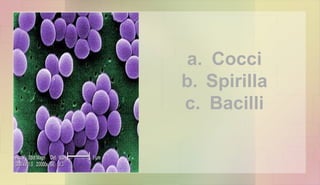
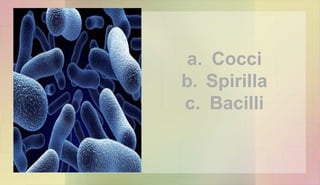
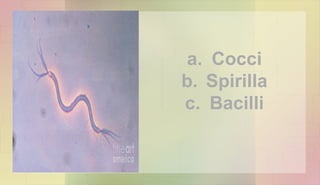
13-15. What are the shapes of eubacteria?
16. known as "true bacteria," unicellular and microspic.
LEVELS OF BIODIVERSITY
•SPECIES DIVERSITY – different kind of organisms
• GENETIC ORGANISMS – genetic information that
organisms contain
• ECOSYSTEM DIVERSITY – different kinds of places
where organisms live and the interconnections that
bind these organisms together
8.
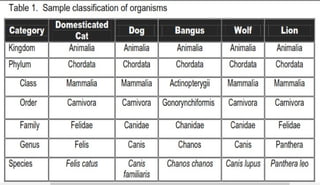
CLASSIFYING AND NAMINGORGANISMS
• DOMAIN – largest category
• KINGDOM
• PHYLUM (plural-phyla)
• CLASS
• ORDER
• FAMILY
• GENUS (plural-genera)
• SPECIES – group of similar organisms and capable of reproducing
their own kind
9.
3 DOMAIN SYSTEMOF CLASSIFICATION
• ARCHAEA
• BACTERIA
• EUKARYA – EUKARYOTE – multicellular (the
materials are enclosed in a membrane)
- includes PROTISTS, FUNGI, PLANTS
and ANIMALS
PROKARYOTES - unicellular
11.
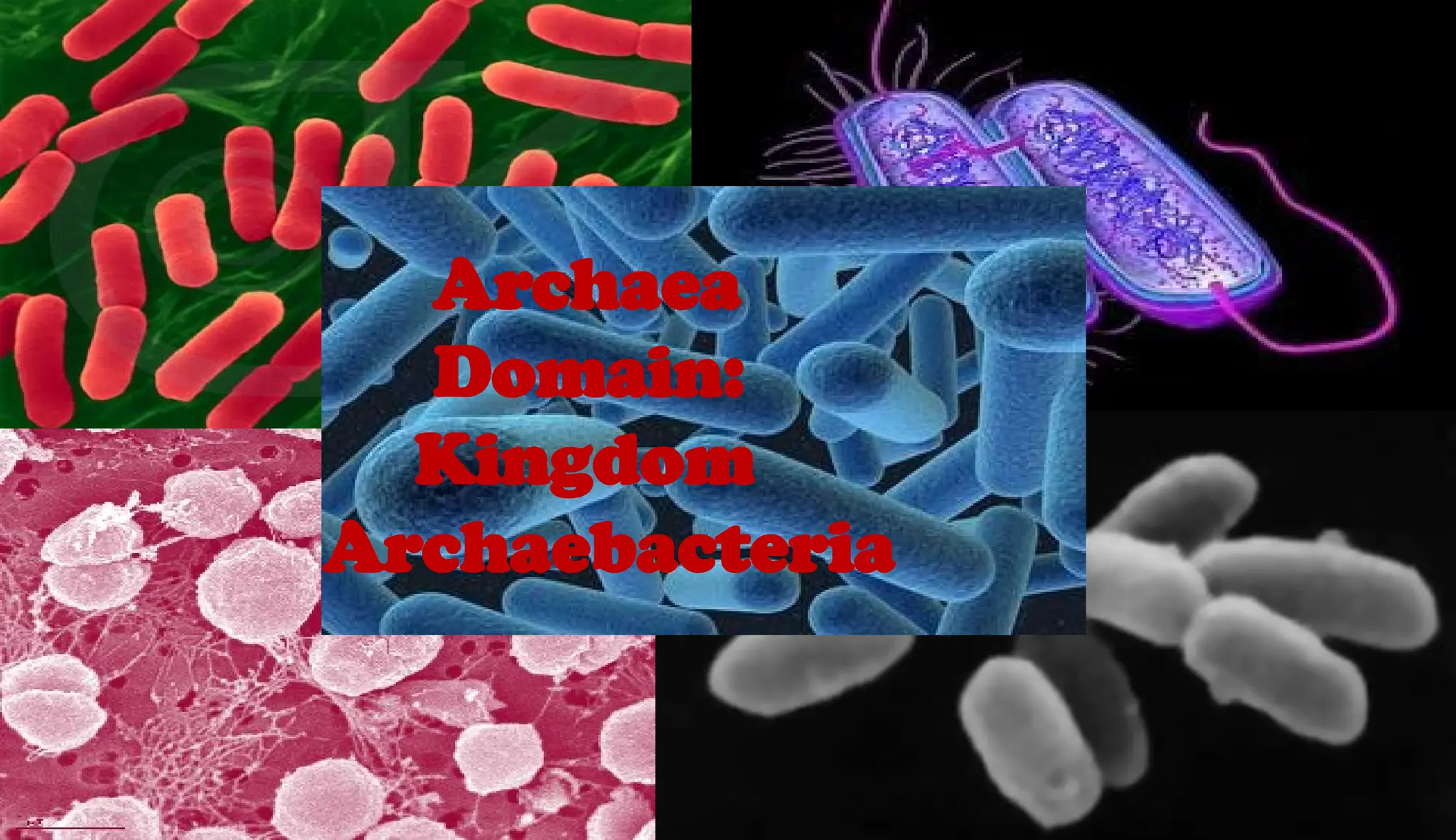
Archaebacteria
Archaebacteria are theoldest organism living on earth. They are unicellurar prokaryotes-
microbes without cell nucleus and any other membrane-bound organelles in their cells and
belongs to the kingdom, Archaea. They were first discovered in 1977 by Carl Woose and George
E. Fox and classified as bacteria. Most archaebacteria appear like bacteria, when observed
under the microscope. However, they are quite different from bacteria and eukaryotes.
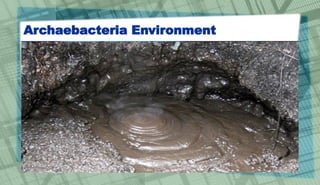
Archaebacteria are found in very harsh conditions such as in the volcanic vents or at the
bottom of the sea. They can easily survive in such extreme environment at sea vents releasing
sulfide-rich gasses, hot spring, or boiling mud around volcanoes.
- The Archaebacteriakingdom is made up of
THREE different kinds of Archaebacteria. Their
funtions and structers of their genes are more
similar to EUKARYOTES than to Eubacteria.
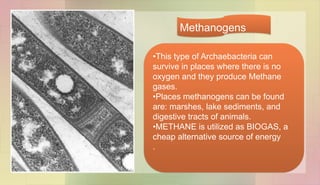
•This type ofArchaebacteria can
survive in places where there is no
oxygen and they produce Methane
gases.
•Places methanogens can be found
are: marshes, lake sediments, and
digestive tracts of animals.
•METHANE is utilized as BIOGAS, a
cheap alternative source of energy
.
Methanogens
17.
•Halophiles live inwater with
a very high concentration of
salt.
•Halophiles can be found: in
Utah's Great Salt Lake and
The Dead Sea in the Middle
East.
Halophiles
•These types ofarchaebacteria
live in hot areas.
•The water is a very hot/acidic
sulfur spring.
•It is anaerobic and thrives in the
deep cracks of the ocean floor.
•It is also a(n) Autotrophic
producer.
Thermophiles
20.
Other information:
The wordarchae came from the
Greek word Arkhaion, which means
ancient. Archae is also the latin name
for prokaryotic cells.
21.
- Organisms thatbelong to this
kingdom are all microscopic. They
live in various places, some even in
the most severe environments.
Methanogens, halophiles and
thermophiles are examples of
archaebacteria.
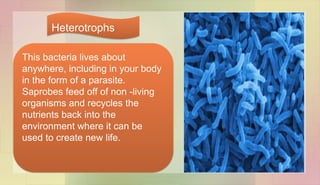
This bacteria livesabout
anywhere, including in your body
in the form of a parasite.
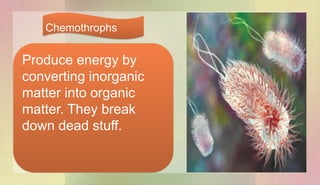
Saprobes feed off of non -living
organisms and recycles the
nutrients back into the
environment where it can be
used to create new life.
Heterotrophs
27.
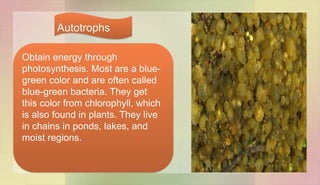
Obtain energy through
photosynthesis.Most are a blue-
green color and are often called
blue-green bacteria. They get
this color from chlorophyll, which
is also found in plants. They live
in chains in ponds, lakes, and
moist regions.
Autotrophs
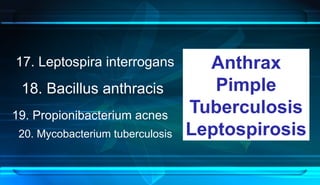
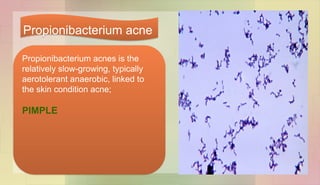
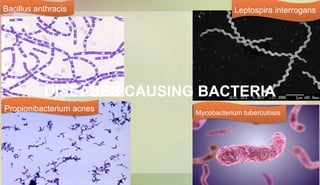
Propionibacterium acnes isthe
relatively slow-growing, typically
aerotolerant anaerobic, linked to
the skin condition acne;
PIMPLE
Propionibacterium acne
42.
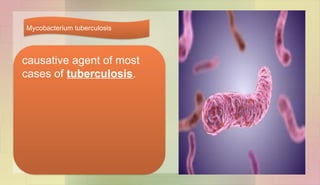
causative agent ofmost
cases of tuberculosis.
Mycobacterium tuberculosis
43.
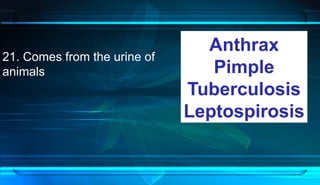
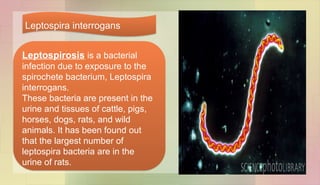
Leptospirosis is abacterial
infection due to exposure to the
spirochete bacterium, Leptospira
interrogans.
These bacteria are present in the
urine and tissues of cattle, pigs,
horses, dogs, rats, and wild
animals. It has been found out
that the largest number of
leptospira bacteria are in the
urine of rats.
Leptospira interrogans
44.
Bacillus anthracis is
responsiblefor the disease
called anthrax, a common
disease of livestock and,
occasionally, of humans
The disease affects animals
like cows and carabaos but
can be transmitted to
humans.
Bacillus anthracis
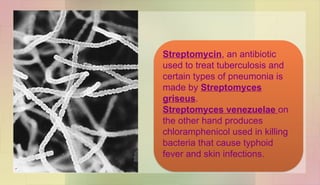
Streptomycin, an antibiotic
usedto treat tuberculosis and
certain types of pneumonia is
made by Streptomyces
griseus.
Streptomyces venezuelae on
the other hand produces
chloramphenicol used in killing
bacteria that cause typhoid
fever and skin infections.
47.
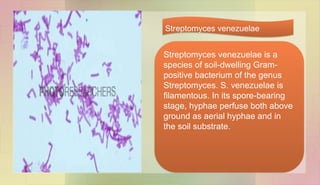
Streptomyces venezuelae isa
species of soil-dwelling Gram-
positive bacterium of the genus
Streptomyces. S. venezuelae is
filamentous. In its spore-bearing
stage, hyphae perfuse both above
ground as aerial hyphae and in
the soil substrate.
Streptomyces venezuelae
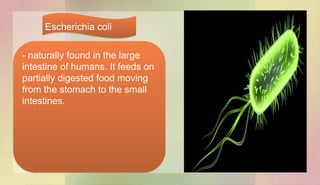
- naturally foundin the large
intestine of humans. It feeds on
partially digested food moving
from the stomach to the small
intestines.
Escherichia coli
1. Streptococcus thermophilus
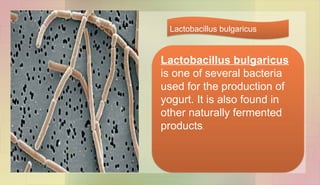
Lactobacillusbulgaricus
is one of several bacteria
used for the production of
yogurt. It is also found in
other naturally fermented
products.
2. Lactobacillus bulgaricus
52.
Lactobacillus bulgaricus
is oneof several bacteria
used for the production of
yogurt. It is also found in
other naturally fermented
products.
Lactobacillus bulgaricus
22. Some membersof eubacteria are able to break down or
remove pollutants through the process of _______________.
23. Another group of bacteria, the ___________ are plantlike
because they have chlorophyll-containing cells.
24. Kingdom Eubacteria belongs in Domain _______.
25. Is eubacteria eukaryote or prokaryote?
55.
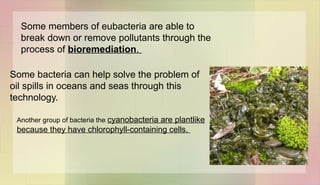
Some members ofeubacteria are able to
break down or remove pollutants through the
process of bioremediation.
Some bacteria can help solve the problem of
oil spills in oceans and seas through this
technology.
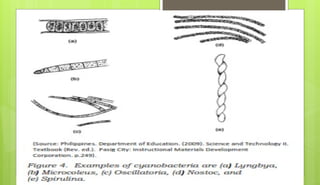
Another group of bacteria the cyanobacteria are plantlike
because they have chlorophyll-containing cells.
56.
Another group ofbacteria the cyanobacteria are plantlike because
they have chlorophyll-containing cells.
Cyanobacteria grow in ditches, esteros, or in moist places like gardens
and sidewalls where light is present.
In Northern Luzon people eat raw Tab-tab (Nostoc) as salad. Spirulina
cells are rich in protein, thus, have been grown to produce Single Cell
Protein (SCP). It is used as swine and cattle feed and is also
recommended as food for humans.
57.
Anabaena azollae, anothercyanobacterium is
important in agriculture. It converts nitrogen in air
into compounds usable by plants for growth and
development. The same is being done by the
Rhizobium group of bacteria. They are present in
the root nodules of legumes.
Certain bacteria, like Bacillus thuringiensis, have
been developed into a microbial pesticide. It is
used to control pests and and insects carrying
disease-causing organisms.
58.
23. Bacteria insidehuman
body
Propionibacterium acnes
Mycobacterium tuberculosis
Eschirichia Coli
59.
24. Bacteria ina Yogurt
Mycobacterium tuberculosis
Eschirichia Coli
Lactobacillus bulgaricus