Body temperature and its regulation
S. Vasanthan
Assistant professor
Department of physiology
MGMCRI
SLOs
• Introduction
• Normal temperature
• Heat loss mechanism
• Heat gain mechanism
• Regulation of body temperature
• Abnormalities of body temperature regulation
Introduction
Homeothermic - maintaining constant internal body
temperature
Endotherms - generate their own internal body heat
Why temperature should maintain?
• For normal enzyme activity
• For normal neuronal activity
• Rise in high temp. cause denature of proteins
Body temperature
Body temp:
Core temperature measured in oral or rectal
Skin temperature measured on skin
Normal body temperature:
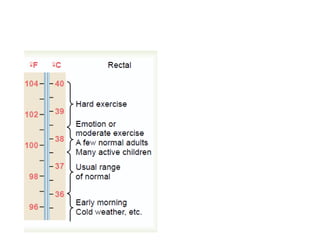
Oral : 98.6°F (97.3–98.8°F) or 370C (36.3–37.1°C)
Rectal : 0.50C more than oral
Axilla : 0.50C less than oral
Skin : depends upon the environment
Exercise : 101° to 104°F
Rectal 0.50C > oral 0.50C > axilla
Maintenance of body temp.
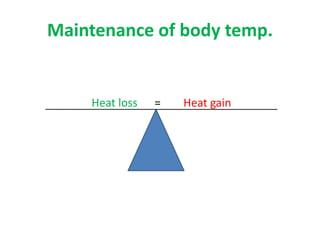
Heat loss = Heat gain
Heat gain mechanism
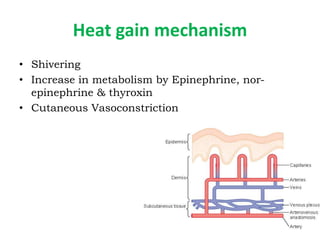
• Shivering
• Increase in metabolism by Epinephrine, nor-
epinephrine & thyroxin
• Cutaneous Vasoconstriction
Heat loss mechanism
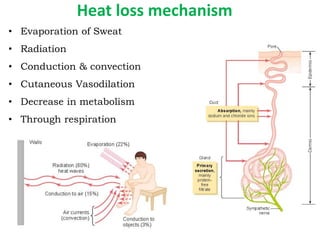
• Evaporation of Sweat
• Radiation
• Conduction & convection
• Cutaneous Vasodilation
• Decrease in metabolism
• Through respiration
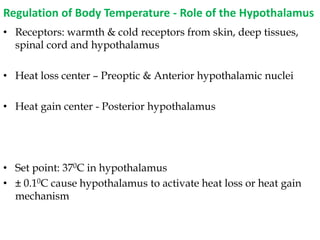
Regulation of Body Temperature - Role of the Hypothalamus
• Receptors: warmth & cold receptors from skin, deep tissues,
spinal cord and hypothalamus
• Heat loss center – Preoptic & Anterior hypothalamic nuclei
• Heat gain center - Posterior hypothalamus
• Set point: 370C in hypothalamus
• ± 0.10C cause hypothalamus to activate heat loss or heat gain
mechanism
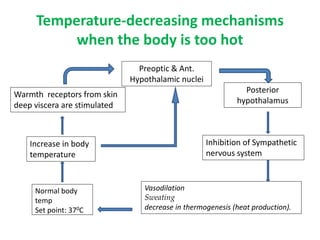
Temperature-decreasing mechanisms
when the body is too hot
Vasodilation
Sweating
decrease in thermogenesis (heat production).
Increase in body
temperature
Preoptic & Ant.
Hypothalamic nuclei
Inhibition of Sympathetic
nervous system
Warmth receptors from skin
deep viscera are stimulated
Normal body
temp
Set point: 370C
Posterior
hypothalamus
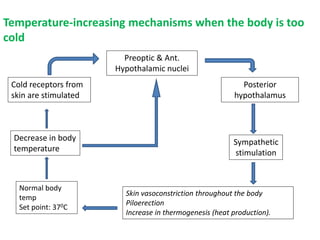
Temperature-increasing mechanisms when the body is too
cold
Skin vasoconstriction throughout the body
Piloerection
Increase in thermogenesis (heat production).
Decrease in body
temperature
Preoptic & Ant.
Hypothalamic nuclei
Posterior
hypothalamus
Sympathetic
stimulation
Cold receptors from
skin are stimulated
Normal body
temp
Set point: 370C
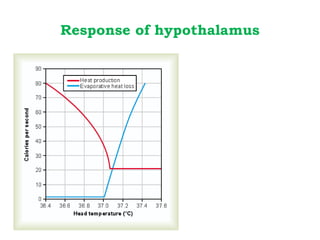
Response of hypothalamus
Abnormalities of body temperature
regulation
Hypothermia: decrease in body temp below normal
range
Hyperthermia: increase in body temp above normal
range
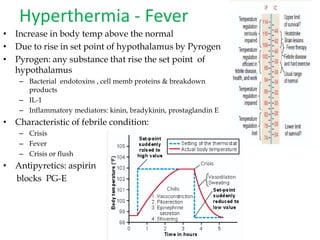
Hyperthermia - Fever
• Increase in body temp above the normal
• Due to rise in set point of hypothalamus by Pyrogen
• Pyrogen: any substance that rise the set point of
hypothalamus
– Bacterial endotoxins , cell memb proteins & breakdown
products
– IL-1
– Inflammatory mediators: kinin, bradykinin, prostaglandin E
• Characteristic of febrile condition:
– Crisis
– Fever
– Crisis or flush
• Antipyretics: aspirin
blocks PG-E
Heatstroke
Occurs when body temp rises beyond the critical
temp ranges from 105 to 1080F
Symptoms:
– Dizziness
– Abdominal distress,
– Vomiting
– Delirium
– Loss of consciousness
– Circulatory shock
– Death
Tepid’s sponging
Hypothermia
• person exposed to ice water for 20 to 30 minutes
ordinarily dies because of heart fibrillation
• the body temperature has fallen below 85°F, the
ability of the hypothalamus to regulate temperature
is lost
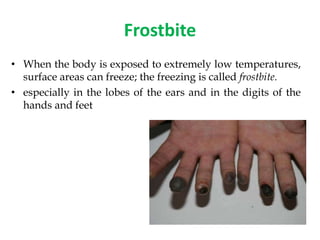
Frostbite
• When the body is exposed to extremely low temperatures,
surface areas can freeze; the freezing is called frostbite.
• especially in the lobes of the ears and in the digits of the
hands and feet
Body temperature and its regulation

Body temperature and its regulation

  • 1.
    Body temperature andits regulation S. Vasanthan Assistant professor Department of physiology MGMCRI
  • 2.
    SLOs • Introduction • Normaltemperature • Heat loss mechanism • Heat gain mechanism • Regulation of body temperature • Abnormalities of body temperature regulation
  • 3.
    Introduction Homeothermic - maintainingconstant internal body temperature Endotherms - generate their own internal body heat Why temperature should maintain? • For normal enzyme activity • For normal neuronal activity • Rise in high temp. cause denature of proteins
  • 4.
    Body temperature Body temp: Coretemperature measured in oral or rectal Skin temperature measured on skin Normal body temperature: Oral : 98.6°F (97.3–98.8°F) or 370C (36.3–37.1°C) Rectal : 0.50C more than oral Axilla : 0.50C less than oral Skin : depends upon the environment Exercise : 101° to 104°F Rectal 0.50C > oral 0.50C > axilla
  • 6.
    Maintenance of bodytemp. Heat loss = Heat gain
  • 7.
    Heat gain mechanism •Shivering • Increase in metabolism by Epinephrine, nor- epinephrine & thyroxin • Cutaneous Vasoconstriction
  • 8.
    Heat loss mechanism •Evaporation of Sweat • Radiation • Conduction & convection • Cutaneous Vasodilation • Decrease in metabolism • Through respiration
  • 9.
    Regulation of BodyTemperature - Role of the Hypothalamus • Receptors: warmth & cold receptors from skin, deep tissues, spinal cord and hypothalamus • Heat loss center – Preoptic & Anterior hypothalamic nuclei • Heat gain center - Posterior hypothalamus • Set point: 370C in hypothalamus • ± 0.10C cause hypothalamus to activate heat loss or heat gain mechanism
  • 10.
    Temperature-decreasing mechanisms when thebody is too hot Vasodilation Sweating decrease in thermogenesis (heat production). Increase in body temperature Preoptic & Ant. Hypothalamic nuclei Inhibition of Sympathetic nervous system Warmth receptors from skin deep viscera are stimulated Normal body temp Set point: 370C Posterior hypothalamus
  • 11.
    Temperature-increasing mechanisms whenthe body is too cold Skin vasoconstriction throughout the body Piloerection Increase in thermogenesis (heat production). Decrease in body temperature Preoptic & Ant. Hypothalamic nuclei Posterior hypothalamus Sympathetic stimulation Cold receptors from skin are stimulated Normal body temp Set point: 370C
  • 12.
  • 13.
    Abnormalities of bodytemperature regulation Hypothermia: decrease in body temp below normal range Hyperthermia: increase in body temp above normal range
  • 14.
    Hyperthermia - Fever •Increase in body temp above the normal • Due to rise in set point of hypothalamus by Pyrogen • Pyrogen: any substance that rise the set point of hypothalamus – Bacterial endotoxins , cell memb proteins & breakdown products – IL-1 – Inflammatory mediators: kinin, bradykinin, prostaglandin E • Characteristic of febrile condition: – Crisis – Fever – Crisis or flush • Antipyretics: aspirin blocks PG-E
  • 15.
    Heatstroke Occurs when bodytemp rises beyond the critical temp ranges from 105 to 1080F Symptoms: – Dizziness – Abdominal distress, – Vomiting – Delirium – Loss of consciousness – Circulatory shock – Death
  • 16.
  • 17.
    Hypothermia • person exposedto ice water for 20 to 30 minutes ordinarily dies because of heart fibrillation • the body temperature has fallen below 85°F, the ability of the hypothalamus to regulate temperature is lost
  • 18.
    Frostbite • When thebody is exposed to extremely low temperatures, surface areas can freeze; the freezing is called frostbite. • especially in the lobes of the ears and in the digits of the hands and feet