Body Temperature Regulation Amelyn R. Rafael, MD
In man, the deep body temperature may fluctuate 1 degree Centigrade in daily activity cycles Lowest in the morning and reaches a peak in late evening The processes utilized by man in regulating the internal temperature in spite of environmental temperature changes
Heat Balance and Body Temperature Heat is continually being produced in the body as a by-product of metabolism Heat is also continually being lost to the surroundings When the rate of heat production is exactly equal to the rate of heat lost = HEAT BALANCE
Relationship of Body Heat to Body Temperature The temperature of an object is a measure of the kinetic activity of its molecules  this is proportional to the amount of heat stored in the object body temperature is directly proportional to the heat in the body
Heat capacity or Specific heat a measurement of the changes in body heat stores utilized to characterize temperature regulation quantitatively defined as the ratio of heat supplied (or remove) to the corresponding temperature rise (or decrease) =  Δ  kilocalories/kg Δ  T BT increases 1 C for each calorie of heat stored per kg of body weight specific heat of tissues is said to be 0.83 calorie/kg/degree centigrade
Normal Body Temperature Internal or Core Temperature (Deep Body Temperature) temperature of the interior of the body the body strives for a rather precise regulation of this temperature value normally varying from the mean by not more than 1 F 2/3 of the body mass is at the core temperature which is usually represented by the rectal temperature
Surface temperature temperature of the skin or tissue immediately underlying the skin rises and falls with the temperature of the surroundings 1/3 of the body mass
Average Body Temperature used when one wishes to calculate the total amount of heat stored in the body = (0.33 x surface temp) + (0.67 x internal temp)
Physiological Fluctuations Diurnal variation – minimum in AM; peak late afternoon 35 C early morning, cold weather 36-37 C usual range of normal 38 C emotion and moderate exercise 39 C hard work, emotions 40 C hard exercise
Factors that affect heat production and heat loss HEAT PRODUCTION BMR – causes continual heat production normal young adult male ordinarily produces at least 40 cal of heat/hour/sq meter body surface area this raises the BT about 2F in one hour if no heat were lost in the body abdominal viscera, heart, brain – generates 63% of total body heat skeletal muscle – 30% of total Muscular exercise – as much as 75% of total heat produced in the muscles when all the muscles of the body are contracted at maximal rate of activity, the metabolic rate can rise to 1500 to 2000 above the basal level
Shivering impulses are transmitted through bilateral tracts that pass ventrolateral to the red nucleus, down the brain stem into the lateral columns of spinal cord    facilitation of anterior motoneurons causing an increased muscle tone    rise in overall metabolic rate 50-100% if degree of facilitation reaches a critical level shivering begins; the rate of heat production rises to 200-300% above normal major mode of acutely increasing heat production
Thyroxine effect on cells has a direct effect on all cells of the body to increase the local rate of metabolism, causing greater than normal quantities of heat to be released in the body an increase of 100% above normal Effect of epinephrine and sympathetic activity on cells directly affect the rate of metabolism in all the cells of the body causing increase in its rate to as much as 40-50%
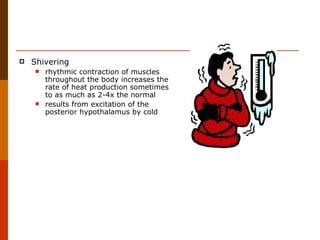
Shivering rhythmic contraction of muscles throughout the body increases the rate of heat production sometimes to as much as 2-4x the normal results from excitation of the posterior hypothalamus by cold
Effect of BT on cells Rate of heat production rises about 13% per degree centigrade Once the temperature rises progressively, greater and greater heat production occurs because of this temperature effect the higher the temperature, the more difficult it is for the heat loss mechanisms to dissipate the heat produced
Specific dynamic action of food this increases the heat production of the body at high environmental temperature, the specific dynamic action of food increases the heat production and adds extra burden to the heat loss mechanism
Heat Loss The various methods by which heat loss is effected are: radiation conduction convection evaporation The amount of heat loss by each of these different mechanisms varies with atmospheric conditions
Radiation loss of heat in the form of infrared heat rays (electromagnetic waves) the body radiates heat rays in all directions, and heat rays are being radiated from the walls of other objects toward the body  varies directly with the temperature difference between the temperature of the body surface and the average temperature of the surroundings
The surface of the human body is extremely absorbent for heat rays Rate of infrared absorption is approximately equal for human beings with either white or colored skin The human skin absorbs 97% of incident radiation
The energy from the sun is transmitted mainly in the form of light rays rather than infrared rays 35% of these waves are reflected from the white skin but only a small amount from the dark skin In sunlight, a dark skin does absorb more heat than white skin The radiation surface of the standing human being is only about 85% of the total surface area, since exposed surfaces do not lose heat to the environment by radiation
Factors influencing heat loss through radiation Temperature of surrounding objects relative to that of the skin Humidity of the atmosphere Air with a high water vapor content is more opaque to radiant heat than dry air Heat loss through radiation is slightly reduced  when the relative humidity is high Rate of loss is proportional to Ts – Te Ts absolute temperature of the skin surface Te absolute temperature of objects in surrounding environment
Conduction Heat transfer between surfaces in contact 1. Conduction to objects – represents only a small % of the total heat loss from the body (3%) 2. Conduction to air – represents a sizeable proportion of the body’s heat loss even under normal conditions (12%) Self-limited unless the air moves so that new, unheated air is continually brought in contact with the skin
Convection Movement of air The clothed body has a layer of warm moist air in contact with the skin When the atmosphere is cooler, convection currents are set up which mix the air lying against the skin with fresh air When the body is exposed to wind, the layer of air immediately adjacent to the skin is replaced by new air much more rapidly than normally, and heat loss by convection increased accordingly The loss increasing with the square of the wind velocity up to 60 miles per hour A wind velocity beyond this exerts little or no further effect Once the wind has cooled the skin to the temp of the air itself, a further increase in the rate of heat loss cannot occur regardless of the wind velocity
Conduction and Convection of Heat from Body to Water Specific heat of water is several times greater than air A unit portion of water can absorb a far greater quantity of heat than can air The conductivity of heat through water is more marked than air Heating a thin layer of water next to body does  not result in formation of an “insulator zone” as occur in air The rate of heat loss from the body in non-flowing water equals the rate of heat loss in rapidly flowing water
The nearer the temperature of the environment comes to that of the blood, the smaller would be the amount of heat which can be lost by radiation and convection At an air temperature of about 37 C heat loss by this means must cease At higher temperature than this, the body would actually gain heat if no other means of cooling were available
Evaporation 1. Invinsible water loss – about 25% of basal heat loss is attributable to evaporation of water even without sweating Through skin – about 2/3 Through respiratory tract – 1/3 Heat loss by evaporation (E) is generally calculated from water loss, which maybe determined from body weight changes after correction for metabolic and other weight losses E (watts) = 0.7 x  gms of H2O evaporated   time in hours Where: 0.7 = latent heat of evaporation (evaporation of 1 gm of H2O per hour requires 0.7 watts or 0.6 K cal)
2. Effect of humid weather on evaporative  loss of heat The rate of evaporation of water is influenced inversely by the degree to which the atm is already saturated with moisture Sweat which is not evaporated but simply drips from the skin does not increase heat loss The sweating mechanism for the elimination of heat is badly crippled when the humidity is high
3. Effect of convection air currents on evaporation Lack of air movement prevents effective evaporation in the same manner that effective cooling by conduction of heat to the air is prevented when there is little convection Convection currents cause air that has become saturated with moisture to move away from the skin while unsaturated air replaces it
Sweating 0.58 cal/g% heat is lost Stimulation of the pre-optic area    impulses are transmitted in the autonomic pathways to the CORD and through the sympathetic outflow to the skin everywhere in the body
Sweat glands Innervated by cholinergic nerve fibers Tubular structures consisting of 2 parts: Deep coiled portion that secretes the sweat Duct portion passing outward through the dermis of the skin The secretory portion secretes a fluid called precursion Active secretory product of the epithelial cells lining the coiled portion of the sweat gland Elicited by Cholinergic sympathetic nerve fibers ending on or near the gland
Sweat  A water solution of an osmolar concentration well below that of plasma The principal constituent is sodium chloride There are traces of potassium, urea and lactate, no protein or glucose When the rate of sweat secretion is very low, most of the sodium and chloride is reabsorbed from the precursor secretion so that the fluid lost to the surface of the body contains almost none of these ions
Acclimatization of the Sweating Mechanism A person exposed to hot weather for several weeks progressively sweat more and more profusely Average maximum of about 1.5 liters per hour at first Rises to a double within 10 days To about 2 ½ times as much within 6 weeks Caused by a direct increase in sweating capability of the sweat glands themselves Decreased concentration of NaCl in the sweat, better conservation of salt After 4-6 wks acclimatization the loss of NaCl maybe as little as 3-5 gms/day
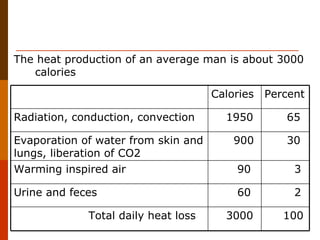
The heat production of an average man is about 3000 calories Calories Percent Radiation, conduction, convection 1950 65 Evaporation of water from skin and lungs, liberation of CO2 900 30 Warming inspired air 90 3 Urine and feces 60 2 Total daily heat loss 3000 100
The Insulator System of the Body Skin Subcutaneous tissues Fat in subcutaneous tissues
The Radiator System of the Body Flow of blood to the skin Skin temperature is important in heat transfer to the environment Delivery of heat to the surface is blood-flow dependent
Control of Heat Conduction to Skin 1. the degree of VC of the arterioles that supply blood to the venous plexus of the skin 2. sympathetic stimulation of sweat glands causing release of bradykinin    increased heat flow over-all human skin BF: 150-200 ml/min 2000 ml/min (heat stress) Tissue conductance: an expression of delivery of heat from the core to surface  =total heat flow from core to surface Tr (rectal)  -  Ts (skin)
Effect of Clothing on Heat Loss Effect on Conductive Heat Loss Effect on Heat Loss by Radiation Loss of Heat through wet clothing Effect of Heat Loss by Evaporation
Regulation of Body Temperature Function of the hypothalamus Thermostatic center of the body neurons
Factors Tending to Maintain Core Temperature in Hot Environment Vasodilatation Sweating Slight increase in RR Behavioral responses: Sprawling Clothing Seeking shade
Factors Tending to Maintain Core Temperature in Cold Environment 1. Factors limiting Heat Loss Vasoconstriction Insulation Behavioral: Dressing up Curling up Seeking warmer environment
2. Factors increasing heat production: Muscular work Voluntary Involuntary Muscle tensing shivering Increased metabolic rate Acute: change in catecholamine release Chronic: adjustments in thyroid function
3. Neural control mechanisms 2 major inputs: Hypothalamic-temperature-sensitive centers Peripheral-temperature-sensitive centers
Abnormalities of Body Temperature Regulation Fever Causes: Abnormalities in the brain itself Toxic substances  pyrogens
Characteristics of Febrile Conditions 1. Chills 2. Crisis
Heat Stroke - the limits of extreme heat that one can stand depend entirely on whether the heat is dry or wet dry air: sufficient convection currents are flowing to promote rapid evaporation from the body 100% humidified air: evaporation cannot occur BT increases as the ambient temp increases above 94F At 110F cellular metabolism increases 2x    increase in heat production, increased body temperature There is a limit at which the body can lose heat even with maximal sweating Excessive heating of the hypothalamus causes depression of heat regulation leading to diminished sweating
Exposure to extreme cold: BT below 77F is fatal. Hypothalamus loses its ability to regulate BT below 85F Rate of heat production in cell is greatly diminished by low temperature Sleepiness and coma occur which depresses CNS activity including heat control mechanisms preventing shivering Frostbite Artificial hypothermia

Body Temperature Regulation

  • 1.
    Body Temperature RegulationAmelyn R. Rafael, MD
  • 2.
    In man, thedeep body temperature may fluctuate 1 degree Centigrade in daily activity cycles Lowest in the morning and reaches a peak in late evening The processes utilized by man in regulating the internal temperature in spite of environmental temperature changes
  • 3.
    Heat Balance andBody Temperature Heat is continually being produced in the body as a by-product of metabolism Heat is also continually being lost to the surroundings When the rate of heat production is exactly equal to the rate of heat lost = HEAT BALANCE
  • 4.
    Relationship of BodyHeat to Body Temperature The temperature of an object is a measure of the kinetic activity of its molecules this is proportional to the amount of heat stored in the object body temperature is directly proportional to the heat in the body
  • 5.
    Heat capacity orSpecific heat a measurement of the changes in body heat stores utilized to characterize temperature regulation quantitatively defined as the ratio of heat supplied (or remove) to the corresponding temperature rise (or decrease) = Δ kilocalories/kg Δ T BT increases 1 C for each calorie of heat stored per kg of body weight specific heat of tissues is said to be 0.83 calorie/kg/degree centigrade
  • 6.
    Normal Body TemperatureInternal or Core Temperature (Deep Body Temperature) temperature of the interior of the body the body strives for a rather precise regulation of this temperature value normally varying from the mean by not more than 1 F 2/3 of the body mass is at the core temperature which is usually represented by the rectal temperature
  • 7.
    Surface temperature temperatureof the skin or tissue immediately underlying the skin rises and falls with the temperature of the surroundings 1/3 of the body mass
  • 8.
    Average Body Temperatureused when one wishes to calculate the total amount of heat stored in the body = (0.33 x surface temp) + (0.67 x internal temp)
  • 9.
    Physiological Fluctuations Diurnalvariation – minimum in AM; peak late afternoon 35 C early morning, cold weather 36-37 C usual range of normal 38 C emotion and moderate exercise 39 C hard work, emotions 40 C hard exercise
  • 10.
    Factors that affectheat production and heat loss HEAT PRODUCTION BMR – causes continual heat production normal young adult male ordinarily produces at least 40 cal of heat/hour/sq meter body surface area this raises the BT about 2F in one hour if no heat were lost in the body abdominal viscera, heart, brain – generates 63% of total body heat skeletal muscle – 30% of total Muscular exercise – as much as 75% of total heat produced in the muscles when all the muscles of the body are contracted at maximal rate of activity, the metabolic rate can rise to 1500 to 2000 above the basal level
  • 11.
    Shivering impulses aretransmitted through bilateral tracts that pass ventrolateral to the red nucleus, down the brain stem into the lateral columns of spinal cord  facilitation of anterior motoneurons causing an increased muscle tone  rise in overall metabolic rate 50-100% if degree of facilitation reaches a critical level shivering begins; the rate of heat production rises to 200-300% above normal major mode of acutely increasing heat production
  • 12.
    Thyroxine effect oncells has a direct effect on all cells of the body to increase the local rate of metabolism, causing greater than normal quantities of heat to be released in the body an increase of 100% above normal Effect of epinephrine and sympathetic activity on cells directly affect the rate of metabolism in all the cells of the body causing increase in its rate to as much as 40-50%
  • 13.
    Shivering rhythmic contractionof muscles throughout the body increases the rate of heat production sometimes to as much as 2-4x the normal results from excitation of the posterior hypothalamus by cold
  • 14.
    Effect of BTon cells Rate of heat production rises about 13% per degree centigrade Once the temperature rises progressively, greater and greater heat production occurs because of this temperature effect the higher the temperature, the more difficult it is for the heat loss mechanisms to dissipate the heat produced
  • 15.
    Specific dynamic actionof food this increases the heat production of the body at high environmental temperature, the specific dynamic action of food increases the heat production and adds extra burden to the heat loss mechanism
  • 16.
    Heat Loss Thevarious methods by which heat loss is effected are: radiation conduction convection evaporation The amount of heat loss by each of these different mechanisms varies with atmospheric conditions
  • 17.
    Radiation loss ofheat in the form of infrared heat rays (electromagnetic waves) the body radiates heat rays in all directions, and heat rays are being radiated from the walls of other objects toward the body varies directly with the temperature difference between the temperature of the body surface and the average temperature of the surroundings
  • 18.
    The surface ofthe human body is extremely absorbent for heat rays Rate of infrared absorption is approximately equal for human beings with either white or colored skin The human skin absorbs 97% of incident radiation
  • 19.
    The energy fromthe sun is transmitted mainly in the form of light rays rather than infrared rays 35% of these waves are reflected from the white skin but only a small amount from the dark skin In sunlight, a dark skin does absorb more heat than white skin The radiation surface of the standing human being is only about 85% of the total surface area, since exposed surfaces do not lose heat to the environment by radiation
  • 20.
    Factors influencing heatloss through radiation Temperature of surrounding objects relative to that of the skin Humidity of the atmosphere Air with a high water vapor content is more opaque to radiant heat than dry air Heat loss through radiation is slightly reduced when the relative humidity is high Rate of loss is proportional to Ts – Te Ts absolute temperature of the skin surface Te absolute temperature of objects in surrounding environment
  • 21.
    Conduction Heat transferbetween surfaces in contact 1. Conduction to objects – represents only a small % of the total heat loss from the body (3%) 2. Conduction to air – represents a sizeable proportion of the body’s heat loss even under normal conditions (12%) Self-limited unless the air moves so that new, unheated air is continually brought in contact with the skin
  • 22.
    Convection Movement ofair The clothed body has a layer of warm moist air in contact with the skin When the atmosphere is cooler, convection currents are set up which mix the air lying against the skin with fresh air When the body is exposed to wind, the layer of air immediately adjacent to the skin is replaced by new air much more rapidly than normally, and heat loss by convection increased accordingly The loss increasing with the square of the wind velocity up to 60 miles per hour A wind velocity beyond this exerts little or no further effect Once the wind has cooled the skin to the temp of the air itself, a further increase in the rate of heat loss cannot occur regardless of the wind velocity
  • 23.
    Conduction and Convectionof Heat from Body to Water Specific heat of water is several times greater than air A unit portion of water can absorb a far greater quantity of heat than can air The conductivity of heat through water is more marked than air Heating a thin layer of water next to body does not result in formation of an “insulator zone” as occur in air The rate of heat loss from the body in non-flowing water equals the rate of heat loss in rapidly flowing water
  • 24.
    The nearer thetemperature of the environment comes to that of the blood, the smaller would be the amount of heat which can be lost by radiation and convection At an air temperature of about 37 C heat loss by this means must cease At higher temperature than this, the body would actually gain heat if no other means of cooling were available
  • 25.
    Evaporation 1. Invinsiblewater loss – about 25% of basal heat loss is attributable to evaporation of water even without sweating Through skin – about 2/3 Through respiratory tract – 1/3 Heat loss by evaporation (E) is generally calculated from water loss, which maybe determined from body weight changes after correction for metabolic and other weight losses E (watts) = 0.7 x gms of H2O evaporated time in hours Where: 0.7 = latent heat of evaporation (evaporation of 1 gm of H2O per hour requires 0.7 watts or 0.6 K cal)
  • 26.
    2. Effect ofhumid weather on evaporative loss of heat The rate of evaporation of water is influenced inversely by the degree to which the atm is already saturated with moisture Sweat which is not evaporated but simply drips from the skin does not increase heat loss The sweating mechanism for the elimination of heat is badly crippled when the humidity is high
  • 27.
    3. Effect ofconvection air currents on evaporation Lack of air movement prevents effective evaporation in the same manner that effective cooling by conduction of heat to the air is prevented when there is little convection Convection currents cause air that has become saturated with moisture to move away from the skin while unsaturated air replaces it
  • 28.
    Sweating 0.58 cal/g%heat is lost Stimulation of the pre-optic area  impulses are transmitted in the autonomic pathways to the CORD and through the sympathetic outflow to the skin everywhere in the body
  • 29.
    Sweat glands Innervatedby cholinergic nerve fibers Tubular structures consisting of 2 parts: Deep coiled portion that secretes the sweat Duct portion passing outward through the dermis of the skin The secretory portion secretes a fluid called precursion Active secretory product of the epithelial cells lining the coiled portion of the sweat gland Elicited by Cholinergic sympathetic nerve fibers ending on or near the gland
  • 30.
    Sweat Awater solution of an osmolar concentration well below that of plasma The principal constituent is sodium chloride There are traces of potassium, urea and lactate, no protein or glucose When the rate of sweat secretion is very low, most of the sodium and chloride is reabsorbed from the precursor secretion so that the fluid lost to the surface of the body contains almost none of these ions
  • 31.
    Acclimatization of theSweating Mechanism A person exposed to hot weather for several weeks progressively sweat more and more profusely Average maximum of about 1.5 liters per hour at first Rises to a double within 10 days To about 2 ½ times as much within 6 weeks Caused by a direct increase in sweating capability of the sweat glands themselves Decreased concentration of NaCl in the sweat, better conservation of salt After 4-6 wks acclimatization the loss of NaCl maybe as little as 3-5 gms/day
  • 32.
    The heat productionof an average man is about 3000 calories Calories Percent Radiation, conduction, convection 1950 65 Evaporation of water from skin and lungs, liberation of CO2 900 30 Warming inspired air 90 3 Urine and feces 60 2 Total daily heat loss 3000 100
  • 33.
    The Insulator Systemof the Body Skin Subcutaneous tissues Fat in subcutaneous tissues
  • 34.
    The Radiator Systemof the Body Flow of blood to the skin Skin temperature is important in heat transfer to the environment Delivery of heat to the surface is blood-flow dependent
  • 35.
    Control of HeatConduction to Skin 1. the degree of VC of the arterioles that supply blood to the venous plexus of the skin 2. sympathetic stimulation of sweat glands causing release of bradykinin  increased heat flow over-all human skin BF: 150-200 ml/min 2000 ml/min (heat stress) Tissue conductance: an expression of delivery of heat from the core to surface =total heat flow from core to surface Tr (rectal) - Ts (skin)
  • 36.
    Effect of Clothingon Heat Loss Effect on Conductive Heat Loss Effect on Heat Loss by Radiation Loss of Heat through wet clothing Effect of Heat Loss by Evaporation
  • 37.
    Regulation of BodyTemperature Function of the hypothalamus Thermostatic center of the body neurons
  • 38.
    Factors Tending toMaintain Core Temperature in Hot Environment Vasodilatation Sweating Slight increase in RR Behavioral responses: Sprawling Clothing Seeking shade
  • 39.
    Factors Tending toMaintain Core Temperature in Cold Environment 1. Factors limiting Heat Loss Vasoconstriction Insulation Behavioral: Dressing up Curling up Seeking warmer environment
  • 40.
    2. Factors increasingheat production: Muscular work Voluntary Involuntary Muscle tensing shivering Increased metabolic rate Acute: change in catecholamine release Chronic: adjustments in thyroid function
  • 41.
    3. Neural controlmechanisms 2 major inputs: Hypothalamic-temperature-sensitive centers Peripheral-temperature-sensitive centers
  • 42.
    Abnormalities of BodyTemperature Regulation Fever Causes: Abnormalities in the brain itself Toxic substances pyrogens
  • 43.
    Characteristics of FebrileConditions 1. Chills 2. Crisis
  • 44.
    Heat Stroke -the limits of extreme heat that one can stand depend entirely on whether the heat is dry or wet dry air: sufficient convection currents are flowing to promote rapid evaporation from the body 100% humidified air: evaporation cannot occur BT increases as the ambient temp increases above 94F At 110F cellular metabolism increases 2x  increase in heat production, increased body temperature There is a limit at which the body can lose heat even with maximal sweating Excessive heating of the hypothalamus causes depression of heat regulation leading to diminished sweating
  • 45.
    Exposure to extremecold: BT below 77F is fatal. Hypothalamus loses its ability to regulate BT below 85F Rate of heat production in cell is greatly diminished by low temperature Sleepiness and coma occur which depresses CNS activity including heat control mechanisms preventing shivering Frostbite Artificial hypothermia