Anthelmintics
Dr.Zulcaif
Ahmad
Helminth
The helminths are macroscopic, multicellular organisms,
having their own digestive, excretory, reproductive and
nervous system.
Helminthiasis
– A disease in which part of the body is infested with one or more intestinal
parasitic worms such as roundworm, tapeworms or flukes.
– The worms usually infest the intestine but sometimes. they may invade
the other organs.
Types of Hilminth
They are of two types:
●
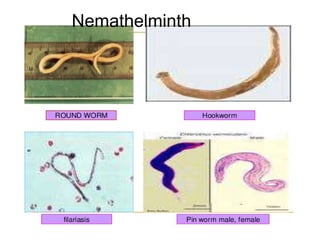
Nemathelminths (round bodied worms)
●
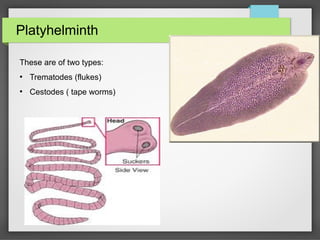
Platyhelminths (flat-boddied worms)
Nemathelminth
Platyhelminth
These are of two types:
●
Trematodes (flukes)
●
Cestodes ( tape worms)
Sub-Types
Trematodes include
●
Blood flukes (schistosomiasis)
●
Liver flukes ( clonorchiasis )
●
Intestinal flukes ( fasciolopsiasis)
●
Lung flukes (paragonimiasis)
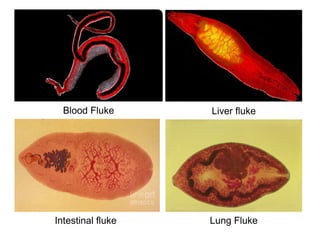
Blood Fluke
Lung Fluke
Liver fluke
Intestinal fluke
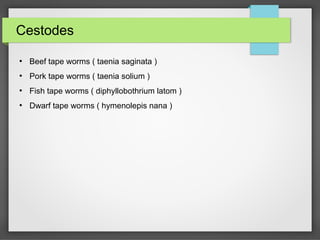
Cestodes
●
Beef tape worms ( taenia saginata )
●
Pork tape worms ( taenia solium )
●
Fish tape worms ( diphyllobothrium latom )
●
Dwarf tape worms ( hymenolepis nana )
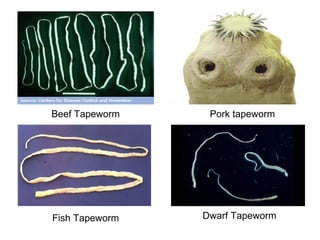
Beef Tapeworm
Dwarf Tapeworm
Pork tapeworm
Fish Tapeworm
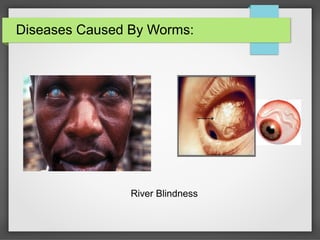
Diseases Caused By Worms:
River Blindness
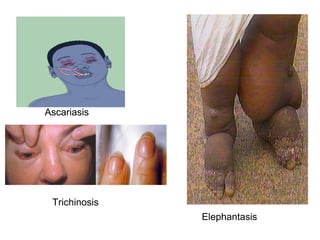
AscariasisAscariasis
Elephantasis
Trichinosis
Anthelminthic Drugs
●
Drugs used to get rid of helminths are called anthelminthic drugs
●
They may be:
– Vermicide (kill)
– Vermifuge (expel)
Mechanism of action
Based on mechanism of action in parasites
a. Drugs affecting energy production
i. Inhibitors of fumarate reductase and glucose uptake, binding of
tubulin in mitochondria.
ii. Inhibitors of (mitochdrial) phosphorylation
iii. Inhibitors of glycolysis
b. Drugs causing paralysis
i. Cholinergic agents
ii. GABA agonists
iii. Muscle hyperpolarizer
iv. Acetyl cholinesterase inhibitors
v. Acetylcholine mimic
c. Other Actions
i. Affecting permeability of the cell membrane
ii. Vaculation of teguments
d. Unknown
Disruption of the teguments
Ideal anthelminths
●
Orally effective in single dose
●
Wide safety of margin with highest toxicity to worms
• Wide therapeutic index
• Broad spectrum activity
• Activity against mature and immature stages
• Single dose efficacy
• Ease of administration
• Economical
• Compatibility with other drugs
Drug Classification
Against:
– Nematodes
– Trematodes
– Cestodes
– Trematodes as well as cestodes
Drug Classification
●
Nematodes:
– Pyrantel pamoate
– Levamisole
– Piperazine
– Ivermectin
– Diethylcarobamazine
– Thiabendazole
●
Trematodes:
– Metrifonate
– Oxamniquine
– Bithionol
– Triclabendazole
Drug Classification
●
Trematodes as well as cestodes
– Praziquantel
●
Cestodes
– Niclosamide
20
Based on Chemical Structure
i. Benzimidazoles
ii. Imidathiazoles
iii. Tetrahydropyrimidines
iv. Organophosphates
v. Piperazines
vi. Macrolides
vii. Unrelated Compounds
Benzimidazoles
• Inhibition of fumarate reductase system
• Glucose uptake
Members
• Thiabendazole
• Albendazole
• Cambendazole
• Fenbendazole
• Mebendazole
• Oxfendazole (R.T.L)
• Oxibendazole (R)
• Panbendazole
Benzimidazole pro-drugs
• Febental – Fenbendazole
• Netobimin - Albendazole
22
Imidathiazoles
• Nicotine like effect
• Immunomodulatory effect
Members
• Tetramisole (R)
• Levamisole (R)
23
Tetrahydropyrimidines
• Cholinergic effect
Members
• Morental (R)
• Pyrentel (R)
• Oxantel (R)
24
Organophosphorus Compounds
• Inhibit Cholinesterases and ali-esterases
Members
• Coumaphos (Asuntol)
• Dichlorvos
• Haloxon
• Napthalophos (Rametin)
• Trichlorphon (Neguvon)
25
Piperazines
• Hyperpolarization
Piperazine salts
• Phosphates
• Citrate
• Adipate
• Sulphate
26
Macrolides
• Avermectins
-Ivermectin
-Abamectin
-Doramectin
• Milbemycins
-milbemycin D
-moxidectin
-milbemycin oxime
27
Unrelated individual entities
• Phenothiazine (R)
• Diethylcarbamazine (R)
• Bunamidine (T)
• Niclosamide (T)
• Praziquantel (T)
• Oxyclozanide (L)
• Rafoxanide (L)
• Nitroxynil (L)
• Closantel (L)
• Clorsulon (L)
Mebendazole (Prototype)
●
Synthetic benzimidazole drivative
●
75% effective for tape worms but not for H. nana
●
Drug of choice for treatement of:
– Round worms
– Whip worms
– Hook worms
●
Alternative for treatment of:
– Trichinosis
– Visceral larva migrans
ADRs
●
No adverse effects with short term therapy, mild GIT disturbanes – nausea,
diarrhoea and abdominal pain
●
Allergic reaction, loss of hair and elevation of liver enzymes
●
Contra-indications:
– In pregnancy
– In liver cirrhosis
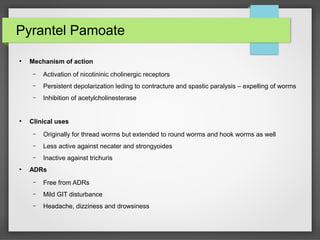
Pyrantel Pamoate
●
Mechanism of action
– Activation of nicotininic cholinergic receptors
– Persistent depolarization leding to contracture and spastic paralysis – expelling of worms
– Inhibition of acetylcholinesterase
●
Clinical uses
– Originally for thread worms but extended to round worms and hook worms as well
– Less active against necater and strongyoides
– Inactive against trichuris
●
ADRs
– Free from ADRs
– Mild GIT disturbance
– Headache, dizziness and drowsiness
Piperazine
●
MOA
– Hyperpolarization of Ascaris muscles GABA agonistic action of Cl-
channel opening
– Decreased responsiveness to Ach contractile response – flaccid
paralysis
●
Clinical uses
– Used for treatment of ascarsis and enterobios (as alternative)
●
ADRs
– Nausea, vomitting, abdominal pain and headache
– Neurotoxic and allergic reactions are rare
●
Contra-indications
– Renal insufficiency
– Epileptics
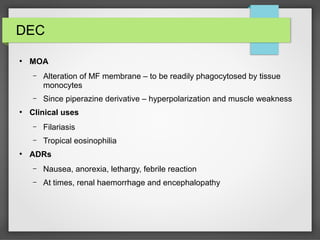
DEC
●
MOA
– Alteration of MF membrane – to be readily phagocytosed by tissue
monocytes
– Since piperazine derivative – hyperpolarization and muscle weakness
●
Clinical uses
– Filariasis
– Tropical eosinophilia
●
ADRs
– Nausea, anorexia, lethargy, febrile reaction
– At times, renal haemorrhage and encephalopathy
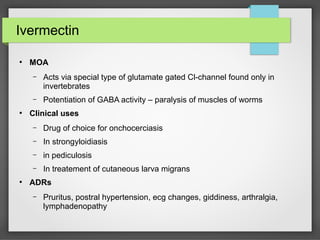
Ivermectin
●
MOA
– Acts via special type of glutamate gated Cl-channel found only in
invertebrates
– Potentiation of GABA activity – paralysis of muscles of worms
●
Clinical uses
– Drug of choice for onchocerciasis
– In strongyloidiasis
– in pediculosis
– In treatement of cutaneous larva migrans
●
ADRs
– Pruritus, postral hypertension, ecg changes, giddiness, arthralgia,
lymphadenopathy
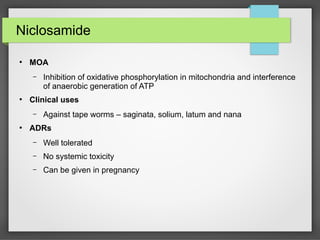
Niclosamide
●
MOA
– Inhibition of oxidative phosphorylation in mitochondria and interference
of anaerobic generation of ATP
●
Clinical uses
– Against tape worms – saginata, solium, latum and nana
●
ADRs
– Well tolerated
– No systemic toxicity
– Can be given in pregnancy
Praziquantel
●
MOA
– Rapidly taken up by worms
– Leakage of intracellular Ca++ causing paralysis
– Worms lose grip on intestinal wall including tissues and veins
– Acts against all stages of worms including larvae
– Other MOA – vacuolization of membrane and release of contents of tape
worms
●
Clinical uses
– Mainly on schisosomiasis and other trematodes, cestodes but not
nematodes
●
ADRs
– Drowsiness
– Dizziness
– Urticaria
Praziquantel
●
Contra-indication
– Inocular cysticercosis
Bithionol
●
MOA
– Uncouples parasites specific oxidative phosphorylation. By blocking ATP
synthesis, inhibits energy derived by helminth by anaerobic metabolism
●
Clinical Uses
– Drug of choice for fascioliasis and parogonimiasis
●
ADRs
– GIT disturbances
– Skin rashes
– Urticaria
●
Contra-indications
– Avoided in children below 8 years of age
Thank you

Anthelmintics Pharmacology

  • 1.
  • 2.
    Helminth The helminths aremacroscopic, multicellular organisms, having their own digestive, excretory, reproductive and nervous system.
  • 3.
    Helminthiasis – A diseasein which part of the body is infested with one or more intestinal parasitic worms such as roundworm, tapeworms or flukes. – The worms usually infest the intestine but sometimes. they may invade the other organs.
  • 4.
    Types of Hilminth Theyare of two types: ● Nemathelminths (round bodied worms) ● Platyhelminths (flat-boddied worms)
  • 5.
  • 6.
    Platyhelminth These are oftwo types: ● Trematodes (flukes) ● Cestodes ( tape worms)
  • 7.
    Sub-Types Trematodes include ● Blood flukes(schistosomiasis) ● Liver flukes ( clonorchiasis ) ● Intestinal flukes ( fasciolopsiasis) ● Lung flukes (paragonimiasis)
  • 8.
    Blood Fluke Lung Fluke Liverfluke Intestinal fluke
  • 9.
    Cestodes ● Beef tape worms( taenia saginata ) ● Pork tape worms ( taenia solium ) ● Fish tape worms ( diphyllobothrium latom ) ● Dwarf tape worms ( hymenolepis nana )
  • 10.
    Beef Tapeworm Dwarf Tapeworm Porktapeworm Fish Tapeworm
  • 11.
    Diseases Caused ByWorms: River Blindness
  • 12.
  • 13.
    Anthelminthic Drugs ● Drugs usedto get rid of helminths are called anthelminthic drugs ● They may be: – Vermicide (kill) – Vermifuge (expel)
  • 14.
    Mechanism of action Basedon mechanism of action in parasites a. Drugs affecting energy production i. Inhibitors of fumarate reductase and glucose uptake, binding of tubulin in mitochondria. ii. Inhibitors of (mitochdrial) phosphorylation iii. Inhibitors of glycolysis b. Drugs causing paralysis i. Cholinergic agents ii. GABA agonists iii. Muscle hyperpolarizer iv. Acetyl cholinesterase inhibitors v. Acetylcholine mimic
  • 15.
    c. Other Actions i.Affecting permeability of the cell membrane ii. Vaculation of teguments d. Unknown Disruption of the teguments
  • 16.
    Ideal anthelminths ● Orally effectivein single dose ● Wide safety of margin with highest toxicity to worms • Wide therapeutic index • Broad spectrum activity • Activity against mature and immature stages • Single dose efficacy • Ease of administration • Economical • Compatibility with other drugs
  • 17.
    Drug Classification Against: – Nematodes –Trematodes – Cestodes – Trematodes as well as cestodes
  • 18.
    Drug Classification ● Nematodes: – Pyrantelpamoate – Levamisole – Piperazine – Ivermectin – Diethylcarobamazine – Thiabendazole ● Trematodes: – Metrifonate – Oxamniquine – Bithionol – Triclabendazole
  • 19.
    Drug Classification ● Trematodes aswell as cestodes – Praziquantel ● Cestodes – Niclosamide
  • 20.
    20 Based on ChemicalStructure i. Benzimidazoles ii. Imidathiazoles iii. Tetrahydropyrimidines iv. Organophosphates v. Piperazines vi. Macrolides vii. Unrelated Compounds
  • 21.
    Benzimidazoles • Inhibition offumarate reductase system • Glucose uptake Members • Thiabendazole • Albendazole • Cambendazole • Fenbendazole • Mebendazole • Oxfendazole (R.T.L) • Oxibendazole (R) • Panbendazole Benzimidazole pro-drugs • Febental – Fenbendazole • Netobimin - Albendazole
  • 22.
    22 Imidathiazoles • Nicotine likeeffect • Immunomodulatory effect Members • Tetramisole (R) • Levamisole (R)
  • 23.
    23 Tetrahydropyrimidines • Cholinergic effect Members •Morental (R) • Pyrentel (R) • Oxantel (R)
  • 24.
    24 Organophosphorus Compounds • InhibitCholinesterases and ali-esterases Members • Coumaphos (Asuntol) • Dichlorvos • Haloxon • Napthalophos (Rametin) • Trichlorphon (Neguvon)
  • 25.
    25 Piperazines • Hyperpolarization Piperazine salts •Phosphates • Citrate • Adipate • Sulphate
  • 26.
  • 27.
    27 Unrelated individual entities •Phenothiazine (R) • Diethylcarbamazine (R) • Bunamidine (T) • Niclosamide (T) • Praziquantel (T) • Oxyclozanide (L) • Rafoxanide (L) • Nitroxynil (L) • Closantel (L) • Clorsulon (L)
  • 28.
    Mebendazole (Prototype) ● Synthetic benzimidazoledrivative ● 75% effective for tape worms but not for H. nana ● Drug of choice for treatement of: – Round worms – Whip worms – Hook worms ● Alternative for treatment of: – Trichinosis – Visceral larva migrans
  • 29.
    ADRs ● No adverse effectswith short term therapy, mild GIT disturbanes – nausea, diarrhoea and abdominal pain ● Allergic reaction, loss of hair and elevation of liver enzymes ● Contra-indications: – In pregnancy – In liver cirrhosis
  • 30.
    Pyrantel Pamoate ● Mechanism ofaction – Activation of nicotininic cholinergic receptors – Persistent depolarization leding to contracture and spastic paralysis – expelling of worms – Inhibition of acetylcholinesterase ● Clinical uses – Originally for thread worms but extended to round worms and hook worms as well – Less active against necater and strongyoides – Inactive against trichuris ● ADRs – Free from ADRs – Mild GIT disturbance – Headache, dizziness and drowsiness
  • 31.
    Piperazine ● MOA – Hyperpolarization ofAscaris muscles GABA agonistic action of Cl- channel opening – Decreased responsiveness to Ach contractile response – flaccid paralysis ● Clinical uses – Used for treatment of ascarsis and enterobios (as alternative) ● ADRs – Nausea, vomitting, abdominal pain and headache – Neurotoxic and allergic reactions are rare ● Contra-indications – Renal insufficiency – Epileptics
  • 32.
    DEC ● MOA – Alteration ofMF membrane – to be readily phagocytosed by tissue monocytes – Since piperazine derivative – hyperpolarization and muscle weakness ● Clinical uses – Filariasis – Tropical eosinophilia ● ADRs – Nausea, anorexia, lethargy, febrile reaction – At times, renal haemorrhage and encephalopathy
  • 33.
    Ivermectin ● MOA – Acts viaspecial type of glutamate gated Cl-channel found only in invertebrates – Potentiation of GABA activity – paralysis of muscles of worms ● Clinical uses – Drug of choice for onchocerciasis – In strongyloidiasis – in pediculosis – In treatement of cutaneous larva migrans ● ADRs – Pruritus, postral hypertension, ecg changes, giddiness, arthralgia, lymphadenopathy
  • 34.
    Niclosamide ● MOA – Inhibition ofoxidative phosphorylation in mitochondria and interference of anaerobic generation of ATP ● Clinical uses – Against tape worms – saginata, solium, latum and nana ● ADRs – Well tolerated – No systemic toxicity – Can be given in pregnancy
  • 35.
    Praziquantel ● MOA – Rapidly takenup by worms – Leakage of intracellular Ca++ causing paralysis – Worms lose grip on intestinal wall including tissues and veins – Acts against all stages of worms including larvae – Other MOA – vacuolization of membrane and release of contents of tape worms ● Clinical uses – Mainly on schisosomiasis and other trematodes, cestodes but not nematodes ● ADRs – Drowsiness – Dizziness – Urticaria
  • 36.
  • 37.
    Bithionol ● MOA – Uncouples parasitesspecific oxidative phosphorylation. By blocking ATP synthesis, inhibits energy derived by helminth by anaerobic metabolism ● Clinical Uses – Drug of choice for fascioliasis and parogonimiasis ● ADRs – GIT disturbances – Skin rashes – Urticaria ● Contra-indications – Avoided in children below 8 years of age
  • 38.