Central Venous Line:
Insertion Technique & Complications
Dr Jebish Pradhan
NAIHS
Mini Topic Presentation
2025 November 25
Definition
Central venous access is defined
as, placement of a catheter such
that the catheter is inserted into a
venous great vessel, and its terminal
lumen rests within the Superior
Vena Cava (SVC), Inferior Vena Cava
(IVC), or the right atrium.
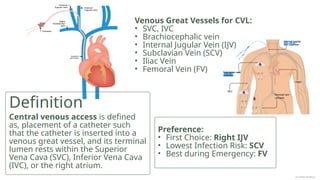
Venous Great Vessels for CVL:
• SVC, IVC
• Brachiocephalic vein
• Internal Jugular Vein (IJV)
• Subclavian Vein (SCV)
• Iliac Vein
• Femoral Vein (FV)
Preference:
• First Choice: Right IJV
• Lowest Infection Risk: SCV
• Best during Emergency: FV
Dr Jebish Pradhan
• Active Skin/Soft Tissue Infection
• Anatomical distortion at the site
• Vascular injury proximal or distal to the site of the catheter insertion
• Relative Contraindications: Coagulopathy, Thrombocytopenia, Morbid
Obesity.
• Hemodynamic Support & Monitoring
• Administration of Agents
• Access Requirements
• Complex Interventions
Indications
Contraindications
Dr Jebish Pradhan
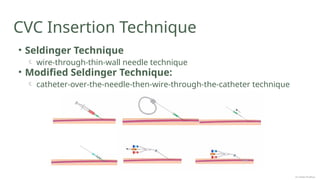
CVC Insertion Technique
• Seldinger Technique
 wire-through-thin-wall needle technique
• Modified Seldinger Technique:
 catheter-over-the-needle-then-wire-through-the-catheter technique
Dr Jebish Pradhan
Pre-Procedure Preparation
• Confirm indication.
• Check coagulation profile (at least when less
emergent).
• Obtain Consent.
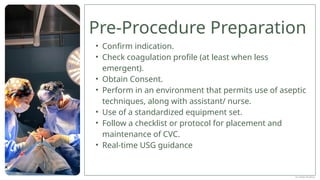
• Perform in an environment that permits use of aseptic
techniques, along with assistant/ nurse.
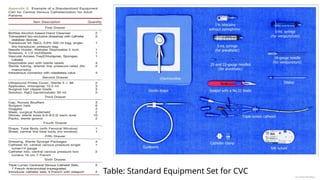
• Use of a standardized equipment set.
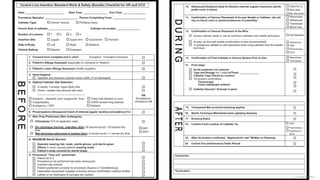
• Follow a checklist or protocol for placement and
maintenance of CVC.
• Real-time USG guidance
Dr Jebish Pradhan
Table: Standard Equipment Set for CVC
Dr Jebish Pradhan
Dr Jebish Pradhan
CVC Procedural Steps
Patient Positioning: Trendelenburg (IJ & SC
access); Supine (Femoral access) 
Aseptic Preparation 
USG Identification [IJV: Compressible, non
pulsatile vessel, lateral to carotid] 
Local Anesthesia [field flooded with LA, distorts
anatomy] 
Venous Puncture under USG guidance [must
visualize the needle entering the vein; aspirate
dark, non-pulsatile blood to confirm] 
Dr Jebish Pradhan
CVC Procedural Steps
Guidewire Insertion [over a stable needle,
advanced slowly; if resistance, stop & recheck
needle position; confirm wire in the vein with USG]

Remove Needle [Wire kept straight and stable by
holding firmly with other hand] 
Skin Nick beside wire [facilitate entry point for
dilator and CVC] 
Dilatation [advance dilator over wire with twisting
motion gently] 
Catheter Insertion [over the wire, to measured
depth; ~15cm Rt IJV to SVC / push until hub
Dr Jebish Pradhan
CVC Procedural Steps
Aspiration and Flushing of each lumen 
Secure [2 sutures to secure catheter to skin] 
Dressing [Sterile Transparent Dressing] 
CXR [confirm tip position & r/o Pneumothorax]
Clear Documentation
Dr Jebish Pradhan
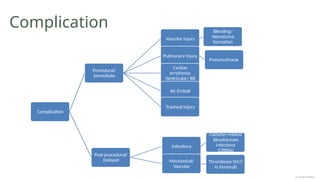
Complication
Complication
Procedural/
Immediate
Vascular Injury
Bleeding/
Hematoma
formation
Pulmonary Injury
Pneumothorax
Cardiac
Arrythmia:
Ventricular/ BB
Air Emboli
Tracheal Injury
Post-procedural/
Delayed
Infections
Catheter-related
bloodstream
infections
(CRBSIs)
Mechanical/
Vascular
Thrombosis (M/C
in Femoral)
Dr Jebish Pradhan
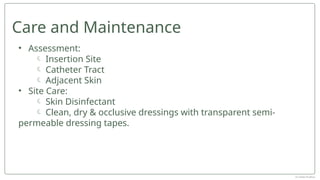
• Assessment:
 Insertion Site
 Catheter Tract
 Adjacent Skin
• Site Care:
 Skin Disinfectant
 Clean, dry & occlusive dressings with transparent semi-
permeable dressing tapes.
Care and Maintenance
Dr Jebish Pradhan
• Seldinger technique is used to obtain safe access to blood
vessels and other hollow organs, where in CVC, the modified
Seldinger technique is noted to provide more stable venous
access.
• Infection prevention should be the utmost priority.
• Confirm venous access by objective means (e.g., manometry,
ultrasound, blood gas) before dilation, and confirm final catheter
tip location (e.g., Chest X-ray for IJ/SC access).
• Daily assess and care the catheter and the site, keeping the
vigilance on the clinical necessity of the catheter and remove it
promptly.
Conclusion
Dr Jebish Pradhan
• Practice Guidelines for Central Venous Access 2020: An Updated Report
by the American Society of Anesthesiologists Task Force on Central
Venous Access*. Anesthesiology 132(1):p 8-43, January 2020. | DOI:
10.1097/ALN.0000000000002864
• Kolikof J, Peterson K, Williams C, et al. Central Venous Catheter Insertion.
[Updated 2025 Feb 4]. In: StatPearls [Internet]. Treasure Island (FL):
StatPearls Publishing; 2025 Jan-. Available from:
https://www.ncbi.nlm.nih.gov/books/NBK557798/
• Australian and New Zealand Intensive Care Society. Central Line
Insertion and Maintenance Guideline. Melbourne: ANZICS; 2012.
Available from:
https://www.anzics.org/wp-content/uploads/2018/08/ANZICS_Insertion
maintenance_guideline2012_04.pdf.
References
Dr Jebish Pradhan
THANK YOU

Central Venous Line: Insertion Technique & Complications

  • 1.
    Central Venous Line: InsertionTechnique & Complications Dr Jebish Pradhan NAIHS Mini Topic Presentation 2025 November 25
  • 2.
    Definition Central venous accessis defined as, placement of a catheter such that the catheter is inserted into a venous great vessel, and its terminal lumen rests within the Superior Vena Cava (SVC), Inferior Vena Cava (IVC), or the right atrium. Venous Great Vessels for CVL: • SVC, IVC • Brachiocephalic vein • Internal Jugular Vein (IJV) • Subclavian Vein (SCV) • Iliac Vein • Femoral Vein (FV) Preference: • First Choice: Right IJV • Lowest Infection Risk: SCV • Best during Emergency: FV Dr Jebish Pradhan
  • 3.
    • Active Skin/SoftTissue Infection • Anatomical distortion at the site • Vascular injury proximal or distal to the site of the catheter insertion • Relative Contraindications: Coagulopathy, Thrombocytopenia, Morbid Obesity. • Hemodynamic Support & Monitoring • Administration of Agents • Access Requirements • Complex Interventions Indications Contraindications Dr Jebish Pradhan
  • 4.
    CVC Insertion Technique •Seldinger Technique  wire-through-thin-wall needle technique • Modified Seldinger Technique:  catheter-over-the-needle-then-wire-through-the-catheter technique Dr Jebish Pradhan
  • 5.
    Pre-Procedure Preparation • Confirmindication. • Check coagulation profile (at least when less emergent). • Obtain Consent. • Perform in an environment that permits use of aseptic techniques, along with assistant/ nurse. • Use of a standardized equipment set. • Follow a checklist or protocol for placement and maintenance of CVC. • Real-time USG guidance Dr Jebish Pradhan
  • 6.
    Table: Standard EquipmentSet for CVC Dr Jebish Pradhan
  • 7.
  • 8.
    CVC Procedural Steps PatientPositioning: Trendelenburg (IJ & SC access); Supine (Femoral access)  Aseptic Preparation  USG Identification [IJV: Compressible, non pulsatile vessel, lateral to carotid]  Local Anesthesia [field flooded with LA, distorts anatomy]  Venous Puncture under USG guidance [must visualize the needle entering the vein; aspirate dark, non-pulsatile blood to confirm]  Dr Jebish Pradhan
  • 9.
    CVC Procedural Steps GuidewireInsertion [over a stable needle, advanced slowly; if resistance, stop & recheck needle position; confirm wire in the vein with USG]  Remove Needle [Wire kept straight and stable by holding firmly with other hand]  Skin Nick beside wire [facilitate entry point for dilator and CVC]  Dilatation [advance dilator over wire with twisting motion gently]  Catheter Insertion [over the wire, to measured depth; ~15cm Rt IJV to SVC / push until hub Dr Jebish Pradhan
  • 10.
    CVC Procedural Steps Aspirationand Flushing of each lumen  Secure [2 sutures to secure catheter to skin]  Dressing [Sterile Transparent Dressing]  CXR [confirm tip position & r/o Pneumothorax] Clear Documentation Dr Jebish Pradhan
  • 11.
    Complication Complication Procedural/ Immediate Vascular Injury Bleeding/ Hematoma formation Pulmonary Injury Pneumothorax Cardiac Arrythmia: Ventricular/BB Air Emboli Tracheal Injury Post-procedural/ Delayed Infections Catheter-related bloodstream infections (CRBSIs) Mechanical/ Vascular Thrombosis (M/C in Femoral) Dr Jebish Pradhan
  • 12.
    • Assessment:  InsertionSite  Catheter Tract  Adjacent Skin • Site Care:  Skin Disinfectant  Clean, dry & occlusive dressings with transparent semi- permeable dressing tapes. Care and Maintenance Dr Jebish Pradhan
  • 13.
    • Seldinger techniqueis used to obtain safe access to blood vessels and other hollow organs, where in CVC, the modified Seldinger technique is noted to provide more stable venous access. • Infection prevention should be the utmost priority. • Confirm venous access by objective means (e.g., manometry, ultrasound, blood gas) before dilation, and confirm final catheter tip location (e.g., Chest X-ray for IJ/SC access). • Daily assess and care the catheter and the site, keeping the vigilance on the clinical necessity of the catheter and remove it promptly. Conclusion Dr Jebish Pradhan
  • 14.
    • Practice Guidelinesfor Central Venous Access 2020: An Updated Report by the American Society of Anesthesiologists Task Force on Central Venous Access*. Anesthesiology 132(1):p 8-43, January 2020. | DOI: 10.1097/ALN.0000000000002864 • Kolikof J, Peterson K, Williams C, et al. Central Venous Catheter Insertion. [Updated 2025 Feb 4]. In: StatPearls [Internet]. Treasure Island (FL): StatPearls Publishing; 2025 Jan-. Available from: https://www.ncbi.nlm.nih.gov/books/NBK557798/ • Australian and New Zealand Intensive Care Society. Central Line Insertion and Maintenance Guideline. Melbourne: ANZICS; 2012. Available from: https://www.anzics.org/wp-content/uploads/2018/08/ANZICS_Insertion maintenance_guideline2012_04.pdf. References Dr Jebish Pradhan
  • 15.

Editor's Notes

  • #3 Indications: • Hemodynamic Support & Monitoring: Needed for hemodynamic instability requiring vasopressor support or monitoring, including measurement of central venous pressure (CVP). • Administration of Agents: To instill medications incompatible with peripheral intravenous access [like hyperosmolar agents or agents known to cause vein scarring (phlebosclerosis), chemotherapy, total parenteral nutrition (TPN), or other acidic medications] • Access Requirements: Inadequate peripheral IV access or the need for multiple IVs for resuscitation/massive transfusion protocols. • Complex Interventions: To facilitate high fluid volume extracorporeal therapies (dialysis, plasmapheresis) or venous interventions such as transvenous cardiac pacing or filter placement. Contraindications • Active Skin/Soft Tissue Infection at the potential site of the Central Line. • Anatomical distortion at the site which includes implantable/indwelling prosthetics, such as hemodialysis catheters and pacemakers; or due to congenital anomalies or trauma. • Vascular injury proximal or distal to the site of the catheter insertion, such as in traumatic injuries. • Relative Contraindications: Coagulopathy, Thrombocytopenia, Morbid Obesity
  • #4 Seldinger To obtain safe access to blood vessels and other hollow organs. The catheter-over-the-needle technique (Modified Seldinger) is noted to provide more stable venous access.