HOMEOSTASIS Ability of the body to maintain a relatively constant  internal environment  necessary for life.
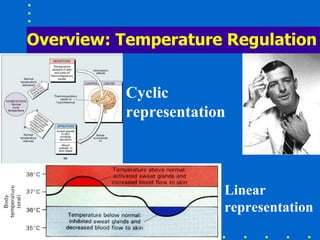
Overview: Temperature Regulation Cyclic representation Linear representation
Temperature Regulation Allows humans to cope with a wide range of environments                            
Mammals are endothermic homeotherms, which is a very precise way of saying they regulate their own body temperature. It is worth noting that not all organisms do so because it would in fact be disadvantageous for some to do so. Furthermore some organisms regulate their body temperature solely through behavioural methods. Temperature Regulation
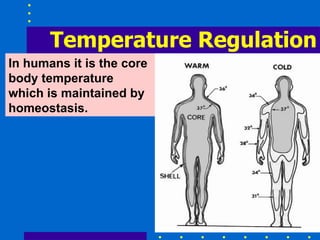
In humans it is the core body temperature which is maintained by homeostasis. Temperature Regulation
Components Receptors   1. Thermoreceptors in the skin 2. Thermoreceptors in the hypothalamus Coordinator The thermoregulatory centre in the hypothalamus (subdivided into heat gain centre and heat loss centre)   Effectors   Sweat glands Hair erector muscles Arterioles supplying skin capillaries Skeletal muscles Glands
Hypothalamus (of a sheep)
Hypothalamus
Skin based effectors
Skin based effectors – responding to heat gain Effector Response Arterioles supplying skin capillaries   The muscles relax – this is known as vasodilation. The effect of this is to increases the blood flow to the surface of the skin causing increased heat loss by radiation. Sweat glands The glands secrete sweat onto the surface of the skin. The sweat is composed mainly of water, which evaporates from the skin surface. As water has a high latent heat of evaporation the evaporating sweat removes heat from the surface of the skin. Hair erector muscles The muscles relax – this lowers the hairs on the skin surface. The hairs do not trap air when laid flat so they allow heat to be removed more easily by convection.
Skin based effectors – responding to heat loss Effector Response Arterioles supplying skin capillaries   The muscle contract – this is known as vasoconstriction. Blood flows through the shunt vessel as this is the path of least resistance. Less blood flows to the surface of the skin so there is less heat loss by radiation.   Sweat glands The sweat glands stop producing sweat therefore stopping the heat loss of evaporating sweat. Hair erector muscles The muscle contract – this raises the hairs on the surface of the skin. The effect of this is to reduce airflow therefore reducing convection of heat from the skin.
 
Effectors Other effectors and responses Another well-known response to a lowered core temperature is shivering. The effectors for this response are the body’s skeletal muscles which contract and relax involuntarily to generate heat.  A lowered core temperature also stimulates the release of the hormones adreneline and thyroxine from the adrenal and thyroid glands. Both these hormones increase the body’s metabolic rate again generating heat.
Shivering
Metabolic changes
         stimulus is the increase in blood temperature            this is caused by exercise/increased respiration/muscle contraction           the increase blood temperature is detected by receptors in the hypothalamus           the hypothalamus also acts as the co-ordinator           the effectors are muscles of arterioles           and sweat glands           response to arteriole muscles stimulation is vasodilation           which causes increased blood flow to the skin capillaries           which causes increased heat loss by radiation           response to sweat gland stimulation is increased sweating           which causes increased heat loss by the latent heat of evaporation Responding to vigorous exercise
1. All living organisms exist in changing external environments and many are able to control their internal environments. (a)  Explain how the body of a mammal may respond to a rise in the environmental temperature.   (8marks) Exam questions
Thermoreceptors in skin; nervous impulse; to hypothalamus; blood temperature monitored; heat loss centre involved; vasodilation / dilation of arterioles; more blood to skin surface; more heat lost by radiation; piloerector muscles relax; hairs flatten on skin surface; less insulation; sweating initiated / increased; panting / licking; evaporation removes latent heat; thinner fur;  migration; drop in metabolic rate / use less brown fat; accept long term changes such as less fat deposition; accept one behavioural process; max. 8   Exam answers
2. Size matters for marathon runners. Big athletes produce more heat and find it harder to keep cool. Shape matters too - a tall, thin runner has fewer problems keeping cool than a short, tubby runner of the same body mass. A 65 kg athlete running a marathon in 2 hours 10 minutes in reasonably dry conditions can avoid overheating at air temperatures up to 37 °C, but in humid conditions the same level of performance is possible only at temperatures below about 17 °C. (a) Explain how athletes produce heat when they run.  (2) (b) Why does a ‘tall, thin runner have fewer problems keeping cool than a short, tubby runner of the same body mass’?  (2) (c) Explain why runners are more likely to overheat in humid conditions.  (3) (d) Describe how the body responds to a rise in core body temperature.  (5) (Total 12 marks) Exam questions
2. (a) Respiration for  muscular  activity;  (energy ‘needed/used’ for respiration’ etc, disqualifies) respiration inefficient / releases waste heat / all energy ‘ends up as ‘heat’ 2 (b) Larger surface area: volume ratio,  or  less fat under skin; more rapid / more heat loss from body surface. 2 (c) Humidity reduces diffusion gradient / less difference in water potential; less evaporation of sweat; less cooling due to  use of heat energy  for evaporation of sweat. 3 (d) Temperature receptors stimulated in;  (in skin disqualifies) hypothalamus; heat loss centre stimulated; nerve impulses to sweat glands; increase rate of / start sweat production; nerve impulses to skin arterioles; vasodilation  (ref to vessels moving disqualifies) max 5 [12] Exam answers

Temperature regulation

  • 1.
    HOMEOSTASIS Ability ofthe body to maintain a relatively constant internal environment necessary for life.
  • 2.
    Overview: Temperature RegulationCyclic representation Linear representation
  • 3.
    Temperature Regulation Allowshumans to cope with a wide range of environments                            
  • 4.
    Mammals are endothermichomeotherms, which is a very precise way of saying they regulate their own body temperature. It is worth noting that not all organisms do so because it would in fact be disadvantageous for some to do so. Furthermore some organisms regulate their body temperature solely through behavioural methods. Temperature Regulation
  • 5.
    In humans itis the core body temperature which is maintained by homeostasis. Temperature Regulation
  • 6.
    Components Receptors 1. Thermoreceptors in the skin 2. Thermoreceptors in the hypothalamus Coordinator The thermoregulatory centre in the hypothalamus (subdivided into heat gain centre and heat loss centre) Effectors Sweat glands Hair erector muscles Arterioles supplying skin capillaries Skeletal muscles Glands
  • 7.
  • 8.
  • 9.
  • 10.
  • 11.
  • 12.
  • 13.
    Skin based effectors– responding to heat gain Effector Response Arterioles supplying skin capillaries The muscles relax – this is known as vasodilation. The effect of this is to increases the blood flow to the surface of the skin causing increased heat loss by radiation. Sweat glands The glands secrete sweat onto the surface of the skin. The sweat is composed mainly of water, which evaporates from the skin surface. As water has a high latent heat of evaporation the evaporating sweat removes heat from the surface of the skin. Hair erector muscles The muscles relax – this lowers the hairs on the skin surface. The hairs do not trap air when laid flat so they allow heat to be removed more easily by convection.
  • 14.
    Skin based effectors– responding to heat loss Effector Response Arterioles supplying skin capillaries The muscle contract – this is known as vasoconstriction. Blood flows through the shunt vessel as this is the path of least resistance. Less blood flows to the surface of the skin so there is less heat loss by radiation. Sweat glands The sweat glands stop producing sweat therefore stopping the heat loss of evaporating sweat. Hair erector muscles The muscle contract – this raises the hairs on the surface of the skin. The effect of this is to reduce airflow therefore reducing convection of heat from the skin.
  • 15.
  • 16.
    Effectors Other effectorsand responses Another well-known response to a lowered core temperature is shivering. The effectors for this response are the body’s skeletal muscles which contract and relax involuntarily to generate heat. A lowered core temperature also stimulates the release of the hormones adreneline and thyroxine from the adrenal and thyroid glands. Both these hormones increase the body’s metabolic rate again generating heat.
  • 17.
  • 18.
  • 19.
             stimulusis the increase in blood temperature          this is caused by exercise/increased respiration/muscle contraction         the increase blood temperature is detected by receptors in the hypothalamus         the hypothalamus also acts as the co-ordinator          the effectors are muscles of arterioles          and sweat glands          response to arteriole muscles stimulation is vasodilation          which causes increased blood flow to the skin capillaries          which causes increased heat loss by radiation          response to sweat gland stimulation is increased sweating          which causes increased heat loss by the latent heat of evaporation Responding to vigorous exercise
  • 20.
    1. All livingorganisms exist in changing external environments and many are able to control their internal environments. (a) Explain how the body of a mammal may respond to a rise in the environmental temperature. (8marks) Exam questions
  • 21.
    Thermoreceptors in skin;nervous impulse; to hypothalamus; blood temperature monitored; heat loss centre involved; vasodilation / dilation of arterioles; more blood to skin surface; more heat lost by radiation; piloerector muscles relax; hairs flatten on skin surface; less insulation; sweating initiated / increased; panting / licking; evaporation removes latent heat; thinner fur; migration; drop in metabolic rate / use less brown fat; accept long term changes such as less fat deposition; accept one behavioural process; max. 8 Exam answers
  • 22.
    2. Size mattersfor marathon runners. Big athletes produce more heat and find it harder to keep cool. Shape matters too - a tall, thin runner has fewer problems keeping cool than a short, tubby runner of the same body mass. A 65 kg athlete running a marathon in 2 hours 10 minutes in reasonably dry conditions can avoid overheating at air temperatures up to 37 °C, but in humid conditions the same level of performance is possible only at temperatures below about 17 °C. (a) Explain how athletes produce heat when they run. (2) (b) Why does a ‘tall, thin runner have fewer problems keeping cool than a short, tubby runner of the same body mass’? (2) (c) Explain why runners are more likely to overheat in humid conditions. (3) (d) Describe how the body responds to a rise in core body temperature. (5) (Total 12 marks) Exam questions
  • 23.
    2. (a) Respirationfor muscular activity; (energy ‘needed/used’ for respiration’ etc, disqualifies) respiration inefficient / releases waste heat / all energy ‘ends up as ‘heat’ 2 (b) Larger surface area: volume ratio, or less fat under skin; more rapid / more heat loss from body surface. 2 (c) Humidity reduces diffusion gradient / less difference in water potential; less evaporation of sweat; less cooling due to use of heat energy for evaporation of sweat. 3 (d) Temperature receptors stimulated in; (in skin disqualifies) hypothalamus; heat loss centre stimulated; nerve impulses to sweat glands; increase rate of / start sweat production; nerve impulses to skin arterioles; vasodilation (ref to vessels moving disqualifies) max 5 [12] Exam answers