Quality Management
Dr.Zulcaif Ahmad
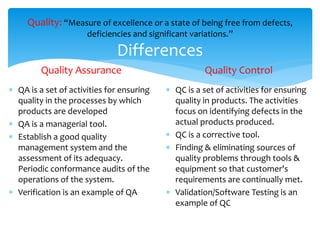
Quality: “Measure of excellence or a state of being free from defects,
deficiencies and significant variations.’’
Differences
Quality Assurance
 QA is a set of activities for ensuring
quality in the processes by which
products are developed
 QA is a managerial tool.
 Establish a good quality
management system and the
assessment of its adequacy.
Periodic conformance audits of the
operations of the system.
 Verification is an example of QA
Quality Control
 QC is a set of activities for ensuring
quality in products. The activities
focus on identifying defects in the
actual products produced.
 QC is a corrective tool.
 Finding & eliminating sources of
quality problems through tools &
equipment so that customer's
requirements are continually met.
 Validation/Software Testing is an
example of QC
Quality Management
QC
Techniques and activities
used to assure product
compliance to specification
QA
Quality through planned and
systematic activities like
validation process and
environment control and
documentation
Quality Management
 Customer focus
 Leadership
 Involvement of people
 Process approach
 System approach to management
 Continual improvement
 Factual approach to decision making
 Mutual beneficial supplier relationships
Principles in Quality Management
Quality
Management
Quality Assurance
GMP
Quality Control
Production
In-process
control
Release
control
Self
Inspection
Aspects of Quality Management
 GMP:
 It deals with section that guarantees that the
products are produced and examined within constant
quality system.
 GMP guidelines build quality into the product.
 Production is the center of the quality management
system. The quality of the production process is
monitored by self inspections, release control and in-
process control.
 Pharmaceutical production guarantees that a stable
and repetitive product quality is maintained.
Aspects of Quality Management
 Proper sampling & adequate testing
 Imperfect composition
 Missing ingredients
 Sub-potent or super-potent addition of ingredients.
 Mistakes in packaging or filling
 Mislabeling
 Lack of conformance to product registration
 QA begin with raw material and components being
testing and include In-process, Packaging, labeling ,
and finished product testing as well as batch auditing
and stability monitoring.
Sources of Quality Control
 Raw Material Control
 Active Material
 Antibiotics
 Inactive or Inert Materials
 In-process item control
Quality Control Programs adopted in
Pharma industry / Control of Quality
Variation
 Good raw material specification must be written in precise
terminology, must provide specific details of test methods,
type of instruments and manner of sampling and must be
properly identified.
 Quality assurance monograph
 It states that components be received, sampled, tested, and
stored in a reasonable way that rejected material be disposed
of ,that samples of tested components be retained and that
appropriate records of these steps be maintained.
 QA should keep preservation samples of active raw materials
that consist of at least twice the necessary quantity to perform
all tests required, to determine whether the raw material
meets the established specification.
Raw Materials Control
 Active Material
 Antibiotics
 Inactive or Inert Materials
 In-process item control
Environmental and microbiologic control and sanitation:
 Personal cleanliness
 Proper hair covering
 Clothing
 Floors, walls and ceilings should be resistant to external forces
 Capable of being easily cleaned
 Good repair
 Adequate ventilation
 Proper temperature
 Proper humidity
 Water supply may be potable, distilled, or deionized and must
be under adequate pressure to keep the water flowing.
Quality Assurance before Start-up
 Lachman/Lieberman’s the theory and practice of
Industrial Pharmacy, Fourth Edition, Chapter # 29
Quality Management, Quality Control and
Assurance, page # 1073-1088
 http://www.diffen.com/difference/Quality_Assuranc
e_vs_Quality_Control
Reference

Quality Management

  • 1.
  • 2.
    Quality: “Measure ofexcellence or a state of being free from defects, deficiencies and significant variations.’’ Differences Quality Assurance  QA is a set of activities for ensuring quality in the processes by which products are developed  QA is a managerial tool.  Establish a good quality management system and the assessment of its adequacy. Periodic conformance audits of the operations of the system.  Verification is an example of QA Quality Control  QC is a set of activities for ensuring quality in products. The activities focus on identifying defects in the actual products produced.  QC is a corrective tool.  Finding & eliminating sources of quality problems through tools & equipment so that customer's requirements are continually met.  Validation/Software Testing is an example of QC
  • 3.
    Quality Management QC Techniques andactivities used to assure product compliance to specification QA Quality through planned and systematic activities like validation process and environment control and documentation Quality Management
  • 4.
     Customer focus Leadership  Involvement of people  Process approach  System approach to management  Continual improvement  Factual approach to decision making  Mutual beneficial supplier relationships Principles in Quality Management
  • 5.
  • 6.
     GMP:  Itdeals with section that guarantees that the products are produced and examined within constant quality system.  GMP guidelines build quality into the product.  Production is the center of the quality management system. The quality of the production process is monitored by self inspections, release control and in- process control.  Pharmaceutical production guarantees that a stable and repetitive product quality is maintained. Aspects of Quality Management
  • 7.
     Proper sampling& adequate testing  Imperfect composition  Missing ingredients  Sub-potent or super-potent addition of ingredients.  Mistakes in packaging or filling  Mislabeling  Lack of conformance to product registration  QA begin with raw material and components being testing and include In-process, Packaging, labeling , and finished product testing as well as batch auditing and stability monitoring. Sources of Quality Control
  • 8.
     Raw MaterialControl  Active Material  Antibiotics  Inactive or Inert Materials  In-process item control Quality Control Programs adopted in Pharma industry / Control of Quality Variation
  • 9.
     Good rawmaterial specification must be written in precise terminology, must provide specific details of test methods, type of instruments and manner of sampling and must be properly identified.  Quality assurance monograph  It states that components be received, sampled, tested, and stored in a reasonable way that rejected material be disposed of ,that samples of tested components be retained and that appropriate records of these steps be maintained.  QA should keep preservation samples of active raw materials that consist of at least twice the necessary quantity to perform all tests required, to determine whether the raw material meets the established specification. Raw Materials Control
  • 10.
     Active Material Antibiotics  Inactive or Inert Materials  In-process item control
  • 11.
    Environmental and microbiologiccontrol and sanitation:  Personal cleanliness  Proper hair covering  Clothing  Floors, walls and ceilings should be resistant to external forces  Capable of being easily cleaned  Good repair  Adequate ventilation  Proper temperature  Proper humidity  Water supply may be potable, distilled, or deionized and must be under adequate pressure to keep the water flowing. Quality Assurance before Start-up
  • 12.
     Lachman/Lieberman’s thetheory and practice of Industrial Pharmacy, Fourth Edition, Chapter # 29 Quality Management, Quality Control and Assurance, page # 1073-1088  http://www.diffen.com/difference/Quality_Assuranc e_vs_Quality_Control Reference