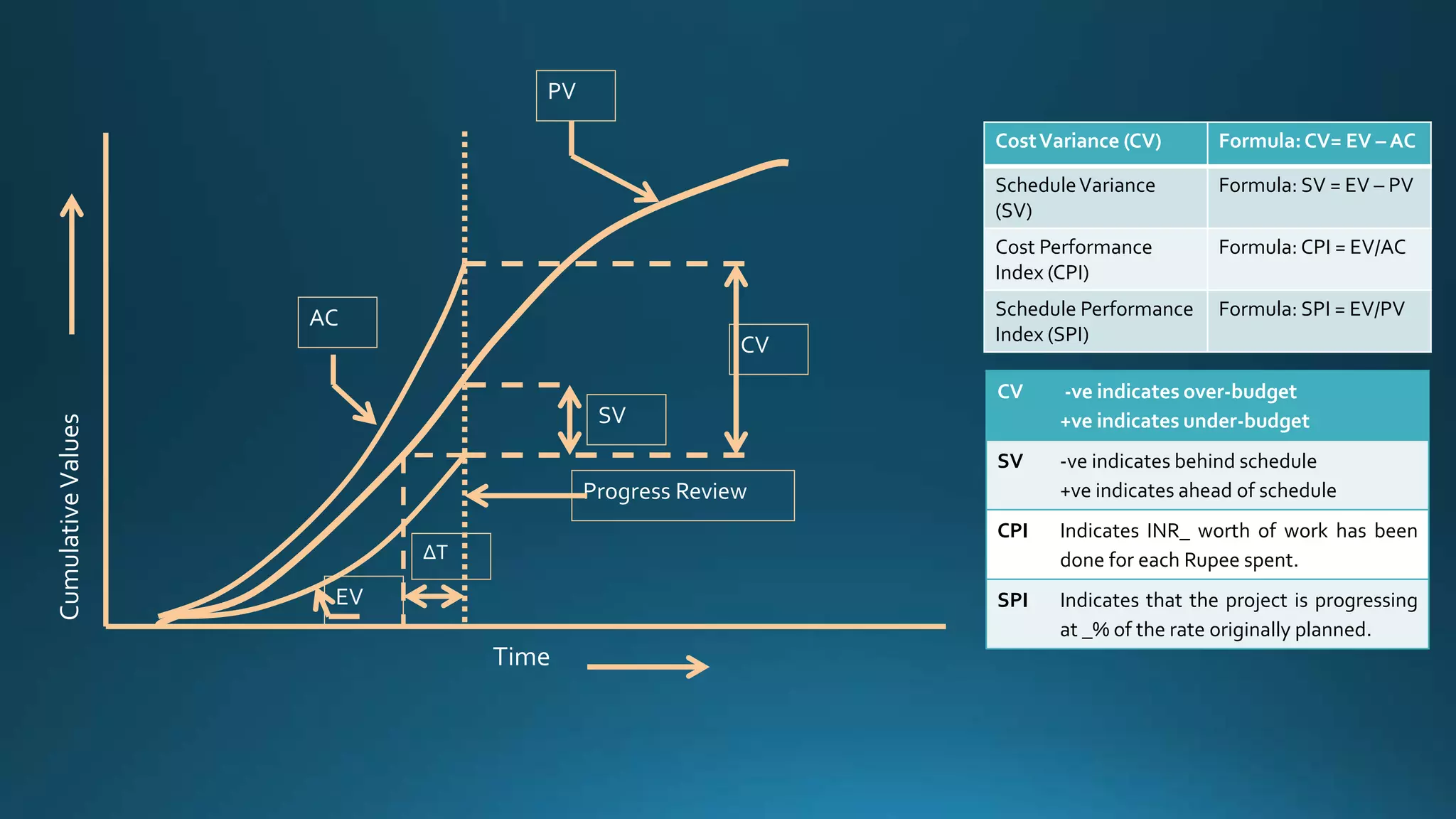
Progress Review
EV
PV
AC
SV
CV
ΔT
CumulativeValues
Time
CV -ve indicates over-budget
+ve indicates under-budget
SV -ve indicates behind schedule
+ve indicates ahead of schedule
CPI Indicates INR_ worth of work has been
done for each Rupee spent.
SPI Indicates that the project is progressing
at _% of the rate originally planned.
CostVariance (CV) Formula:CV= EV – AC
ScheduleVariance
(SV)
Formula: SV = EV – PV
Cost Performance
Index (CPI)
Formula: CPI = EV/AC
Schedule Performance
Index (SPI)
Formula: SPI = EV/PV
Item Formula Remark
Cost Variance (CV) EV – AC Negative value indicates over budget and positive
value indicates under budget
ScheduleVariance (SV) EV – PV Negative value indicates behind schedule and positive
value indicates ahead of schedule
Cost Performance Index (CPI) EV / AC Lesser than one indicates over budget and greater
than one indicates under budget
Schedule Performance Index (SPI) EV / PV Lesser than one indicates behind schedule and greater
than one indicates ahead of schedule
Estimate at Completion (EAC) BAC / CPI Considering that the rate of spending remains the
same
AC + ETC Considering that the current estimate is fundamentally
flawed
AC + (BAC – EV) Considering atypical variances
AC + [(BAC – EV) /CPI] Considering typical variances
Estimate to Complete (ETC) EAC – AC Considering that the current estimate is fundamentally
flawed
BAC – EV Considering atypical variances
(BAC – EV) / CPI Considering typical variances
Variance at Completion (VAC) BAC – EAC Considering the status of the budget expected at the
end of the project
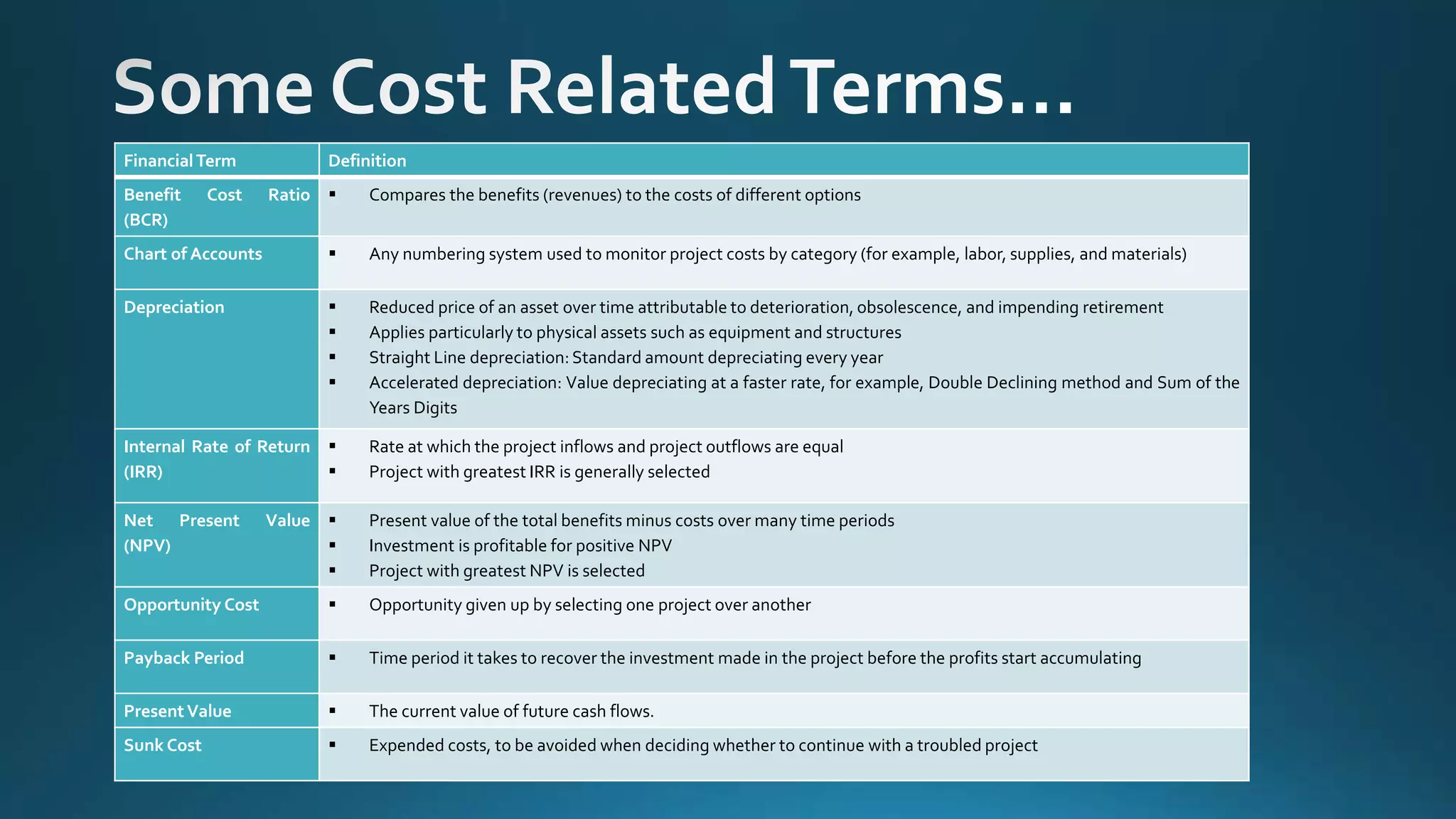
FinancialTerm Definition
Benefit Cost Ratio
(BCR)
 Compares the benefits (revenues) to the costs of different options
Chart of Accounts  Any numbering system used to monitor project costs by category (for example, labor, supplies, and materials)
Depreciation  Reduced price of an asset over time attributable to deterioration, obsolescence, and impending retirement
 Applies particularly to physical assets such as equipment and structures
 Straight Line depreciation:Standard amount depreciating every year
 Accelerated depreciation: Value depreciating at a faster rate, for example, Double Declining method and Sum of the
Years Digits
Internal Rate of Return
(IRR)
 Rate at which the project inflows and project outflows are equal
 Project with greatest IRR is generally selected
Net Present Value
(NPV)
 Present value of the total benefits minus costs over many time periods
 Investment is profitable for positive NPV
 Project with greatest NPV is selected
Opportunity Cost  Opportunity given up by selecting one project over another
Payback Period  Time period it takes to recover the investment made in the project before the profits start accumulating
Present Value  The current value of future cash flows.
Sunk Cost  Expended costs, to be avoided when deciding whether to continue with a troubled project
THANKS

Project Monitoring and Controlling Processes

  • 9.
    Progress Review EV PV AC SV CV ΔT CumulativeValues Time CV -veindicates over-budget +ve indicates under-budget SV -ve indicates behind schedule +ve indicates ahead of schedule CPI Indicates INR_ worth of work has been done for each Rupee spent. SPI Indicates that the project is progressing at _% of the rate originally planned. CostVariance (CV) Formula:CV= EV – AC ScheduleVariance (SV) Formula: SV = EV – PV Cost Performance Index (CPI) Formula: CPI = EV/AC Schedule Performance Index (SPI) Formula: SPI = EV/PV
  • 10.
    Item Formula Remark CostVariance (CV) EV – AC Negative value indicates over budget and positive value indicates under budget ScheduleVariance (SV) EV – PV Negative value indicates behind schedule and positive value indicates ahead of schedule Cost Performance Index (CPI) EV / AC Lesser than one indicates over budget and greater than one indicates under budget Schedule Performance Index (SPI) EV / PV Lesser than one indicates behind schedule and greater than one indicates ahead of schedule Estimate at Completion (EAC) BAC / CPI Considering that the rate of spending remains the same AC + ETC Considering that the current estimate is fundamentally flawed AC + (BAC – EV) Considering atypical variances AC + [(BAC – EV) /CPI] Considering typical variances Estimate to Complete (ETC) EAC – AC Considering that the current estimate is fundamentally flawed BAC – EV Considering atypical variances (BAC – EV) / CPI Considering typical variances Variance at Completion (VAC) BAC – EAC Considering the status of the budget expected at the end of the project
  • 11.
    FinancialTerm Definition Benefit CostRatio (BCR)  Compares the benefits (revenues) to the costs of different options Chart of Accounts  Any numbering system used to monitor project costs by category (for example, labor, supplies, and materials) Depreciation  Reduced price of an asset over time attributable to deterioration, obsolescence, and impending retirement  Applies particularly to physical assets such as equipment and structures  Straight Line depreciation:Standard amount depreciating every year  Accelerated depreciation: Value depreciating at a faster rate, for example, Double Declining method and Sum of the Years Digits Internal Rate of Return (IRR)  Rate at which the project inflows and project outflows are equal  Project with greatest IRR is generally selected Net Present Value (NPV)  Present value of the total benefits minus costs over many time periods  Investment is profitable for positive NPV  Project with greatest NPV is selected Opportunity Cost  Opportunity given up by selecting one project over another Payback Period  Time period it takes to recover the investment made in the project before the profits start accumulating Present Value  The current value of future cash flows. Sunk Cost  Expended costs, to be avoided when deciding whether to continue with a troubled project
  • 24.