

PROJECT MONITORING
SHOWAIB AHMED CHOWDHURY
Lecturer
Department of Building Engineering & Construction Management
Rajshahi University of Engineering & Technology(RUET)
Project Monitoring refers to the process of keeping track of
all project-related metrics including team performance and
task duration, identifying potential problems and taking
corrective actions necessary to ensure that the project is
within scope, on budget and meets the specified deadlines.
It clarifies the objectives of the project, links the activities to
the objectives, sets the target, reports the progress to the
management and keeps the management aware of the
problems which crop up during the implementation of the
project.
Why Project monitoring?
• To assess the project results
•To improve process planning
• To promote learning
• To understand stakeholder’s perspectives
• To ensure accountability
Questions have to be answered through Project
Monitoring
Are tasks being carried out as planned?
Are there any unforeseen consequences that arise as a
result of these tasks?
How is your team performing at a given period of
time?
What are the elements of the project that needs
changing?
What is the impact of these changes?
Will these actions lead you to your expected results?
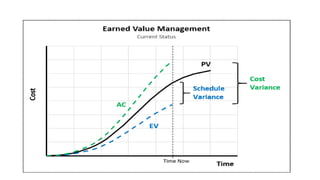
EARNED VALUE ANALYSIS
• Earned value analysis is the project monitoring tool that is used
to measure project progress which compares the actual work
completed at any time with respect to the original budget and
schedule.
• It also compares the work achieved with the cost of achieving
that work. From these three pieces of data, performance can be
trended and metrics calculated to express the status of the project.
• This is the practice of determining how much of the contract
budget has been ‘earned’ on the basis of the actual progress
which has been made to date and comparing this to the amount of
cost incurred and to the planned value.
Earned Value Calculation
Performing the earned value calculation at each predefined
status points is a 5 step process.
1. Gather Work Performance Information
2. Determine Schedule Status
3. Determine Cost Status
4. Forecasting
5. Reporting
Gathering Work Performance Information
To start, the project manager gathers four pieces of information
for each task:
Budget at Completion (BAC)
Planned Value (PV)
Earned Value (EV)
Actual Cost (AC)
These are the inputs to the earned value analysis.
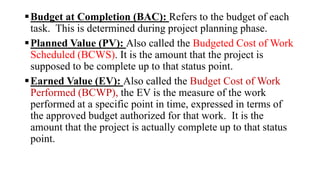
Budget at Completion (BAC): Refers to the budget of each
task. This is determined during project planning phase.
Planned Value (PV): Also called the Budgeted Cost of Work
Scheduled (BCWS). It is the amount that the project is
supposed to be complete up to that status point.
Earned Value (EV): Also called the Budget Cost of Work
Performed (BCWP), the EV is the measure of the work
performed at a specific point in time, expressed in terms of
the approved budget authorized for that work. It is the
amount that the project is actually complete up to that status
point.
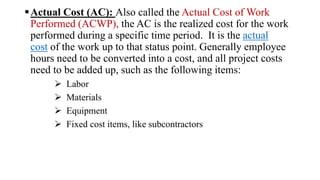
Actual Cost (AC): Also called the Actual Cost of Work
Performed (ACWP), the AC is the realized cost for the work
performed during a specific time period. It is the actual
cost of the work up to that status point. Generally employee
hours need to be converted into a cost, and all project costs
need to be added up, such as the following items:
 Labor
 Materials
 Equipment
 Fixed cost items, like subcontractors
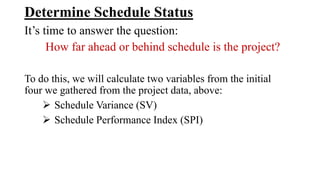
Determine Schedule Status
It’s time to answer the question:
How far ahead or behind schedule is the project?
To do this, we will calculate two variables from the initial
four we gathered from the project data, above:
 Schedule Variance (SV)
 Schedule Performance Index (SPI)
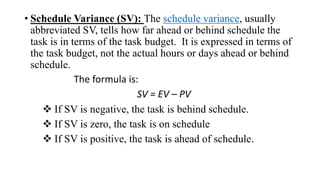
• Schedule Variance (SV): The schedule variance, usually
abbreviated SV, tells how far ahead or behind schedule the
task is in terms of the task budget. It is expressed in terms of
the task budget, not the actual hours or days ahead or behind
schedule.
The formula is:
SV = EV – PV
 If SV is negative, the task is behind schedule.
 If SV is zero, the task is on schedule
 If SV is positive, the task is ahead of schedule.
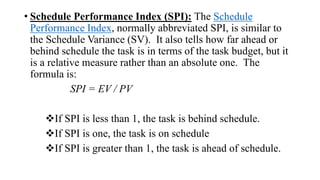
• Schedule Performance Index (SPI): The Schedule
Performance Index, normally abbreviated SPI, is similar to
the Schedule Variance (SV). It also tells how far ahead or
behind schedule the task is in terms of the task budget, but it
is a relative measure rather than an absolute one. The
formula is:
SPI = EV / PV
If SPI is less than 1, the task is behind schedule.
If SPI is one, the task is on schedule
If SPI is greater than 1, the task is ahead of schedule.
Determine Cost Status
In this step, we seek to answer the following question.
How far over or under budget is the project?
To do this we will calculate two more variables from the initial
four we gathered from the project data.
• Cost Variance (CV)
• Cost Performance Index (CPI)
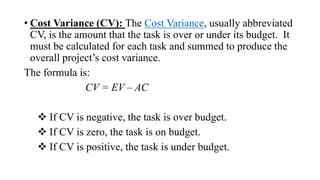
• Cost Variance (CV): The Cost Variance, usually abbreviated
CV, is the amount that the task is over or under its budget. It
must be calculated for each task and summed to produce the
overall project’s cost variance.
The formula is:
CV = EV – AC
 If CV is negative, the task is over budget.
 If CV is zero, the task is on budget.
 If CV is positive, the task is under budget.
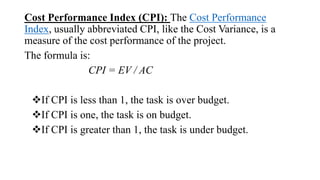
Cost Performance Index (CPI): The Cost Performance
Index, usually abbreviated CPI, like the Cost Variance, is a
measure of the cost performance of the project.
The formula is:
CPI = EV / AC
If CPI is less than 1, the task is over budget.
If CPI is one, the task is on budget.
If CPI is greater than 1, the task is under budget.
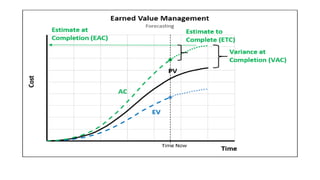
Forecasting
There are four variables which allow the project manager to
forecast the future performance of the project:
 Estimate to Complete (ETC)
 Estimate at Completion (EAC)
 Variance at Completion (VAC)
 To Complete Performance Index (TCPI)
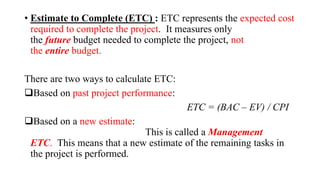
• Estimate to Complete (ETC) : ETC represents the expected cost
required to complete the project. It measures only
the future budget needed to complete the project, not
the entire budget.
There are two ways to calculate ETC:
Based on past project performance:
ETC = (BAC – EV) / CPI
Based on a new estimate:
This is called a Management
ETC. This means that a new estimate of the remaining tasks in
the project is performed.
• Estimate at Completion (EAC): The EAC is the full task or project cost
expected at completion (the new project budget).
It is based on how you expect the future of the performance of the project
to be:
Future performance will be based on the budgeted cost:
EAC = AC + (BAC – EV)
Future cost performance will be based on past cost performance:
 EAC = AC + [(BAC – EV) / CPI]
Future cost performance will be influenced by past schedule
performance
EAC = AC + [(BAC -EV) / (CPI x SPI)]
You could also use a combination of the past schedule or cost performance
to extrapolate the final project cost, where
EAC = AC + [(BAC -EV) / (0.8·CPI x 0.2·SPI)]
A new estimate is produced
EAC = AC + ETC
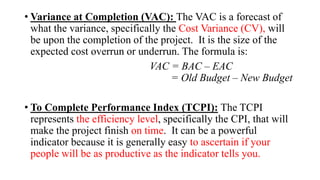
• Variance at Completion (VAC): The VAC is a forecast of
what the variance, specifically the Cost Variance (CV), will
be upon the completion of the project. It is the size of the
expected cost overrun or underrun. The formula is:
VAC = BAC – EAC
= Old Budget – New Budget
• To Complete Performance Index (TCPI): The TCPI
represents the efficiency level, specifically the CPI, that will
make the project finish on time. It can be a powerful
indicator because it is generally easy to ascertain if your
people will be as productive as the indicator tells you.
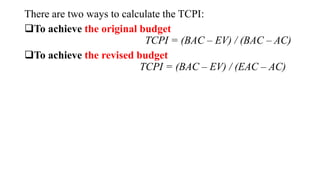
There are two ways to calculate the TCPI:
To achieve the original budget
TCPI = (BAC – EV) / (BAC – AC)
To achieve the revised budget
TCPI = (BAC – EV) / (EAC – AC)
Reporting
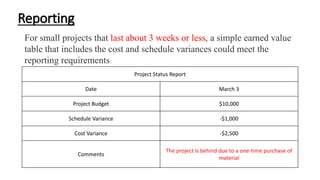
Project Status Report
Date March 3
Project Budget $10,000
Schedule Variance -$1,000
Cost Variance -$2,500
Comments
The project is behind due to a one-time purchase of
material
For small projects that last about 3 weeks or less, a simple earned value
table that includes the cost and schedule variances could meet the
reporting requirements:
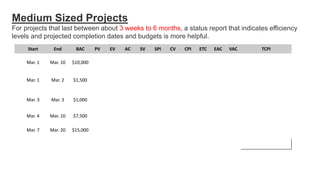
Start End BAC PV EV AC SV SPI CV CPI ETC EAC VAC TCPI
Mar. 1 Mar. 10 $10,000
Mar. 1 Mar. 2 $1,500
Mar. 3 Mar. 3 $1,000
Mar. 4 Mar. 10 $7,500
Mar. 7 Mar. 20 $15,000
Medium Sized Projects
For projects that last between about 3 weeks to 6 months, a status report that indicates efficiency
levels and projected completion dates and budgets is more helpful.
That’s it! You’re now on your way to earned value management on your projects and nailing every project
deadline and budget.

Project monitoring & Earned Value Analysis

  • 1.
    PROJECT MONITORING SHOWAIB AHMEDCHOWDHURY Lecturer Department of Building Engineering & Construction Management Rajshahi University of Engineering & Technology(RUET)
  • 2.
    Project Monitoring refersto the process of keeping track of all project-related metrics including team performance and task duration, identifying potential problems and taking corrective actions necessary to ensure that the project is within scope, on budget and meets the specified deadlines. It clarifies the objectives of the project, links the activities to the objectives, sets the target, reports the progress to the management and keeps the management aware of the problems which crop up during the implementation of the project.
  • 3.
    Why Project monitoring? •To assess the project results •To improve process planning • To promote learning • To understand stakeholder’s perspectives • To ensure accountability
  • 4.
    Questions have tobe answered through Project Monitoring Are tasks being carried out as planned? Are there any unforeseen consequences that arise as a result of these tasks? How is your team performing at a given period of time? What are the elements of the project that needs changing? What is the impact of these changes? Will these actions lead you to your expected results?
  • 5.
  • 6.
    • Earned valueanalysis is the project monitoring tool that is used to measure project progress which compares the actual work completed at any time with respect to the original budget and schedule. • It also compares the work achieved with the cost of achieving that work. From these three pieces of data, performance can be trended and metrics calculated to express the status of the project. • This is the practice of determining how much of the contract budget has been ‘earned’ on the basis of the actual progress which has been made to date and comparing this to the amount of cost incurred and to the planned value.
  • 8.
    Earned Value Calculation Performingthe earned value calculation at each predefined status points is a 5 step process. 1. Gather Work Performance Information 2. Determine Schedule Status 3. Determine Cost Status 4. Forecasting 5. Reporting
  • 9.
    Gathering Work PerformanceInformation To start, the project manager gathers four pieces of information for each task: Budget at Completion (BAC) Planned Value (PV) Earned Value (EV) Actual Cost (AC) These are the inputs to the earned value analysis.
  • 10.
    Budget at Completion(BAC): Refers to the budget of each task. This is determined during project planning phase. Planned Value (PV): Also called the Budgeted Cost of Work Scheduled (BCWS). It is the amount that the project is supposed to be complete up to that status point. Earned Value (EV): Also called the Budget Cost of Work Performed (BCWP), the EV is the measure of the work performed at a specific point in time, expressed in terms of the approved budget authorized for that work. It is the amount that the project is actually complete up to that status point.
  • 11.
    Actual Cost (AC):Also called the Actual Cost of Work Performed (ACWP), the AC is the realized cost for the work performed during a specific time period. It is the actual cost of the work up to that status point. Generally employee hours need to be converted into a cost, and all project costs need to be added up, such as the following items:  Labor  Materials  Equipment  Fixed cost items, like subcontractors
  • 12.
    Determine Schedule Status It’stime to answer the question: How far ahead or behind schedule is the project? To do this, we will calculate two variables from the initial four we gathered from the project data, above:  Schedule Variance (SV)  Schedule Performance Index (SPI)
  • 13.
    • Schedule Variance(SV): The schedule variance, usually abbreviated SV, tells how far ahead or behind schedule the task is in terms of the task budget. It is expressed in terms of the task budget, not the actual hours or days ahead or behind schedule. The formula is: SV = EV – PV  If SV is negative, the task is behind schedule.  If SV is zero, the task is on schedule  If SV is positive, the task is ahead of schedule.
  • 14.
    • Schedule PerformanceIndex (SPI): The Schedule Performance Index, normally abbreviated SPI, is similar to the Schedule Variance (SV). It also tells how far ahead or behind schedule the task is in terms of the task budget, but it is a relative measure rather than an absolute one. The formula is: SPI = EV / PV If SPI is less than 1, the task is behind schedule. If SPI is one, the task is on schedule If SPI is greater than 1, the task is ahead of schedule.
  • 15.
    Determine Cost Status Inthis step, we seek to answer the following question. How far over or under budget is the project? To do this we will calculate two more variables from the initial four we gathered from the project data. • Cost Variance (CV) • Cost Performance Index (CPI)
  • 16.
    • Cost Variance(CV): The Cost Variance, usually abbreviated CV, is the amount that the task is over or under its budget. It must be calculated for each task and summed to produce the overall project’s cost variance. The formula is: CV = EV – AC  If CV is negative, the task is over budget.  If CV is zero, the task is on budget.  If CV is positive, the task is under budget.
  • 17.
    Cost Performance Index(CPI): The Cost Performance Index, usually abbreviated CPI, like the Cost Variance, is a measure of the cost performance of the project. The formula is: CPI = EV / AC If CPI is less than 1, the task is over budget. If CPI is one, the task is on budget. If CPI is greater than 1, the task is under budget.
  • 19.
    Forecasting There are fourvariables which allow the project manager to forecast the future performance of the project:  Estimate to Complete (ETC)  Estimate at Completion (EAC)  Variance at Completion (VAC)  To Complete Performance Index (TCPI)
  • 20.
    • Estimate toComplete (ETC) : ETC represents the expected cost required to complete the project. It measures only the future budget needed to complete the project, not the entire budget. There are two ways to calculate ETC: Based on past project performance: ETC = (BAC – EV) / CPI Based on a new estimate: This is called a Management ETC. This means that a new estimate of the remaining tasks in the project is performed.
  • 21.
    • Estimate atCompletion (EAC): The EAC is the full task or project cost expected at completion (the new project budget). It is based on how you expect the future of the performance of the project to be: Future performance will be based on the budgeted cost: EAC = AC + (BAC – EV) Future cost performance will be based on past cost performance:  EAC = AC + [(BAC – EV) / CPI] Future cost performance will be influenced by past schedule performance EAC = AC + [(BAC -EV) / (CPI x SPI)] You could also use a combination of the past schedule or cost performance to extrapolate the final project cost, where EAC = AC + [(BAC -EV) / (0.8·CPI x 0.2·SPI)] A new estimate is produced EAC = AC + ETC
  • 22.
    • Variance atCompletion (VAC): The VAC is a forecast of what the variance, specifically the Cost Variance (CV), will be upon the completion of the project. It is the size of the expected cost overrun or underrun. The formula is: VAC = BAC – EAC = Old Budget – New Budget • To Complete Performance Index (TCPI): The TCPI represents the efficiency level, specifically the CPI, that will make the project finish on time. It can be a powerful indicator because it is generally easy to ascertain if your people will be as productive as the indicator tells you.
  • 23.
    There are twoways to calculate the TCPI: To achieve the original budget TCPI = (BAC – EV) / (BAC – AC) To achieve the revised budget TCPI = (BAC – EV) / (EAC – AC)
  • 25.
    Reporting Project Status Report DateMarch 3 Project Budget $10,000 Schedule Variance -$1,000 Cost Variance -$2,500 Comments The project is behind due to a one-time purchase of material For small projects that last about 3 weeks or less, a simple earned value table that includes the cost and schedule variances could meet the reporting requirements:
  • 26.
    Start End BACPV EV AC SV SPI CV CPI ETC EAC VAC TCPI Mar. 1 Mar. 10 $10,000 Mar. 1 Mar. 2 $1,500 Mar. 3 Mar. 3 $1,000 Mar. 4 Mar. 10 $7,500 Mar. 7 Mar. 20 $15,000 Medium Sized Projects For projects that last between about 3 weeks to 6 months, a status report that indicates efficiency levels and projected completion dates and budgets is more helpful.
  • 27.
    That’s it! You’renow on your way to earned value management on your projects and nailing every project deadline and budget.