Earned Value Analysis
Tracking Project Progress
What Is Earned Value?The dollar amount you planned to spend
for the work actually completed
Earned Value is the budgeted cost of the work that has actually
been performed/completed
Earned Value = Budgeted Cost of the Work Performed (BCWP)
What Is Earned Value Analysis (EVA)?
EVA enables the project progress to be tracked in terms of:
The work that has actually been completed
--- Compared To ---
The work that was scheduled to be completed
Why Is Earned Value Analysis Important?EVA enables the
project team to know:If the project is ahead of, or behind
schedule
How far the project is ahead of, or behind schedule
If the project is over or under budget
How much the project is over or under budget
Why Is Earned Value Analysis Important?EVA enables the team
to address the project’s triple constraints earlier rather than
later Scope – re-prioritize/reduce requirements
--- and/or ---
Schedule – adjust the timeline
--- and/or ---
Cost – request additional funding
The Components of Earned Value Analysis WBS – Work
Breakdown StructureIdentifies products to be delivered by the
project Products or sub-products should be broken down to what
can be completed in 80 hours (“80-hour rule”), when applicable
Provides the basis for Distinct products or sub-products – which
help to provideValid estimates – which enableTracking earned
value / project progress
The Components of Earned Value Analysis Earned Value (EV)
---- or BCWPThe budgeted cost of the work actually performed
How much work was actually completed
Planned Value (PV) ---- or BCWSThe budgeted cost of the
work scheduled to be performed How much work should have
been completed
Actual Cost (AC) ------- or ACWPThe actual cost of the work
performedHow much money has been actually spent
The Components of Earned Value AnalysisBudget at
Completion (BAC)Dollar amount originally budgeted to
complete the project
Estimate at Completion (EAC)Estimate of dollar amount needed
to complete the project
Variance at Completion (VAC)Estimate of the dollar amount
projected above or below budget
Schedule at Completion (SAC)Projection of the time needed to
complete the project
The Components of Earned Value Analysis
Schedule Variance (SV)The work completed vs. the work
planned to be completed
SV = (Earned Value – Planned Value)
Tells us if the project is ahead of, or behind schedule
Negative value means the project is behind schedule
The Components of Earned ValueSchedule Performance Index
(SPI)Utilized to forecast how long it will take to complete the
project
SPI = (Earned Value / Planned Value)
Tells us if the project is ahead of, or behind schedule
Less than 1.00 means the project is behind schedule
The Components of Earned Value
Cost Variance (CV)What we planned to spend on the work
completed vs. what was actually spent on the work completed
CV = (Earned Value – Actual Cost)
Tells us if the project is over or under budget
Negative value means the project is over budget
The Components of Earned ValueCost Performance Index
(CPI)Utilized to forecast how much it will cost to complete the
project
CPI = (Earned Value / Actual Cost)
Tells us if the project is above or below budget
Less than 1.00 means the project is over budget
The Components of Earned ValueEstimate at Completion
(EAC)EAC = (Budget at Completion / Cost Performance
Index)Forecast of the total project cost
Variance at Completion (VAC)VAC = (Budget at Completion –
Estimate at Completion)Forecast of how much the project will
be over or under budget
Schedule at Completion (SAC)SAC = (Scheduled Project Length
/ Schedule Performance Index)Forecast of total project length
(days, weeks, months, etc.)
A Sample Project ScenarioAssumption: for the sake of
simplicity, all screens will require the same time and effort, and
all reports will require the same time and effort
WBS = 20 screens and 10 reports
Scheduled Project Length = 12 weeks
Cost is estimated at $3,000 per screen = $60,000
Cost is estimated at $2,000 per report = $20,000
Cost estimate to complete the project = $80,000
A Sample Project ScenarioAt week 6 (half-way through the
project) we know:Planned Work and Planned Expenses:10 of the
20 screens were scheduled to have been completed5 of the 10
reports were scheduled to have been completed$40,000 (50% of
the money) was scheduled to have been spent
Actual Work Completed and Actual Expenses:4 of the 20
screens have been completed2 of the 10 reports have been
completed20% of the work has been completed $25,000 has
been spent (actual cost)
A Sample Project ScenarioHalf-way through the project we
know: BAC = $80,000 (the budget to complete 20 screens and
10 reports)
PV = $40,000 (we planned to complete 50% of the
work)Planned to complete $40,000 worth of productPlanned to
complete 10 screens and 5 reports
EV = $16,000 (we completed 20% of the work)Completed
$16,000 worth of product Completed 4 screens and 2 reports
AC = $25,000 (we spent approximately 30% of the
budget)Actual cost to complete 4 screens and 2 reports was
$25,000
A Sample Project ScenarioCalculationsCost VarianceCV = (EV
– AC) CV = ($16,000 – $25,000) = -$9,000More money
($9,000) has been spent, than was plannedThe project is
currently $9,000 over budgetCost Performance Index CPI = (EV
/ AC)CPI = $16,000 / $25,000 = .64 1/.64 = 1.56 The project
will cost over one-and-a-half times the original estimate
A Sample Project ScenarioCalculationsSchedule VarianceSV =
(EV – PV) SV = ($16,000 – $40,000) = -$24,000The project is
behind scheduleSchedule Performance Index SPI = (EV /
PV)SPI = $16,000 / $40,000 = .4Only 40% of the project will be
completed at the end of 12 weeks1/.4 = 2.5The project is
projected to take 2.5 times longer than planned
Forecasts
Estimate at CompletionEAC = (BAC / CPI) EAC = ($80,000 /
.64) = $125,000 to complete the project
Variance at Completion VAC = (BAC - EAC)VAC = ($80,000 –
125,000) = $45,000 over budget at completion
Schedule at CompletionSAC = (Scheduled Project Length /
SPI)SAC = (12 weeks / .4) = 30 weeks to complete the project
Forecasts
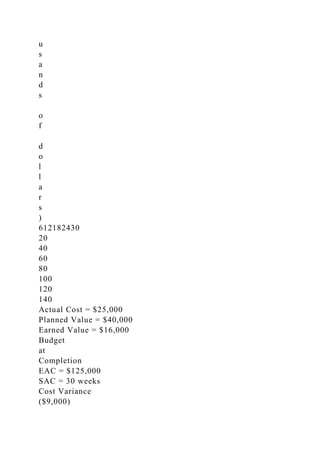
Timeline
(weeks)
Cost
(thousands of dollars)
6
12
18
24
30
Actual Cost = $25,000
Planned Value = $40,000
Earned Value = $16,000
Budget
at
Completion
20
40
60
80
100
120
140
EAC = $125,000
SAC = 30 weeks
Cost Variance
($9,000)
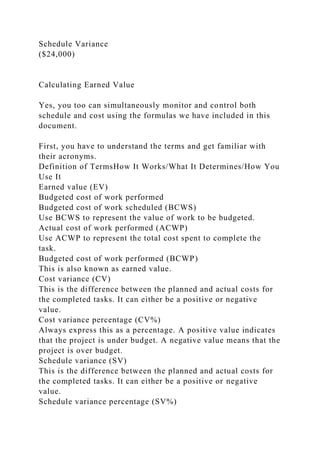
Schedule Variance
($24,000)
Summary
The project is currently $9,000 over budget
At this rate, the project is forecast to be $45,000 over budget
upon completion
The project is behind schedule
At this rate, only 40% of the work will be completed at the end
of 12 weeks
The project is forecasted to take 30 weeks, as opposed to the
original 12 weeks to complete development
SummaryAdjustments can be made to address these
issuesRequirements can be re-prioritized Utilize the 80/20
principleSome “requirements” may not be needed during this
phaseThe business solution can be delivered on-time and within
budgetAdditional resources utilizedAll requirements are
satisfiedThe project is completed on-time However, the project
goes over budget
SummaryEarned Value Analysis enables you to determine:If
your project is on, ahead of, or behind scheduleIf your project is
under or over budgetHow much additional time will be needed
to complete the projectHow much additional money will be
needed to complete the projectEarned Value Analysis enables
you to: Report accurate project statusMake the necessary
adjustments earlier, rather than later, to address project issues
Timeline
(weeks)
C
o
s
t
(
t
h
o
u
s
a
n
d
s
o
f
d
o
l
l
a
r
s
)
612182430
20
40
60
80
100
120
140
Actual Cost = $25,000
Planned Value = $40,000
Earned Value = $16,000
Budget
at
Completion
EAC = $125,000
SAC = 30 weeks
Cost Variance
($9,000)
Schedule Variance
($24,000)
Calculating Earned Value
Yes, you too can simultaneously monitor and control both
schedule and cost using the formulas we have included in this
document.
First, you have to understand the terms and get familiar with
their acronyms.
Definition of TermsHow It Works/What It Determines/How You
Use It
Earned value (EV)
Budgeted cost of work performed
Budgeted cost of work scheduled (BCWS)
Use BCWS to represent the value of work to be budgeted.
Actual cost of work performed (ACWP)
Use ACWP to represent the total cost spent to complete the
task.
Budgeted cost of work performed (BCWP)
This is also known as earned value.
Cost variance (CV)
This is the difference between the planned and actual costs for
the completed tasks. It can either be a positive or negative
value.
Cost variance percentage (CV%)
Always express this as a percentage. A positive value indicates
that the project is under budget. A negative value means that the
project is over budget.
Schedule variance (SV)
This is the difference between the planned and actual costs for
the completed tasks. It can either be a positive or negative
value.
Schedule variance percentage (SV%)
Always express this as a percentage. A positive value indicates
that the project is on schedule. A negative value means that the
project is off schedule.
Estimate at completion (EAC)
Use this to recalculate a project budget to obtain a more
accurate value of what the project will cost at the end.Formulas
for Calculating Earned Value
Determining Schedule Variances
(+)Variance = Ahead of Schedule
(-)Variance = Behind Schedule
SV = BCWP less BCWS
SV% = SV divided by BCWP
SPI = BCWP divided by BCWS
% Complete = 100 x SPIDetermining Cost Variances
(+)Variance = Below Budget
(-)Variance = Over Budget
CV = BCWP less ACWP
CV% = CV divided by BCWP
CPI = BCWP divided by ACWP
EAC = BAC times (ACWP divided by BCWP)
Earned Value Exercise
Question 1
You have just been assigned to take over a project that is
already in progress. It is an 18-month project that has been
running for 9 months. The project budget is $100,000.
According to current work performance information, the project
is 60% complete and has cost $80,000 so far.
I. What is the current Schedule Variance (SV)?
II. What is the PV for this project at this point in time?
III. Good News or Bad News?
Question 2
You have just been assigned to take over a project that is
already in progress. It is an 18-month project that has been
running for 9 months. The project budget is $100,000.
According to current work performance information, the project
is 60% complete and has cost $80,000 so far.
I. What is the current Cost Variance (CV)?
II. What is the EV for this project?
III. Good News or Bad News?
Question 3
You have just been assigned to take over a project that is
already in progress. It is an 18-month project that has been
running for 9 months. The project budget is $100,000.
According to current work performance information, the project
is 60% complete and has cost $80,000 so far.
I. What is the current Schedule Performance Index (SPI)?
II. What is the AC for this project?
III. What is the EV for this project?
IV. Good News or Bad News?
Question 4
You have just been assigned to take over a project that is
already in progress. It is an 18-month project that has been
running for 9 months. The project budget is $100,000.
According to current work performance information, the project
is 60% complete and has cost $80,000 so far.
I. What is your Estimate at Completion (EAC)?
II. What is the BAC for this project?
III. What is the CPI for this project?
Earned Value AnalysisTracking Project ProgressWh.docx

Earned Value AnalysisTracking Project ProgressWh.docx

  • 1.
    Earned Value Analysis TrackingProject Progress What Is Earned Value?The dollar amount you planned to spend for the work actually completed Earned Value is the budgeted cost of the work that has actually been performed/completed Earned Value = Budgeted Cost of the Work Performed (BCWP) What Is Earned Value Analysis (EVA)? EVA enables the project progress to be tracked in terms of: The work that has actually been completed --- Compared To --- The work that was scheduled to be completed Why Is Earned Value Analysis Important?EVA enables the project team to know:If the project is ahead of, or behind schedule How far the project is ahead of, or behind schedule If the project is over or under budget How much the project is over or under budget
  • 2.
    Why Is EarnedValue Analysis Important?EVA enables the team to address the project’s triple constraints earlier rather than later Scope – re-prioritize/reduce requirements --- and/or --- Schedule – adjust the timeline --- and/or --- Cost – request additional funding The Components of Earned Value Analysis WBS – Work Breakdown StructureIdentifies products to be delivered by the project Products or sub-products should be broken down to what can be completed in 80 hours (“80-hour rule”), when applicable Provides the basis for Distinct products or sub-products – which help to provideValid estimates – which enableTracking earned value / project progress The Components of Earned Value Analysis Earned Value (EV) ---- or BCWPThe budgeted cost of the work actually performed How much work was actually completed Planned Value (PV) ---- or BCWSThe budgeted cost of the work scheduled to be performed How much work should have been completed Actual Cost (AC) ------- or ACWPThe actual cost of the work performedHow much money has been actually spent The Components of Earned Value AnalysisBudget at Completion (BAC)Dollar amount originally budgeted to
  • 3.
    complete the project Estimateat Completion (EAC)Estimate of dollar amount needed to complete the project Variance at Completion (VAC)Estimate of the dollar amount projected above or below budget Schedule at Completion (SAC)Projection of the time needed to complete the project The Components of Earned Value Analysis Schedule Variance (SV)The work completed vs. the work planned to be completed SV = (Earned Value – Planned Value) Tells us if the project is ahead of, or behind schedule Negative value means the project is behind schedule The Components of Earned ValueSchedule Performance Index (SPI)Utilized to forecast how long it will take to complete the project SPI = (Earned Value / Planned Value) Tells us if the project is ahead of, or behind schedule Less than 1.00 means the project is behind schedule The Components of Earned Value Cost Variance (CV)What we planned to spend on the work completed vs. what was actually spent on the work completed CV = (Earned Value – Actual Cost) Tells us if the project is over or under budget Negative value means the project is over budget
  • 4.
    The Components ofEarned ValueCost Performance Index (CPI)Utilized to forecast how much it will cost to complete the project CPI = (Earned Value / Actual Cost) Tells us if the project is above or below budget Less than 1.00 means the project is over budget The Components of Earned ValueEstimate at Completion (EAC)EAC = (Budget at Completion / Cost Performance Index)Forecast of the total project cost Variance at Completion (VAC)VAC = (Budget at Completion – Estimate at Completion)Forecast of how much the project will be over or under budget Schedule at Completion (SAC)SAC = (Scheduled Project Length / Schedule Performance Index)Forecast of total project length (days, weeks, months, etc.) A Sample Project ScenarioAssumption: for the sake of simplicity, all screens will require the same time and effort, and all reports will require the same time and effort WBS = 20 screens and 10 reports Scheduled Project Length = 12 weeks Cost is estimated at $3,000 per screen = $60,000 Cost is estimated at $2,000 per report = $20,000 Cost estimate to complete the project = $80,000 A Sample Project ScenarioAt week 6 (half-way through the project) we know:Planned Work and Planned Expenses:10 of the 20 screens were scheduled to have been completed5 of the 10
  • 5.
    reports were scheduledto have been completed$40,000 (50% of the money) was scheduled to have been spent Actual Work Completed and Actual Expenses:4 of the 20 screens have been completed2 of the 10 reports have been completed20% of the work has been completed $25,000 has been spent (actual cost) A Sample Project ScenarioHalf-way through the project we know: BAC = $80,000 (the budget to complete 20 screens and 10 reports) PV = $40,000 (we planned to complete 50% of the work)Planned to complete $40,000 worth of productPlanned to complete 10 screens and 5 reports EV = $16,000 (we completed 20% of the work)Completed $16,000 worth of product Completed 4 screens and 2 reports AC = $25,000 (we spent approximately 30% of the budget)Actual cost to complete 4 screens and 2 reports was $25,000 A Sample Project ScenarioCalculationsCost VarianceCV = (EV – AC) CV = ($16,000 – $25,000) = -$9,000More money ($9,000) has been spent, than was plannedThe project is currently $9,000 over budgetCost Performance Index CPI = (EV / AC)CPI = $16,000 / $25,000 = .64 1/.64 = 1.56 The project will cost over one-and-a-half times the original estimate A Sample Project ScenarioCalculationsSchedule VarianceSV = (EV – PV) SV = ($16,000 – $40,000) = -$24,000The project is behind scheduleSchedule Performance Index SPI = (EV / PV)SPI = $16,000 / $40,000 = .4Only 40% of the project will be
  • 6.
    completed at theend of 12 weeks1/.4 = 2.5The project is projected to take 2.5 times longer than planned Forecasts Estimate at CompletionEAC = (BAC / CPI) EAC = ($80,000 / .64) = $125,000 to complete the project Variance at Completion VAC = (BAC - EAC)VAC = ($80,000 – 125,000) = $45,000 over budget at completion Schedule at CompletionSAC = (Scheduled Project Length / SPI)SAC = (12 weeks / .4) = 30 weeks to complete the project Forecasts Timeline (weeks) Cost (thousands of dollars) 6 12 18 24 30 Actual Cost = $25,000 Planned Value = $40,000
  • 7.
    Earned Value =$16,000 Budget at Completion 20 40 60 80 100 120 140 EAC = $125,000 SAC = 30 weeks Cost Variance ($9,000) Schedule Variance ($24,000) Summary The project is currently $9,000 over budget At this rate, the project is forecast to be $45,000 over budget
  • 8.
    upon completion The projectis behind schedule At this rate, only 40% of the work will be completed at the end of 12 weeks The project is forecasted to take 30 weeks, as opposed to the original 12 weeks to complete development SummaryAdjustments can be made to address these issuesRequirements can be re-prioritized Utilize the 80/20 principleSome “requirements” may not be needed during this phaseThe business solution can be delivered on-time and within budgetAdditional resources utilizedAll requirements are satisfiedThe project is completed on-time However, the project goes over budget SummaryEarned Value Analysis enables you to determine:If your project is on, ahead of, or behind scheduleIf your project is under or over budgetHow much additional time will be needed to complete the projectHow much additional money will be needed to complete the projectEarned Value Analysis enables you to: Report accurate project statusMake the necessary adjustments earlier, rather than later, to address project issues Timeline (weeks) C o s t ( t h o
  • 9.
    u s a n d s o f d o l l a r s ) 612182430 20 40 60 80 100 120 140 Actual Cost =$25,000 Planned Value = $40,000 Earned Value = $16,000 Budget at Completion EAC = $125,000 SAC = 30 weeks Cost Variance ($9,000)
  • 10.
    Schedule Variance ($24,000) Calculating EarnedValue Yes, you too can simultaneously monitor and control both schedule and cost using the formulas we have included in this document. First, you have to understand the terms and get familiar with their acronyms. Definition of TermsHow It Works/What It Determines/How You Use It Earned value (EV) Budgeted cost of work performed Budgeted cost of work scheduled (BCWS) Use BCWS to represent the value of work to be budgeted. Actual cost of work performed (ACWP) Use ACWP to represent the total cost spent to complete the task. Budgeted cost of work performed (BCWP) This is also known as earned value. Cost variance (CV) This is the difference between the planned and actual costs for the completed tasks. It can either be a positive or negative value. Cost variance percentage (CV%) Always express this as a percentage. A positive value indicates that the project is under budget. A negative value means that the project is over budget. Schedule variance (SV) This is the difference between the planned and actual costs for the completed tasks. It can either be a positive or negative value. Schedule variance percentage (SV%)
  • 11.
    Always express thisas a percentage. A positive value indicates that the project is on schedule. A negative value means that the project is off schedule. Estimate at completion (EAC) Use this to recalculate a project budget to obtain a more accurate value of what the project will cost at the end.Formulas for Calculating Earned Value Determining Schedule Variances (+)Variance = Ahead of Schedule (-)Variance = Behind Schedule SV = BCWP less BCWS SV% = SV divided by BCWP SPI = BCWP divided by BCWS % Complete = 100 x SPIDetermining Cost Variances (+)Variance = Below Budget (-)Variance = Over Budget CV = BCWP less ACWP CV% = CV divided by BCWP CPI = BCWP divided by ACWP EAC = BAC times (ACWP divided by BCWP) Earned Value Exercise Question 1 You have just been assigned to take over a project that is already in progress. It is an 18-month project that has been running for 9 months. The project budget is $100,000. According to current work performance information, the project is 60% complete and has cost $80,000 so far. I. What is the current Schedule Variance (SV)? II. What is the PV for this project at this point in time? III. Good News or Bad News? Question 2
  • 12.
    You have justbeen assigned to take over a project that is already in progress. It is an 18-month project that has been running for 9 months. The project budget is $100,000. According to current work performance information, the project is 60% complete and has cost $80,000 so far. I. What is the current Cost Variance (CV)? II. What is the EV for this project? III. Good News or Bad News? Question 3 You have just been assigned to take over a project that is already in progress. It is an 18-month project that has been running for 9 months. The project budget is $100,000. According to current work performance information, the project is 60% complete and has cost $80,000 so far. I. What is the current Schedule Performance Index (SPI)? II. What is the AC for this project? III. What is the EV for this project? IV. Good News or Bad News? Question 4 You have just been assigned to take over a project that is already in progress. It is an 18-month project that has been running for 9 months. The project budget is $100,000. According to current work performance information, the project is 60% complete and has cost $80,000 so far. I. What is your Estimate at Completion (EAC)? II. What is the BAC for this project? III. What is the CPI for this project?